

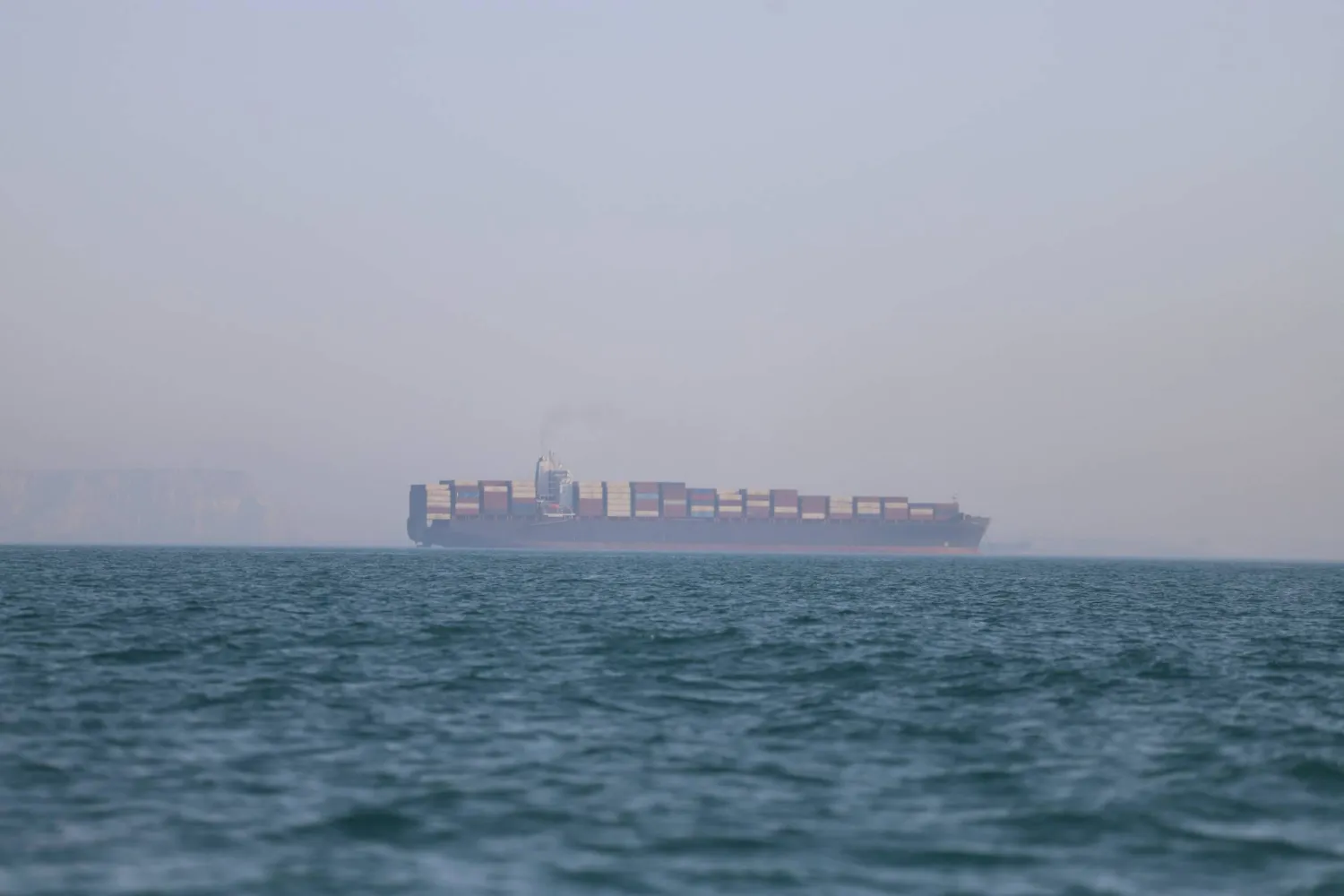

Hormuz Reopening to Release Wave of Oil Supply, Depress Prices

Vessels in the Strait of Hormuz near the beach of Bandar Abbas, Iran, June 17, 2026. Amirhosein Khorgooi/ISNA/via WANA (West Asia News Agency)/Handout via REUTERS
TT

Hormuz Reopening to Release Wave of Oil Supply, Depress Prices

Vessels in the Strait of Hormuz near the beach of Bandar Abbas, Iran, June 17, 2026. Amirhosein Khorgooi/ISNA/via WANA (West Asia News Agency)/Handout via REUTERS

Middle Eastern crude oil markets could come under further pressure if the Strait of Hormuz reopens on Friday following the US-Iran interim deal, releasing millions of barrels of oil stranded in the Middle East Gulf into global markets, industry executives said.

The wave of supply comes after Gulf producers ramped up exports via ship-to-ship transfers off the United Arab Emirates and Oman this month, which depressed spot differentials for Middle East crude to discounts on Tuesday.

Kpler analyst Muyu Xu said in a June 17 note that the reopening of the Hormuz Strait could unleash some 93 million barrels of stranded non-Iranian barrels from the Arabian Gulf, while producers are expected to continue supplying cargoes through less visible channels.

Some traders estimated that about 50 million barrels are set to be released as some cargoes had already been shipped out. In addition, the lifting of US restrictions on Iranian crude could also release some 72 million barrels stranded on tankers west of Chabahar, with volumes set to rise further if Washington grants broader sanctions relief, ‌Kpler said.

Iran's fleet has ‌been gearing up to boost exports with three of its tankers this week exiting the ‌strait, ⁠which carried about ⁠a fifth of the world's oil and liquefied natural gas shipments before the US and Israel attacked Iran on February 28.

US President Donald Trump and Iranian President Masoud Pezeshkian digitally signed the 14-point agreement to end the war on Wednesday, US and Iran officials said. Iran's foreign ministry said the agreement was already in effect.

ASIAN BUYERS COMMITTED TO SUPPLY ARRIVING JUNE TO AUGUST

While supply is set to surge, most Asian refiners have already booked crude cargoes to arrive in June to August and several refineries in China are scheduled to shut for maintenance, refining and trade sources said, reducing demand for immediate supplies.

Consultancy Energy Aspects tracked more than 1.8 million bpd of Chinese refining capacity that will be shut for turnarounds in July, including ⁠nearly 1.2 million bpd at private firms.

China's throughput, already at a near four-year low in ‌May, is expected to slide further to about 12.4 million bpd this month, before recovering ‌above 13 million bpd in July with state-owned refiners raising runs, it added.

Many Chinese refiners paused spot buying this week as they eyed the reopening ‌of the strait and details of the agreement.

Although weaker crude prices improved refinery economics and narrowed losses, fuel demand in China ‌is expected to stay subdued as a result of the country's rapid adoption of electric vehicles.

"A large-scale increase in crude buying appears unlikely unless Beijing relaxes restrictions on product exports and/or proceeds with another round of strategic petroleum reserves replenishment," said Kpler's Xu.

Some Middle Eastern crude suppliers offered cargoes to independent refiners in eastern Shandong province, two sources said, but at prices higher than sanctioned oil from Iran and Russia.

Crude sellers will need to cut prices further to attract ‌demand once the strait opens, given that some of them, including TotalEnergies, still have unsold cargoes, said one Singapore-based trader. The sources declined to be named as they were not authorized to speak ⁠to the media.

"Refiners are expecting profitability ⁠to be quite poor in the second half of the year," a South Korean industry official said.

"So rather than it being a matter of securing a specific crude, this is becoming a fight over economics," he added.

ASIA OIL DEMAND SHIFTING BACK TO MIDEAST

Still, refiners are preparing for the eventual rise in Middle Eastern supply, which is expected to cool Asia's demand for oil from the Americas. Taiwanese state refiner CPC said it was ready to import heavier grades with a higher sulphur content, to produce more bitumen and sulphur to meet domestic demand if the strait reopens. Some Middle Eastern oil producers have asked Indian refiners to consider buying the committed supplies under their term deals, which would reduce their purchase of oil via spot tenders, sources at three refiners said.

Kpler expects a gradual recovery in Indian demand for Gulf oil to potentially support an additional 400,000 bpd to 600,000 bpd of Middle Eastern imports through August as refiners rebalance their crude slate.

"Increased supply of Middle Eastern crude oil would deepen contango in regional oil benchmarks," an Asian trader said.

Benchmark Dubai's premium to swaps returned to positive territory on Wednesday after slipping into a discount of 46 cents on Tuesday, Reuters' data showed.

In a contango market, prompt prices are lower than those in future months indicating comfortable supplies.



Philippines Says in Talks with Saudi Arabia for Oil Storage

Oil storage tanks in the Philippines (X)
TT

Philippines Says in Talks with Saudi Arabia for Oil Storage

Oil storage tanks in the Philippines (X)

The Philippines is in talks with Saudi Arabia, Russia and the United States to store oil in the country, its energy secretary said on Wednesday, in a bid to hedge against fuel price spikes driven by the Iran war.

The Southeast Asian nation, which imports nearly all its energy needs, also plans to increase diesel and gas-fired power output to make up for an estimated 60% decline in hydropower and 20% fall in solar output in the first half of 2027 due to the El Nino weather phenomenon, Secretary Sharon Garin told Reuters.

The Philippines is also in talks with ⁠Japan, Kuwait, the ⁠United Arab Emirates and Australia on oil storage, Garin said, as it looks to build stockpiles after the US-Israeli strikes on Iran in February disrupted supplies.

"If El Nino finishes in April, that's the time that summer starts for us. So this would be a prolonged pressure for us, which started with the oil crisis in the Middle East," Garin said on the sidelines of the Singapore International Energy Week conference.

Saudi Arabia announced this week an initial agreement to store Saudi crude in Singapore's rock caverns starting 2027.

The Philippines plans to build its first government-owned storage tank next year at Bataan to hold strategic oil reserves, Garin said, adding that the government has been working with Tokyo to build regional oil stockpiles, which would complement its national reserve.

Fuel inventories in the Philippines are currently at 55 days, up from a 15-day minimum requirement, Garin said. The government has 1 million barrels of oil stocks in private facilities, she added.

"We start with 1 million (barrels) and scale it up over the years with the objective of ⁠reaching 60 days," ⁠she said, adding that the volume will be split evenly between crude and fuels.

The country's average daily demand for petroleum products was about 78 million liters, or about 490,600 barrels, as of May, government data showed.


Mercedes to Cut More Jobs as Chinese Competition Bites

Mercedes-Benz CEO Ola Kaellenius gestures as he participates in a talk during the Berlin Global Dialogue 2026 in Berlin, Germany, 21 October 2026. EPA/CLEMENS BILAN
TT

Mercedes to Cut More Jobs as Chinese Competition Bites

Mercedes-Benz CEO Ola Kaellenius gestures as he participates in a talk during the Berlin Global Dialogue 2026 in Berlin, Germany, 21 October 2026. EPA/CLEMENS BILAN

Premium German carmaker Mercedes-Benz will restart a voluntary redundancy program and is in discussion with unions over further cost-cuts, its chief executive Ola Kaellenius said Wednesday after the firm warned on full-year profits.

"Germany accounts for roughly 15 percent of our sales, but two-thirds of our employees and structures are based here," Kaellenius told reporters and investors on an earnings call to present third-quarter results.

"To reduce our fixed costs further, we have decided to restart the severance program in Germany in December," he added, without giving a target number of job cuts.

German carmakers have struggled with cutthroat competition and falling demand in China, the world's largest car market, leading to painful adjustments at home.

Mercedes-Benz on Tuesday became the third of the big three German carmakers -- alongside Volkswagen and BMW -- to have issued a profit warning for the year, citing difficulties in China.

BMW aims to cut 8,000 jobs by the end of 2027 with its own voluntary redundancy program, and the Volkswagen Group plans to have cut 120,000 jobs globally by the end of the decade across its brands, which include Porsche and Audi.

Kaellenius said Mercedes-Benz could not give more detail since discussions were ongoing, adding that he was nevertheless pressing hard to get costs down.

"We will continue with determination to adjust the structures of the company to fit the revenue position of the company," AFP quoted him as saying.

Labor costs in China, Hungary, Romania and the United States are all lower than in Germany, Kaellenius said, adding that "eastern Europe as a whole is open to any industrialist looking to expand.”

Net profit for the third quarter rose almost 30 percent to 1.52 billion euros ($1.69 billion) even as overall sales declined 4.5 percent to 30.7 billion euros, largely the result of a collapse in China.

But Kaellenius said the company could not afford to abandon the Chinese market despite an intense price war driven by over 100 competing carmakers.

"If you're a global car company like Mercedes, there's not a play where you put China aside," he said.


Merz Invites Japan to Back Trade Alliance as China Asks Germany to Be ‘Rational’

German Chancellor Friedrich Merz attends the ISEAS 49th Singapore Lecture, in Singapore, October 27, 2026. (Reuters)
TT

Merz Invites Japan to Back Trade Alliance as China Asks Germany to Be ‘Rational’

German Chancellor Friedrich Merz attends the ISEAS 49th Singapore Lecture, in Singapore, October 27, 2026. (Reuters)

German Chancellor Friedrich Merz on Wednesday urged Japan to back a proposed global alliance to defend rules-based trade that he has been touting during a week-long Asia trip.

An alliance of "like-minded partners" ‌would help ‌countries resist the growing use of tariffs ‌and ⁠economic coercion, he ⁠told a business summit in Tokyo, according to prepared remarks.

"Should the rules of the global trading system be violated by others, or should economic coercion be employed, we could coordinate our actions within the alliance and present a united front," he said, an apparent ⁠reference to the US and China.

In ‌responding to Merz's proposal, ‌China said it hoped Germany and the EU would be "objective and ‌rational" and that it was committed to working ‌with all parties to maintain the stability of trade and supply chains.

Merz's initiative echoes calls by Canadian Prime Minister Mark Carney this year for the world's middle powers to ‌work more closely together to counter pressure from larger economies.

"If we move forward together, ⁠the ⁠question will no longer be whether we are 'on the menu' or 'sitting at the table'," Merz said, invoking a line used by Carney during his January speech.

"Because in that case, the restaurant itself belongs to us."

Germany sees China as both a massive trading partner and a strategic rival. Coinciding with Merz's visit, a report said Germany's trade deficit with Asia-Pacific is set to hit a record of nearly €146 billion ($163 billion) in 2026 as falling exports to China outweigh growing sales elsewhere in the region.