


Syrian Petroleum Company to Asharq Al-Awsat: Syria to Receive 56% Share of US Gas Development Deal

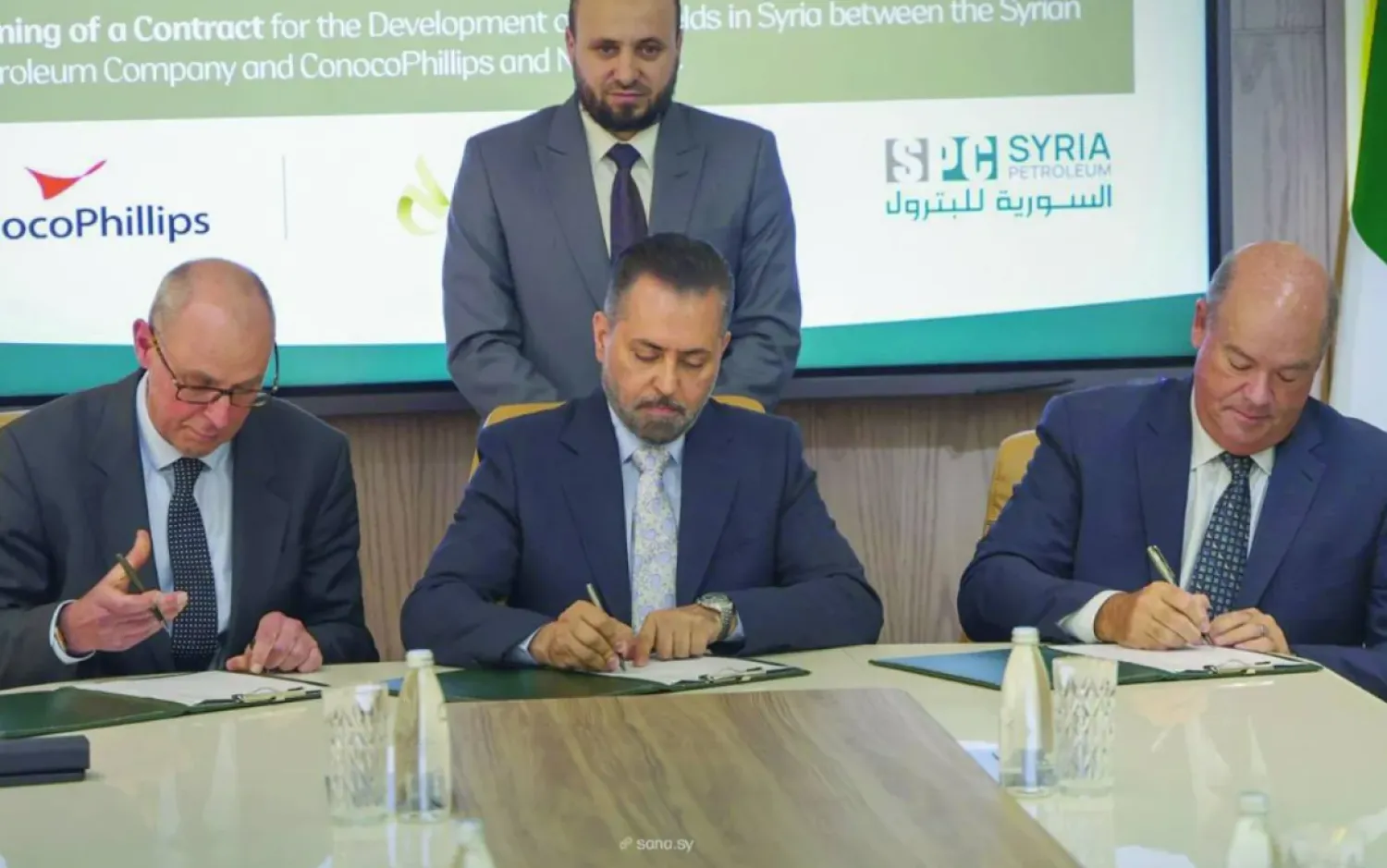
During the signing of the agreement between the Syrian Petroleum Company and US firms ConocoPhillips and Novaterra Energy. (SANA)
TT

Syrian Petroleum Company to Asharq Al-Awsat: Syria to Receive 56% Share of US Gas Development Deal

During the signing of the agreement between the Syrian Petroleum Company and US firms ConocoPhillips and Novaterra Energy. (SANA)

Mohammad Nour Al-Ahdab, Director of Media Relations at the state-owned Syrian Petroleum Company (SPC), revealed on Thursday that under the contract signed with US companies ConocoPhillips and Novaterra Energy to develop and increase production from Syria’s gas fields, the Syrian side will receive a 56 percent share under the agreement, while the two investing companies will hold the remaining 44 percent.

Al-Ahdab told Asharq Al-Awsat that the arrangement is “favorable for Syria, particularly since gas-development contracts are typically structured close to a 50-50 split because of the scale of investment, technical and operational risks, and the nature of rehabilitation and production activities.”

He added: “What matters most to us is that the contract was designed to safeguard the national interest and deliver clear economic and technical returns through increased domestic production, stronger energy security, a gradual reduction in imports, and the transfer of expertise and technology to Syrian personnel.”

In what represents the most significant strategic breakthrough in economic and political relations between Damascus and Washington since the fall of the regime of Bashar al-Assad in late 2024, SPC on Tuesday signed a major implementation agreement with ConocoPhillips and Novaterra Energy to develop gas fields and increase production.

The move marks the country’s first major US energy deal in years and serves as a tangible indication of the beginning of a phase of “full-scale implementation,” supported by US President Donald Trump’s decision to lift sanctions in July 2025.

The contract follows earlier US initiatives launched at the beginning of 2026 through memoranda of understanding signed by other companies, including Chevron for offshore exploration and HKN Energy for the onshore Rmeilan fields.

However, the ConocoPhillips agreement stands out as the largest binding implementation contract aimed at developing the domestic gas sector, backed by Gulf and European partnerships and financing arrangements intended to help end the country’s severe energy crisis.

Al-Ahdab described the agreement as an important milestone in the rehabilitation and development of Syria’s gas sector because it moves cooperation with international partners beyond the memorandum-of-understanding stage and into formal contractual commitments and practical implementation.

“The importance of the agreement stems from several factors,” he said. “First, it targets the development of a number of existing gas fields and an increase in their production, which will support the energy system, particularly gas supplies needed for the electricity sector and other vital industries. Second, it opens the door to the introduction of international expertise and technologies in assessment, rehabilitation, processing, and operational-efficiency enhancement.”

According to Al-Ahdab, the agreement also reflects a clear commitment by SPC and the Ministry of Energy to building strategic partnerships capable of accelerating the recovery of the energy sector, gradually reducing reliance on imported gas, and preserving the role of Syrian professionals by empowering them through training and knowledge transfer.

“For us, this is not merely a production agreement,” he added. “It is part of a broader vision to rebuild the energy sector on sustainable technical and economic foundations in a manner that serves the national economy and meets citizens’ needs over the medium and long term.”

Al-Ahdab said the contract includes implementation phases related to the development of existing fields, the rehabilitation of operational infrastructure, and the gradual increase of gas production.

“There are also subsequent phases linked to additional development and exploration activities, subject to technical and contractual approvals agreed upon by the parties,” he said.

He added that the duration of the contract “is tied to the nature of the technical work and the various stages of implementation and production. Details that can be officially disclosed will be announced through the approved channels.”

Goldman Sachs Sees October Fed Hike after Hawkish Signal

FILE PHOTO: The Federal Reserve building is set against a blue sky in Washington, US, May 1, 2020. REUTERS/Kevin Lamarque/File Photo
TT

Goldman Sachs Sees October Fed Hike after Hawkish Signal

FILE PHOTO: The Federal Reserve building is set against a blue sky in Washington, US, May 1, 2020. REUTERS/Kevin Lamarque/File Photo

Goldman Sachs now expects the Federal Reserve to raise interest rates by another quarter point in October, making it one of the first major Wall Street banks to forecast consecutive rate hikes following the US central bank's hawkish signal on Wednesday.

The call represents a reversal of Goldman's earlier view that the US Fed had completed its tightening cycle after September's quarter-point increase.

Goldman said the Fed's updated rate projections, which showed a strong ⁠majority of policymakers ⁠expecting at least one more increase this year, pointed to a "two-hike baseline" for 2026.

The brokerage said October was the most likely timing for the next move because policymakers framed further tightening as supporting "a timelier return" to the Fed's 2% inflation target.

The ⁠Fed earlier on Wednesday raised interest rates by 25 basis points to a 3.75%-4.00% range.

Goldman said the meeting was more hawkish than expected, citing policymakers' rate projections, an upward revision to the neutral interest rate and Chair Kevin Warsh's repeated description of the move as having only "removed a dose of accommodation."

Traders see roughly 50% odds of another quarter-point Fed rate hike in October, according to CME Group's ⁠FedWatch tool, ⁠up sharply after policymakers signaled further tightening could be needed.

Goldman's revised forecast leaves Bank of America Global Research as the only other major brokerage expecting a more aggressive tightening path, with BofA projecting rate hikes in October and December, Reuters reported.

Markets will also be watching policy decisions from the Bank of England, due later in the day, and the Bank of Japan on Friday for further clues on the global interest-rate outlook.


Saudi Money Market Funds Face Investment Reshuffle

The Saudi Capital Market Authority’s headquarters in Riyadh (Asharq Al-Awsat)
TT

Saudi Money Market Funds Face Investment Reshuffle

The Saudi Capital Market Authority’s headquarters in Riyadh (Asharq Al-Awsat)

Saudi money market funds are entering a new phase of liquidity management and portfolio restructuring as new rules cap foreign investments at 5% of net asset value.

Fund managers will have to balance returns, liquidity and risk more carefully.

The rules do not require funds to exit existing foreign investments immediately. The Capital Market Authority has given managers transition periods to bring portfolios into compliance. This allows deposits and murabaha transactions to mature before funds are reallocated, avoiding early exits that could hurt returns or disrupt liquidity management.

The measures also require foreign counterparties to hold investment-grade credit ratings, strengthening protection against overseas exposure risks.

Financial analysts say the main impact may not be an immediate shift in capital flows. Instead, the rules are likely to reshape money market fund portfolios and how managers allocate liquidity between domestic and foreign instruments, based on returns, liquidity and credit quality.

As investment options in the Saudi market expand, the restructuring could direct greater attention toward domestic liquidity instruments. The transition periods will allow managers to adjust gradually, retain flexibility over existing investments and reduce the risks of rapid reinvestment.

Investor protection

Financial analyst Abdullah Al-Jabali told Asharq Al-Awsat that the move was part of the Capital Market Authority’s efforts to regulate higher-risk investments and strengthen investor protection, particularly amid global market shifts and continued uncertainty over interest rates.

The decision seeks to reduce Saudi money market funds’ exposure to foreign investments and limit the impact of related volatility, he said. The timing and scale of interest-rate cuts in the coming years remain unclear.

Al-Jabali said the measures go beyond imposing a cap on foreign investments. They also tighten requirements governing the entities through which funds may invest, taking into account credit ratings, solvency and reliability. This would help reduce risk and safeguard investors’ money.

The rules also seek to prevent money market funds from concentrating investments in instruments or entities that could be difficult to exit when needed. This would strengthen liquidity and improve funds’ ability to respond to market changes, he said.

Al-Jabali expected further regulations to follow, potentially covering other foreign investments such as real estate funds, financing funds and foreign sukuk. The measures could also extend to funds’ private-equity investments outside the kingdom.

He said the changes reflected the authority’s efforts to reduce risks linked to some investment practices, strengthen the investment environment and protect investors in the Saudi market.

Financial analyst Tariq Al-Atiq told Asharq Al-Awsat that the decision was primarily intended to reduce risk, strengthen investor protection and impose greater discipline on the placement of liquidity outside the kingdom.

Money market funds typically invest in deposits, murabaha transactions and short-term sukuk. Financial companies affiliated with banks manage a large proportion of these funds, he said.

A fund valued in Saudi riyals does not necessarily hold all its investments inside the kingdom, Al-Atiq said. Some liquidity may be placed with Gulf or foreign banks in search of higher returns. The decision would reduce that exposure and return some liquidity to the domestic market.

Giving funds up to two years to comply takes into account the fixed maturities of deposits and murabaha transactions, he said. Early exits could hurt fund performance, while allowing foreign deposits to expire without renewal would support a gradual, orderly transition.

Gradual compliance

The Saudi Capital Market Authority has capped foreign investments by public money market funds at 5% of net asset value and given managers transition periods to bring existing holdings into compliance.

Under a circular sent to capital market institutions, managers of public money market funds whose foreign investments exceed 5% must comply with the cap within two years of the circular’s date.

The requirement also affects transactions made during the transition. Until compliance is achieved, managers must not make an investment or enter into or renew any transaction that would breach the limit.

Funds with foreign investments exceeding 20% of net asset value face a shorter deadline. Their managers must reduce that exposure to below 20% within six months of the circular’s date.

They must then continue reducing foreign investments until they reach the final 5% cap within the timeframe set by the circular.

The rules therefore set different paths based on the level of foreign exposure. Funds above the 5% cap have up to two years to comply, while those above 20% must first bring their exposure below 20% within six months.

The authority also required all foreign investments by public money market funds to be made with counterparties holding investment-grade credit ratings issued by licensed credit-rating agencies.

Managers whose funds hold foreign investments that do not meet this requirement must bring them into compliance within two years of the circular’s date.

The Capital Market Authority stressed that capital market institutions must comply with the circular, the Capital Market Law and its implementing regulations. It designated the Collective Investment Schemes Compliance Department to answer questions about the new requirements.


Saudi Tourism Minister Announces Launch of Second Edition of TOURISE Forum in March

Tourists are seen at Saudi Arabia's AlUla. (SPA)
TT

Saudi Tourism Minister Announces Launch of Second Edition of TOURISE Forum in March

Tourists are seen at Saudi Arabia's AlUla. (SPA)

Saudi Minister of Tourism and Chairman of the TOURISE Forum Board Ahmed Al-Khateeb announced on Wednesday the launch of the second edition of the “TOURISE 2027” Forum, under the theme “Alliances That Move the World,” to be held in Riyadh from March 23 to 25, 2027.

The forum, held under the patronage of Prince Mohammed bin Salman bin Abdulaziz Al Saud, Crown Prince and Prime Minister, brings together leading figures from the tourism, technology, investment, sustainability, culture and transport sectors from around the world to discuss the key opportunities and challenges facing these sectors and help shape the next phase of global tourism.

The forum comes as Saudi Arabia presents a prominent example of what can be achieved in the tourism sector as an integrated economic ecosystem. The Kingdom surpassed its initial target of welcoming 100 million visitors annually in 2023, seven years ahead of schedule, and raised its ambition to 150 million visitors annually by 2030.

The TOURISE Forum serves as an attractive platform for investment. Its inaugural edition last year succeeded in catalyzing investments worth $113 billion, spanning destinations, hotels, retail, talent development and AI-powered platforms, demonstrating how cross-sector collaboration can turn ambition into investment and practical action.

The theme of the forum’s second edition, “Alliances That Move the World,” underscores the importance of forging alliances that transcend sectors, borders and business fields, connecting tourism with capital, technology and infrastructure to unlock investment opportunities, accelerate innovation and facilitate the traveler experience, supporting a more growing, sustainable and inclusive global tourism economy.

Minister Al-Khateeb said: “No single destination, company or organization will shape the future of tourism. Rather, it will be determined by the strength of the alliances we build together. Saudi Arabia has witnessed first-hand what can be achieved when ambitions, investments and strategic partnerships come together.”

“Through the second edition of the TOURISE Forum, we are inviting the world to Riyadh to build the alliances that will shape the next 50 years of the tourism sector,” he added.

The Ministry of Tourism announced the first group of speakers for the 2027 edition, comprising leading figures from the tourism, hospitality, technology and destination development sectors. They will showcase their organizations’ contributions to facilitating travel, tourism and mobility, as well as the most promising areas for investment in the global tourism sector.
