


Stocks Rally Falters, Oil Rises as US-Iran Talks Postponed

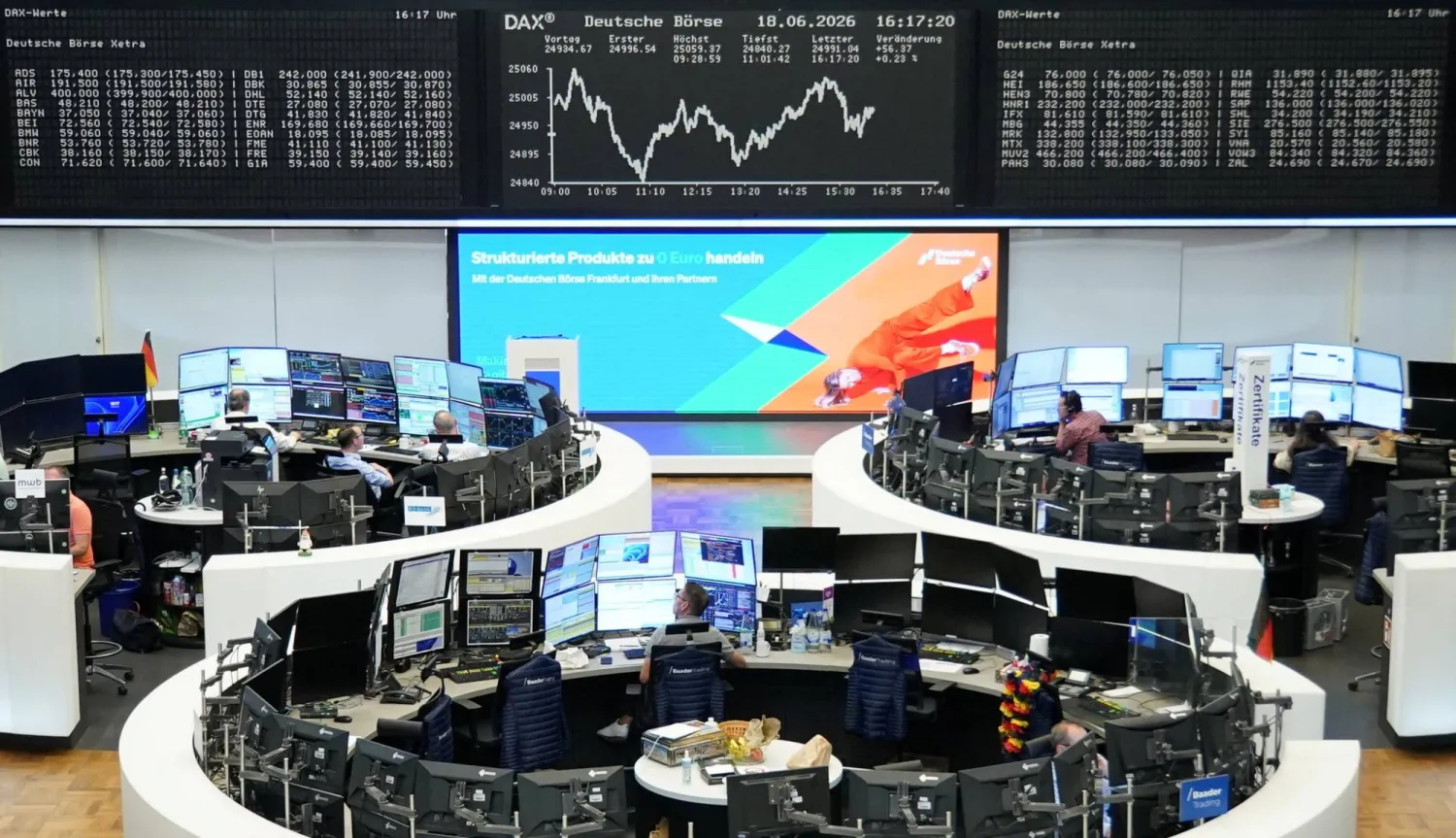
The German share price index DAX graph is pictured at the stock exchange in Frankfurt, Germany, June 18, 2026.  REUTERS/staff
The German share price index DAX graph is pictured at the stock exchange in Frankfurt, Germany, June 18, 2026. REUTERS/staff
TT

Stocks Rally Falters, Oil Rises as US-Iran Talks Postponed

The German share price index DAX graph is pictured at the stock exchange in Frankfurt, Germany, June 18, 2026.  REUTERS/staff
The German share price index DAX graph is pictured at the stock exchange in Frankfurt, Germany, June 18, 2026. REUTERS/staff

Stock markets were mixed on Friday and oil prices rose after Switzerland said planned talks following up on the US-Iran agreement had been postponed, dealing a blow to the week-long rally.

Equities have been on a tear since the two announced last weekend that they would end their three-month conflict and reopen the Strait of Hormuz, fueling global relief as economies have been hit by energy shortages and surging inflation.

The agreement has been signed separately by US President Donald Trump and his Iranian counterpart Masoud Pezeshkian, and approved by Iran's supreme leader.

That was meant to signal the beginning of 60 days of talks on wider issues, including Tehran's nuclear program.

But Swiss officials said they would not start on Friday as expected, hours after US Vice President JD Vance's departure for the country was cancelled, with a spokesperson saying the "logistics of these negotiations have never been simple or predictable".

The deal was also meant to halt the fighting in Lebanon, but Israel's military announced new strikes against Hezbollah targets in the nation's south. Lebanon has been a major sticking point in reaching a US-Iran deal.

"The planned talks between the US, Iran, Qatar and Pakistan have been postponed," the Swiss foreign ministry said in a message to AFP.

"Switzerland remains ready to facilitate these talks. The relevant preparatory work at Burgenstock is continuing," it said, without providing a new date for the talks.

Iran's Tasnim news agency had said "nothing has been confirmed" about the Tehran delegation's trip to Switzerland.

The news sparked a reverse in several equity markets that had been heading for a positive end, with profit-taking adding to the selling.

Seoul, which has hit multiple records this week and topped 9,000 points for the first time on Thursday, ended in the red after a strong start to the day led by tech firms.

There were also losses in Tokyo, Singapore, Sydney, Mumbai, Bangkok and Jakarta but Tokyo, Wellington and Manila edged up.

London dipped at the open but Paris and Frankfurt rose.

Oil prices, which have tanked around 10 percent this week, climbed with West Texas Intermediate up around 1.8 percent.

"With the deal signed, that geopolitical cloud is lifting, but markets have learned more than once that a resolution can unravel quickly," Josh Gilbert, at eToro, said.

"The hard work starts now, and investors will likely be cautious until we've got an air-tight deal and traffic genuinely flowing in full through the strait again."

American forces lifted on Thursday their naval blockade of Iranian ports that had prevented ships from sailing to or from the Iranian republic, the US military said, noting that its warships "will remain in the general area".

Activity was still muted in the Strait of Hormuz, the strategic bottleneck for energy shipments that Iran blockaded during the conflict.

Observers have pointed out that while the waterway -- through which about a fifth of crude passes -- has reopened, it could take some time before supplies are back up to pre-war levels.

The US-Iran agreement had allowed investors to look past Tuesday's Federal Reserve meeting, which ended with officials indicating they could hike interest rates before the end of the year owing to elevated inflation caused by the war.

Still, Forex.com's Fawad Razaqzada said traders would turn their focus back to the economic outlook.

"What is almost certain to happen now is that markets will become increasingly data-dependent once again. For now, equity bulls maintain some control," he wrote in a commentary.

"However, with valuations still elevated and a lack of obvious near-term catalysts, the prospect of profit-taking or a modest correction has become more plausible following the Fed's hawkish pivot."

The yen strengthened but remained above 161 per dollar -- and near its weakest level since 1986 -- after this week's jump fueled by Fed rate hike expectations.

The yen's gains were also helped by comments from Japan's Finance Minister Satsuki Katayama, who warned of "bold action against excessive speculative moves in the foreign-exchange market".

The government spent around 11.7 trillion yen ($72 billion) last month propping up the currency by intervening in financial markets.

The currency was still in trouble despite the Bank of Japan's decision to hike interest rates on Tuesday to their highest since 1995.



Iraq to Export Crude, Naphtha through Syria after Hormuz Shock

A pump jack operates near a crude oil reserve in the Permian Basin oil field near Midland, Texas, US February 18, 2025. REUTERS/Eli Hartman/File Photo
TT

Iraq to Export Crude, Naphtha through Syria after Hormuz Shock

A pump jack operates near a crude oil reserve in the Permian Basin oil field near Midland, Texas, US February 18, 2025. REUTERS/Eli Hartman/File Photo

Iraq is preparing to export crude oil and naphtha through ports in Syria, Syrian and Iraqi energy officials and refinery sources said after the Iran war cut off its main Gulf shipping routes.

The move would broaden an arrangement that has seen Iraq export fuel oil through the Mediterranean port of Baniyas after the effective closure of the Strait of Hormuz, which sharply curtailed Gulf export routes for OPEC's second-largest producer.

Two Iraqi oil officials said plans to diversify crude and fuel export routes, including through Syria, would continue even after the Iran war ends and shipping through the Strait of Hormuz returns to normal, as part of a government-approved strategy to reduce Iraq's reliance on a single export corridor.

"The Iraqi government and the oil ministry attach the highest importance to diversifying crude export routes, particularly through Syrian territory," Iraqi oil ministry spokesperson Saleem al-Rikabi told Reuters.

Rikabi said the oil ministry, through state oil marketer SOMO, was continuing "discussions and cooperation" with Syria to expand exports through its western neighbor.

Iraq ‌normally exports a ‌total of around 3.6 million barrels of oil per day and before the Iran war around ‌3.4 ⁠million bpd flowed through ⁠its southern Basra terminals.

Mohammed Al-Ahdab, head of the media office at Syrian Petroleum Company (SPC), said the operation and offloading were continuing, despite the anticipated opening of the strait.

Before the disruption caused by the Iran war, Iraq mainly exported its fuel oil from the Gulf port of Khor al-Zubair, but the conflict has forced it to seek alternative routes after the strait was closed and storage facilities began filling up.

The initial work-around, which began operating in April, saw millions of barrels of Iraqi fuel oil trucked across Syria to Baniyas and re-exported from there.

Syria plans to open two extra unloading areas and other facilities in Baniyas within a week to handle Iraqi crude oil and naphtha, a Syrian energy ministry official said. ⁠Ahdab said Baniyas can now unload an average of 900 tanker-trucks per day.

Crude could begin crossing ‌from Iraq to Syria at around 50,000 barrels per day once the loading installations ‌are ready, the two Iraqi oil ministry officials said. There were no immediate details on planned levels of naphtha exports.

Tanker-truck exports are expected to begin ‌in early July, Syrian and Iraqi officials said, while SOMO is set to open offices in Baniyas.

FEE INCOME FOR SYRIA

In April, SOMO ‌awarded contracts to supply about 650,000 metric tons of fuel oil per month from April to June to be trucked overland via Syria. Iraq exported a record 18 million tons of fuel oil in 2024, equivalent to roughly 1.5 million tons per month, with the best available data for 2025 showing they were near the levels reached in late 2024.

SPC Deputy CEO Ahmad Kobbaji told Reuters in May that Syria had limited infrastructure but was increasing its ‌unloading and re-export capacity for Iraqi fuel products.

Under President Ahmed al-Sharaa, Syria is seeking to reintegrate into the regional and global economy after decades of Assad family rule and nearly 14 years ⁠of war devastated its economy and ⁠left it politically and financially isolated.

Syria is earning transit fees from the fuel oil shipments, paid through buyers and intermediaries rather than directly by SOMO, the Iraqi oil ministry officials said. Reuters was unable to determine what Syria was earning or how fees were collected.

Iraqi fuel oil shipped via Syria had reached destinations across Africa and Europe, with the latest tanker arriving in Alexandria, Egypt, on June 9, LSEG shipping data showed.

IRAQ KEEN TO EXPORT, DESPITE RISKS

The route to Baniyas is fraught with challenges, with highways damaged by years of war, and Reuters reporters saw lines of Iraqi tankers stretching for more than 30 km (19 miles) along the road to the port.

In June, two Iraqi fuel tankers collided near Homs, spilling thousands of liters of fuel, while protesters in northeast Syria blocked Iraqi tankers to protest against rising fuel prices and deteriorating living conditions.

A source at the Baniyas facility with direct knowledge of the transfers said the Iraqi fuel oil is not processed at the refinery. Instead, tanker trucks unload at a marine platform connected to storage tanks north of the refinery, from where the fuel is pumped directly to waiting export tankers.

Meanwhile, Syria is working on reviving war-damaged pipelines to replace the tanker route, SPC's Kobbaji said in May. The Iraq-Syria oil pipeline can pump up to 300,000 barrels per day, the Syrian energy ministry official said.


Kuwait Offers Crude for July Delivery after Lifting Force Majeure

A boat sails in the Gulf waters as the sun sets behind Kuwait City's landmark Kuwait Towers on June 9, 2026. (Photo by YASSER AL-ZAYYAT / AFP)
TT

Kuwait Offers Crude for July Delivery after Lifting Force Majeure

A boat sails in the Gulf waters as the sun sets behind Kuwait City's landmark Kuwait Towers on June 9, 2026. (Photo by YASSER AL-ZAYYAT / AFP)

Kuwait Petroleum Corp is offering crude for July delivery via a tender, a document showed on Friday, after lifting force majeure and announcing plans to ramp up output.

The producer is offering Kuwait Export Crude with each cargo at 2 million barrels, according to the document.

They will be sold at a differential to the average Oman and Dubai price quotes on a delivered ex-ship basis, Reuters quoted it as saying.

The tender will close on Tuesday with bids ⁠remaining valid until Wednesday.

KPC ⁠said on Thursday that all force majeure notices issued during the US-Israeli war on Iran have been lifted with immediate effect, the government communication center reported on X.

The country's oil production would increase to 2 million barrels per day (bpd) ⁠within a week, coinciding with the opening of the Strait of Hormuz and resumption of commercial shipping, it added.

Kuwait exported about 1.2 million bpd of crude on average in the first two months of this year, which plummeted to near zero in April, data from shiptracker Kpler showed.

Last week, KPC sold 4 million barrels of crude for June delivery via a tender.

The cargoes were loaded via STS at Oman's Sohar area onto Very Large Crude Carriers Sea Ruby and Maran Atalanta, which are heading to China, Kpler data showed.


UK Runs Much Bigger Than Expected Budget Deficit in May

Skyscrapers and office buildings in the City of London are pictured from Hampstead Heath in north London on June 18, 2026. (Photo by Toby Shepheard / AFP)
TT

UK Runs Much Bigger Than Expected Budget Deficit in May

Skyscrapers and office buildings in the City of London are pictured from Hampstead Heath in north London on June 18, 2026. (Photo by Toby Shepheard / AFP)

Britain's government ran a budget deficit of £23.3 billion pounds ($30.7 billion) in May, the Office for National Statistics said on Friday, up 30% on a year earlier and above all economists' expectations in a Reuters poll.

Economists polled by Reuters had a median forecast of £18.5 billion ⁠for the month.

In ⁠March, before the impact of the US-Iran war was clear, the government's budget watchdog forecast Britain would run a £115.5 billion ⁠deficit in the 2026/27 financial year, equivalent to 3.6% of national income and down from 4.3% in 2025/26.

Since then, the outlook for growth has weakened and borrowing costs have risen.

Last week Britain offered investors the highest yield since at least ⁠1998 ⁠when it sold £9 billion of 15-year debt.

The government is also struggling to finance extra defense spending within existing budget rules and previous promises to other departments, prompting defense minister John Healey to resign in protest last week.
