Iran Minister Says Oil Industry to Be Testing Ground for Any Final US-Iran Deal

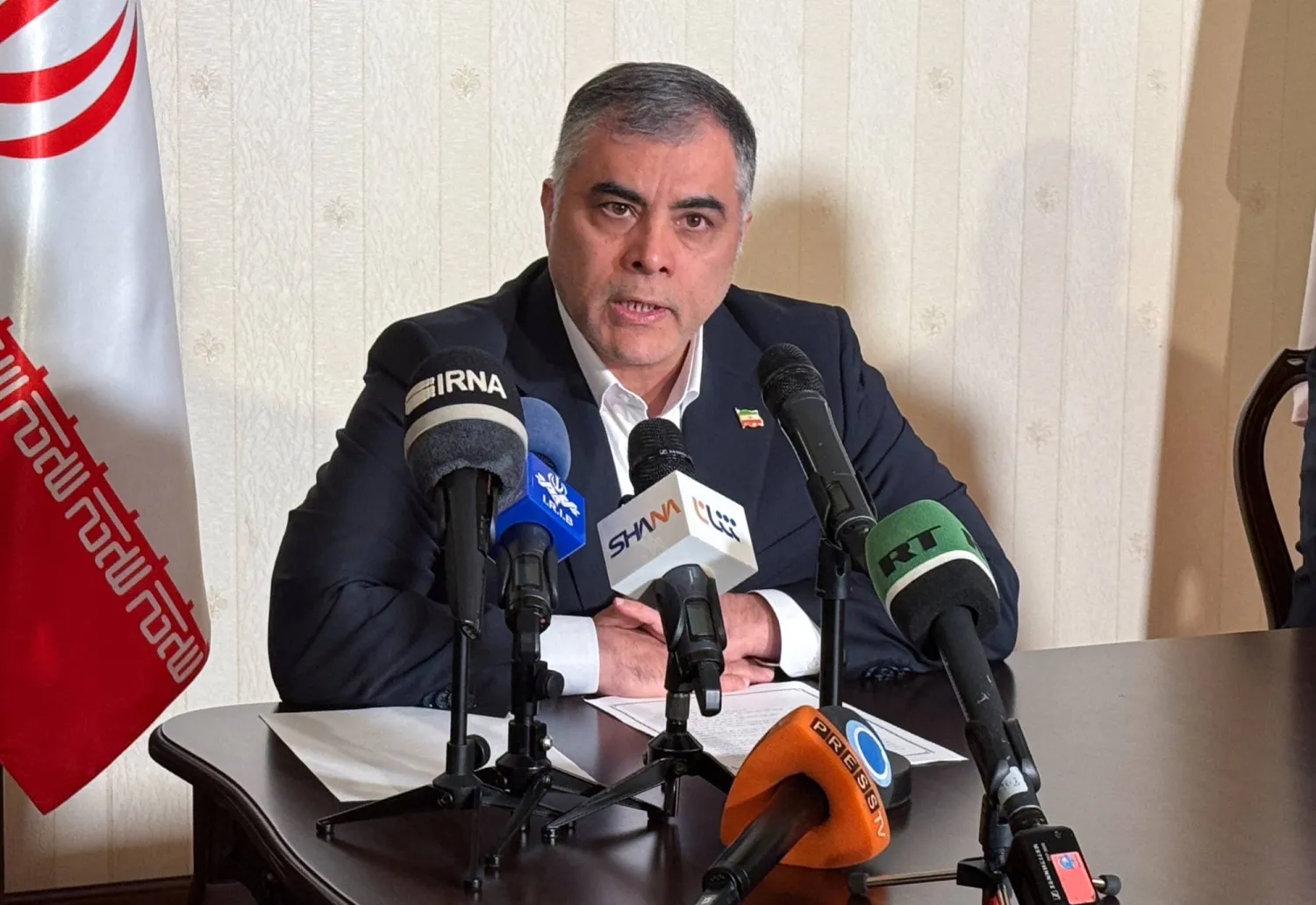
Iranian Oil Minister Mohsen Paknejad makes a statement following a signing ceremony attended by Russian Energy Minister Sergei Tsivilev in Moscow, Russia, April 25, 2025. REUTERS/Olesya Astakhova
TT

Iran Minister Says Oil Industry to Be Testing Ground for Any Final US-Iran Deal

Iranian Oil Minister Mohsen Paknejad makes a statement following a signing ceremony attended by Russian Energy Minister Sergei Tsivilev in Moscow, Russia, April 25, 2025. REUTERS/Olesya Astakhova

Iran's oil industry will be a key testing ground for any final peace agreement with the ‌US ‌if Western parties ‌remain ⁠committed to its ⁠spirit, Oil Minister Mohsen Paknejad said on Sunday.

The ministry's news ⁠outlet, Shana, ‌quoted Paknejad ‌as saying that ‌in a ‌post-agreement era, Iran's oil sector would offer ‌the global economy major investment opportunities and ⁠has ⁠hundreds of investment projects, as well as technical and operational partnership contracts ready to be signed, according to Reuters.

A new round of negotiations over the Middle East war was set to kick off Sunday, with Iranian negotiators arriving in the Swiss host city hours ahead of US Vice President JD Vance, even as Tehran said it was closing the Strait of Hormuz again over Israeli attacks in Lebanon.

Follow-up talks had been planned in Switzerland on Friday but were postponed at the last minute after Israel launched deadly strikes in Lebanon following the deaths of four of its soldiers in combat.

Hormuz, a key conduit for oil and gas shipments, was blockaded by Iran for much of the war, sending shockwaves through global energy markets.


Pakistan’s Mango Exports Shrink as Middle East War Impacts Linger

This photograph taken on June 4, 2026 shows a worker checking the quality of mangoes at an orchard in Hyderabad City, in Pakistan's Sindh province. (AFP)
TT

Pakistan’s Mango Exports Shrink as Middle East War Impacts Linger

This photograph taken on June 4, 2026 shows a worker checking the quality of mangoes at an orchard in Hyderabad City, in Pakistan's Sindh province. (AFP)

Beneath the scorching sun in Pakistan's southern mango belt, laborers balance on tree branches, working at a swift pace to throw the freshly picked fruit into sacks held ready by farmhands waiting below.

Though mango season is well underway, far less of the fruit will be bound for the lucrative export market than usual, with Pakistan's agriculturally dependent economy caught in the crosshairs of the Middle East crisis that its government has helped mediate.

An initial deal between the warring sides announced by Pakistan this week has come too late for this mango season, which began in June in southern Sindh province.

Mango traders told AFP they expect export sales to fall at least 30 percent this year due to dampened demand in key markets, including the Gulf, and soaring shipping costs.

Adding to the financial pain, local households struggling with a spike in inflation emanating from the regional crisis are holding off on buying the fruit, depressing domestic sales.

In the mango-growing heartland of Tando Allahyar, Mohammad Shakeel manages orchards that grow the golden-yellow Sindhri variety, named after the province where it flourishes and famous for its rich flavor and juicy pulp.

He feared his business would fall short of generating the income needed to cover the upfront cost of the orchard leases, noting some had abandoned their contracts entirely.

"So many losses have been incurred, the contractors have even left their advance money," Shakeel said.

This photograph taken on June 5, 2026 shows workers packing mangoes at a market in Karachi. (AFP)

- King of fruits -

Known in South Asia as the "king of fruits", Pakistan grows over two dozen varieties of mango that normally earn around $110 million in international sales a year -- making the country the world's fourth-largest exporter.

The challenges sparked by the Middle East war underscore the geopolitical vulnerability of Pakistan's economy, heavily dependent on an agriculture sector already struggling with the impacts of climate change.

"Almost 80 percent of mango export is to the Gulf region, Iran and Afghanistan," Waheed Ahmed, Chief Patron of the All Pakistan Fruit and Vegetable Exporter Association, told AFP, noting conflict had gripped all of those countries in recent months.

Total mango exports were expected to shrink by around 30,000 tons since last season to 80,000 tons this year, Ahmed said.

"The border to Afghanistan is closed, there is war in Iran... there is war in the entire Middle East."

Though he welcomed a preliminary agreement to halt fighting between the United States and Iran this week, the outlook looks shaky and it has come too late for this year's roughly three-month-long mango season.

"The main challenges still remain," he said.

Conflict with neighboring Afghanistan has also led to a stall in trade, with hundreds of trucks laden with goods sitting stuck at closed border crossings for months.

Competing blockades around the Strait of Hormuz maritime oil trade route pushed up energy prices, sending shipping costs soaring.

Ahmed estimated that shipping a container of 25 tons of mangoes cost around $1,400 last year.

"The same freight has increased to $6,000 to $7,000 this year," he said.

This photograph taken on June 4, 2026 shows an aerial view of a mango farm in Tando Allahyar district, in Pakistan's Sindh province. (AFP)

- 'Bread or mangoes'? -

Any hopes that the glut of mangoes into local markets could help offset lost export earnings were dashed by households' struggles with soaring prices for many goods, driven up during the Middle East war.

In a bustling outdoor market in Pakistan's largest city, Karachi, customer Muhammad Ashad eyes the surprisingly cheap mangoes on offer -- now around 200 Pakistani rupees ($0.72) per kilogram, half last year's price.

"Mangoes are very cheap this time compared to the last few years... because our export has stopped," he said.

"I am seeing everywhere that there are very good mangoes, but people are still not able to buy them," he said.

Pakistan's inflation rate leapt to 10 percent in the three months after the conflict began, from 5.5 percent in the July-February period, according to a government survey.

Shakeel, from the fruit export association, confirmed the hit to local sales.

"In the local market the price is low. But not everyone can afford to buy mangoes. Look at the state of the country: expenses are rising... income is low. Should they buy their bread first or our mangoes?"


Riyadh International Industry Week 2026 to Kick Off on Sunday

Riyadh International Industry Week 2026 to Kick Off on Sunday
TT

Riyadh International Industry Week 2026 to Kick Off on Sunday

Riyadh International Industry Week 2026 to Kick Off on Sunday

Riyadh International Industry Week 2026 will open Sunday at the Riyadh International Convention and Exhibition Center (RICEC), under the patronage of the Ministry of Industry and Mineral Resources.

The event will showcase the development of Saudi Arabia’s industrial capabilities and explore opportunities for international partnerships across several industrial sectors, bringing together more than 337 exhibitors from 17 countries, SPA reported.

It also serves as a key platform for showcasing the latest industrial technologies and products from leading local and international industrial companies. The event brings together three specialized exhibitions under one roof: Saudi Plastics and Petrochem and Saudi Print and Pack, both in their 21st editions, and the 4th edition of Saudi Smart Logistics.

The week, which runs until June 24, is organized through a strategic partnership between Riyadh Exhibitions Company Ltd. and Germany’s Messe Düsseldorf. The partnership marks an important step toward strengthening links between specialized Saudi exhibitions and their global counterparts, connecting the event with three of the leading international trade fairs in plastics, packaging, and printing: K, interpack, and drupa.

Several entities from the industry and mineral resources ecosystem will take part in the exhibition and its accompanying events. The week will feature several panel discussions and specialized workshops with senior officials and local and international experts.

Key topics include industrial transformation, innovation and localization, advanced packaging solutions for the food industry, industrial enablers and their role in promoting investment and strengthening competitiveness, the latest industrial practices in plastics, packaging and printing, and plastic recycling.

Riyadh International Industry Week contributes to strengthening international industrial partnerships and drawing on the experiences of leading countries. It comes as Saudi Arabia’s industrial sector continues to grow and develop under Saudi Vision 2030, which aims to position the Kingdom as a leading regional and global industrial power.


Iraq Projects Oil Production to Return to Pre-war Levels Within Two Months

A handout picture released by Iraq's Prime Minister's Press Office on January 2, 2025, shows a partial view of the oil refinery of Baiji north of Baghdad, during the inauguration ceremony of the fourth and fifth units. (Iraq's Prime Minister's Press Office / AFP)
TT

Iraq Projects Oil Production to Return to Pre-war Levels Within Two Months

A handout picture released by Iraq's Prime Minister's Press Office on January 2, 2025, shows a partial view of the oil refinery of Baiji north of Baghdad, during the inauguration ceremony of the fourth and fifth units. (Iraq's Prime Minister's Press Office / AFP)

Iraqi authorities predict oil production will return to peacetime levels "within one to two months", state media reported, after the Middle East war caused exports to plummet.

The war and Iran's ensuing blockade of the Strait of Hormuz choked off shipments and prompted production cuts in key oil-producing countries including Iraq, shaking world energy markets.

But a deal agreed this week between Washington and Tehran to end the fighting has offered some relief, despite follow-up negotiations having stalled.

The spokesman for Iraq's oil ministry, Salim Farhoud, told the state-run Iraq News Agency (INA) late Friday that "we can return within one to two months to the previous production levels".

"The fields that reduced their production capacity have currently begun raising this capacity," he said.

Before the war broke out in late February, Iraq exported about 3.5 million barrels per day of oil, the majority of it via the Hormuz Strait.

But the OPEC founding member was forced to halt production in most of its oil fields as reservoirs filled up, limiting its exports to routes via neighbouring Türkiye and Syria.

The vital strait began reopening this week following the signing of the initial agreement between Iran and the United States.

Iraqi Oil Minister Bassem Khodeir on Friday told INA that exports "will return gradually based on the smooth flow through the Strait of Hormuz".

In April, Iraqi crude exports via the waterway declined to 10 million barrels from an average of 93 million before the war, according to authorities.

Iraq is highly reliant on crude exports, which normally account for about 90 percent of its revenues.