


EU Bets on Digital Euro to Cut US Tech Addiction

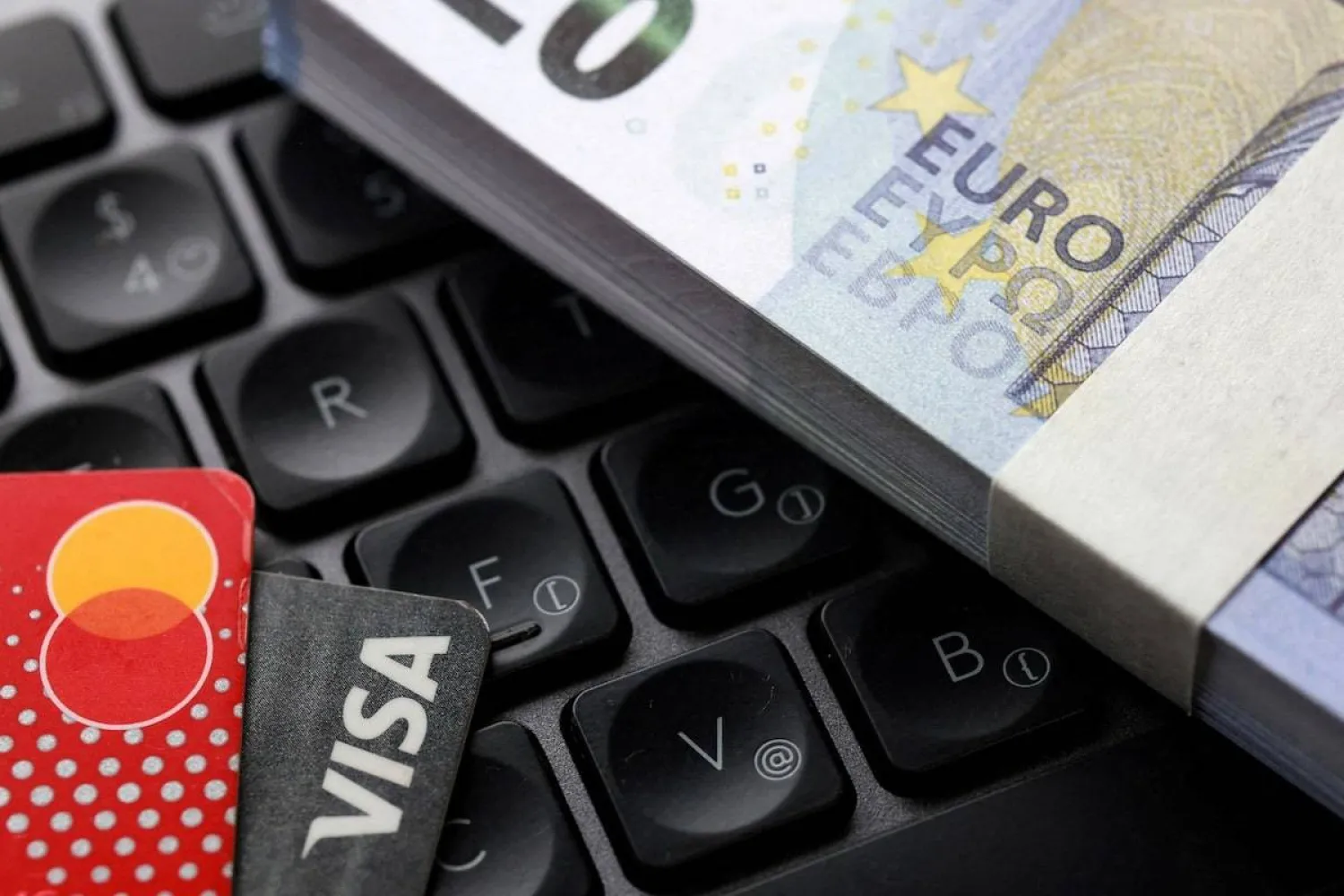
Euro banknotes, Visa and Mastercard cards are placed on a keyboard in this illustration taken September 24, 2025. (Reuters)
TT

EU Bets on Digital Euro to Cut US Tech Addiction

Euro banknotes, Visa and Mastercard cards are placed on a keyboard in this illustration taken September 24, 2025. (Reuters)

The EU believes a digital euro is the answer to cutting its addiction to US payment systems, like Visa and Mastercard, as well as Apple Pay and Google Pay, as the bloc seeks to favor European firms over others.

Brussels hopes it could provide an alternative local option for any payments in shops or online since people could easily pay, just like other systems, using a card, an app or via their banking app.

The European Union will move one step closer on Tuesday to creating a digital euro when EU lawmakers hold a long-awaited vote on the virtual currency.

The European Central Bank first suggested the digital euro in 2020 because Europe lacked its own system before the EU executive made its formal proposal.

The digital euro cannot be created without the rules underpinning the project being approved by the EU capitals and the European Parliament.

What is the digital euro?

Don't confuse it with your cash in the bank. When you use your bank card, Apple or Google Pay, you pay with physical money that exists in your account.

Instead, your digital euros would be in a separate virtual wallet.

The ECB hopes the digital euro will be available to citizens in 2029 if the EU negotiators greenlight the rules by the end of the year.

If that timeline sticks, the ECB is ready to launch a pilot program in mid-2027 to test how it would work in practice.

Some say that is too long, but "banks and merchants need time to prepare so they can roll it out smoothly and at scale", Alessandro Giovannini, advisor to the digital euro director at the ECB told AFP.

How will it work?

Digital euros will have the same value as cash and banknotes.

Any user would need to create an account with a bank or a public institution, like a post office, and transfer money into it from another account or via a cash deposit.

Users can then pay with digital euros in shops, online and between individuals using different methods, including card, app or phone.

Officials stress the system would protect people's privacy, with no possibility to identify who made transactions, and an offline mode that would be as confidential as using cash.

"It wouldn't replace anything. Cash would still be available, and people could use existing private payment methods," the ECB's Giovannini said.

The digital euro would give more choice and let consumers "preserve their freedom to choose how to pay as daily life becomes more digital", he added.

Why does the EU want a digital euro?

Payment systems are "not neutral" but "instruments of power", centrist EU lawmaker Gilles Boyer said in a statement.

"We, Europeans, have had many wake-up calls about our dependence on the US. We're fully awake now, but we're not always acting," he said, adding Tuesday's vote would make "a sovereign, pan-European payment solution a reality".

EU officials often point to Washington's 2025 sanctions against International Criminal Court judges to illustrate the grip of US firms. French judge Nicolas Guillou has described how he lost access to his Visa card.

The digital euro is "a chance to end a dependence we have lived with for too long".

According to the ECB, nearly two-thirds of card payments in the euro area are handled by non-European companies -- mostly Visa and Mastercard.

And 13 out of 21 eurozone countries have no national card scheme for day-to-day payments in shops or online stores.

Who doesn't want it?

Banks. The main reason for their reticence is the cost.

Adapting the banking system to the digital euro will cost 18 billion euros ($20 billion), a report in April by the European Banking Federation said.

But the ECB insists it will cost the banking sector between four and 5.8 billion euros in investment costs.

Banks also fear the effects on their financial stability because if customers convert their money into digital euros, bank deposits would plummet.

The ECB says there is no risk.

"Thanks to its design that prevents large deposit outflows, the digital euro wouldn't cause these risks -- even in extreme and unlikely crisis situations," Giovannini said.

European banks also fear reduced demand for their online services and worry the digital euro is a rival to the pan-European payment system Wero.




Oil Falls 1% as Investors Focus on Hormuz Flows after Peace Talks

FILE PHOTO: Storage tanks and oil refineries in Jurong Island, Singapore, March 24, 2026. REUTERS/Edgar Su/File Photo
TT

Oil Falls 1% as Investors Focus on Hormuz Flows after Peace Talks

FILE PHOTO: Storage tanks and oil refineries in Jurong Island, Singapore, March 24, 2026. REUTERS/Edgar Su/File Photo

Oil prices fell more than 1% on Tuesday, extending losses from the previous session, on signs of some progress in restoring crude flows through the Strait of Hormuz following US-Iran peace talks.

Brent crude futures fell $1.09, or 1.4%, to $76.81 a barrel and US West Texas Intermediate declined to $72.99 a barrel, down 87 cents, or 1.2%, as of 0607 GMT.

Prices fell more than 3% on Monday after the United States granted Iran a 60-day sanctions waiver following initial peace talks, and as officials reported a ‌lull in hostilities ‌in Lebanon under the broader agreement, Reuters said.

"The gradual increase ‌in ⁠oil flows through ⁠the Strait of Hormuz continues to weigh on the market," said ING analysts in a note.

Two crude tankers with just under 2 million barrels of oil sailed through the Strait of Hormuz on Monday, ship-tracking data showed, in a sign that traffic was picking up following weaker flows on Sunday due to concerns over passage through ⁠the waterway.

"Transits over recent days look to have ‌risen sharply, (which) the market will ‌treat as a proxy for both physical oil, perhaps paper oil, and diplomatic ‌progress," said Sparta Commodities' head of research Neil Crosby in ‌a note. "It feels like we will be stuck in this bearish risk-off/optimistic mood until such time as something changes."

The price declines come after a weekend that had appeared to put the week-old accord in jeopardy, including ‌threats from US President Donald Trump to restart the war if Iran disrupted shipping through the Strait ⁠of Hormuz ⁠after Tehran declared the strategic waterway closed.

"There remains a prevailing dose of market skepticism, rooted in deep-seated mistrust between Washington and Tehran, suggesting that any return to pre-war oil prices is likely to be delayed rather than immediate," said Tim Waterer, chief market analyst at KCM Trade.

Separately, analysts in a Reuters poll expect US crude inventories to have fallen last week, along with distillate and gasoline inventories.

On Monday, government data showed US crude stocks in the Strategic Petroleum Reserve fell to 331.2 million barrels last week, the lowest since June 1983, as supplies tightened in the wake of the US-Iran conflict.


China Lines Up Second LNG Terminal For Sanctioned Russian Cargoes

Chinese and Russian flags fly at an airport in Tianjin, China August 31, 2025. Sputnik/Vladimir Smirnov/Pool via REUTERS 
TT

China Lines Up Second LNG Terminal For Sanctioned Russian Cargoes

Chinese and Russian flags fly at an airport in Tianjin, China August 31, 2025. Sputnik/Vladimir Smirnov/Pool via REUTERS 

China is preparing a second import terminal to handle liquefied natural gas cargoes from Russia's sanctioned Arctic LNG 2 project, expanding a ‌route that so far relies on a single facility, three sources with knowledge of the matter said.

The newly built Longkou LNG terminal in eastern China's Shandong province, operated by state pipeline giant PipeChina, is being lined up to receive Arctic LNG 2 cargoes, the sources told Reuters.

The move would provide a lifeline to the $21 billion project, which is under heavy sanctions, and to Moscow, whose gas exports have been hit by Europe's decision to halt purchases and ⁠whose oil sector faces pressure from Ukrainian attacks.

A second import terminal would allow China to take larger volumes of sanctioned Russian LNG, while giving Arctic LNG 2 - designed to produce 19.8 million metric tons a year - another export outlet.

China, the only known buyer of sanctioned Arctic LNG 2 cargoes, has so far received shipments through PipeChina's Beihai terminal in Guangxi. That facility took the project's first delivery to an offtaker in August 2025 aboard the Arctic Mulan tanker.

Since then, Beihai has received 41 cargoes, or 2.6 million tons, of LNG from Arctic LNG 2 - many via two floating storage units in Russia - according to ship-tracking data and Kpler estimates. It ‌has also ⁠received three LNG cargoes from Russia's sanctioned Portovaya terminal.

China needs an additional terminal to absorb more sanctioned cargoes, one of the sources said. All declined to be named as they were not authorized to speak to media.

The world's largest LNG importer, China bought 7.57 million tons from Russia last year, according to Chinese customs data.

Longkou is seen as a logical choice because, like Beihai, it is operated by PipeChina ⁠and is closer to the Koryak floating storage unit in Russia's Far East, where Arctic LNG 2 cargoes are stored and reloaded, the sources said.

An industry executive said Longkou has completed its mechanical build phase and should be ready before October, in time for peak winter ⁠demand.

Under its completed first phase, the Longkou terminal in the coastal city of Yantai has an annual receiving capacity of 5 million tons, compared with 6 million tons at Beihai.

PipeChina's Dalian LNG terminal in northeastern China is also being discussed as ⁠a potential future receiving point, a fourth source said.

Novatek has recently stepped up hiring in China, a separate source said.

Reuters reported last year that Novatek has cut cargo prices by 30% to 40% since August 2025 to attract Chinese buyers despite sanctions.


BofA Expects Fed to Hike Interest Rates 75 Basis Points in 2026

The Federal Reserve building in Washington. (Reuters)
TT

BofA Expects Fed to Hike Interest Rates 75 Basis Points in 2026

The Federal Reserve building in Washington. (Reuters)

Bank of America (BofA) expects the Federal Reserve to hike interest rates by 75 basis points in 2026, it said on Monday, citing resilient economic data and rising expectations of a hawkish Fed under new Chair Kevin Warsh.

BofA Global Research said in a note it expects the US central bank to raise rates in September, October, and December, compared with its prior forecast ⁠for no change this year, according to Reuters.

BofA's view is contrary to current 2026 outlooks of top Wall Street brokerages and comes after the Fed left its benchmark rate unchanged earlier this month, even as almost half of Fed policymakers indicated that they now expect rates to rise this year.

The policymakers' more hawkish outlook is accompanied by strength in the labor market and elevated inflation concerns.

“June Summary of Projections and ⁠Warsh's comments indicate that the Fed's reaction function is much more hawkish than we thought,” analysts at BofA said in a note.

In contrast to BofA's call, markets are pricing in 42 bps of hikes ⁠in 2026, according to London Stock Exchange Group (LSEG) data.

After three rate hikes this year, BofA analysts expect the central bank to keep interest rates on hold in ⁠2027.

“Inflation is likely to remain sticky, keeping the real policy rate from becoming overly restrictive,” they said.

Brokerages including BNP Paribas ⁠and Macquarie are also among the minority that expect the central bank to start hiking rates this year.