


Sudan Edges Closer to Currency Split

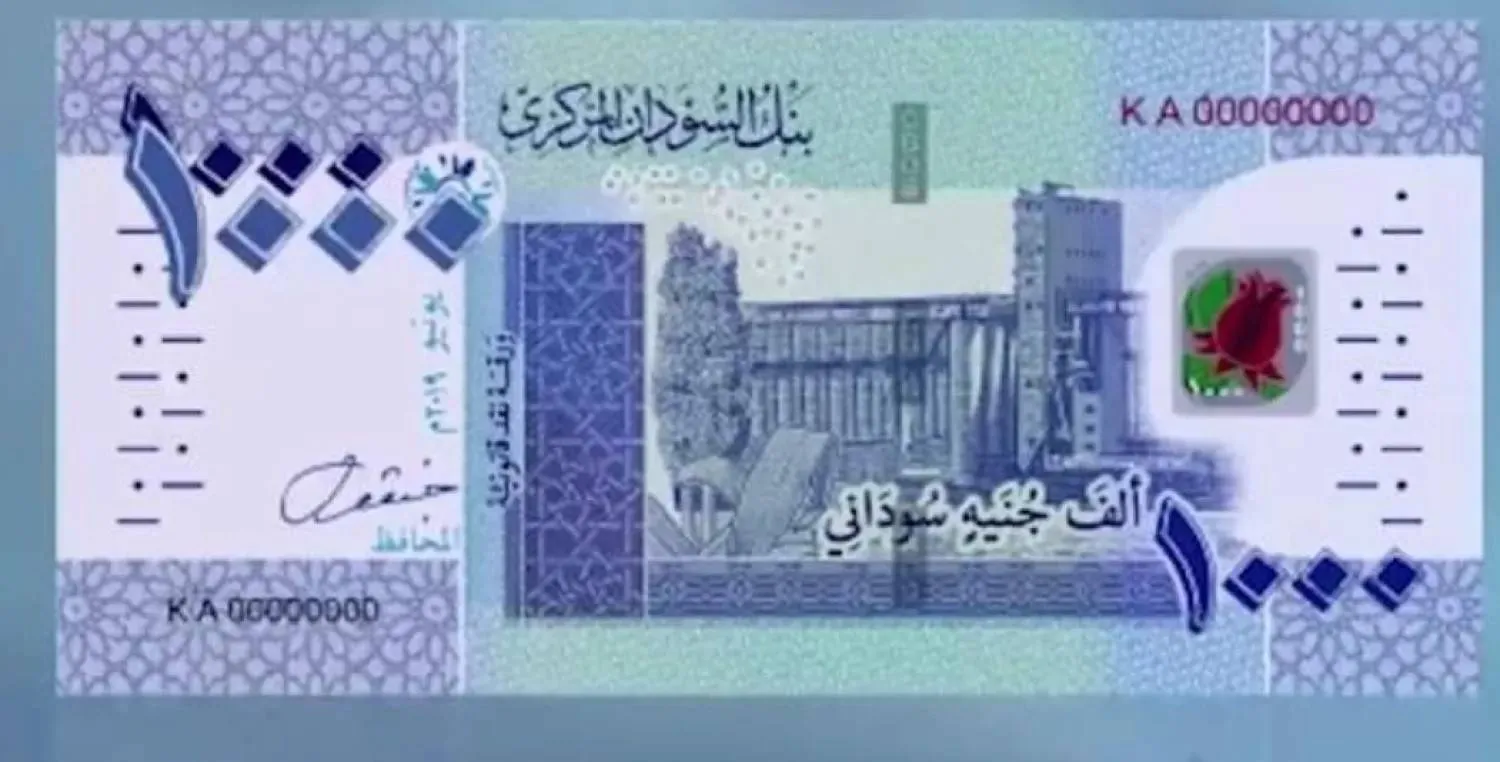
A 1,000-pound note print (X)
TT

Sudan Edges Closer to Currency Split

A 1,000-pound note print (X)

Sudan’s division is no longer confined to geography, administration and public services. It has begun to touch one of the state’s most sensitive institutions.

New 1,000- and 500-pound banknotes, issued by the Central Bank of Sudan in May 2022, have been observed circulating in areas controlled by the Rapid Support Forces, raising questions about the future of the national currency's unity and the central bank’s ability to maintain authority over the country’s cash supply.

The RSF-aligned government, based in Nyala, has allowed the circulation of banknotes bearing the signature of former Central Bank of Sudan governor Hussein Yahia Jangol after reappointing him to the same post as governor of what it calls a parallel central bank.

The Nyala government has banned other denominations bearing the signature of Burai al-Siddiq, who succeeded Jangol at the central bank. Meanwhile, Mohamed Hasan al-Taishi, prime minister of the parallel government, has announced monetary and banking policies that he said are aimed at building an integrated financial system.

Asharq Al-Awsat has learned from a source whose identity has not been definitively established that the circulation of new banknotes in RSF-controlled areas is not the first such case. It remains unclear whether the notes had been stored previously or were newly printed.

Bankers and economists say the danger lies not in the banknote itself, but in the authority controlling its issuance and circulation, and in the possible impact on the effectiveness of economic policy, confidence in the national currency and the stability of the financial system.

Experts say the effectiveness of monetary policy depends mainly on the Central Bank of Sudan’s ability to exercise authority over the money supply, manage liquidity, ease pressure on the foreign exchange market, control inflation and support exchange-rate stability.

If cash circulates outside that authority, measuring the money supply becomes more complicated. It also weakens the monetary authorities’ ability to fight inflation, manage liquidity, contain pressure on the exchange rate, maintain price stability and protect the financial system.

According to data released by the Central Bank of Sudan in April, money supply growth stood at 27.3%, reflecting challenges in liquidity management, especially given the exceptional conditions the country faces.

Experts say the circulation of banknotes in RSF-controlled areas further complicates measuring the money supply, particularly the component of currency circulating outside the banking system.

It also reduces the accuracy of monetary indicators and weakens the design and implementation of monetary policy, leading to lower confidence in the national currency and limiting the ability of institutions to enforce economic policies uniformly across the country.

According to the Central Bank of Sudan’s economic and financial review issued last December, currency held by the public accounted for about 97.4% of total currency in circulation, compared with only 2.6% held by commercial banks.

This high level of cash circulating outside the banking system points to the spread of direct cash transactions, limiting the banking sector’s ability to mobilize savings and making liquidity management more difficult.

Experts say any additional circulation of cash outside the central bank’s authority would deepen economic imbalances and obstruct the management of the money supply and the stability of the monetary and financial systems.

Informal economy

Recent studies indicate that Sudan’s informal economy accounts for about 60% of economic activity, a high level that limits the effectiveness of policy and weakens the state’s ability to measure and manage it.

Sudan’s economy still relies heavily on cash transactions compared with electronic payment methods. Despite recent developments in banking applications, financial inclusion and banking penetration remain below the required level. This strengthens the parallel economy and limits the efficiency of economic policies and their development into a “real” economy.

From the perspective of experts and bankers, the scenario of Sudan moving toward two banking systems appears technically and institutionally unlikely in the near term. Establishing an independent banking system requires more than issuing banknotes.

It requires a central bank capable of carrying out its core functions, including managing monetary policy, operating payment and settlement systems, supervising and regulating banks, managing reserves and establishing banking relationships with foreign correspondent banks. These requirements are difficult to meet under current conditions.

Financial bodies have warned that the continuation of the conflict could lead to the emergence of a parallel financial network carrying out banking functions informally, especially money transfers, cash movement and local trade financing.

Two central banks

Some countries that have suffered prolonged conflicts, such as Somalia, have seen the significant development of private money transfer networks that have effectively performed part of the banking system’s functions, while remaining outside the official regulatory framework. In Sudan’s case, the expansion of such channels could reduce the role of the formal banking sector.

Although Sudan does not yet have a parallel central bank exercising full institutional functions, as is the case in eastern Libya, this may depend on how long the conflict continues.

Sudan could gradually move closer to the Libyan model, with the Sudanese pound remaining one national currency legally, while multiple banknote issues circulate, acceptance levels vary from one region to another and partial cash markets emerge.

Sudanese authorities had previously ruled out the possibility that the RSF would print a new currency through companies or in countries subject to the global banking system.

Former Finance Minister Ibrahim Elbadawi told Asharq Al-Awsat that what happened was natural and expected, given the continuation of a fierce war for more than three years.

Elbadawi said the larger dilemma was the “insistence on war,” despite the difficulty of either side achieving a “decisive victory.” He added: “Most civil conflicts end in political settlements, and this is especially true of the Sudanese war.”

Tasis Prime Minister Mohamed Hasan al-Taishi said in press remarks that his government was moving ahead with monetary and banking policies to build an integrated financial system. He did not comment directly on reports about the introduction of new banknotes in Nyala.

Taishi said citizens in areas administered by his government had faced difficulties obtaining banking services and making money transfers due to conditions imposed by the war and institutional divisions.

The man leading the RSF-aligned government and the Tasis alliance renewed accusations against the army-led government, saying it had targeted citizens in areas under his control by “changing the currency,” draining markets of cash and using liquidity as a pressure card and a tool of war.

He said that all matters related to currency printing fall under the authority of the monetary authorities and relevant technical bodies. Any arrangements related to cash management or liquidity provision, he said, are carried out in accordance with carefully studied technical plans aimed at maintaining economic stability and meeting the needs of citizens and markets.

Taishi announced last May the creation of a “Transitional Currency Council,” defining its role as regulating monetary and banking affairs, managing currency circulation, supervising currency replacement programs and granting banking licenses in coordination with the governor of the Central Bank of Sudan in Nyala.

In recent months, the Tasis government established Future Bank, the first commercial bank to offer several banking services, including foreign currency transfers.

After the war broke out between the Sudanese army and the RSF in April 2023, banks went completely out of service in the western region of Darfur. This led to a severe liquidity shortage in markets and the deterioration of banknotes in circulation, while the Sudanese government continued to tighten controls at crossings to prevent any new currency from entering those areas.



Russia Extends Ban on Diesel Exports Until September 30

Drivers queue at a Rosneft petrol station to refuel their cars in Moscow on August 21, 2026. (AFP)
TT

Russia Extends Ban on Diesel Exports Until September 30

Drivers queue at a Rosneft petrol station to refuel their cars in Moscow on August 21, 2026. (AFP)

Russia said on Saturday it had extended a ban on diesel exports until September 30.

The ban also covers exports of marine fuel and gas oils shipped by Russian producers, the government ‌said in a statement.

"These ‌measures have been ‌taken ⁠to stabilize the ⁠domestic fuel market," it said.

Three sources previously told Reuters that Russia would extend the ban as domestic fuel shortages persist, with several refineries still offline ⁠after repeated Ukrainian drone ‌attacks.

Russia ‌introduced the export ban from July ‌8 to July 31 ‌as part of a broader package of measures to support the domestic fuel market, before extending it for ‌fuel producers until August 31.

Russia has also banned exports ⁠of ⁠diesel by non-producers and motor gasoline until January 31, 2027, and jet fuel until the end of November 2026.

Russia is typically the world's second-largest diesel exporter after the US. Exports had already slowed before the ban because of domestic shortages linked to Ukrainian drone attacks.


REGA: Saudi Property Market Draws Strong Int’l Investor Interest

A view of the Saudi Luxury Real Estate Show, which opened in the British capital, London (Asharq Al-Awsat)
TT

REGA: Saudi Property Market Draws Strong Int’l Investor Interest

A view of the Saudi Luxury Real Estate Show, which opened in the British capital, London (Asharq Al-Awsat)

Saudi Arabia’s property market is entering a new phase of openness to international capital, driven by new rules on real estate ownership by non-Saudis and the designation of geographical zones where they can buy property.

The move advances the Kingdom’s push to establish itself as a global real estate investment destination as interest grows among international investors and investment funds.

Government entities and several property developers are seeking to draw investors to the Saudi market through the inaugural Saudi Luxury Real Estate Show.

Held in strategic partnership with the Real Estate General Authority, or REGA, the event brings together Saudi developers, investors, family offices and industry specialists from Britain and other international markets.

Taiseer Al-Mufarrej, REGA’s official spokesperson, said the authority was participating to raise awareness of the Kingdom’s new real estate framework, particularly the recently approved Law of Real Estate Ownership by Non-Saudis and the geographical zones designated for ownership.

Al-Mufarrej told Asharq Al-Awsat that REGA’s role at the show went beyond explaining the law. The authority was also engaging directly with investors, answering their questions and outlining the process for buyers, investors and real estate brokers through to the completion of transactions involving ownership by non-Saudis.

He said the Saudi Properties portal was the main channel for transactions covered by the law. REGA was using the show to explain the customer journey and how to use the platform, offering those seeking to enter the Saudi market a clearer view of its procedures and opportunities.

International funds show interest

REGA’s participation extended beyond its exhibition pavilion. On the sidelines, the authority organized workshops, panel discussions and roundtables aimed directly at investors, in cooperation with several Saudi government entities and private-sector institutions.

Al-Mufarrej said one roundtable was dedicated to investors from international investment funds and included the Saudi British Business Council. The meeting underscored growing efforts to draw institutional capital into Saudi real estate as the new rules broaden the targeted investor base.

The meetings gave investors a chance to speak directly with officials and raise questions about ownership procedures, available opportunities and the nature of the market, Al-Mufarrej said.

They come as the sector’s regulatory environment undergoes changes aimed at strengthening transparency and making the market more attractive to investors from Saudi Arabia and abroad.

Riyadh and Jeddah — and Makkah and Madinah

Al-Mufarrej said REGA’s participation revealed strong interest in the property ownership law for non-Saudis among investors, visitors and people looking for real estate in the Kingdom.

Interest was not limited to Riyadh and Jeddah. It extended to Makkah and Madinah, which attract particular attention because of their religious importance and the nature of property demand in both cities.

“We saw a very significant increase in awareness among investors, visitors and even people looking for property in the Kingdom,” Al-Mufarrej said.

Inquiries covered the main cities, led by Riyadh and Jeddah, as well as Makkah and Madinah, he added.

The efforts are gaining importance as Saudi Arabia seeks to increase the real estate sector’s contribution to the economy and diversify investment channels, alongside the large-scale projects, urban expansion and population and economic growth reshaping the Kingdom’s cities.

‘A global real estate investment destination’

Al-Mufarrej described the turnout at the show as strong, citing the prominent presence of investors, media outlets and influencers. He said the attendance reflected a shift in how foreign investors viewed the Saudi property market.

“What we witnessed at the show clearly demonstrates that Saudi Arabia has become a global real estate investment destination,” he said.

Investors and property seekers showed strong interest in the Kingdom, whether for investment, ownership or housing, he added.

International interest is rising as Saudi Arabia undertakes a broad overhaul of its real estate regulatory and investment framework.

The focus is shifting from simply offering property opportunities to building a clearer investment environment — from identifying areas open to ownership to explaining the procedures and platforms through which investments are processed.

Al-Mufarrej said the show’s timing alongside those changes had made it a platform for raising awareness of the new rules and engaging directly with investors.

The event came “at exactly the right time” and helped introduce investors to the Kingdom’s property ownership law, he said.

The growing presence of international investors reflects a broader shift in the Saudi market. Real estate opportunities are no longer tied solely to domestic demand.

The Kingdom is seeking to position the sector as a channel for international investment, drawing on regulatory reforms, large-scale projects and the transformation of Saudi cities under the goals of Saudi Vision 2030.


Trump Announces Deal for Huge US Stake in Venezuelan Oil Reserves

View of an oil tanker at the Maracaibo Lake in Maracaibo, Venezuela, on March 9, 2026. Margioni BERMÚDEZ / AFP
TT

Trump Announces Deal for Huge US Stake in Venezuelan Oil Reserves

View of an oil tanker at the Maracaibo Lake in Maracaibo, Venezuela, on March 9, 2026. Margioni BERMÚDEZ / AFP

President Donald Trump said Friday his administration has reached a huge oil deal with Venezuela that gives the United States majority control of 65 billion barrels of proven petroleum reserves.

The deal -- which Trump proclaimed as "the biggest oil deal in world history" -- will bring nearly $100 billion in private investment to Venezuela, US and Venezuelan officials said.

Venezuela has the world's largest proven oil reserves. Its government has operated under intense pressure and close scrutiny from the Trump administration since the US ousted and captured long time ruler Nicolas Maduro in January, said AFP.

Washington allowed his vice president, Delcy Rodriguez, to stay on and serve as interim leader so long as she toes the US line.

Trump has made no secret of his desire to secure Venezuelan oil for the US, and in his post announcing the deal on his Truth Social platform, he said it will more than double US oil reserves.

Interim leader Rodriguez confirmed what she called a "historic agreement" that would "have a significant impact on the rebirth of our nation."

Writing on social media, she hailed potential investment of "more than $100 billion and more than $209 billion in tax revenue for the State."

Trump said Secretary of State Marco Rubio and Defense Secretary Pete Hegseth had reached the deal with Rodriguez "through a partnership with private business."

"This Transaction will greatly strengthen the already growing relationship between Venezuela and the United States!" Trump wrote.

- Many questions remain -

Rubio said the deal demonstrated how "President Trump's bold foreign policy is driving America First wins: securing stable reserves and low-cost oil in our Hemisphere and lowering gas prices here at home."

"For the Venezuelan people, this deal will bring nearly $100 billion in private investment, support thousands of high-paying jobs, and drive the reconstruction of Venezuela's economy," Rubio wrote on X, without providing further details.

Jorge Pinon, a senior researcher at the Energy Institute at the University of Texas at Austin, said the agreement was unconventional and many questions remained about how the oil assets would be transferred, "not to a private enterprise, but to another country."

"We don't know how the transfer would take place," he said. "Is it a sale? Is it a title transfer? Is it only transferred once the reserves are actually produced?"

The news site Axios had reported Thursday that the two countries were in talks on a dozen productive oil fields with 90 billion barrels of proven reserves -- about a third of Venezuela's total proven reserves of 300 billion barrels.

In return for a US ownership stake, private companies, including American firms, would develop the fields and return more oil revenue to Venezuela, according to Axios.

Axios also said the deal would more than double US oil reserves at a time when the US strategic petroleum reserve is at a 40-year low.

High gasoline prices for Americans is a major political issue for Trump, whose approval ratings have fallen ahead of November's midterm elections after launching a war on Iran that has disrupted global oil supplies.

The Trump administration has been urging US companies to invest in Venezuela, but they remain wary due to dilapidated infrastructure and past appropriation of assets of foreign investors by the government in Caracas.

Chevron, the only US oil company that was still operating in Venezuela when Maduro was ousted, said in July that it had raised its daily crude production to 280,000 barrels and plans to increase output by 50 percent by the end of 2028.

John Kilduff, energy expert at Again Capital, said the biggest problem for companies to operate in Venezuela is "the safety and security of your investment."

He said if the US is now going to control or own the oil fields, the goal would be "to establish a sort of state zone where US companies can go in, operate, and not be impacted, and hopefully eliminate the political risk that otherwise goes with investing in Venezuela."