


EU, China Trade Tensions Loom over Minister Visit

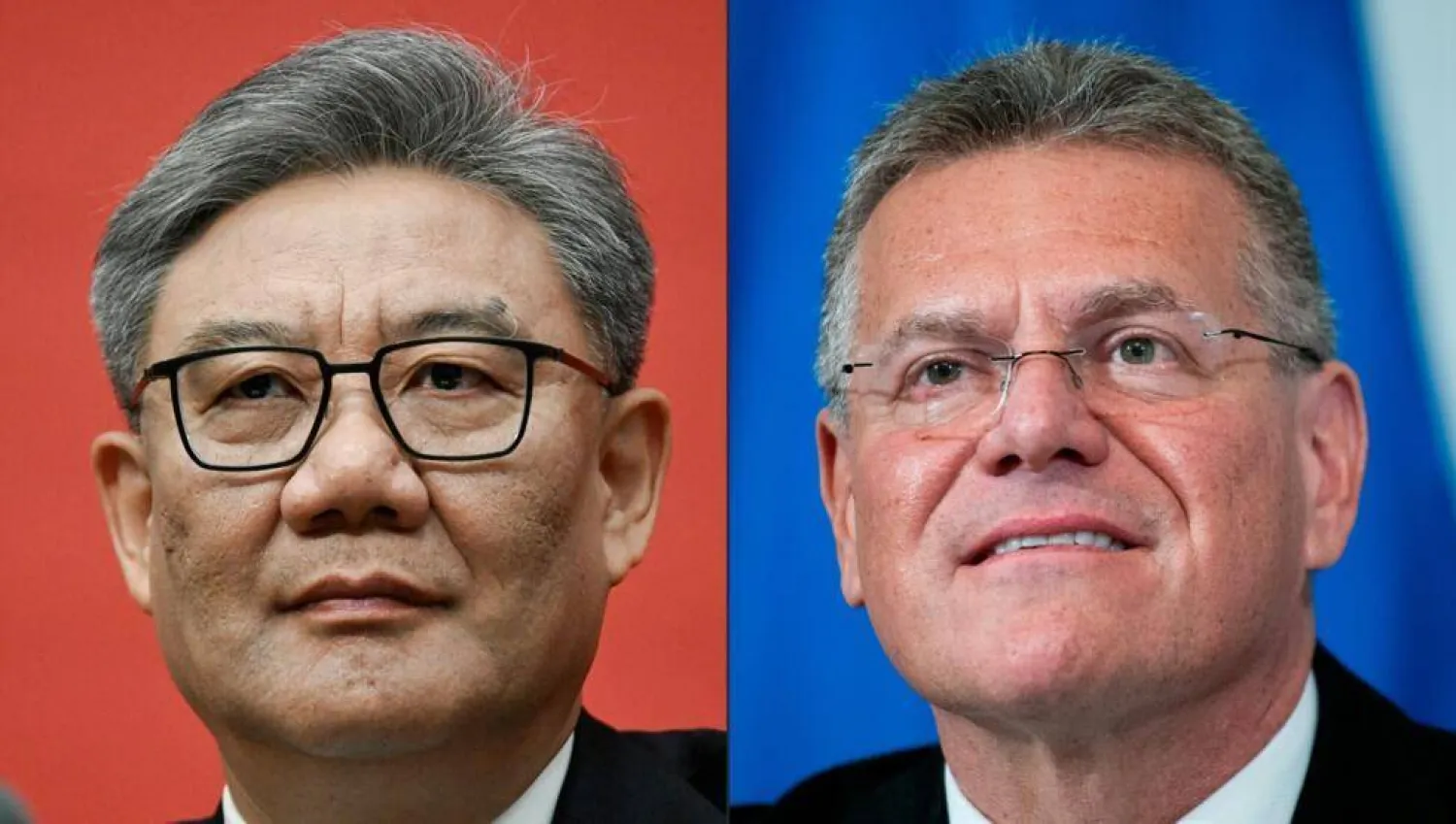
Chinese Commerce Minister Wang Wentao will meet his EU counterpart Maros Sefcovic in Brussels. Pedro PARDO, Annabelle GORDON / AFP/File
TT

EU, China Trade Tensions Loom over Minister Visit

Chinese Commerce Minister Wang Wentao will meet his EU counterpart Maros Sefcovic in Brussels. Pedro PARDO, Annabelle GORDON / AFP/File

Europe and China will gauge whether trade frictions can be resolved through talks Monday when top EU trade official Maros Sefcovic hosts his Chinese counterpart Wang Wentao in Brussels for day-long discussions.

The European Union has turned its attention to China as Brussels frets over increasing trade imbalances between the 27-nation bloc and the Asian powerhouse.

The issue is existential for the EU, AFP reported.

Brussels fears it will lose certain industries entirely if it does not act against a glut of cheap goods made in China threatening manufacturers in Europe.

Wang's visit comes less than two weeks after EU leaders tasked the European Commission with tackling the issue through talks with Beijing -- while simultaneously preparing beefed-up defense measures to protect key sectors.

Sefcovic will tell Wang the current imbalances are unsustainable for the EU before hosting the Chinese minister for a special dinner on Monday evening.

The EU's trade deficit in goods hit around 360 billion euros ($410 billion) in 2025, meaning the bloc imported way more from China than it exported there.

In turn, Wang will likely seek to understand how serious the EU is in threatening to deploy its trade defense armory against Beijing.

But the EU still hopes to avoid a trade war with its second-largest trading partner for goods alone, according to the European Commission -- with China making clear it will retaliate against actions it views as unfair.

Following Trump's playbook?

Europe insists on the need for a level-playing field, pointing out that Chinese firms have an unfair advantage because of massive state subsidies.

The numbers support Brussels' argument. Between 2005 and 2024, Chinese companies received around three to eight times more government support than businesses in the Organization for Economic Co-operation and Development, according to the OECD, which called it "a conservative estimate".

The EU has an arsenal of trade defense tools it can use to address the issue.

These include imposing higher tariffs if investigations prove companies are selling goods at unfairly low prices or if there is state support that gives an unjust advantage to the manufacturers.

Brussels could also slap restrictions known as safeguard measures -- including quotas -- if there is a sudden surge in imports.

New measures are likely also on the way.

The European Commission, which leads EU trade policy, is working on an instrument that would force businesses to diversify their suppliers in critical sectors like chips and rare earths.

And French President Emmanuel Macron in May proposed a European "Section 301" -- the trade tool US President Donald Trump has employed to set higher tariffs for certain sectors after investigations.

'Not enemies'

The EU has taken several measures to confront soaring imports from China including doubling its duties on foreign steel, slapping higher levies on small parcels from abroad and hefty tariffs on Chinese-made electric vehicles.

Despite growing acceptance of the need to get tougher however, Brussels has shown zero appetite for a painful trade war with Beijing.

Beijing warns it is ready to respond to any measures it believes target China.

They are not empty threats for the EU since China previously slapped duties on European cognac and conducted anti-dumping probes into pork and dairy products.

The warning weighs on EU capitals.

Germany has until recently been more cautious since it is more exposed to China's economy but the biggest supporter of a more pragmatic approach has been Spain as it seeks Beijing's investment.

Although he echoed China's retaliation warning last week, Beijing's envoy to the EU Cai Run also urged dialogue as he told a Brussels audience that the bloc and Beijing were "partners, not rivals, and certainly not enemies".

The relationship is significant for China too: the EU is its second-largest trading partner.

After dinner with Sefcovic, Wang will head to London.


Oil Climbs Following Renewed US, Iran Strikes

The 'Al-Yarmouk' oil tanker sails in the Arabian Gulf waters, off the coast of Kuwait City on June 27, 2026. (Photo by YASSER AL-ZAYYAT / AFP)
TT

Oil Climbs Following Renewed US, Iran Strikes

The 'Al-Yarmouk' oil tanker sails in the Arabian Gulf waters, off the coast of Kuwait City on June 27, 2026. (Photo by YASSER AL-ZAYYAT / AFP)

Oil prices rose on Monday following days of tit-for-tat strikes by the U.S. and Iran that underscored the fragility of their interim peace deal and again slowed energy shipping through the Strait of Hormuz.

Brent crude futures climbed 45 cents, or 0.6%, to $72.44 a barrel at 0627 GMT while US West Texas Intermediate crude was at $70.05 a barrel, up 82 cents, or 1.2%, Reuters reported.

"There's still plenty of risk facing the oil market. Even so, participants appear to be ... focusing on what a continued recovery in oil ⁠flows would mean ⁠for the global balance," ING analysts said in a note on Monday.

"This complacency is odd and clearly leaves significant upside risk if the supply recovery proves slow."

Brent crude fell 10.6% last week, its third weekly decline, after crude shipments through the strait rose last week to their highest level since the US-Israeli war on Iran ⁠began in late February.

However, traffic has since slowed following renewed attacks on ships in the strait from Thursday that triggered strikes from the US and Iran in the worst escalation since they signed an interim peace deal.

Capping oil price gains, Iran and the US agreed to halt recent hostilities in the Gulf and renew talks regarding their dispute over the Strait of Hormuz, a US official said on Sunday.


Gold Slips as Fresh US-Iran Strikes Boost Oil, Fed Rate-hike Bets Weigh

AFP_96Gold bars weighing 1000 grams each are displayed at the Austrian Gold and Silver Refinery _Oegussa_ in Vienna
TT

Gold Slips as Fresh US-Iran Strikes Boost Oil, Fed Rate-hike Bets Weigh

AFP_96Gold bars weighing 1000 grams each are displayed at the Austrian Gold and Silver Refinery _Oegussa_ in Vienna

Gold prices eased on Monday as recent US-Iran strikes in the Gulf pushed oil prices higher, while expectations of US Federal Reserve interest rate hikes further weighed on the non-yielding metal, Reuters reported.

Spot gold was down 0.8% at $4,057.77 per ounce, as of 0602 GMT. US gold futures for August delivery lost 0.6% to $4,072.20. The metal was headed for a ‌fourth consecutive monthly ‌loss of 10.5%.

"US and Iran were at ‌it ⁠again over the ⁠weekend, with fresh military strikes reported from both parties, which casts further doubt over how long oil can stay at these subdued levels and therefore over the broader inflation and interest rate outlook," said Tim Waterer, chief market analyst at KCM Trade.

Oil prices rose after Iran launched missiles and drones at US military sites in Kuwait ⁠and Bahrain early on Sunday, shortly after US President ‌Donald Trump threatened to wipe ‌out the Iranian leadership if they did not stick to the agreement ‌to end their war.

However, Tehran and Washington agreed to halt recent hostilities ‌in the Gulf and renew talks regarding their dispute over the Strait of Hormuz, Axios reported on Sunday.

Elevated crude oil prices can fuel inflation and chances of interest rate hikes, and while gold is typically ‌seen as an inflation hedge, it loses its appeal as a non-yielding asset in a high interest-rate ⁠environment.

Traders expect ⁠three Fed rate hikes this year and are pricing in an about 80% chance of a December increase, according to the CME FedWatch Tool.

Investors are now looking out for June's ADP employment data and the US nonfarm payrolls data, both due later this week, to further gauge the Fed's monetary policy stance.

"Gold could see the $5,000 level again this year but this would be based on further de-escalation, oil having a sustained move to pre-war levels to dull the inflationary impact of the conflict, and a softer dollar," said Waterer.

Spot silver fell 0.9% to $58.64 per ounce, while platinum gained 0.1% to $1,616.55 and palladium rose 1% to $1,221.29.


Bousso: Hormuz Oil Exodus Sets Stage for Chaotic Rebalancing Act

Vessels at the Strait of Hormuz, as seen from Musandam, Oman, June 24, 2026. REUTERS/Stringer
TT

Bousso: Hormuz Oil Exodus Sets Stage for Chaotic Rebalancing Act

Vessels at the Strait of Hormuz, as seen from Musandam, Oman, June 24, 2026. REUTERS/Stringer

Crude prices may ‌be back near levels seen before the Iran war, but the surge in oil exports from the Middle East following the reopening of the Strait of Hormuz is creating a chaotic market that could take months to settle. The steep slide in Brent crude back to pre-war levels of around $73 a barrel following the US-Iran interim deal might, at first glance, suggest business as usual has returned to the world’s most important oil and gas hub. The narrow waterway, which once carried about a fifth of global oil and gas, had been effectively paralyzed by conflict for more than 100 days, Ron Bousso, a columnist for Reuters says.

But beneath the surface, the market is anything but orderly. What looks like normality is a system trying to reboot all at once. First, there’s the race to liberate trapped volumes. Dozens of tankers stranded inside the Gulf during the war have rushed to leave in recent days. US Energy Secretary Chris Wright said flows briefly exceeded pre-war levels of around 20 million barrels per day, though ship-tracking data suggests overall traffic remains far below the roughly 125 daily crossings seen before the conflict. Some vessels appear to be disabling tracking systems during transit, further clouding the picture.

Whatever the precise numbers, one thing is clear: more Middle Eastern oil is hitting the market.

But clearing outbound cargo is only half the equation.

Inbound tankers are needed to load crude ‌sitting in onshore storage, ‌a key step in allowing producers to restart fields and refineries shut during the war. Without that inflow ‌of vessels, the ⁠recovery in supply ⁠cannot proceed smoothly.

The constraint should be short-lived. Consultancy Rystad Energy estimates that shut-in production across the Gulf fell to 9.6 million bpd by mid-June from 11.7 million bpd three weeks earlier, and the region is now expected to return to pre-war output by December. Perhaps an even bigger factor complicating the supply outlook is Iran. Tehran is expected to quickly ramp up oil production after the US suspended most sanctions restricting Iran's oil exports and sales.

Iran's oil output could reach 3.3 million bpd by year-end, above pre-conflict levels, if the sanctions relief stays in place, according to Rystad.

Logistics aside, a flood of oil appears likely to hit markets.

FROM SHORTAGE TO GLUT

That surge is running headlong into weak short-term demand. Refineries in Asia and Europe ⁠have already largely secured their crude supplies for July and August, leaving the extra barrels with nowhere to go.

Many ‌tankers may therefore have little choice but to remain at sea, effectively turning into floating storage and ‌keeping those barrels off the market for weeks. Having endured the largest oil supply shock in history, the market may soon face the opposite problem.

Indeed, investors appear to be ‌pricing in a short-term "mini glut." Last week, August Brent futures traded below the September contract, flipping into a market structure, known as contango, for the first ‌time since the war began on February 28.

That contango could persist for several weeks as the backlog of oil trapped in the Gulf is gradually cleared. But it is unlikely to last. Once flows normalize, the market will require enormous volumes of crude to both meet recovering demand in Asia and refill inventories around the world that have been depleted during the conflict.

Does that mean supply and demand will easily shift back into balance? Probably not.

While global supply is forecast to fall by 3.9 million bpd in 2026, it is expected ‌to rebound by about 8 million bpd in 2027 to roughly 110.3 million bpd, according to the International Energy Agency.

Demand, by contrast, is expected to recover far more modestly, creating a potential surplus of roughly 5 million ⁠bpd next year.

This scenario may not play ⁠out, given the physical constraints of the oil supply chain, but the scale of the potential supply-demand mismatch suggests the market faces a very bumpy ride ahead.

LINGERING RISKS

While exports may be surging now, concerns about the future of the Strait of Hormuz are already resurfacing.

Under the US-Iran interim deal, transit through the waterway is supposed to be unimpeded and toll-free for 60 days, while Tehran negotiates with Oman over a longer-term framework to govern traffic. That temporary arrangement leaves plenty of room for uncertainty.

A stark reminder came in recent days, when Iranian forces fired on a Taiwanese cargo vessel transiting the strait on Thursday, sparking a round of tit-for-tat strikes with the United States. The incidents appeared less an escalation than a signal: Tehran intends to assert its authority through the newly created Gulf Strait Authority.

Although traffic resumed quickly after the incident, many shipowners and charterers are likely to remain wary of sending vessels back into the Gulf.

That caution is already showing up in flows. For every four tankers leaving the region last week, only one entered, far below pre-war levels, according to LSEG data.

Markets appear to be shrugging off concerns about political risks, logistical problems or lasting changes in the region.

But after months of severe disruption, the road back to balance is unlikely to be smooth. That suggests today’s market optimism might be overdone.
