UK Economy Grows as Expected before Iran War Impact

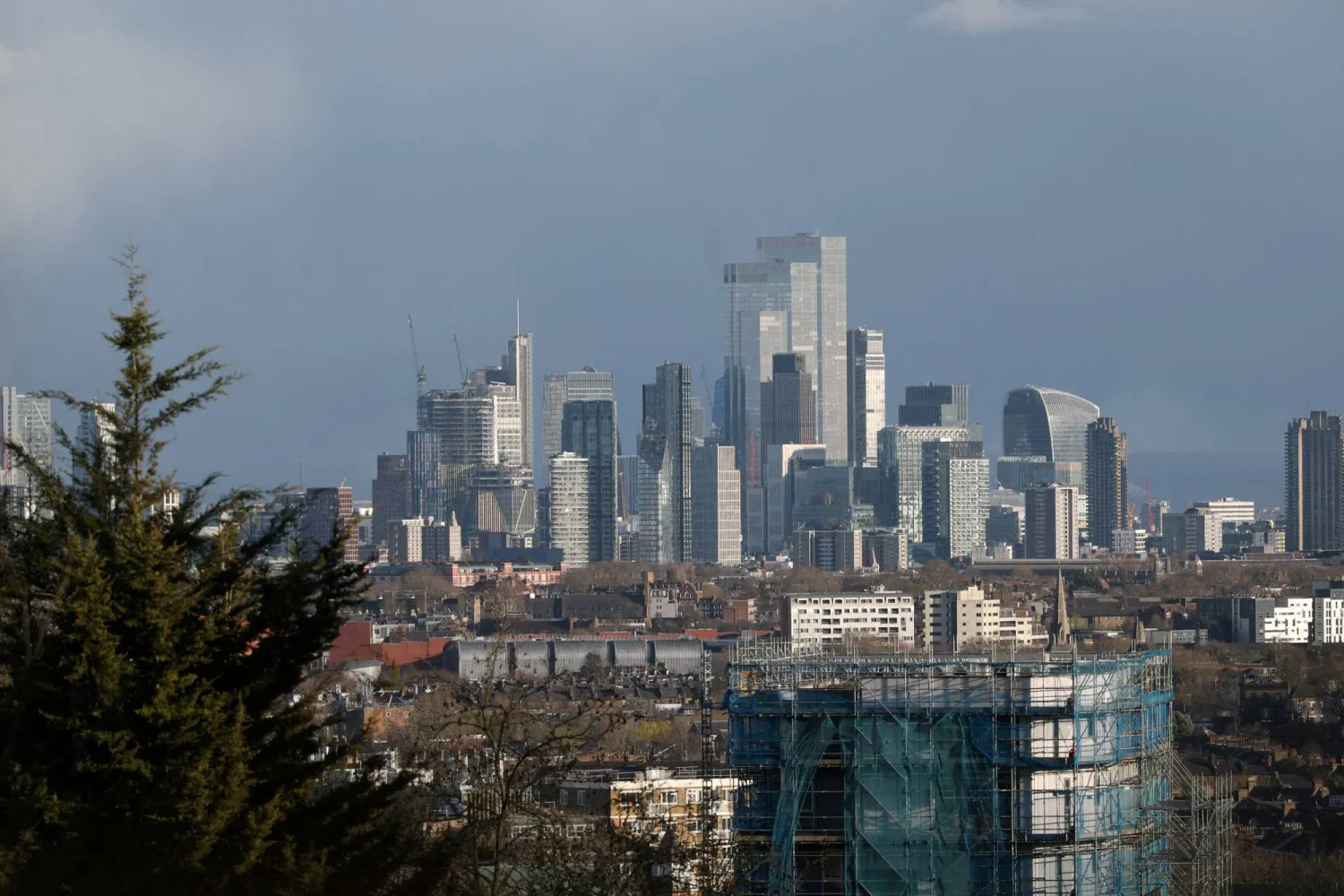
FILE PHOTO: The London skyline is seen with the financial district in the background, in London, Britain, March 25, 2026. REUTERS/Isabel Infantes/File Photo
TT

UK Economy Grows as Expected before Iran War Impact

FILE PHOTO: The London skyline is seen with the financial district in the background, in London, Britain, March 25, 2026. REUTERS/Isabel Infantes/File Photo

Britain's economy grew robustly in the first quarter of 2026, official data confirmed on Tuesday, but households were squeezed even before the worst effects of the US-Iran conflict started to feed through.

Economic output grew by 0.6% in the first three months of the year, unchanged from an initial estimate by the Office for National Statistics.

"Services were the main driver of growth in the latest quarter, with strengths in computer programming, wholesale and advertising only offset by falls in rental companies and recruitment agencies," ⁠Liz McKeown, director ⁠of economic statistics at the ONS, said.

It marked the third year running of conspicuously strong growth in the first quarter — and some economists have raised concerns with the statistics office's seasonal adjustment processes.

According to Reuters, the ONS reiterated on Tuesday that a review had found no statistically significant seasonality, although it was monitoring it closely.

Business surveys and economic growth data for April suggest Britain's likely next prime minister to replace ⁠Keir Starmer, Andy Burnham, will face a tougher inheritance.

"Alongside softer household spending, tighter financial conditions and economic uncertainty will weigh on investment," said Matt Swannell, chief economic adviser to the EY ITEM Club, a consultancy.

"Even though the government will soon be under new leadership, fiscal policy is likely to remain tight in the near term."

The ONS revised growth in the final three months of 2025 down to 0.1%.

Output in 2025 as a whole was also slightly lower than previously thought at 1.3%, compared with a previous estimate of 1.4%.

Sterling showed little reaction to the data.

Real household disposable income per head, a measure of living standards that the Labour government aims to ⁠raise by the end ⁠of the parliamentary term, contracted by 0.8% in the first quarter, after a 1.2% rise at the end of 2025.

Households put less money aside in the first quarter with the savings ratio decreasing by 0.7 percentage points to 8.9%, driven by a fall in the contribution of non-pension saving.

The squeeze on households looks set to continue as the Bank of England held interest rates at 3.75% in June and investors are pricing in the first quarter-point increase by February 2027.

Britain's budget watchdog in March forecast the economy to expand 1.1%, although the projections were made before the Iran war started.

Compared with a year earlier, GDP was 0.9% higher, the ONS said, revised down from a previous estimate of 1.1%, while output on a per capita basis was 0.7% higher than the year before.


Saudi Arabia Ranks First in GCC, 12th Globally in 2026 Marsh CFA Institute Global Pension Index

The Saudi flag. Asharq Al-Awsat
TT

Saudi Arabia Ranks First in GCC, 12th Globally in 2026 Marsh CFA Institute Global Pension Index

The Saudi flag. Asharq Al-Awsat

The Kingdom of Saudi Arabia ranked first among GCC states and 12th globally out of 55 pension systems in the 2026 Marsh CFA Institute Global Pension Index. The Kingdom's overall score climbed to 73.2 out of 100, up from 67.6 in 2025, continuing an upward trajectory that has seen it advance 15 places since 2022.

The Kingdom achieved notable gains across the index's three primary pillars. In the Integrity sub-index—which evaluates regulatory governance, member communication, and participant rights—Saudi Arabia scored 83.5, up 9.3 points from the previous year, securing an A rating, the highest classification in the category.

The Kingdom's Sustainability score increased to 61.2 points from 54.6, while Adequacy rose to 77.2 from 75, maintaining an overall B grade, SPA reported.

With its 73.2 score, Saudi Arabia outperformed established international pension systems categorized within the B band, including the United Kingdom, Canada, France, Germany, Belgium, Ireland, and Hong Kong, while leading all participating Gulf nations.

The index noted that Saudi Arabia's advancement was driven by sustained governance reforms, regulatory enhancements, data modernization, and stronger safeguards for scheme beneficiaries.

These results reflect ongoing modernization within the national social insurance ecosystem led by the Social Insurance, aimed at expanding benefit adequacy and safeguarding long-term fiscal sustainability.

Published in collaboration with the Monash Centre for Financial Studies, the 18th edition of the Marsh CFA Institute Global Pension Index evaluates retirement systems covering two-thirds of the world's population across more than 50 sub-indicators.


China’s January-September Fiscal Revenue up 5.1% y/y

People look at their phones in a touristic area in Beijing, China, 22 October 2026. (EPA)
TT

China’s January-September Fiscal Revenue up 5.1% y/y

People look at their phones in a touristic area in Beijing, China, 22 October 2026. (EPA)

China's fiscal revenue increased 5.1% in the first nine months of 2026 from a year earlier, following a gain of 5.7% in the January-August period, the finance ministry said on Friday.

In the January-September period, fiscal revenue totaled 17.2 trillion yuan ($2.58 trillion), with tax revenue growing 6.1% year-on-year and non-tax ‌revenue expanding ‌1.2%.

Fiscal expenditure was up ‌1.0% ⁠on the year ⁠in the period, slowing from a rise of 1.2% in the first eight months.

China has accelerated local special bond issuance this year and plans to front-load part of its 2027 ⁠quota, finance ministry official Zhao Zeyong ‌told a press ‌conference on Friday.

Net special bond issuance ‌from January to September reached 3.56 trillion ‌yuan, accounting for 81% of the annual quota, and issuance for September was at 633.5 billion yuan, up by 214.8 billion yuan ‌from the same month last year, Zhao said.

Revenue from ⁠government ⁠land sales fell 27.9% on the year for the period from January to September, narrowing from a fall of 28.6% in the first eight months of this year.

The property sector downturn that began in mid-2021 has eroded land-sale revenue, long a crucial funding source for Chinese local governments.


Asian Stocks Mixed Ahead of Weekend as Tech Recovers Early Losses

 A person walks in front of an electronic stock board showing Japan's Nikkei index at a securities firm Thursday, Oct. 22, 2026, in Tokyo. (AP)
A person walks in front of an electronic stock board showing Japan's Nikkei index at a securities firm Thursday, Oct. 22, 2026, in Tokyo. (AP)
TT

Asian Stocks Mixed Ahead of Weekend as Tech Recovers Early Losses

 A person walks in front of an electronic stock board showing Japan's Nikkei index at a securities firm Thursday, Oct. 22, 2026, in Tokyo. (AP)
A person walks in front of an electronic stock board showing Japan's Nikkei index at a securities firm Thursday, Oct. 22, 2026, in Tokyo. (AP)

Asian equities were mixed Friday as tech firms managed to claw back some early losses on bargain-buying at the end of tough week for the sector, while traditional safe havens benefited from a generally cautious mood.

Since AI-linked companies hit record highs in June, their equity prices have been pummeled by concerns they were overvalued, their huge outlays on infrastructure and hardware might not return a profit and, more recently, their servicing costs were spiraling.

That has combined with an Iran war-fueled surge in oil prices to more than $100 that has ramped up inflation, forced central banks to hike interest rates and sent government borrowing costs to multi-decade highs.

Strong earnings in past quarters have been able to temper many of the concerns, but analysts pointed out that investors are demanding better and better results to justify their backing.

Earnings from Facebook-parent Meta and chip equipment maker Lam Research this week have beaten forecasts but seen their shares dive.

"Even positive news is being ignored," said FOREX.com's Fawad Razaqzada.

"Strong results are no longer enough if the outlook fails to match an already demanding valuation. Investors are becoming much less forgiving."

The rush out of tech has, however, boosted industrial companies overlooked for much of the AI boom, with the Dow rising this week while the Nasdaq and S&P 500 retreated.

The general losses in New York filtered through to Asia in the morning, but some markets staged a comeback as the day progressed.

Seoul -- which was at the forefront of the AI boom and has led recent losses -- shed more than two percent after the open but was up at the close.

Chipmaker and market heavyweight SK hynix -- a major target amid the waves of buying and selling -- ended up more than four percent. However, its US shares fell more than eight percent Thursday after it said it was scrapping plans for an initial public offering for its US subsidiary Solidigm, citing "market conditions and share price trends".

There were also gains in Hong Kong, Shanghai, Sydney, Singapore and Jakarta.

Tokyo's Nikkei 225, which is also heavily weighted to tech, ended in the red, though well off earlier lows. Wellington, Mumbai and Manila were also down. Taipei was closed as Typhoon Champi neared Taiwan.

London, Frankfurt and Paris dropped in the morning.

Safe havens benefited, with the yen rallying against the dollar, helped by strong Japanese inflation data that boosted bets on another interest rate hike.

The currency has struggled against the greenback in recent years owing to the wide interest rate gap between the United States and Japan, as well as worries about the Asian giant's fiscal situation.

US Treasuries were also in demand, with yields falling from two-decade highs.

"Markets are looking for safe havens as the now familiar fears over AI and the tech sector, alongside ever higher oil and energy prices are powering a move back into bonds," said National Australia Bank's Gavin Friend.

"Regardless of the continued climb in oil prices, investors are increasingly looking for safe havens with the recent pullback in US Treasury yields getting a sizeable push," he said, adding that two- and 10-year Treasury yields were at one-month lows.

And Carol Kong at Commonwealth Bank of Australia said the yen could benefit further if the tech trade continued to deteriorate.

Oil prices added to the dour mood on fresh Middle East worries. Brent extended Thursday's spike and headed back towards $115 a barrel for the first time since May, while WTI topped $100.

The latest rally came after Iran threatened to hit US bases in the region if its military continued to escort ships through the Strait of Hormuz.