
India Eyes Oil Exploration Expansion After Middle East War Shortages

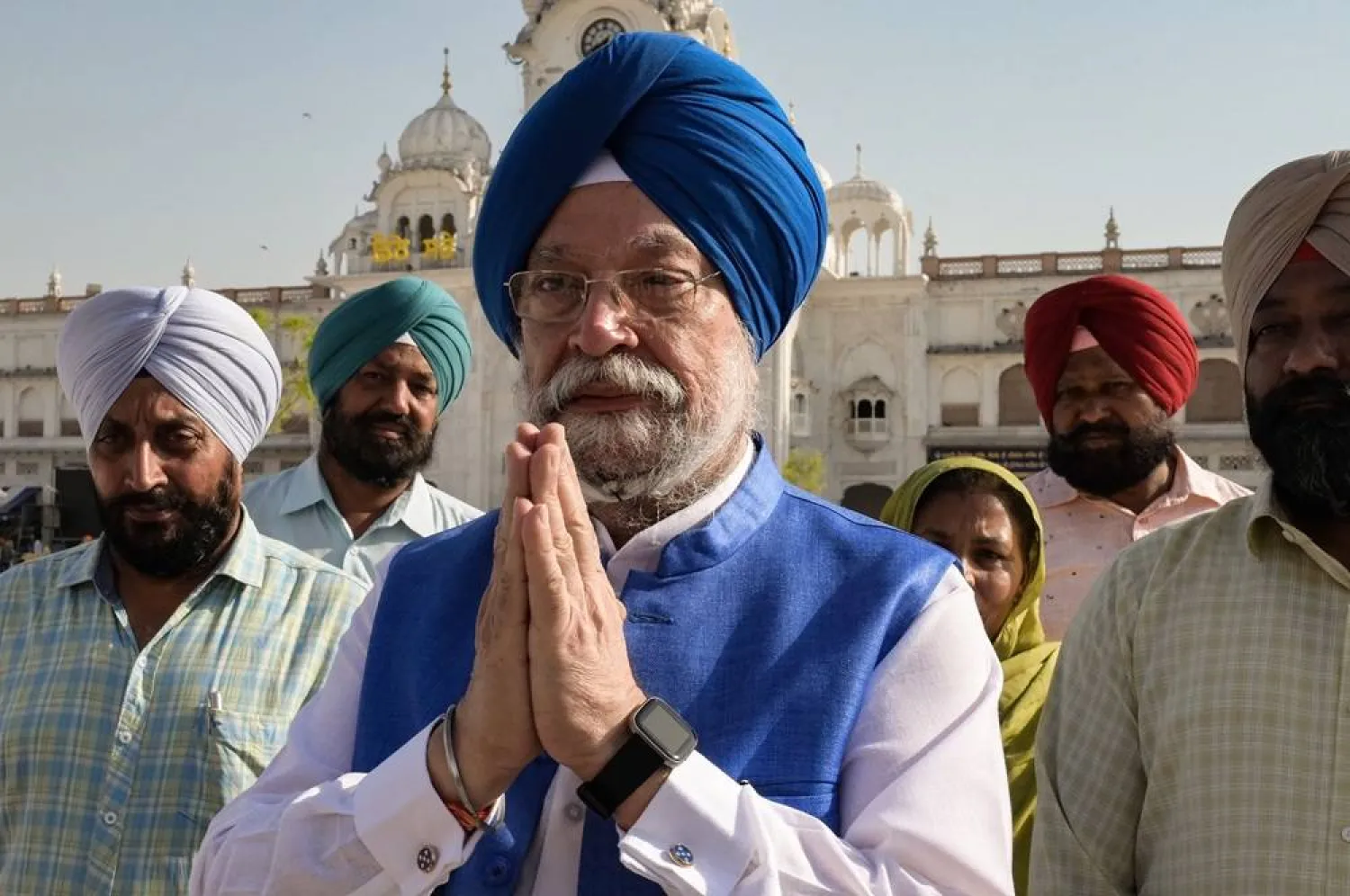
Minister of Petroleum and Natural Gas Hardeep Singh Puri (C) gestures during his visit at the Golden temple in Amritsar on May 15, 2023. (AFP)
TT

India Eyes Oil Exploration Expansion After Middle East War Shortages

Minister of Petroleum and Natural Gas Hardeep Singh Puri (C) gestures during his visit at the Golden temple in Amritsar on May 15, 2023. (AFP)

Hit by the biggest energy supply shock in decades during the Middle East war, import-dependent India is expanding domestic crude exploration, its oil minister says.

India, the world's third-largest importer of oil and the second-largest buyer of liquefied petroleum gas, faced major disruptions due to restrictions on the Strait of Hormuz during the conflict between the United States and Iran.

With a temporary US-Iran deal in place to pause hostilities, oil and gas shipments are flowing through the Gulf waterway again, and restrictions and price hikes in India are being rolled back.

But Minister of Petroleum and Natural Gas Hardeep Singh Puri said the energy crunch provided fresh impetus for India's expansion of domestic supplies.

"We are currently in the process... to bid out about 250,000 square kilometers (96,500 square miles) of unexplored area," Puri told AFP.

India is a modest producer in global terms.

Domestic crude production in 2025-2026 was 25.98 million metric tons, according to the oil ministry.

That meets just 10 percent of India's crude needs, equivalent to roughly 522,000 barrels per day (bpd) -- a figure well below its production peak of just more than 900,000 bpd in 2011.

India survived the energy crunch by expanding its crude suppliers from 27 to 41 countries, including Iran, Venezuela, greater purchases from Russia and several African nations.

New Delhi has previously been criticized by both the United States and Europe for its purchase of Russian oil, with critics arguing that it bankrolled Moscow's war against Kyiv.

But Puri said India had a "pragmatic approach" that put its energy needs above "ideological considerations".

- 'Ocean of energy opportunities' -

The country's domestic crude production is concentrated in the west -- in its Mumbai offshore fields, Rajasthan and Gujarat -- as well as the northeastern state of Assam.

But Puri has hailed what he calls an "ocean of energy opportunities" off India's Andaman and Nicobar archipelago, an 800-kilometer-long (500-mile) chain of environmentally sensitive islands in the seas bordering Thailand and Indonesia.

The vast Andaman Basin is geologically similar to hydrocarbon-bearing basins in Southeast Asia.

Puri posted a video on social media in June of a gas flare at an exploratory well drilled in the Andaman Sea by state-owned Oil India.

"Large number of deepwater and ultra-deepwater exploration wells are planned in our offshore basins to fully exploit our hydrocarbon reserves," Puri said when he released the video.

New Delhi is working with "deepwater exploration experts" including Petrobras, TotalEnergies, BP, Shell and ExxonMobil, he said.

In the same Andaman Sea, India is readying a $9 billion Great Nicobar Island Project to build a megaport, airport and city, creating a strategic base on what is, for now, a far-flung island covered in pristine forests and home to one of Earth's most isolated peoples.

- 'Exceptionally bullish' -

The push pre-dates the Middle East war.

Hindu-nationalist Prime Minister Narendra Modi launched the "Samudra Manthan" mission during a speech marking Independence Day in August 2025.

The name refers to a central event in Hindu mythology meaning the "churning of the ocean".

"We want to work in a mission mode towards finding oil reserves, gas reserves under the sea and hence India is going to start the National Deep Water Exploration Mission," Modi said at the time.

But India's bid to reduce dependence faces challenges.

Domestic demand in the world's most populous nation of 1.4 billion people is growing rapidly -- even as the government vows to achieve carbon neutrality by 2070.

India is also ramping up investments in renewables, nuclear energy and blending petrol with ethanol.

"India's energy consumption today is growing at three times the pace compared to rest of the world," Puri said.

"It has jumped from five million barrels per day in 2021 to about 5.6 million barrels today, and would soon touch six million barrels per day, on the back of the robust economic and per capita income growth."

Puri said he was "exceptionally bullish" for the future.

"I am happy with the knowledge that our E+P (exploration & production) is going up and, believe me, it's going to rise very fast," Puri said.

He noted it was "a very capital intensive and time-consuming" process, but said he had high hopes.

"We are putting fiscal resources into oil and gas exploration in a very big way -- with a $10 billion program," he added.

"With it, we are going into one million kilometers of unexplored area."


Europe Can’t Afford to Miss AI Revolution, Says ECB Chief

European Central Bank President Christine Lagarde addresses a press conference following the ECB Governing Council meeting at the ECB headquarters in Frankfurt, Germany, July 23, 2026. (Reuters)
TT

Europe Can’t Afford to Miss AI Revolution, Says ECB Chief

European Central Bank President Christine Lagarde addresses a press conference following the ECB Governing Council meeting at the ECB headquarters in Frankfurt, Germany, July 23, 2026. (Reuters)

European Central Bank chief Christine Lagarde said Wednesday that the continent could not afford to miss out on the artificial intelligence revolution as the continent's growth model comes under increasing pressure.

The United States and China are seen leading the AI race, with their companies producing the most advanced large language models and rapidly building vast new data centers.

"Europe largely missed out on the first digital revolution, as the commercial gains from the spread of information and communication technologies were captured disproportionately elsewhere," Lagarde said at a World Economic Forum event in Geneva.

"We cannot afford to repeat that experience with artificial intelligence, the second digital revolution," she said.

While European companies are investing heavily in AI, barriers in the eurozone are hindering them from scaling up their operations, she said.

The "fragmentation" of EU markets means firms are not competing enough across the whole eurozone and also struggled to raise funds, particular when compared to US peers, Lagarde said.

"The result is fewer firms growing to global size and slower diffusion of new technologies across the economy."

She added that scale is particularly important for Europe to be able to compete in AI and other new technologies at a time when Europe's post-war growth model faces major challenges.

She noted that Europe had long benefitted from "three pillars" -- a rules-based global order underpinned by US security guarantees, cheap energy and expanding global trade.

"All three are weakening as the international environment changes," she said.

"These shifts suggest that Europe's post-war growth model is eroding. And it is unlikely to return to the form we once knew."

The return of US President Donald Trump to the White House, in particular, has shaken relations between the United States and Europe.

He has imposed hefty tariffs on European Union imports and questioned long-standing US commitments to the continent's security.


Trump Pauses 50% Tariffs on Canadian Goods for Three Days

This aerial view shows a Capital Southern Transportation, Inc. truck passing over the Peace Bridge between Canada and the US in Fort Erie, Ontario, on August 18, 2026. (AFP)
TT

Trump Pauses 50% Tariffs on Canadian Goods for Three Days

This aerial view shows a Capital Southern Transportation, Inc. truck passing over the Peace Bridge between Canada and the US in Fort Erie, Ontario, on August 18, 2026. (AFP)

US President Donald Trump paused the planned rollout of punishing new tariffs on Canadian goods late Tuesday, as both sides indicated they were close to a broader trade agreement after weeks of talks.

Trump announced the three-day reprieve from 50-percent duties on select goods just hours before a midnight deadline.

The delay was "based on the fact that Canada and the U.S.A., subject to the finalization of documents, have a DEAL!" Trump wrote on his Truth Social platform.

Canadian Prime Minister Mark Carney was less definitive, saying "substantial progress has been made" towards a comprehensive trade deal, but "there is important work still to be done."

Ottawa and Washington have held intense negotiations on revising their existing deal, the United States-Canada-Mexico Agreement (USMCA), which Trump signed and praised during his first term but now says needs to change.

The US Trade Representative's office said on X that the pact between Washington and Ottawa is set to "include comprehensive market access for all American goods, economic security commitments, digital trade alignment" and other provisions.

A proclamation by Trump to pause the duties added that the suspension came about as "Canada has expressed a commitment to remove the discriminations or unreasonable and unequal impositions at issue."

Carney said the prospective deal aims to "address outstanding trade issues and deliver greater certainty and real benefits for Canadian businesses, workers, farmers and families."

- 'Discriminatory treatment' -

Trump had signed orders for the 50-percent duties last month, with the White House alleging "discriminatory treatment" by Canada against US automobile and dairy products.

The new tariffs would cover products such as wine, hockey sticks and cement.

They target around 5.5 percent of Canada's exports to the United States, worth about $20 billion, Oxford Economics estimates.

While this only poses a "modest" negative risk to Canada's economy, Oxford Economics said in a recent report that the duties would "affect central Canada's manufacturing sector much more severely."

Canadian negotiators have been in Washington to push for a deal to avoid the new tariffs and also secure relief on Trump's sector-specific duties, which have battered Canada's auto, steel, lumber and aluminum industries.

Ottawa reportedly offered concessions like pressuring provinces to put some US beverages back on their shelves.

Without going into details, Trump added in his Truth Social post: "The great Keystone XL Pipeline, long ago killed by Sleepy Joe Biden, may be awoken from the grave!"

Trump has previously called for the revival of the controversial project opposed by environmental activists, which was blocked under his predecessor Biden.

- Political concerns -

"It's not unusual for a trade negotiation to go right up to the deadline," former US commerce official Christopher Padilla told AFP.

He expects that the Trump administration threatened new tariffs to try and win early concessions from Canada as the countries negotiate new terms for the USMCA.

Oxford Economics anticipates that manufacturers who stand to be most impacted include those in the cement, paper, printing, wood, clothing and electronic equipment sectors.

With the US Supreme Court striking down many of Trump's global tariffs earlier this year, the president had tapped an untested legal provision for the new duties targeting Canada.

The US duties will not apply to Canadian energy, potash or goods already facing sector-specific tariffs, but are set to hit products covered by the USMCA.

Trump's trade envoy Jamieson Greer previously said the tariffs aimed to "hold Canada accountable" for its retaliation against the United States.


Oil Extends Climb on Prolonged Hormuz Export Uncertainty

An automated oil drilling rig operated by ExxonMobil in Midland, Texas, US, August 17, 2026. REUTERS/Sheila Dang
TT

Oil Extends Climb on Prolonged Hormuz Export Uncertainty

An automated oil drilling rig operated by ExxonMobil in Midland, Texas, US, August 17, 2026. REUTERS/Sheila Dang

Oil prices climbed for a fourth straight day on Wednesday as investors weighed conflicting messages from Tehran and Washington on whether the Strait of Hormuz is open to ships.

Brent crude futures climbed 69 cents, or 0.8%, to $91.71 by 0415 GMT, while US West Texas Intermediate crude futures were up 76 cents, or 0.9%, to $85.70 a barrel, Reuters reported.

Both contracts closed on Tuesday at their highest in more than three weeks as hopes of peace between the US and Iran faded.

US President Donald Trump said on Tuesday no talks were taking place with Iran ⁠and insisted the ⁠Strait of Hormuz was open, contradicting Iran's assertion that the critical waterway remained shut to shipping.

A temporary ceasefire agreement expired on Monday and a senior Iranian official told Reuters that his country was moving to a "fully offensive" military posture due to the diplomatic stalemate, though there were no reports of fresh strikes by either side on Tuesday.

"The shipping risks are increasing again as attacks from Iran ⁠and Houthis remain prevalent in both key chokepoints, keeping oil prices supported in the near term," said June Goh, senior oil market analyst at Sparta Commodities, referring to the Strait of Hormuz and Bab el-Mandeb strait.

Shipping through Hormuz slowed, data showed on Wednesday, as most shipowners avoided the key waterway due to a lack of clear signaling on its reopening from a blockade.

"However, Gulf producers are finding alternative export routes to bring oil out to the Gulf of Oman," said Goh. "If sustainable, this could help increase shut-in production from these two producers."

To avoid the Strait of Hormuz, Iraq's cabinet approved mechanisms for exporting Iraqi ⁠crude through specialized international ⁠and local companies and via multiple export outlets, the government said on Tuesday.

The contracts under the new mechanism will run for three months starting September 1, according to a statement issued after the cabinet meeting.

In the US, crude oil and distillate inventories fell, while gasoline stocks rose last week, market sources said, citing data from the American Petroleum Institute.

Official inventory numbers from the US Energy Information Administration are due at 10:30 a.m. ET (1430 GMT), with analysts polled by Reuters expecting crude stocks fell by about 600,000 barrels in the week ended August 14.