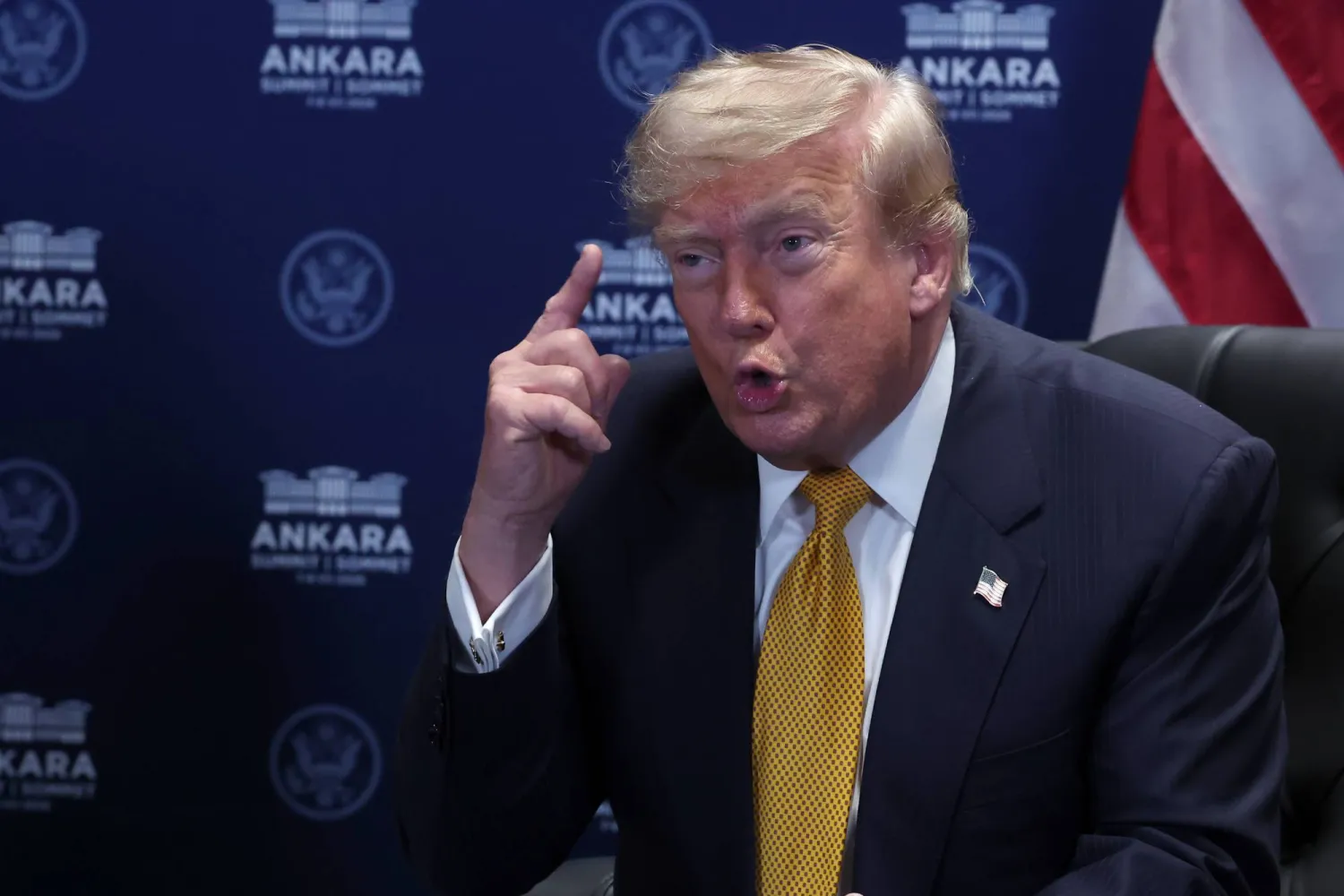
Trump Says he Ordered Cutting Off All Trade with Spain

US President Donald Trump speaks during a meeting with NATO Secretary General Mark Rutte (not pictured) on the sidelines of the NATO summit in Ankara, Türkiye, 08 July 2026. EPA/FILIP SINGER / POOL
TT

Trump Says he Ordered Cutting Off All Trade with Spain

US President Donald Trump speaks during a meeting with NATO Secretary General Mark Rutte (not pictured) on the sidelines of the NATO summit in Ankara, Türkiye, 08 July 2026. EPA/FILIP SINGER / POOL

US President Donald Trump said on Wednesday he had ordered his Treasury Secretary ⁠Scott Bessent to cut ⁠off all trade with Spain, ⁠calling Madrid a "terrible partner" in NATO.

Trump was speaking alongside NATO Secretary General Mark Rutte ahead of ⁠an alliance ⁠summit in Ankara.

New figures released by NATO on Tuesday showed that Slovenia, Belgium, Spain and the Czech Republic could be in hot water with the Trump administration as they struggle to meet the alliance’s old target of investing 2% of their GDP.

The Trump administration wants to see a more lean and lethal “NATO 3.0,” with Europe taking responsibility for its own security, including Ukraine, with conventional weapons while America would continue to provide its nuclear umbrella.

However, European allies and Canada are still seeking clarity on just how deeply Trump intends to cut US force numbers in Europe.


Alswaha at LEAP East: Saudi Arabia is Global Hub Connecting AI Ecosystem Between East, West

Minister of Communications and Information Technology Abdullah Alswaha. SPA
TT

Alswaha at LEAP East: Saudi Arabia is Global Hub Connecting AI Ecosystem Between East, West

Minister of Communications and Information Technology Abdullah Alswaha. SPA

Minister of Communications and Information Technology Abdullah Alswaha affirmed that under the Saudi leadership, the Kingdom is advancing toward building one of the world’s most accessible and AI-ready digital infrastructures, reinforcing its position as a trusted partner in enabling the digital economy and connecting the East and the West.

Speaking at the opening of LEAP East 2026 in Hong Kong, Alswaha noted that LEAP, which was launched in Riyadh five years ago, has evolved into a global technology movement that has generated a multiplier effect not only across the Kingdom and the region but around the world.

He added that LEAP’s expansion to the East reflects the region’s growing importance as a global hub for shaping the future of technology and artificial intelligence.

The minister highlighted that the East today represents a $34 trillion economy, accounting for nearly 30% of global GDP, with a $10 trillion digital economy and a population of 3.7 billion people, representing approximately 46% of the world’s population.

He emphasized that the East offers not only scale but is also building the very foundation of the artificial intelligence age.

He further noted that 82% of the world’s AI patents originate from the East, while the region accounts for 60% of the global semiconductor market and 90% of advanced chip manufacturing, making it a global powerhouse for computing and artificial intelligence.

Alswaha also highlighted Saudi Arabia’s achievements over the past several years, noting that the Kingdom’s digital economy has grown by 75% in the past eight years to reach $139 billion.

The contribution of the non-oil digital economy to GDP has increased to 16%, while the Kingdom’s operational data center capacity has reached 467 MW, representing 47% of the total data center capacity across the Middle East and North Africa.

He emphasized that the empowerment of Saudi women represents one of the Kingdom’s greatest global success stories.

Women’s participation in the ICT workforce has increased from 7% to 35%, surpassing the averages of both the European Union and Silicon Valley, while Saudi women now rank among the world’s leaders in AI participation and empowerment.

On digital infrastructure, Alswaha emphasized that Saudi Arabia is building 6.9 GW of data center capacity by 2034, including 3 GW by 2030, supported by 12.8 GW of available power capacity today.

This positions the Kingdom among the fastest countries globally in providing power for computing and AI infrastructure projects.

Concluding his remarks, the minister stated that Saudi Arabia brings together the three essential pillars for success in the AI era—compute, customers, and capital—adding that leading global companies from the East have already begun investing and expanding in the Kingdom, including ByteDance, Lenovo, and Tencent.


UN: AI Boom Drives Intangible Investment to Record Level

FILE PHOTO: An AI sign is seen at the World Artificial Intelligence Conference in Shanghai, China July 6, 2023. REUTERS/Aly Song/File Photo
TT

UN: AI Boom Drives Intangible Investment to Record Level

FILE PHOTO: An AI sign is seen at the World Artificial Intelligence Conference in Shanghai, China July 6, 2023. REUTERS/Aly Song/File Photo

The AI boom has helped drive investments in intangible assets such as software, data and research to a record high in 2025, the United Nations' patent and innovation agency said Wednesday.

These investments, which encompass research and development, software and data, brands, design and organizational know-how, represent a large and growing share of the global economy, the World Intellectual Property Organization said.

Across the 29 economies studied, which account for 57 percent of global GDP, intangible investment "reached an all-time high" of over $10 trillion in 2025, according to WIPO.

The study included the United States, EU nations, Britain, Japan, India as well as other countries. However, China, the world's second-largest economy, was not among the nations covered.

The record figure was detailed in the World Intangible Investment Highlights 2026, which WIPO co-published with the Rome-headquartered Luiss Business School.

Since 2008, intangible investment has grown by 3.5 percent annually in real terms; way ahead of tangible investments, which saw annual growth of just 0.98 percent over the same period, the study said.

"These figures point to a durable structural shift in the composition of investment, with intangible assets playing a growing role in value creation," WIPO said.

The United States accounts for the largest share of intangible investment by far, reaching nearly $5 trillion in 2025.

This was around six times the level in second-placed Japan, with Germany third.

Sweden retains its position as the most intangible-intensive economy, reaching 17.4 percent of GDP in 2025, followed by the United States at 15.6 percent and France at 15.2 percent.

Meanwhile India, Japan and the Philippines recorded the fastest growth, said WIPO.

The report said intangible investments proved more resilient than tangible ones in the face of high interest rates, trade tensions and the economic slowdown seen in recent years.

Between 2020 and 2025, they grew by 5.5 percent annually in real terms, compared to 3.2 percent for tangible investments.

The report said artificial intelligence was playing a major role in the transformation.

While it initially drives physical investments in data centers, semiconductors and energy infrastructure, WIPO estimates that its lasting impact stems primarily from investments in software, data, research and development, and corporate reorganization.

Investment in software and databases recorded the highest aggregate real growth rate across all intangible asset categories between 2013 and 2023, at 7.3 percent annually, ahead of organizational capital (4.9 percent) and brands (4.4 percent).

According to AFP, the report also highlights the economic importance of brands, with investments across the 29 economies reaching $1.4 trillion in 2025.

The US leads global brand investment by a wide margin, exceeding $566 billion in 2025 -- more than four times the figure for Britain, in second place on $137 billion, followed by Japan on $112 billion.

Established in 1967, Geneva-based WIPO helps creators and entrepreneurs protect their intellectual property across borders.


S&P: Resilient GCC Economies to Support Recovery Despite Prolonged Geopolitical Uncertainty

A view of Riyadh, Saudi Arabia. (Reuters file)
TT

S&P: Resilient GCC Economies to Support Recovery Despite Prolonged Geopolitical Uncertainty

A view of Riyadh, Saudi Arabia. (Reuters file)

The economies of Gulf Cooperation Council (GCC) are based on strong foundations that enhance their ability to overcome the fallout of the Middle East war, supported by robust net asset positions and liquidity buffers despite prolonged geopolitical uncertainty, Standard & Poor’s Global Ratings said in a recent report.

The rating agency projected a temporary slowdown in GCC growth in 2026 before the region's economies regain strong recovery in 2027, with countries and economic sectors' ability to absorb shocks according to their financial and geographical conditions.

In its report “Middle East War: GCC Sensitivity and Sector Vulnerabilities Aren't Homogenous”, S&P said outlooks on GCC sovereign ratings are stable supported by expectation that large, liquid government assets will absorb fiscal shocks and that hydrocarbon exports will resume amid supportive prices

“We anticipate a pronounced dip in GDP growth in 2026 followed by a strong recovery, with average real GDP growth of about 5.3% in 2027,” the agency wrote.

Gradual recovery of energy supplies

S&P Global Ratings' base case assumes that supply disruptions in the Strait of Hormuz will ease in the second half of 2026.

“We expect oil shipments during that period will average about 75% of the pre-war volumes and that Brent crude will average $110 per barrel (/bbl) for the remainder of 2026 and $80/bbl for 2027,” the report said.

It expected the GCC region's real GDP to fall 3% on average in 2026, with Saudi Arabia (2.6%) and Oman (1.6%) and UAE (1.5%) projected to grow.

Ability to recover differs

S&P said four of the six GCC sovereigns' net assets exceed annual GDP.

It said sovereigns, such as the UAE, Saudi Arabia, Kuwait, and Qatar, display greater capacity for resilience than Bahrain and Oman, though Oman stands to benefit further from its geography outside the Strait of Hormuz.

The agency added that Saudi Arabia's and Oman's geographic advantages will likely continue to offer benefits extending beyond hydrocarbons, with maritime and logistical disruption weighing more on other GCC countries' trade, manufacturing, real estate, and hospitality.

Oil production exceeds pre-war levels

S&P forecasted that between 2027 and 2029, GCC oil production will exceed pre-war levels.

During this period, Saudi Arabia's oil production will increase to an average of 10.6 million barrels per day (bpd) while the UAE’s production will increase to 4.5 million bpd.

“We expect regional pre-war production levels will be exceeded as Qatar’s North Field East expansion starts producing with the first train expected to come on stream in early 2027,” the report added.

Resilience of GCC banks

In the banking sector, S&P said despite uneven external risks across the region, “we consider GCC banks' credit quality to be stable, supported by deposit growth that offers funding stability and solid capital buffers that mitigate risks from potentially weaker asset quality.”

In the first quarter of 2026, it said total domestic deposits rose by about 4.2% in the GCC region, slightly accelerating to 6.2% year-to date to April-end.

Domestic private sector deposit growth remained on par with 2025, at about 11.6% annualized at the end of April 2026, supported by a strong pick-up in Saudi Arabia.

In a scenario involving external funding outflows--assuming 50% external bank funding and 30% non-bank funding outflows, the rating agency said some banks would likely require support of about $1.2 billion and $5.8 billion, respectively, based on the first quarter 2026 financial data.

Energy and real estate more vulnerable

S&P said the conflict will weigh heaviest on sectors reliant on tourism, consumer spending, transportation and logistics and energy.

It said regional uncertainty could negatively affect high-net-worth investors' decisions, leading to weak transaction volumes, particularly in the apartments segment given the potential for oversupply.

Conversely, utilities, telecommunications, and healthcare continue to demonstrate resilience, supported by defensive business models and relatively stable demand.

Redirecting investment

S&P said the prolonged geopolitical fragmentation, intermittent regional clashes, and the failure to normalize trade flows through key routes like the Strait of Hormuz would be a sustained erosion of business confidence, investment appetite, and cross-border capital flows.

The next phase of GCC corporate credit differentiation will be shaped less by balance sheet strength alone, and more by companies' ability to sustain confidence, investment, and economic diversification amid prolonged uncertainty.