


Saudi Integration of Energy, Industry, and Mining Aims to Maximize National Wealth

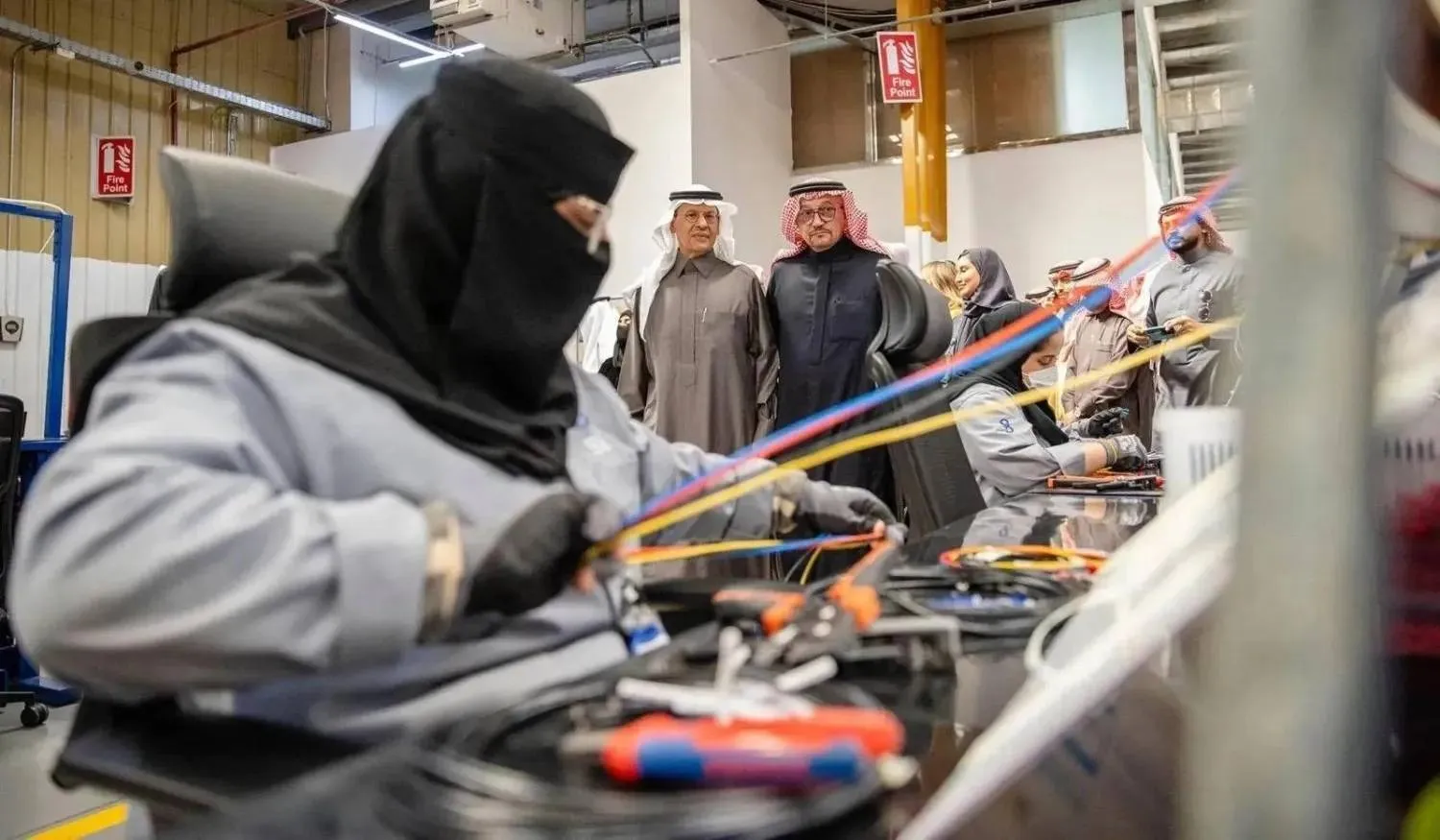
Saudi Energy Minister Prince Abdulaziz bin Salman visits a national factory in the capital Riyadh. (SPA)
TT

Saudi Integration of Energy, Industry, and Mining Aims to Maximize National Wealth

Saudi Energy Minister Prince Abdulaziz bin Salman visits a national factory in the capital Riyadh. (SPA)

The appointment of Prince Abdulaziz bin Salman as Saudi Arabia’s minister of industry and mineral resources, while retaining the energy portfolio, reflects a strategic push to strengthen integration among three of the Kingdom’s most important economic sectors. Analysts say placing energy, industry, and mining under a single ministry could accelerate policy coordination, strengthen domestic value chains, and advance the goals of Vision 2030 by diversifying the economy and maximizing the value of national resources.

The move stems from the close interdependence of the three sectors, which form an integrated chain - from energy production and mineral extraction to industrial manufacturing that transforms natural resources into higher-value products. Greater coordination is expected to enhance Saudi Arabia’s competitiveness, improve the efficiency of resource investment, and support a more diversified and sustainable industrial base.

Experts told Asharq Al-Awsat that the restructuring marks a new phase in implementing national strategies. They noted that the industrial sector has undergone major transformation since the Ministry of Industry and Mineral Resources was established as an independent entity and the National Industrial Strategy was launched. Bringing the Kingdom’s key economic portfolios together, they said, will better align policies and reinforce value chains in line with Vision 2030.

Economic diversification

said Saudi Arabia’s economic transformation since the launch of Vision 2030 has been guided by successive strategies culminating in the broader objective of economic diversification and increasing the contribution of key sectors to GDP.

According to Al-Buainain, the initial phases focused on building the legislative framework, developing a roadmap to achieve strategic goals, and moving into implementation, which has already delivered several targets ahead of schedule.

He credited former Minister of Industry and Mineral Resources Bandar Alkhorayef with leading major legislative, regulatory, and executive reforms, saying he left the ministry “at the peak of its performance” after achieving its objectives.

Integrated value chains

Al-Buainain said integrating the three portfolios is expected to accelerate implementation of the National Industrial and Mining Strategy, particularly in the mining sector, which has significant potential to expand its contribution to the economy. He added that the sector requires bold decisions to accelerate progress toward Vision 2030, especially its economic diversification objectives.

He also stressed the importance of integrating economic value chains under unified decision-making. Linking the mining and energy portfolios, he said, would strengthen Saudi Arabia’s hand in attracting foreign investment by enabling it to combine highly sought-after investment opportunities with less sought-after ones, creating deal structures that maximize benefits for the Kingdom.

Economic analyst Ahmed Al-Shehri said the appointment carries significant economic implications. Energy is the primary input for industry, mining provides the raw materials, and manufacturing converts them into value-added products, he said. Bringing all three sectors under one umbrella would therefore facilitate integrated planning instead of managing each independently.

Al-Shehri added that the move would also boost local value creation by shifting policy away from exporting raw materials toward developing advanced domestic industries, increasing economic returns and creating high-skilled jobs.

He said unified policymaking would improve investment efficiency by reducing complexity and providing greater clarity for investors. Ultimately, he argued, integrating energy, industry, and mining will accelerate economic diversification by supporting Saudi Arabia’s transition from a resource-exporting economy to one driven by manufacturing and industrial production.




Asian Shares Mostly Fall After S&P 500 Drops 3.7% into a Correction

A currency dealer works in front of an electronic board displaying the Korea Composite Stock Price Index (KOSPI), the Korea Securities Dealers Automated Quotations (KOSDAQ) and the exchange rate between the US dollar and South Korean won at the dealing room of a bank in Seoul, South Korea, November 23, 2026. (Reuters)
TT

Asian Shares Mostly Fall After S&P 500 Drops 3.7% into a Correction

A currency dealer works in front of an electronic board displaying the Korea Composite Stock Price Index (KOSPI), the Korea Securities Dealers Automated Quotations (KOSDAQ) and the exchange rate between the US dollar and South Korean won at the dealing room of a bank in Seoul, South Korea, November 23, 2026. (Reuters)

Asian shares were mostly lower Monday after a brutal sell-off of artificial intelligence stocks pulled the S&P 500 down 3.7% on Friday.

The Kospi in South Korea fell 5.8% to 4,586.80. Shares in Samsung Electronics Corp. lost 5.5%, while SK Hynix fell 4.9%.

Markets in Tokyo were closed for a holiday.

In Hong Kong, the Hang Seng lost 1.8% to 22,015.86, while the Shanghai Composite index declined 1.4% to 3,484.53.

Taiwan's Taiex lost 0.6%.

Australia's S&P/ASX 200 edged 0.1% lower to 8,589.10.

The future for the S&P 500 was up 1.9% early Monday, while the futures contract for the Dow Jones Industrial Average gained 1.6%.

After Friday’s decline, the S&P 500 is now in what professional investors call a “correction,” having fallen more than 10% from its Oct. 6 all-time high. The Nasdaq composite, which is heavily influenced by tech stocks, slumped 5.3%, pulling it into negative territory for the year. The Dow fell 1.9%.

The last time the S&P 500 had a correction was in March 2025, as the Trump administration’s trade war rattled markets.

Chip stocks like Nvidia, Micron Technology, Broadcom and Advanced Micro Devices bore the brunt of the selling, but other companies connected to the AI buildout tanked as well, including the optical products company Corning and the energy provider Bloom Energy. The AI lab Anthropic, coming off a successful IPO Thursday, tumbled 8.5%.

The AI trade has been losing steam partly over worries that AI stocks’ big market values and heavy spending are unjustified.

Nvidia, considered by many to be the poster child for the AI boom, fell for the ninth day in the past 10, closing 14% lower.

The chip company’s stock was caught up in the market’s anxiety about the strength of the AI buildout and more recently has been pressured by worries about its future following the sudden downfall of Jensen Huang, its former CEO and co-founder. Since the Huang scandal erupted earlier this month, the stock has dropped more than 30%.

Thursday's big market debut for Anthropic, maker of the Claude AI tool, fizzled Friday with the rest of the tech sector. The stock fell 8.5% to $88.91 but remains above its IPO price of $83 per share. It was the biggest public stock offering ever, at one point surpassing $2 trillion in value.

Anthropic’s share price drop Friday amounts to a roughly 23% decline from its brief peak of $115.10 a share set the day prior.

While the stock market’s mood has soured, the sentiment among US consumers appears to have brightened, a reversal of the dynamic seen earlier this year.

The University of Michigan’s latest index of consumer sentiment rose sharply compared to October, coming in slightly ahead of economists’ expectations. Consumers noted some relief from easing gas prices and improved expectations for business conditions following the midterm elections. Still, sentiment remains below where it was in February, before the start of the US war with Iran.

In other dealings early Monday, Brent crude oil, the international standard, lost 0.5% to $92.10 per barrel. US benchmark crude oil slipped 0.3% to $83.13 per barrel.

The US dollar rose to 158.88 Japanese yen from 158.62 yen. The euro climbed to $1.10987 from $1.10973.


Gold Rises from 14-Month Low as Markets Await Key US Inflation Data

Customers check ornaments at a jewelry showroom in Mumbai, India November 2, 2021. (Reuters)
TT

Gold Rises from 14-Month Low as Markets Await Key US Inflation Data

Customers check ornaments at a jewelry showroom in Mumbai, India November 2, 2021. (Reuters)

Gold regained some ground on Monday after falling to a 14-month low last week, with investors weighing the deep selloff in US equities against upcoming US inflation data for fresh clues on the trajectory of interest rates.

Spot gold climbed 2.4% to $3,616.51 per ounce by 0530 GMT. Bullion fell about 9% last week, its steepest weekly decline ‌since March.

US ‌gold futures gained 2.9% to $3,616.60.

"The selloff in ‌tech ⁠stocks and the ⁠expectations of weaker economic activity because of the weaker AI boom have led the markets to reprice the path forward for US interest rates, which has provided gold with some fundamental support," said Kyle Rodda, senior financial market analyst at Capital.com.

Traders are currently pricing in a 93.5% chance of a rate hike ⁠at the Fed's policy meeting in December, down ‌from about a 100% probability last ‌week, according to CME's FedWatch tool.

Lower odds of higher rates ‌reduce the opportunity cost of holding bullion, enhancing the appeal ‌of the non-yielding asset.

"Despite a modest rebound in early trading today, we still need to be cautious to call a bottom in gold. We also cannot rule out further forced liquidation if volatility in ‌equity markets persists," said Dilin Wu, research strategist at Pepperstone.

US stock futures rose while authorities scrambled ⁠to shore up ⁠sliding stock markets in Asia, after a wipeout last week for the tech and chip stocks at the center of the AI boom.

Fed Governor Lisa Cook made a case for more rate hikes on Friday, saying the Fed's current policy rate was not high enough to deal with inflation levels she viewed with "great concern."

Market participants now await the US Personal Consumption Expenditures data due on Wednesday, a key gauge closely watched by the central bank as it targets a 2% inflation rate.

Spot silver climbed 3% to $42.41 per ounce, platinum gained 1.2% to $1,314.85 and palladium rose 1.2% to $903.15.


Arabian Drilling Signs $400 Million Deal for Two Offshore Vessels in Khafji

An Arabian Drilling Company offshore platform. (Arabian Drilling Company)
TT

Arabian Drilling Signs $400 Million Deal for Two Offshore Vessels in Khafji

An Arabian Drilling Company offshore platform. (Arabian Drilling Company)

Arabian Drilling Company said it signed a new long-term contract with Khafji Joint Operations (KJO) worth 1.5 billion Saudi riyals ($400 million) to provide and operate two self-propelled offshore vessels.

The contract replaces two existing offshore service vessel contracts and lifts Arabian Drilling’s backlog to a record of around SAR 18.5 billion, the company said in a statement to the Saudi stock exchange, Tadawul.

The first platform runs on a 10-year term starting in the fourth quarter of 2026. The second will operate under a 15-year contract and is expected to begin operations in the fourth quarter of 2028.

The contract is expected to contribute to the company’s financial results starting when each vessel becomes operational, the statement added.

Al Khafji Joint Operations is a joint venture between Kuwait Gulf Oil Company and Aramco Gulf Operations Company of Saudi Arabia. Its objective is to conduct onshore and offshore activities related to the exploration, drilling and production of oil and gas in the Divided Zone.
