


Oil Extends Gains after Latest US Strikes, Tech Suffers More Losses

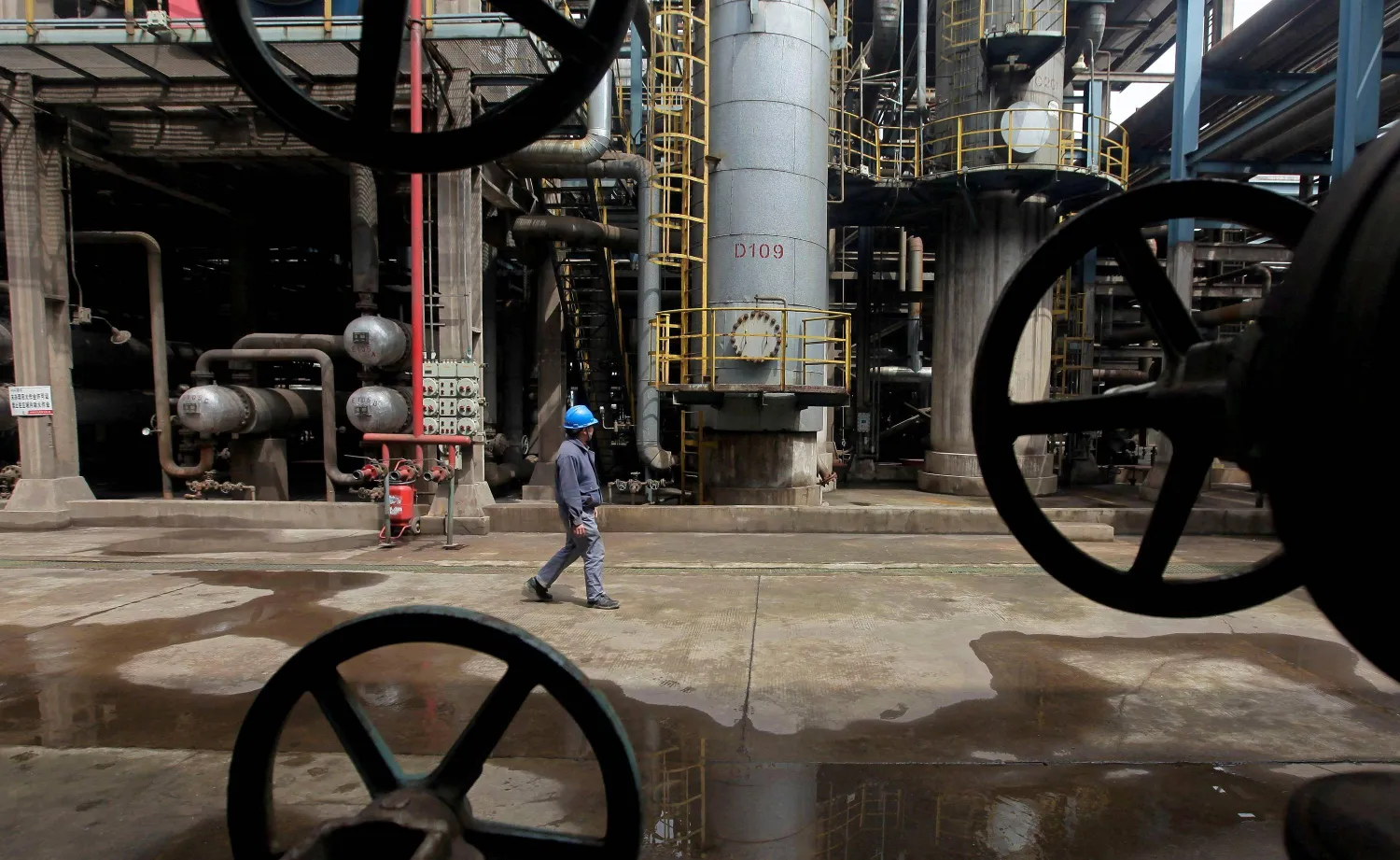
FILE PHOTO: A worker walks past oil pipes at a refinery in Wuhan, Hubei province March 23, 2012.   REUTERS/Stringer/File Photo/File Photo
FILE PHOTO: A worker walks past oil pipes at a refinery in Wuhan, Hubei province March 23, 2012. REUTERS/Stringer/File Photo/File Photo
TT

Oil Extends Gains after Latest US Strikes, Tech Suffers More Losses

FILE PHOTO: A worker walks past oil pipes at a refinery in Wuhan, Hubei province March 23, 2012.   REUTERS/Stringer/File Photo/File Photo
FILE PHOTO: A worker walks past oil pipes at a refinery in Wuhan, Hubei province March 23, 2012. REUTERS/Stringer/File Photo/File Photo

Oil prices jumped and stocks fell again Tuesday after fresh US strikes against Iran that marked a new escalation in hostilities that has fueled fears over their already fragile truce and the chances of another spike in inflation.

Tech firms were once again in the crosshairs, with South Korea's Kospi extending a painful selloff as chip titan SK hynix continued to be routed amid growing fears about the AI boom.

The latest attacks came after Iranian forces struck a commercial ship in the Strait of Hormuz -- through which a fifth of global oil passes -- early Sunday, before announcing the closure of the waterway.

That led to a series of US strikes on sites in the Iranian republic, which replied by hitting targets in Bahrain, Jordan, Kuwait and Oman.

Before the latest US attacks, President Donald Trump told conservative radio host Hugh Hewitt on Monday that "we're going to hit them very hard tonight, and we're going to hit them hard tomorrow".

He later declared on Truth Social that the United States would be "known as 'THE GUARDIAN OF THE HORMUZ STRAIT'" and levy a 20 percent fee on all cargo shipped through the waterway.

While Iran's ports would again be blockaded, Trump said "all other countries will have fair and open use of the strait".

However, he also said a deal with Tehran to end the crisis was still possible.

"Yeah, I think a deal is possible. Sure, I do," he told reporters in the Oval Office. "We had a deal with them two days ago and then they said 'Oh we can't make that deal. We have to negotiate it further.'"

Oil prices shot up more than nine percent Monday over fears of renewed conflict and the possibility that a fresh surge in inflation could force the Federal Reserve and other central banks to hike interest rates soon.

And they continued to rise Tuesday, piling on more than one percent.

"With Trump, one never quite knows how seriously to take such pronouncements, but Gulf allies would not be pleased with this plan, and it almost certainly violates international law," said BNZ's Jason Wong.

"The 20 percent levy would add about $16 to the cost of every barrel of oil passing through the strait on a typical supertanker.

"It remains to be seen whether the plan will stick -- probably not -- and whether it is merely a negotiating tactic aimed at getting Iran to pause its military strikes on shipping in the area."

The renewed hostilities once again dragged on equities, compounding the flight from tech firms that has characterized markets in recent weeks as traders worry that the sector's AI-led rally has gone too far.

Seoul again suffered heavy selling, with SK hynix shedding more than three percent, the day after a 15 percent collapse. Its New York-listed shares -- which soared more than 13 percent on their debut Friday -- plunged more than nine percent Monday.

Tokyo, Hong Kong, Sydney, Singapore, Taipei, Wellington, Manila and Jakarta were also sharply down.

The losses came at the start of a big week for traders, with earnings season about to kick off, Fed boss Kevin Warsh due to testify in Congress and US inflation data set to be released.

Meanwhile, Fed governor Christopher Waller stoked concerns over an early interest rate hike as inflation continues to remain elevated.

"If we get another hot reading on core inflation this week, then the (rate-setting committee) will need to consider tightening monetary policy in the near term," he said Monday.



Data Centers Open New Avenue for Localizing Saudi Cooling Industry

Nabil Shahin discusses standards developed by the US-based Air-Conditioning, Heating, and Refrigeration Institute (AHRI). (LinkedIn) 
TT

Data Centers Open New Avenue for Localizing Saudi Cooling Industry

Nabil Shahin discusses standards developed by the US-based Air-Conditioning, Heating, and Refrigeration Institute (AHRI). (LinkedIn) 

From buildings and megaprojects to data centers, demand for air-conditioning and cooling solutions is expanding across Saudi Arabia, driven by rapid construction and accelerating investment in digital infrastructure.

As artificial intelligence and cloud computing enter a period of rapid expansion, data centers are emerging as a new growth driver for the cooling industry, requiring advanced levels of efficiency and reliability and equipment capable of operating under harsh climatic conditions.

The boom extends beyond Saudi Arabia. Globally, the cooling industry is expanding as temperatures rise and demand for data centers grows. The International Energy Agency estimates that global electricity demand for building cooling has risen by about 50% since 2015 to around 2,900 terawatt-hours, while worldwide air-conditioner shipments reached about 200 million units in 2024.

Cooling buildings is placing increasing pressure on power grids, particularly during heat waves, while data centers and AI are adding another layer of demand for advanced cooling technologies.

Global data-center electricity consumption stood at around 415 TWh in 2024 and is projected to reach about 945 TWh by 2030, with cooling and environmental-control systems accounting for a significant share of energy use at these facilities.

The growth comes amid mounting pressure to improve air-conditioning efficiency and reduce its environmental impact. According to the UN Environment Program, global cooling demand could more than triple from current levels by 2050 under existing policies, making equipment efficiency and less energy-intensive technologies increasingly important.

These shifts offer Saudi Arabia an opportunity to expand its domestic air-conditioning and cooling manufacturing base as the Kingdom seeks to increase local content and meet more of its market needs through domestic production.

Nabil Shahin, managing director of the Middle East and North Africa office of the US-based Air-Conditioning, Heating, and Refrigeration Institute (AHRI), told Asharq Al-Awsat that Saudi Arabia accounts for more than half of the Gulf air-conditioning market. He attributed the market’s growth to expanding commercial and construction projects, alongside the boom in data centers.

Data Centers Reshape Cooling Market

The Kingdom is experiencing a “growth boom” in data centers, according to the AHRI executive, fueled by the rapid spread of AI and rising demand for cloud-computing services. He noted that several US and European companies are developing data-center projects in Saudi Arabia.

As their cooling requirements increase, AHRI is working with the Saudi Standards, Metrology and Quality Organization (SASO) to develop and modify standards for data-center equipment to reflect the Kingdom’s temperatures, climatic conditions and local requirements.

Saudi Standard for Evaporative Coolers

Shahin noted that SASO had asked AHRI to develop a new standard for evaporative cooling systems, locally known as “desert coolers,” which use water in the cooling process rather than the refrigerants used in conventional air-conditioning systems.

There is currently no unified global standard for such systems, he explained. AHRI is developing the standard for submission to SASO, with the aim of providing a reference for manufacturers in the Saudi market.

The new standard will include energy-efficiency measurement criteria to assess equipment performance and suitability for local conditions.

Improving air-conditioning efficiency is particularly important in Saudi Arabia because of the sector’s high electricity consumption. More efficient systems could reduce power demand and emissions associated with electricity generation.

Saudi Arabia Leads Gulf Market

The AHRI executive estimated Saudi Arabia’s share of the Gulf air-conditioning market at more than 50%, with demand continuing to rise alongside commercial and construction projects, particularly in Riyadh, coastal areas and Makkah.

Some estimates put the Kingdom’s share at about 60%, he noted, but he prefers the more conservative figure of over 50% because no verified official data precisely establish its market share.

The scale of demand has made Saudi Arabia attractive to international companies, several of which have expanded their presence over the past two years by establishing new factories or enlarging existing facilities.

Local manufacturing can give companies an additional advantage by reducing some import costs, which can range from 5% to 12%, according to Shahin. He pointed to three large domestic factories that are expanding their operations.

From Assembly to Component Manufacturing

Localization, however, still faces the challenge of dependence on imported components. Most key air-conditioning components — including electric motors, compressors, copper and refrigerants — continue to come from abroad.

Much of Saudi Arabia’s current manufacturing activity remains focused on assembly, although some components, including heat exchangers, are produced domestically.

The next step, the AHRI official argued, is to move gradually from assembly toward manufacturing a greater proportion of air-conditioning components in the Kingdom, including electronics, circuit boards and electric motors.

He called for additional government incentives and support, including land, industrial space, free zones and investment facilities, to help Saudi factories expand and increase the share of locally manufactured components.


Gold Slips on Rate-Hike Bets; Inflation Data in Focus

Gold jewelry is displayed at an exhibition in Kabul, Afghanistan, 03 September 2026. (EPA)
TT

Gold Slips on Rate-Hike Bets; Inflation Data in Focus

Gold jewelry is displayed at an exhibition in Kabul, Afghanistan, 03 September 2026. (EPA)

Gold slipped on Monday as strong US jobs data reinforced expectations for higher interest rates, while investors awaited key US inflation reports due later this week for further clarity on the Federal Reserve's policy path.

Spot gold was down 0.6% at $4,402.86 per ounce, as of 0420 GMT, after falling 1% on Friday.

US gold futures for December delivery were down 0.6% at $4,447.60.

Data ‌on Friday ‌showed US job growth accelerated sharply in August ‌while ⁠the unemployment rate ⁠held steady at 4.1%, suggesting an improvement in the labor market after recent struggles and keeping a rate increase this month on the table.

US producer price index (PPI) data is due on Thursday, followed by consumer price index (CPI) data on Friday.

"The jobs number delivered a clear upside surprise and put some pressure ⁠on the metal, but it wasn't a ‌complete slam dunk for a September ‌rate hike. The real missing piece of the puzzle arrives this ‌week with U.S. CPI," said Tim Waterer, chief market analyst ‌at KCM Trade.

"A strong inflation print would reinforce expectations of a Fed hike, lift yields further and weigh more heavily on gold."

Traders are pricing in a 58.4% chance of a rate hike ‌at the Fed's September 15-16 meeting, CME's FedWatch tool showed.

While gold is typically viewed as ⁠an inflation ⁠hedge, higher interest rates tend to weigh on the appeal of non-yielding bullion.

US President Donald Trump said on Friday that unless the Fed cuts interest rates, he would stop trading with countries with which the United States had a deficit.

On the Middle East front, Iran said it will step up efforts to tackle problems created by US sanctions that are crippling its economy, while a senior Iranian official warned of a "painful response" if it comes under further attack.

Among other metals, spot silver eased 0.6% to $65.80 per ounce, platinum lost 1.1% to $1,800.59 and palladium declined 0.5% to $1,394.00.


SEREDO 2026 Real Estate Expo Opens in Jeddah with Broad Participation

SEREDO 2026 real estate expo opens in Jeddah with broad participation. (SPA)
TT

SEREDO 2026 Real Estate Expo Opens in Jeddah with Broad Participation

SEREDO 2026 real estate expo opens in Jeddah with broad participation. (SPA)

Undersecretary of the Ministry of Municipalities and Housing for Stimulating Housing Supply and Real Estate Development Abdulrahman bin Abdullah Al-Tawil opened the fifth edition of the SEREDO Expo for Real Estate Development and Ownership 2026 at Jeddah Superdome.

Held under the ministry’s patronage, the event is bringing together government entities, real estate developers and financing companies, with broad participation from across the sector, the Saudi Press Agency reported on Sunday.

During the opening, Al-Tawil reviewed the key real estate and financing projects, products, and services offered by participating entities, as well as investment opportunities, solutions, and ownership options available to visitors and investors.

The expo brings together leading real estate entities and companies, providing a platform for industry stakeholders to connect, showcase their projects and products, and explore investment opportunities and ownership options available in the Saudi real estate market.

The opening ceremony also honored the event's patron, sponsors, and supporting partners in recognition of their contributions to SEREDO 2026 and their role in encouraging participation from across the real estate sector.

The exhibition runs through September 8, targeting real estate professionals, industry stakeholders, business leaders, and investors, as well as those interested in exploring projects and opportunities in real estate development, ownership, and investment.