

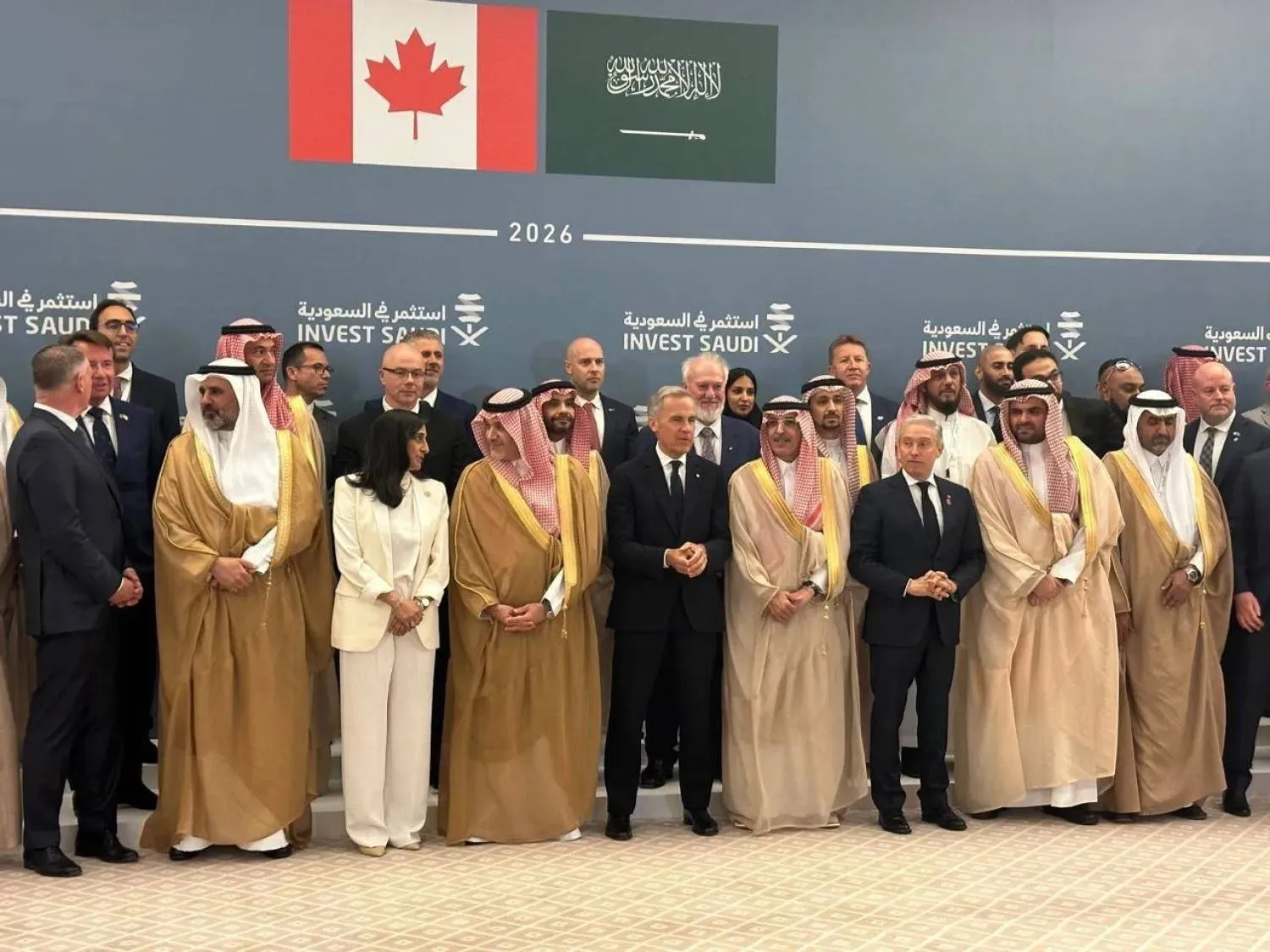

Critical Minerals Drive Billion-Dollar Saudi-Canadian Partnership

Saudi and Canadian officials attend the recent Saudi-Canadian Investment Forum in Jeddah. (Asharq Al-Awsat)
TT

Critical Minerals Drive Billion-Dollar Saudi-Canadian Partnership

Saudi and Canadian officials attend the recent Saudi-Canadian Investment Forum in Jeddah. (Asharq Al-Awsat)

Economic ties between Saudi Arabia and Canada are entering a new phase. After a year of intensified diplomatic and investment engagement, Prince Mohammed bin Salman, Saudi Crown Prince and Prime Minister, and Canadian Prime Minister Mark Carney launched a new strategic partnership focused on high-value, future-oriented sectors during official talks in Jeddah earlier this month.

The momentum was immediately reinforced by the signing of 15 agreements and memorandums of understanding at the Saudi-Canadian Investment Forum, laying the groundwork for broader cooperation that reflects both countries’ shared commitment to expanding economic ties.

The mining and critical minerals sector is expected to be the first major beneficiary. Canada offers abundant mineral resources and longstanding engineering expertise, while Saudi Arabia brings substantial industrial and investment capacity to develop its estimated $2.5 trillion in untapped mineral wealth.

The sector is expected to deliver the earliest returns from the newly signed agreements before expanding into energy, advanced technology and data centers, strengthening value chains and creating globally competitive industrial and investment opportunities.

Mohammed Nasser Al-Dulaim, chairman of the Saudi-Canadian Business Council, told Asharq Al-Awsat that more agreements will be announced “at the appropriate time” and that implementation of the signed deals would be closely monitored.

Both countries are planning an exchange of trade delegations and regular meetings between companies throughout this year and into 2027, he added.

His remarks echoed those of Canadian Minister of Energy and Natural Resources Tim Hodgson, who said deeper cooperation with Saudi Arabia - Canada’s largest trading partner in the region - is a cornerstone of Ottawa’s strategy to attract $500 billion in private investment and double non-US exports over the next decade.

Earlier this year, Canadian engineering firm Hatch signed a strategic agreement worth up to $700 million with Saudi mining company Maaden to develop its portfolio of gold, phosphate and aluminum projects.

Another partnership between Canada’s Northern Graphite and Saudi Arabia’s Obeikan Investment Group will establish an advanced battery anode materials processing plant in the Kingdom, helping secure and diversify clean energy supply chains.

Al-Dulaim said mining and critical minerals would form the backbone of the partnership, describing the model as: “Canada supplies, Saudi Arabia transforms, and the world benefits.”

He added that energy, advanced technology and data centers would follow as complementary sectors.

Following the Jeddah forum, he said, the council’s immediate priority is to turn the 15 agreements into operational projects through implementation plans, timelines and performance indicators, supported by sector-specific working groups that will coordinate with government agencies and investors in both countries.

The forum also highlighted investment opportunities in Saudi Arabia’s nearly $1.3 trillion economy, where non-oil activities account for more than 50 percent of GDP.

Gatherers identified priority sectors including financial services, mining, advanced industries, artificial intelligence, data centers, education and innovation, while discussions continue on additional projects that have yet to be announced.



South Korea to Send First Container Ship Through Arctic Route

The container ship "Panstar Acro" is anchored to load containers at Busan New Port in Busan on August 22, 2026, as the vessel is scheduled to sail to Europe via the Arctic to test the commercial viability of the shipping route opened by melting ice. (AFP)
TT

South Korea to Send First Container Ship Through Arctic Route

The container ship "Panstar Acro" is anchored to load containers at Busan New Port in Busan on August 22, 2026, as the vessel is scheduled to sail to Europe via the Arctic to test the commercial viability of the shipping route opened by melting ice. (AFP)

South Korea was set Saturday to send its first trial container through the Arctic, as the Middle East war rattles global shipping, while environmental groups warned the route could accelerate polar ice melt.

The Middle East conflict, sparked by US-Israeli strikes on Iran in February, has roiled global shipping, sending governments and shipping firms scrambling to seek alternative routes.

Sailing from Busan New Port, the container ship -- the "PanStar Acro" -- will sail to Europe via the Arctic, testing whether a route opened by melting sea ice can be commercially viable.

"The ship will depart at 8 pm (1100 GMT) today unless there are unforeseen circumstances, such as bad weather," an oceans ministry official told AFP on Saturday.

The ship will leave for Felixstowe in Britain, Rotterdam in the Netherlands and Gdansk in Poland before returning, with the voyage expected to take about 45 days, according to the ministry.

The voyage follows that of the Chinese container ship "Dubai Tower", which left the eastern port city of Ningbo for Europe this month, heading north through the Bering Strait before turning west along Russia's Arctic coast.

The usual maritime route between Asia and Europe runs through the Suez Canal, but travelling through the Arctic can cut the journey by around 7,000 kilometers (4,300 miles) and about 10 days, according to the Korea Institute for International Economic Policy.

South Korea's Vice Oceans Minister Nam Jae-hon said the Arctic route was "bound to become an alternative" to Middle Eastern shipping lanes -- as geopolitical risks and technological advances make it increasingly competitive.

Marc Lanteigne, a political science professor at the Arctic University of Norway, said the voyage -- coming soon after China's "Dubai Tower" began its own Arctic journey -- showed the Northern Sea Route (NSR) was becoming normalized as a "secondary maritime transit corridor".

A successful voyage would demonstrate South Korea's interest in "developing alternative shipping sea lanes", he told AFP, with concerns that it could fall behind as Chinese firms expand regular services through the increasingly viable Arctic route.

- Russia issue -

Some experts warn South Korean ships using the Arctic route could risk breaching Western sanctions on Russia -- currently a key security ally of North Korea -- as they would receive Russian navigation and weather services involving payments, albeit small ones.

South Korea's foreign ministry declined to comment when asked by AFP about the concerns involving Russia.

The oceans ministry said this week that "consultations with key relevant countries and agencies" have been completed to "implement administrative procedures necessary" for the voyage.

Vladimir Tikhonov, Korean Studies professor at the University of Oslo, said "strictly speaking, US and EU sanctions are not international law, unlike UN sanctions".

"And with continued uncertainty in the Middle East - itself driven in part by US actions - South Korea may have few alternatives if the Arctic route proves economically viable," he told AFP.

Lanteigne said China's Northern Sea Route ambitions were more politically driven than South Korea's, with Beijing viewing the polar regions as "strategic new frontiers", raising Western security concerns.

Meanwhile, environmental groups warned growing traffic along the shorter NSR could accelerate Arctic sea ice loss already driven by global warming.

Major carriers including CMA CGM, MSC and Hapag-Lloyd have pledged to avoid Arctic shipping routes.

The NSR is believed to be accessible only during the time of year when the ice is melted enough to allow transits without icebreakers.

"The Northern Sea Route has become increasingly viable as the Arctic warms about four times faster than the global average, leading to a sharp decline in sea ice," South Korean environmental group Paran Ocean Citizen Science Center said in a statement last year.

"But making the route commercially viable would require further warming, putting the policy at odds with efforts to combat climate change."


World Bank Projects Lebanon Economy to Contract by 6.4% Due to War

People inspect a damaged building after an Israeli airstrike on the village of Ansar, southern Lebanon, 15 August 2026. (EPA)
TT

World Bank Projects Lebanon Economy to Contract by 6.4% Due to War

People inspect a damaged building after an Israeli airstrike on the village of Ansar, southern Lebanon, 15 August 2026. (EPA)

The World Bank on Friday projected that Lebanon's economy would contract by 6.4 percent this year, as the latest Israel-Hezbollah war derailed the country's efforts at recovery.

Lebanon has been dealing with an unprecedented financial crisis since 2019 and was still reeling from the 2024 Israel-Hezbollah war when the Iran-backed group drew it into the Middle East conflict by attacking Israel in March.

Israel responded with a heavy air campaign and ground invasion that Lebanese authorities say have killed more than 4,300 people.

Due to the war, "real GDP is projected to contract by 6.4 percent in 2026, reflecting the collapse in tourism, weaker consumption, disrupted supply chains, heightened insecurity, and prolonged displacement," the World Bank said in a report.

Inflation is also expected to rise to 17.5 percent this year, according to the report.

The World Bank said Lebanon's economy had strengthened before the latest conflict, with an estimated real GDP growth of 4.2 percent in 2025, "the fastest since the onset of the 2019 financial crisis".

"Advancing reforms -- particularly on banking sector restructuring and fiscal management -- will be critical to restoring confidence, protecting stability, and mobilizing the financing needed for reconstruction and recovery," Dahlia Khalifa, the World Bank's Middle East director, said.

The international community has been demanding that Lebanese authorities enact financial reforms in order to secure much-needed economic aid.

Last week, parliament passed amendments to a bank resolution law aimed at restructuring troubled banks and addressing the country's banking crisis.

The International Monetary Fund welcomed the law, describing it as "a very good step that reflects Lebanon's commitment to aligning its legislation with the best international practices".

Lebanon has been in discussions with the IMF, which said it would resume its meetings in Beirut next month.


Tunisia Olive Oil Exports Surge 55%, Bringing in $1.6 billion

Tunisian olive oil producer, Mustapha Mtiraoui, displays olives to be pressed at his oil mill in Kairouan, Tunisia February 24, 2024. REUTERS/Jihed Abidellaoui
TT

Tunisia Olive Oil Exports Surge 55%, Bringing in $1.6 billion

Tunisian olive oil producer, Mustapha Mtiraoui, displays olives to be pressed at his oil mill in Kairouan, Tunisia February 24, 2024. REUTERS/Jihed Abidellaoui

Tunisia's olive oil exports surged 55.3% to a record 368,000 metric tons in the first nine months of the 2025/26 season, bringing in $1.6 billion in export revenue, up 44.4% from a year earlier, official data showed on Friday.

The surge in olive oil shipments, a vital source of foreign currency and Tunisia's top agricultural export, will provide a much-needed boost to the country's finances as the government grapples with persistent economic and fiscal pressure.

The jump in exports was driven by strong global demand during the first nine months of the season, which began in November.

Extra virgin olive oil accounted for 83.6% of total shipments, the National Observatory of Agriculture said, Reuters reported.

The European Union remained the biggest destination, taking 57.1% of Tunisian olive oil exports, while North America accounted for 24%. More than 70 countries imported Tunisian oil during the period.

Exports to other markets included Saudi Arabia, which took 4.6%, Jordan with 3.1% and African markets at 3.8%, with Egypt accounting for 3.3%.

Bottled olive oil exports rose 50.8% to 51,500 tons, but bulk oil still accounted for the vast majority of shipments, underscoring Tunisia's challenge in capturing more value from one of its most important export products.
