


US Imposes New Tariffs on 60 Partners as Trump Rebuilds Trade Agenda

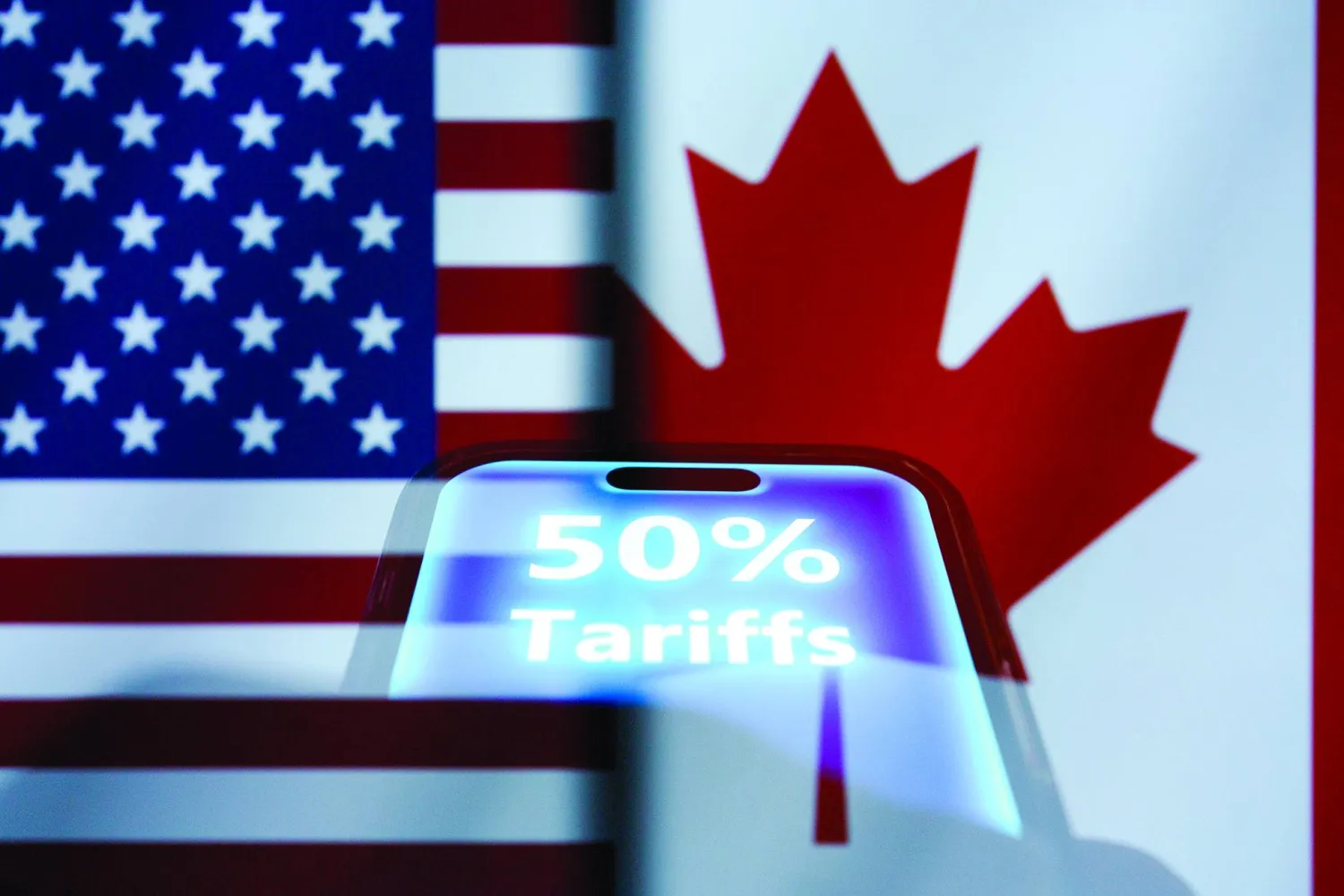
21 July 2026, Taiwan, Taichung: A hand holds a smartphone displaying the term 50 percent tariffs backdropped by cropped flags of the United States and Canada. Photo: Andre M. Chang/ZUMA Press Wire/dpa
TT

US Imposes New Tariffs on 60 Partners as Trump Rebuilds Trade Agenda

21 July 2026, Taiwan, Taichung: A hand holds a smartphone displaying the term 50 percent tariffs backdropped by cropped flags of the United States and Canada. Photo: Andre M. Chang/ZUMA Press Wire/dpa

A new wave of US tariffs targeting 60 trading partners took effect Friday, replacing an expiring global duty rolled out by President Donald Trump earlier this year.

The levies range from 10 percent to 12.5 percent and impact major economies like China, India and the European Union.

"The United States has had a forced labor import ban for nearly a century, and rigorously enforces it; it's well past time for our trading partners to do the same," said US Trade Representative Jamieson Greer.

He earlier added that the targeted economies represent the majority of US trade, AFP said.

The Trump administration has moved swiftly to rebuild the president's tariff wall after the Supreme Court struck down a host of his duties in February -- dealing a blow to his ability to unleash steep levies at will.

After the setback, Trump tapped different authorities to reimpose a 10-percent tariff on imports. But this only lasted 150 days and expired Friday.

The volley of new duties, initially proposed in June, now takes its place.

The measures were planned after a months-long investigation and are considered more resistant to legal challenges than earlier moves.

Under Thursday's announcement, economies that have implemented a forced labor import prohibition or committed to do so are hit with the lower 10-percent rate. They include Canada, the EU, India and the United Kingdom.

China, Japan, South Korea and dozens of others were deemed to deserve the higher 12.5 percent tariff.

But the EU, Taiwan, Japan, South Korea and Switzerland receive some relief in line with trade pacts they previously reached with the United States.

The new levies received swift condemnation from target countries, with Japan saying it "regrets" the duties and Australia's trade minister calling them "unjustified."

Goods already facing sector-specific tariffs -- like steel and aluminum -- will not be impacted.

Certain energy products and fertilizers will be exempt too, alongside products covered by the US-Mexico-Canada free trade pact, a US official told reporters.

- Maintaining leverage -

Washington is separately investigating 16 economies over excess industrial capacity, in probes that could lead to additional duties.

These could result in varying rates among countries eventually, experts warn.

The Trump administration's move to impose a baseline tariff while sustaining the threat of further duties maintains leverage over its trading partners, trade lawyer Greta Peisch told AFP.

It also creates an incentive for countries to comply with trade pacts that they earlier struck, she added.

In spending time on investigations, officials want their incoming tariffs to be robust if there are court challenges, said Peisch, a former general counsel for the Office of the US Trade Representative, who is now a partner at Wiley Rein.

"This makes it much more likely that they stay for the duration of Trump's term," signaling a "much more protectionist world's largest economy" moving forward, Josh Lipsky of the Atlantic Council told AFP.

Resurrecting tariffs boosts government revenues too, he added.

- 'Fragile' deals -

The Trump administration has been hunting for options that would allow it to aggressively deploy tariffs, said former US trade official Ryan Majerus.

In the longer term, Section 301 of the Trade Act of 1974, which Greer tapped to impose the latest duties, provides "more flexibility than people realize," Majerus said.

Once in place, officials can modify them based on new developments, added Majerus, a partner at King & Spalding.

The latest salvo comes shortly after a 25-percent tariff took effect on various Brazilian goods, as Washington accused the Latin American giant of unfair trade practices.

This week, Trump also ordered new 50-percent tariffs on many Canadian products, citing Ottawa's "discriminatory treatment" of American alcohol, automobile and dairy products.

The Canadian tariffs taking effect in a month rely on an untested legal provision, showing that Trump has other tools to swiftly wield, said Lipsky.

This signals that US tariff deals "are still fragile," he said.

Nonetheless, the EU, which has signed a trade pact, expects that Washington "will honor the commitments that are spelled out under the EU-US Joint Statement."



World Bank Projects Lebanon Economy to Contract by 6.4% Due to War

People inspect a damaged building after an Israeli airstrike on the village of Ansar, southern Lebanon, 15 August 2026. (EPA)
TT

World Bank Projects Lebanon Economy to Contract by 6.4% Due to War

People inspect a damaged building after an Israeli airstrike on the village of Ansar, southern Lebanon, 15 August 2026. (EPA)

The World Bank on Friday projected that Lebanon's economy would contract by 6.4 percent this year, as the latest Israel-Hezbollah war derailed the country's efforts at recovery.

Lebanon has been dealing with an unprecedented financial crisis since 2019 and was still reeling from the 2024 Israel-Hezbollah war when the Iran-backed group drew it into the Middle East conflict by attacking Israel in March.

Israel responded with a heavy air campaign and ground invasion that Lebanese authorities say have killed more than 4,300 people.

Due to the war, "real GDP is projected to contract by 6.4 percent in 2026, reflecting the collapse in tourism, weaker consumption, disrupted supply chains, heightened insecurity, and prolonged displacement," the World Bank said in a report.

Inflation is also expected to rise to 17.5 percent this year, according to the report.

The World Bank said Lebanon's economy had strengthened before the latest conflict, with an estimated real GDP growth of 4.2 percent in 2025, "the fastest since the onset of the 2019 financial crisis".

"Advancing reforms -- particularly on banking sector restructuring and fiscal management -- will be critical to restoring confidence, protecting stability, and mobilizing the financing needed for reconstruction and recovery," Dahlia Khalifa, the World Bank's Middle East director, said.

The international community has been demanding that Lebanese authorities enact financial reforms in order to secure much-needed economic aid.

Last week, parliament passed amendments to a bank resolution law aimed at restructuring troubled banks and addressing the country's banking crisis.

The International Monetary Fund welcomed the law, describing it as "a very good step that reflects Lebanon's commitment to aligning its legislation with the best international practices".

Lebanon has been in discussions with the IMF, which said it would resume its meetings in Beirut next month.


Tunisia Olive Oil Exports Surge 55%, Bringing in $1.6 billion

Tunisian olive oil producer, Mustapha Mtiraoui, displays olives to be pressed at his oil mill in Kairouan, Tunisia February 24, 2024. REUTERS/Jihed Abidellaoui
TT

Tunisia Olive Oil Exports Surge 55%, Bringing in $1.6 billion

Tunisian olive oil producer, Mustapha Mtiraoui, displays olives to be pressed at his oil mill in Kairouan, Tunisia February 24, 2024. REUTERS/Jihed Abidellaoui

Tunisia's olive oil exports surged 55.3% to a record 368,000 metric tons in the first nine months of the 2025/26 season, bringing in $1.6 billion in export revenue, up 44.4% from a year earlier, official data showed on Friday.

The surge in olive oil shipments, a vital source of foreign currency and Tunisia's top agricultural export, will provide a much-needed boost to the country's finances as the government grapples with persistent economic and fiscal pressure.

The jump in exports was driven by strong global demand during the first nine months of the season, which began in November.

Extra virgin olive oil accounted for 83.6% of total shipments, the National Observatory of Agriculture said, Reuters reported.

The European Union remained the biggest destination, taking 57.1% of Tunisian olive oil exports, while North America accounted for 24%. More than 70 countries imported Tunisian oil during the period.

Exports to other markets included Saudi Arabia, which took 4.6%, Jordan with 3.1% and African markets at 3.8%, with Egypt accounting for 3.3%.

Bottled olive oil exports rose 50.8% to 51,500 tons, but bulk oil still accounted for the vast majority of shipments, underscoring Tunisia's challenge in capturing more value from one of its most important export products.


South African Rand Hits Strongest Level since Start of Iran War

South African Rand coins are seen in this illustration picture taken October 28, 2020. REUTERS/Mike Hutchings/Illustration
TT

South African Rand Hits Strongest Level since Start of Iran War

South African Rand coins are seen in this illustration picture taken October 28, 2020. REUTERS/Mike Hutchings/Illustration

The South African rand strengthened on Friday to its strongest level since the United States and Israel launched attacks on Iran on February 28, as rising gold prices and a weaker dollar boosted the commodity-linked currency.

At 1229 GMT, the rand traded at 15.9925 against the dollar , about 0.8% stronger from its previous close.

Gold, one of South Africa's main exports, rose to a more than three-month high on Friday and was on track for a third straight weekly gain.

The precious metal was supported by a weaker dollar and the US Treasury's announcement that it would increase buybacks of longer-dated securities, Reuters reported.

US Treasury Secretary Scott Bessent said he may further increase the government's repurchases of Treasuries. That came after the Treasury said it would double the size of buybacks on longer-dated securities over the next quarter.

The US dollar was set to end a bumpy week lower, making greenback-priced bullion more affordable for buyers overseas.

Like other emerging market currencies, the rand has been at the mercy of global market sentiment, particularly since the start of the Iran war.

On the Johannesburg Stock Exchange, the Top-40 index was last up 2.2%.

South Africa's benchmark 2035 government bond was also firmer in early deals, as the yield fell 0.5 basis points to 8.56%.