Gold Softens on Prospects of Fed Rate Hikes as Brent Tops $100

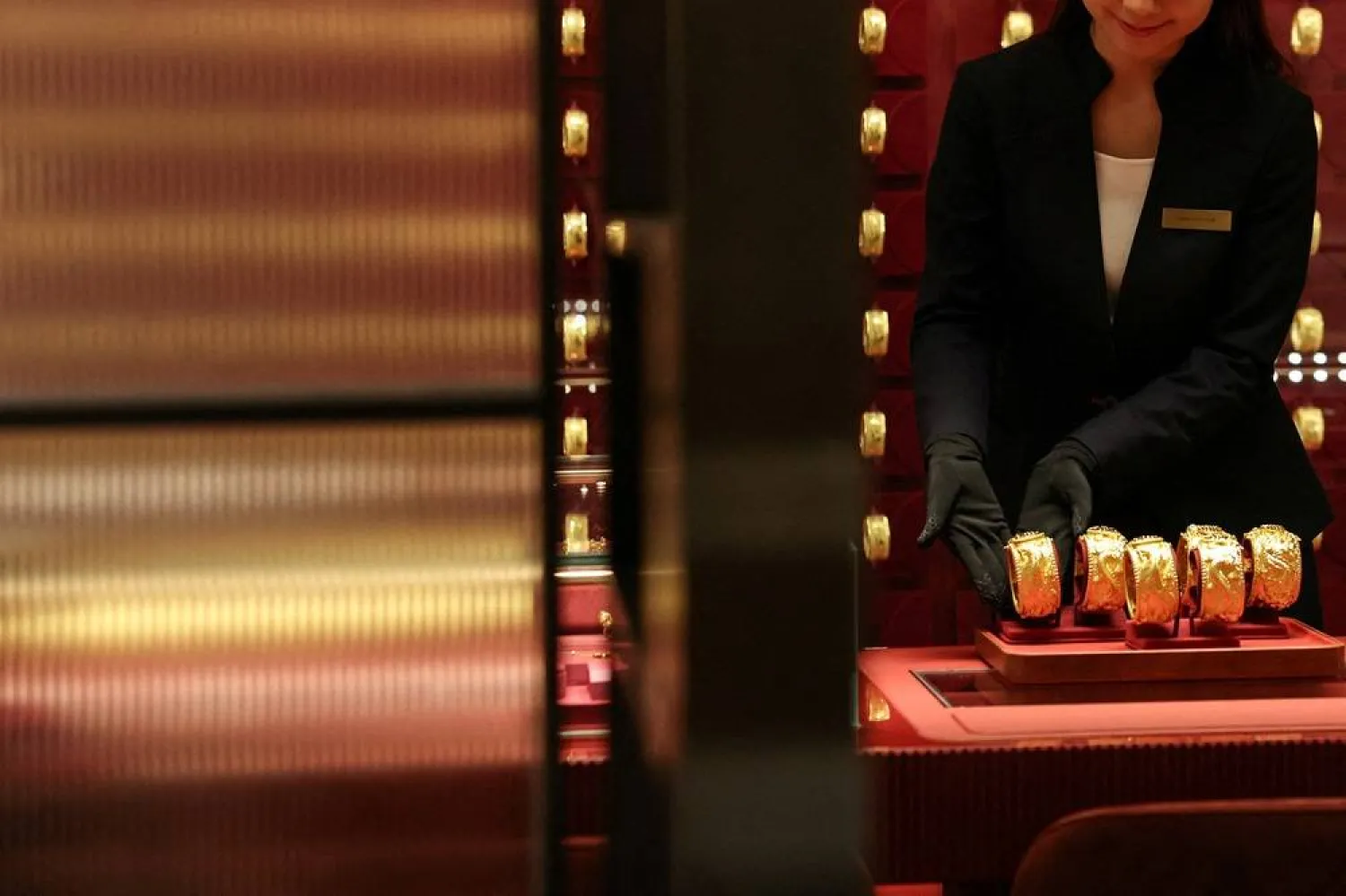
A shop attendant displays pairs of gold bracelets for Chinese weddings during a media preview of the Chow Tai Fook Jewellery Group flagship store soft opening, in Hong Kong, China, February 11, 2026. (Reuters)
TT

Gold Softens on Prospects of Fed Rate Hikes as Brent Tops $100

A shop attendant displays pairs of gold bracelets for Chinese weddings during a media preview of the Chow Tai Fook Jewellery Group flagship store soft opening, in Hong Kong, China, February 11, 2026. (Reuters)

Gold extended losses on Friday after falling 2% in the previous session, as Brent crude's move back above $100 a barrel stoked inflation concerns and strengthened the case for higher interest rates ahead of a Federal Reserve policy meeting next week.

Spot gold eased 0.5% to $4,027.54 per ounce by 0523 GMT, with prices down more than $130 from a two-week ‌high hit on Wednesday. ‌

US gold futures for August delivery were 0.5% ‌lower ⁠at $4,029.60. Bullion was ⁠still on track for a small weekly gain of 0.3% though.

"In the short term, we expect more volatility... gold has been trading between $3,980 all the way to about $4,170 and has been stuck in this way for weeks. Every time prices hit close to $4,000 or slightly below, we see that there will be big ⁠buyers coming to buy it back up," said GoldSilver ‌Central Managing Director Brian Lan.

US President ‌Donald Trump promised on Thursday "major military punishment" for Iran and its Houthi ‌allies, after the Yemeni fighters struck two Saudi oil tankers in ‌the Red Sea.

Brent crude surged 7% on Thursday, breaking through $100 a barrel for the first time since May in one of the steepest run-ups since the war began.

Elevated crude oil prices stir market concerns ‌around inflation and the potential for higher-for-longer interest rates.

While gold is traditionally seen as a hedge ⁠against inflation, its ⁠appeal as a non-yielding asset reduces in a high-interest-rate environment.

Investors are also focused on next week's US Federal Reserve meeting, where policymakers are widely expected to keep rates unchanged.

Traders are pricing in about an 81% chance of a hike in September, according to the CME FedWatch Tool.

The European Central Bankheld interest rates as expected on Thursday but kept the door open for another increase in September.

Spot silver was down 0.4% at $57.48 per ounce, though still headed for a weekly gain of 3%. Platinum fell 0.9% to $1,585.50 and palladium dropped 1.5% to $1,238.55, both on track for a weekly drop.


Saudi Arabia Agrees to Store Additional 16 Million Barrels of Crude in Japan

The Saudi Minister of Energy and Minister of Industry and Mineral Resources met with the Turkish Minister of Environment, Urbanization and Climate Change on the sidelines of the 31st Conference of the Parties to the United Nations Framework Convention on Climate Change (COP31) in Antalya. SPA
TT

Saudi Arabia Agrees to Store Additional 16 Million Barrels of Crude in Japan

The Saudi Minister of Energy and Minister of Industry and Mineral Resources met with the Turkish Minister of Environment, Urbanization and Climate Change on the sidelines of the 31st Conference of the Parties to the United Nations Framework Convention on Climate Change (COP31) in Antalya. SPA

Saudi Minister of Energy and Minister of Industry and Mineral Resources Prince Abdulaziz bin Salman bin Abdulaziz and Japan’s Minister of Economy, Trade and Industry Akazawa Ryosei have reaffirmed the strong and longstanding strategic partnership between the two countries and discussed ways to further strengthen bilateral cooperation, particularly in the energy sector.

The ministers held a virtual meeting on November 9.

Following discussions within the joint task force established in May 2026, the two countries confirmed that the Kingdom regards Japan as a strategic partner and attaches great importance to supporting Japan's long term energy security through reliable and stable crude oil supplies.

Japan expressed its deep appreciation to Saudi Arabia for its stable and reliable supply of crude oil.

The Kingdom has already begun to replenish the joint oil stockpiling tanks in Japan.

Recognizing the longstanding importance of the Joint Crude Oil Stockpiling Project since its establishment in 2010 and the effectiveness it recently demonstrated, Japan intends to lend the Kingdom crude oil storage capacity of 16 million barrels, alongside the existing 8 million barrels storage, using Japan's national stockpiling facilities on a time-bound basis.

Japan also intends to purchase up to 8 million barrels of crude oil from Saudi Arabia for its national stockpile reserves, subject to favorable market conditions and the completion of necessary internal procedures.

Japan and the Kingdom will cooperate under “POWERR Asia,” announced by Japan, to enhance energy security in Asia, based on the AZEC Ministerial Work Program for Strengthening Oil Stockpiling presented at the AZEC Ministerial Meeting held on October 8.

The Work Program outlines future measures, including the development of both institutional frameworks and infrastructure for oil stockpiling in Asia, cooperation with oil-producing countries, and coordinated emergency responses.

The ministers welcomed the continued engagement between the two countries and expressed their shared aspiration to further strengthen the strategic energy partnership between Japan and Saudi Arabia.

Both ministries will continue their constructive engagement to explore further energy cooperation and avenues for further enhancing the existing joint crude oil stockpiling scheme and maximizing its potential.

Meanwhile, Prince Abdulaziz met with Turkish Minister of Environment, Urbanization and Climate Change Murat Kurum on the sidelines of the 31st Conference of the Parties to the United Nations Framework Convention on Climate Change (COP31) in Antalya, Türkiye.

The two ministers explored ways to strengthen cooperation on climate action, reviewed developments at COP31 and discussed efforts to meet the goals of the Paris Agreement in a manner that takes into account countries’ national circumstances and contributes to balanced and inclusive outcomes.


Türkiye Says It Is Starting Offshore Hydrocarbon Exploration in Pakistan, Plans Drilling Next Year

This handout photograph taken on November 10, 2026 and released by Türkiye's Ministry of Energy and Natural Resources on November 12, 2026 shows Türkiye's Minister of Energy and Natural Resources Alparslan Bayraktar (C) during a session at the 31st United Nations Climate Change Conference (COP31) at the Antalya Expo Center in Antalya. (Handout / Turkish Energy Ministry / AFP)
TT

Türkiye Says It Is Starting Offshore Hydrocarbon Exploration in Pakistan, Plans Drilling Next Year

This handout photograph taken on November 10, 2026 and released by Türkiye's Ministry of Energy and Natural Resources on November 12, 2026 shows Türkiye's Minister of Energy and Natural Resources Alparslan Bayraktar (C) during a session at the 31st United Nations Climate Change Conference (COP31) at the Antalya Expo Center in Antalya. (Handout / Turkish Energy Ministry / AFP)

Türkiye's Oruc Reis seismic research vessel will begin exploration for hydrocarbon resources in offshore fields in Pakistan, Turkish Energy Minister Alparslan Bayraktar said on Friday, adding that drilling was expected to start in 2027.

Last year, Türkiye's state oil company TPAO ‌signed hydrocarbon exploration ‌and production agreements ‌with ⁠Pakistani companies including Mari ⁠Energies, Fatima, OGDCL, PPL, Prime and GHDL for three offshore and two onshore fields in Pakistan.

Bayraktar, who attended a ceremony to welcome Oruc ⁠Reis at Karachi Port alongside ‌Pakistan's Foreign ‌Minister Ishaq Dar and Petroleum Minister ‌Ali Pervaiz Malik, said on ‌X the vessel would carry out two- and three-dimensional seismic survey operations in the Indus and Makran basins ‌to "uncover the potential there".

The step marked a "strong ⁠turning ⁠point" in energy cooperation between the two countries, he said, noting that it came at a time of turbulence in global oil and gas markets.

Last month, Bayraktar said the planned operations off Pakistan had been delayed by about six months due to the war in Iran.


ECB's Lagarde: Cyber Threat Boosted by AI is My Top Worry

President of the European Central Bank (ECB) Christine Lagarde addresses guests at the 36th Frankfurt European Banking Congress (EBC) at the Old Opera (Alte Oper) in Frankfurt am Main, western Germany on November 20, 2026. (Photo by Kirill KUDRYAVTSEV / AFP)
TT

ECB's Lagarde: Cyber Threat Boosted by AI is My Top Worry

President of the European Central Bank (ECB) Christine Lagarde addresses guests at the 36th Frankfurt European Banking Congress (EBC) at the Old Opera (Alte Oper) in Frankfurt am Main, western Germany on November 20, 2026. (Photo by Kirill KUDRYAVTSEV / AFP)

The greatest immediate challenge facing the world of finance may be cyber threats supercharged by increasingly sophisticated AI agents, European Central Bank President Christine Lagarde said on ⁠Friday.

Attackers are often ⁠anonymous, and difficult to track, and rely on dubious funding often from "toxic ⁠states" that have a vested interest in disrupting the world, Lagarde said.

"The one (worry) that keeps me awake, and many of you awake as well ... is AI ⁠applied ⁠together with cyber threat," Lagarde told the European Banking Congress in Frankfurt, adding that policymakers have not paid enough attention to this threat.

She also said that the ECB will make its currency swap lines with other countries more accessible to shield the euro area from outside financial shocks and boost the euro's global role.

The ECB only has swap lines with major central banks such as the US Federal Reserve and the People's Bank of China at present, allowing them to exchange their own currencies for euros at times ⁠when financial markets ⁠seize up.

Lagarde's comments suggest these financial lifelines might one day become more widely available as part of the ECB's push to promote the international use of the single currency and make the euro zone less dependent on the US dollar for trade and investment.

"We are working ⁠to keep our swap lines fit for purpose in a more fragmented world," she told the conference. "They will be more accessible, too."

Policymakers globally have been questioning the long-term dominance of the dollar in light of US President Donald Trump's unpredictable economic policy and the United States' ballooning public debt.

Lagarde said the primary goal of the swap lines was to limit spillover of financial stress from abroad, indirectly helping the ECB ⁠control borrowing ⁠costs in the euro area.

But she added these central bank swaps make foreign investors more comfortable holding euros.

"A reserve manager who knows that euro securities can be turned into euro liquidity without a fire sale has more reason to hold them in normal times," Lagarde said.

In a similar vein, the ECB has recently opened up its EUREP facility, which allows foreign central banks to obtain euros against collateral, but only provided that it is denominated in the single currency. More than 30 countries have expressed interest in getting access.