

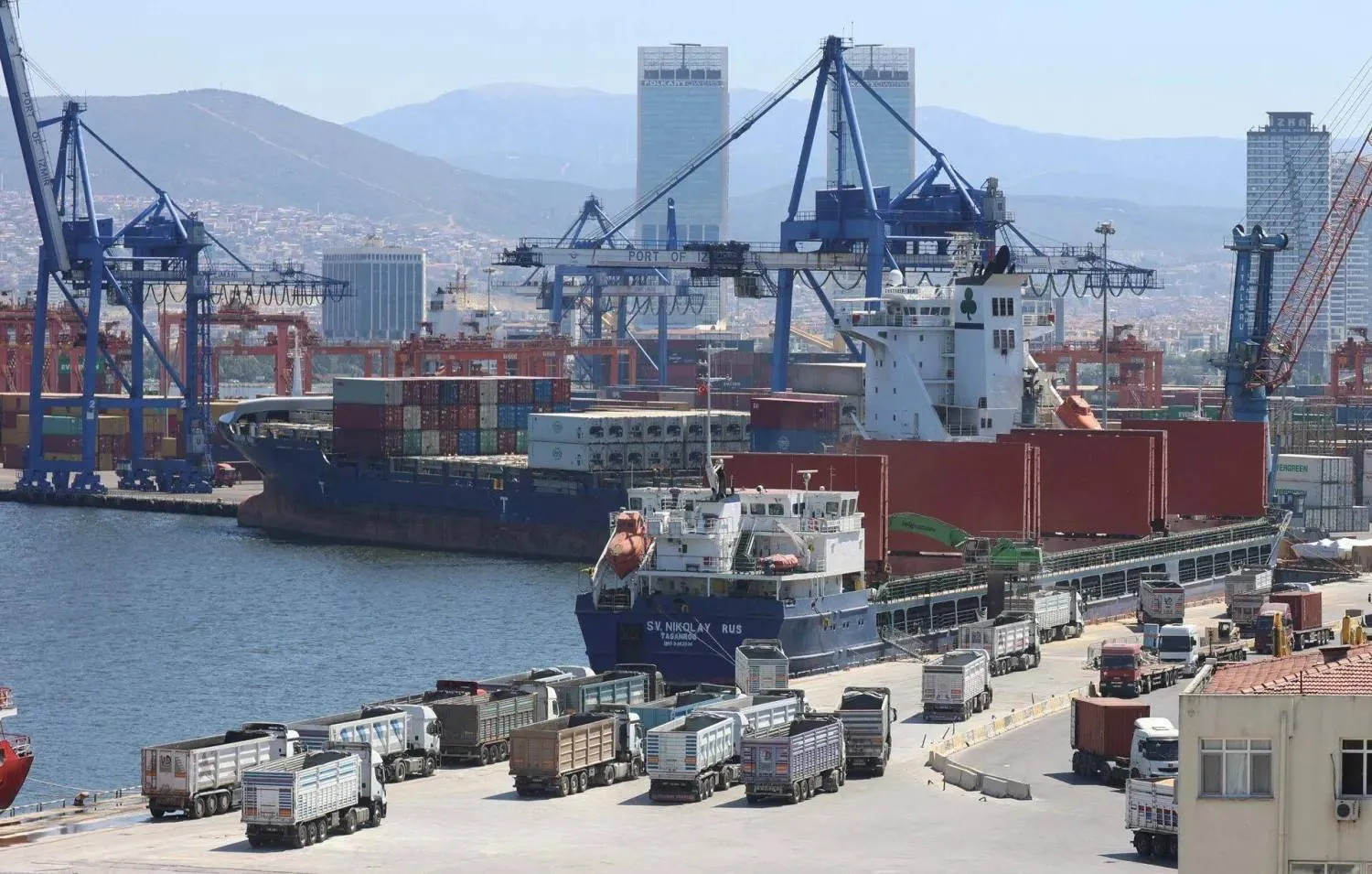

Turkish Exports to Syria Up 26% in 6 Months

Russian-flagged bulk carrier SV Nikolay is unloaded at Izmir port in Türkiye June 25, 2022. REUTERS/Yoruk Isik/File Photo 
TT

Turkish Exports to Syria Up 26% in 6 Months

Russian-flagged bulk carrier SV Nikolay is unloaded at Izmir port in Türkiye June 25, 2022. REUTERS/Yoruk Isik/File Photo 

Turkish exports to Syria reached $1.28 billion in the first half of 2026, up 26.4% compared to the same period last year, according to figures released by the Turkish Exporters Assembly (TIM).

Total export volume by weight also grew by 36.6% to reach 3.18 million tons between January and June, the Anadolu Agency said.

Milling products led the shipments at $103.9 million, followed by cement at $102.3 million and electricity and energy equipment at $80.1 million.

Southeast Anatolia, the Turkish region bordering northern Syria, registered the largest share of trade at $461.8 million, up 34.6% in volume and 11.4% in value growth compared to the same period last year.

Celal Kadoglu, head of the Syria Committee within the Turkish Exporters Assembly, said in a statement that Turkish exports to Syria rose by about 70% during 2025, noting that this upward trend continued during 2026.

He said reconnecting Syria to the global financial network, improving local security, and reopening the Nusaybin–Islahiye border crossings will help rebuild trade between both countries.

Celal praised the positive steps initiated by the two countries' leaderships, which placed bilateral trade on a sustainable path with shared mutual growth goals.


World Bank Projects Lebanon Economy to Contract by 6.4% Due to War

People inspect a damaged building after an Israeli airstrike on the village of Ansar, southern Lebanon, 15 August 2026. (EPA)
TT

World Bank Projects Lebanon Economy to Contract by 6.4% Due to War

People inspect a damaged building after an Israeli airstrike on the village of Ansar, southern Lebanon, 15 August 2026. (EPA)

The World Bank on Friday projected that Lebanon's economy would contract by 6.4 percent this year, as the latest Israel-Hezbollah war derailed the country's efforts at recovery.

Lebanon has been dealing with an unprecedented financial crisis since 2019 and was still reeling from the 2024 Israel-Hezbollah war when the Iran-backed group drew it into the Middle East conflict by attacking Israel in March.

Israel responded with a heavy air campaign and ground invasion that Lebanese authorities say have killed more than 4,300 people.

Due to the war, "real GDP is projected to contract by 6.4 percent in 2026, reflecting the collapse in tourism, weaker consumption, disrupted supply chains, heightened insecurity, and prolonged displacement," the World Bank said in a report.

Inflation is also expected to rise to 17.5 percent this year, according to the report.

The World Bank said Lebanon's economy had strengthened before the latest conflict, with an estimated real GDP growth of 4.2 percent in 2025, "the fastest since the onset of the 2019 financial crisis".

"Advancing reforms -- particularly on banking sector restructuring and fiscal management -- will be critical to restoring confidence, protecting stability, and mobilizing the financing needed for reconstruction and recovery," Dahlia Khalifa, the World Bank's Middle East director, said.

The international community has been demanding that Lebanese authorities enact financial reforms in order to secure much-needed economic aid.

Last week, parliament passed amendments to a bank resolution law aimed at restructuring troubled banks and addressing the country's banking crisis.

The International Monetary Fund welcomed the law, describing it as "a very good step that reflects Lebanon's commitment to aligning its legislation with the best international practices".

Lebanon has been in discussions with the IMF, which said it would resume its meetings in Beirut next month.


Tunisia Olive Oil Exports Surge 55%, Bringing in $1.6 billion

Tunisian olive oil producer, Mustapha Mtiraoui, displays olives to be pressed at his oil mill in Kairouan, Tunisia February 24, 2024. REUTERS/Jihed Abidellaoui
TT

Tunisia Olive Oil Exports Surge 55%, Bringing in $1.6 billion

Tunisian olive oil producer, Mustapha Mtiraoui, displays olives to be pressed at his oil mill in Kairouan, Tunisia February 24, 2024. REUTERS/Jihed Abidellaoui

Tunisia's olive oil exports surged 55.3% to a record 368,000 metric tons in the first nine months of the 2025/26 season, bringing in $1.6 billion in export revenue, up 44.4% from a year earlier, official data showed on Friday.

The surge in olive oil shipments, a vital source of foreign currency and Tunisia's top agricultural export, will provide a much-needed boost to the country's finances as the government grapples with persistent economic and fiscal pressure.

The jump in exports was driven by strong global demand during the first nine months of the season, which began in November.

Extra virgin olive oil accounted for 83.6% of total shipments, the National Observatory of Agriculture said, Reuters reported.

The European Union remained the biggest destination, taking 57.1% of Tunisian olive oil exports, while North America accounted for 24%. More than 70 countries imported Tunisian oil during the period.

Exports to other markets included Saudi Arabia, which took 4.6%, Jordan with 3.1% and African markets at 3.8%, with Egypt accounting for 3.3%.

Bottled olive oil exports rose 50.8% to 51,500 tons, but bulk oil still accounted for the vast majority of shipments, underscoring Tunisia's challenge in capturing more value from one of its most important export products.


South African Rand Hits Strongest Level since Start of Iran War

South African Rand coins are seen in this illustration picture taken October 28, 2020. REUTERS/Mike Hutchings/Illustration
TT

South African Rand Hits Strongest Level since Start of Iran War

South African Rand coins are seen in this illustration picture taken October 28, 2020. REUTERS/Mike Hutchings/Illustration

The South African rand strengthened on Friday to its strongest level since the United States and Israel launched attacks on Iran on February 28, as rising gold prices and a weaker dollar boosted the commodity-linked currency.

At 1229 GMT, the rand traded at 15.9925 against the dollar , about 0.8% stronger from its previous close.

Gold, one of South Africa's main exports, rose to a more than three-month high on Friday and was on track for a third straight weekly gain.

The precious metal was supported by a weaker dollar and the US Treasury's announcement that it would increase buybacks of longer-dated securities, Reuters reported.

US Treasury Secretary Scott Bessent said he may further increase the government's repurchases of Treasuries. That came after the Treasury said it would double the size of buybacks on longer-dated securities over the next quarter.

The US dollar was set to end a bumpy week lower, making greenback-priced bullion more affordable for buyers overseas.

Like other emerging market currencies, the rand has been at the mercy of global market sentiment, particularly since the start of the Iran war.

On the Johannesburg Stock Exchange, the Top-40 index was last up 2.2%.

South Africa's benchmark 2035 government bond was also firmer in early deals, as the yield fell 0.5 basis points to 8.56%.
