


Trump Economy Is a Tale of Shocks, Resilience, and Signs of Stalled Progress

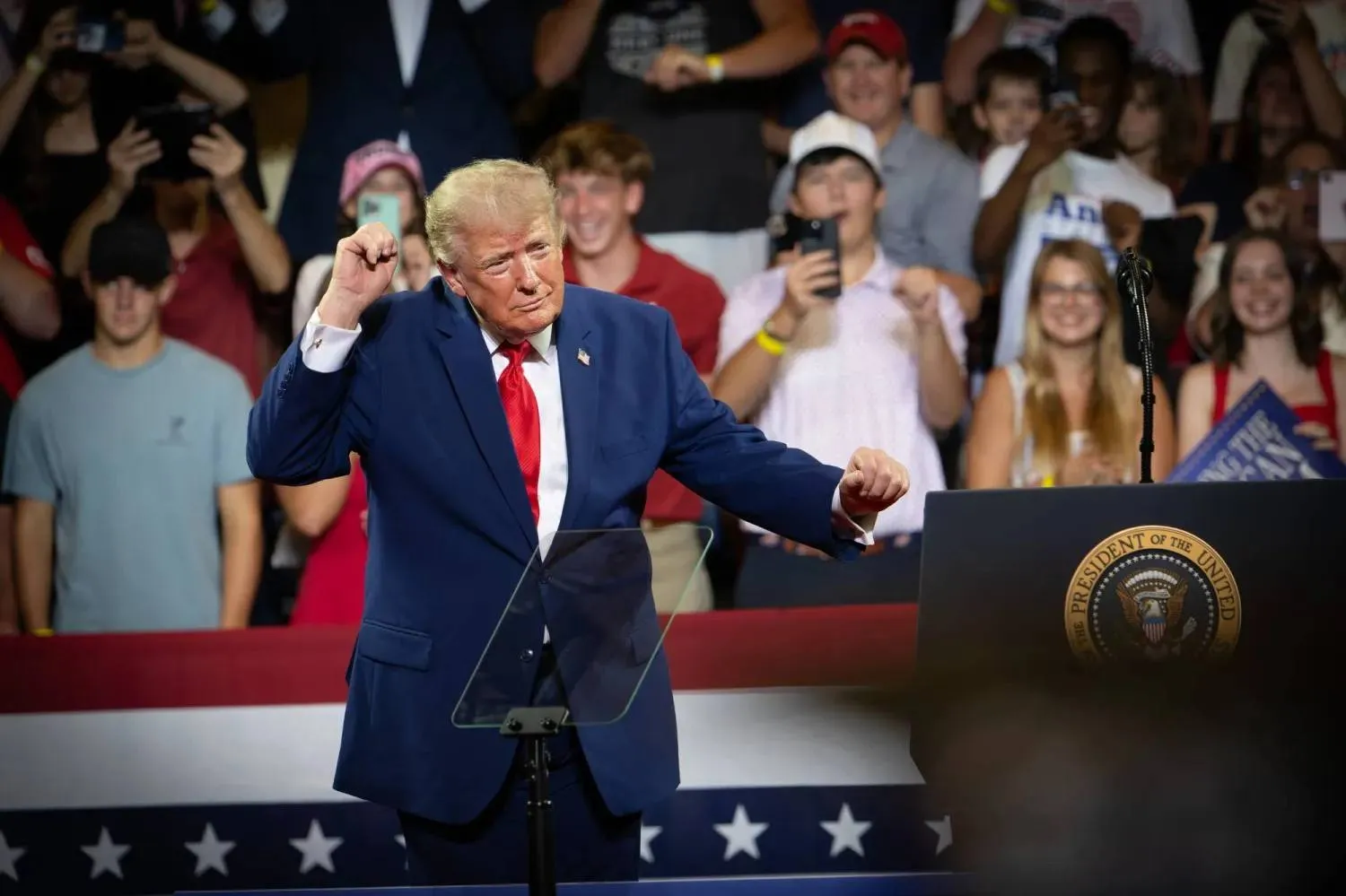
US President Donald Trump greets crowd at a rally at Wheeler High School north of Atlanta (dpa) 
TT

Trump Economy Is a Tale of Shocks, Resilience, and Signs of Stalled Progress

US President Donald Trump greets crowd at a rally at Wheeler High School north of Atlanta (dpa) 

The first 18 months of US President Donald Trump's second term in the White House have seen a series of policy-driven economic shocks, highlighted by the immigration crackdown and higher tariffs that he promised during his 2024 campaign, and an unanticipated war with Iran that has boosted the price of oil and threatened global supply chains.

While the US economy overall has withstood the policy changes and Middle East war better than many economists expected, Trump's vow to lower prices, boost factory jobs, and improve life for the middle class has yet to materialize, with the ‌midterm elections a little more than three months away, according to Reuters.

Stalled Labor Force

Between tougher immigration and an aging resident population, there are fewer people available for work. Household surveys also show a recent decline in the number of people working.

The broadest measure of employment comes from the Bureau of Labor Statistics' household survey. Changes in population statistics in early 2026 mean BLS's published data is not strictly comparable from year to year, showing a sharp drop in employment and the number of people looking for jobs in January largely due to the new controls.

That data also shows declines in both the labor force and number of people working since Trump's return to office, a logical development given the efforts to limit immigration and increase deportations. Coupled with an aging native population, fewer people are available to fill jobs.

Decline in Manufacturing Jobs

Trump said his policies would lead to a US manufacturing revival, with ⁠jobs to follow. There has been an investment boom — in artificial intelligence data centers whose impact on output and jobs remains to be seen.

The AI investment has pushed construction employment higher. But payroll reports show fewer manufacturing jobs than at the end of former President Joe Biden's administration. Biden left the presidency in January 2025.

Some of Trump's priorities are reflected in the jobs data, such as the drop in the number of government workers.

But it's hard to reshape what an economy of 342 million people demands. It's a society that likes restaurants and bars. And it's one that is getting older and in need of more healthcare services.

Changes in hiring reflect that dynamic.

Inflation Hinders Trump’s Promises

Inflation was a major campaign theme in 2024, with anger over the COVID-19 pandemic price shock still fresh even as price pressures eased while the Federal Reserve raised interest rates.

But Trump's promise to lower prices was never realistic. Historically, US prices on a broad basis only fall during dire economic times.

Lowering inflation is possible, but any improvement under Trump has been modest. The most closely watched price indexes show progress stalling, with inflation still above the Fed's 2% target, and policymakers concerned about the risks of it moving higher.

Import tariffs added to the price hikes to some degree; oil's surge to around $100 a barrel, about 50% more than where it traded before the war in the Middle East began in late February, added to the pressure; and now the demands from the AI buildout are doing the same.

Economists expect relative price shifts. In any given period, certain goods will increase relative to others.

But when the increases are big and broad enough, and different items keep rotating through the price-increase cycle, the result is more generalized inflation.

Some Fed officials see that scenario as an imminent risk.

US Spending Resists Shocks

Setting aside debate about whether the US income ‌distribution, in which the wealthy ⁠and highest earners prosper while lower- and middle-income households fare less well, is fair or sustainable, consumer spending has held up throughout the various Trump-era shocks.

But it's unclear how long that trend can continue given that the broadest measure of household spending power — disposable personal income adjusted for inflation — has stalled out and even declined recently.

Disposable personal income is what's left over after taxes and covers wages as well as things like payments from the Social Security pension program — in effect the money left in a person's pocket to pay for housing, food and other goods and services.

Affordability

Trump has veered from promising to make life more affordable to dismissing that objective as unimportant, calling recently enacted congressional legislation aimed at improving home affordability “a big yawn” and refusing to sign it.

Housing is a difficult issue. Presidents have held out homeownership as a touchstone of individual wealth and success for Americans, but lawmakers have curbed credit standards when markets got frothy and caused a ⁠global financial crisis.

After years of ultra-low interest rates, the pandemic added further fuel to the US housing market — driving up home prices — and then Fed rate hikes meant to curb inflation made affordability worse by pushing mortgage rates to new highs.

Mortgage rates remain elevated, as do home insurance premiums that are linked to higher home values and other relevant costs.

The federal government can do only so much about housing supply. Extending tax credits or similar policies can help, but the sector remains under the control of local governments and their patchwork of land-use and zoning rules.

The bottom line, however, is that homeownership continues to command an outsized share of household income.

The Stock Market

Trump has long been fixated on the performance of the US stock market, with the president touting major indexes' recent record highs as evidence of his policy successes.

The fact is, though, stocks tend to rise over time regardless of who is president, and most modern US leaders have seen record equity prices during their terms.

The market's performance since January 2025 ranks right in the middle of the pack when measured against presidents going back to Ronald Reagan. The S&P 500 index has gained roughly 25% during Trump's second term versus a median gain of about 24% over the first ⁠18 months of presidential terms dating back to 1981. That performance still measures up well against the overall compound annual growth rate of 9.5% for stocks in that period.


World Bank Projects Lebanon Economy to Contract by 6.4% Due to War

People inspect a damaged building after an Israeli airstrike on the village of Ansar, southern Lebanon, 15 August 2026. (EPA)
TT

World Bank Projects Lebanon Economy to Contract by 6.4% Due to War

People inspect a damaged building after an Israeli airstrike on the village of Ansar, southern Lebanon, 15 August 2026. (EPA)

The World Bank on Friday projected that Lebanon's economy would contract by 6.4 percent this year, as the latest Israel-Hezbollah war derailed the country's efforts at recovery.

Lebanon has been dealing with an unprecedented financial crisis since 2019 and was still reeling from the 2024 Israel-Hezbollah war when the Iran-backed group drew it into the Middle East conflict by attacking Israel in March.

Israel responded with a heavy air campaign and ground invasion that Lebanese authorities say have killed more than 4,300 people.

Due to the war, "real GDP is projected to contract by 6.4 percent in 2026, reflecting the collapse in tourism, weaker consumption, disrupted supply chains, heightened insecurity, and prolonged displacement," the World Bank said in a report.

Inflation is also expected to rise to 17.5 percent this year, according to the report.

The World Bank said Lebanon's economy had strengthened before the latest conflict, with an estimated real GDP growth of 4.2 percent in 2025, "the fastest since the onset of the 2019 financial crisis".

"Advancing reforms -- particularly on banking sector restructuring and fiscal management -- will be critical to restoring confidence, protecting stability, and mobilizing the financing needed for reconstruction and recovery," Dahlia Khalifa, the World Bank's Middle East director, said.

The international community has been demanding that Lebanese authorities enact financial reforms in order to secure much-needed economic aid.

Last week, parliament passed amendments to a bank resolution law aimed at restructuring troubled banks and addressing the country's banking crisis.

The International Monetary Fund welcomed the law, describing it as "a very good step that reflects Lebanon's commitment to aligning its legislation with the best international practices".

Lebanon has been in discussions with the IMF, which said it would resume its meetings in Beirut next month.


Tunisia Olive Oil Exports Surge 55%, Bringing in $1.6 billion

Tunisian olive oil producer, Mustapha Mtiraoui, displays olives to be pressed at his oil mill in Kairouan, Tunisia February 24, 2024. REUTERS/Jihed Abidellaoui
TT

Tunisia Olive Oil Exports Surge 55%, Bringing in $1.6 billion

Tunisian olive oil producer, Mustapha Mtiraoui, displays olives to be pressed at his oil mill in Kairouan, Tunisia February 24, 2024. REUTERS/Jihed Abidellaoui

Tunisia's olive oil exports surged 55.3% to a record 368,000 metric tons in the first nine months of the 2025/26 season, bringing in $1.6 billion in export revenue, up 44.4% from a year earlier, official data showed on Friday.

The surge in olive oil shipments, a vital source of foreign currency and Tunisia's top agricultural export, will provide a much-needed boost to the country's finances as the government grapples with persistent economic and fiscal pressure.

The jump in exports was driven by strong global demand during the first nine months of the season, which began in November.

Extra virgin olive oil accounted for 83.6% of total shipments, the National Observatory of Agriculture said, Reuters reported.

The European Union remained the biggest destination, taking 57.1% of Tunisian olive oil exports, while North America accounted for 24%. More than 70 countries imported Tunisian oil during the period.

Exports to other markets included Saudi Arabia, which took 4.6%, Jordan with 3.1% and African markets at 3.8%, with Egypt accounting for 3.3%.

Bottled olive oil exports rose 50.8% to 51,500 tons, but bulk oil still accounted for the vast majority of shipments, underscoring Tunisia's challenge in capturing more value from one of its most important export products.


South African Rand Hits Strongest Level since Start of Iran War

South African Rand coins are seen in this illustration picture taken October 28, 2020. REUTERS/Mike Hutchings/Illustration
TT

South African Rand Hits Strongest Level since Start of Iran War

South African Rand coins are seen in this illustration picture taken October 28, 2020. REUTERS/Mike Hutchings/Illustration

The South African rand strengthened on Friday to its strongest level since the United States and Israel launched attacks on Iran on February 28, as rising gold prices and a weaker dollar boosted the commodity-linked currency.

At 1229 GMT, the rand traded at 15.9925 against the dollar , about 0.8% stronger from its previous close.

Gold, one of South Africa's main exports, rose to a more than three-month high on Friday and was on track for a third straight weekly gain.

The precious metal was supported by a weaker dollar and the US Treasury's announcement that it would increase buybacks of longer-dated securities, Reuters reported.

US Treasury Secretary Scott Bessent said he may further increase the government's repurchases of Treasuries. That came after the Treasury said it would double the size of buybacks on longer-dated securities over the next quarter.

The US dollar was set to end a bumpy week lower, making greenback-priced bullion more affordable for buyers overseas.

Like other emerging market currencies, the rand has been at the mercy of global market sentiment, particularly since the start of the Iran war.

On the Johannesburg Stock Exchange, the Top-40 index was last up 2.2%.

South Africa's benchmark 2035 government bond was also firmer in early deals, as the yield fell 0.5 basis points to 8.56%.
