

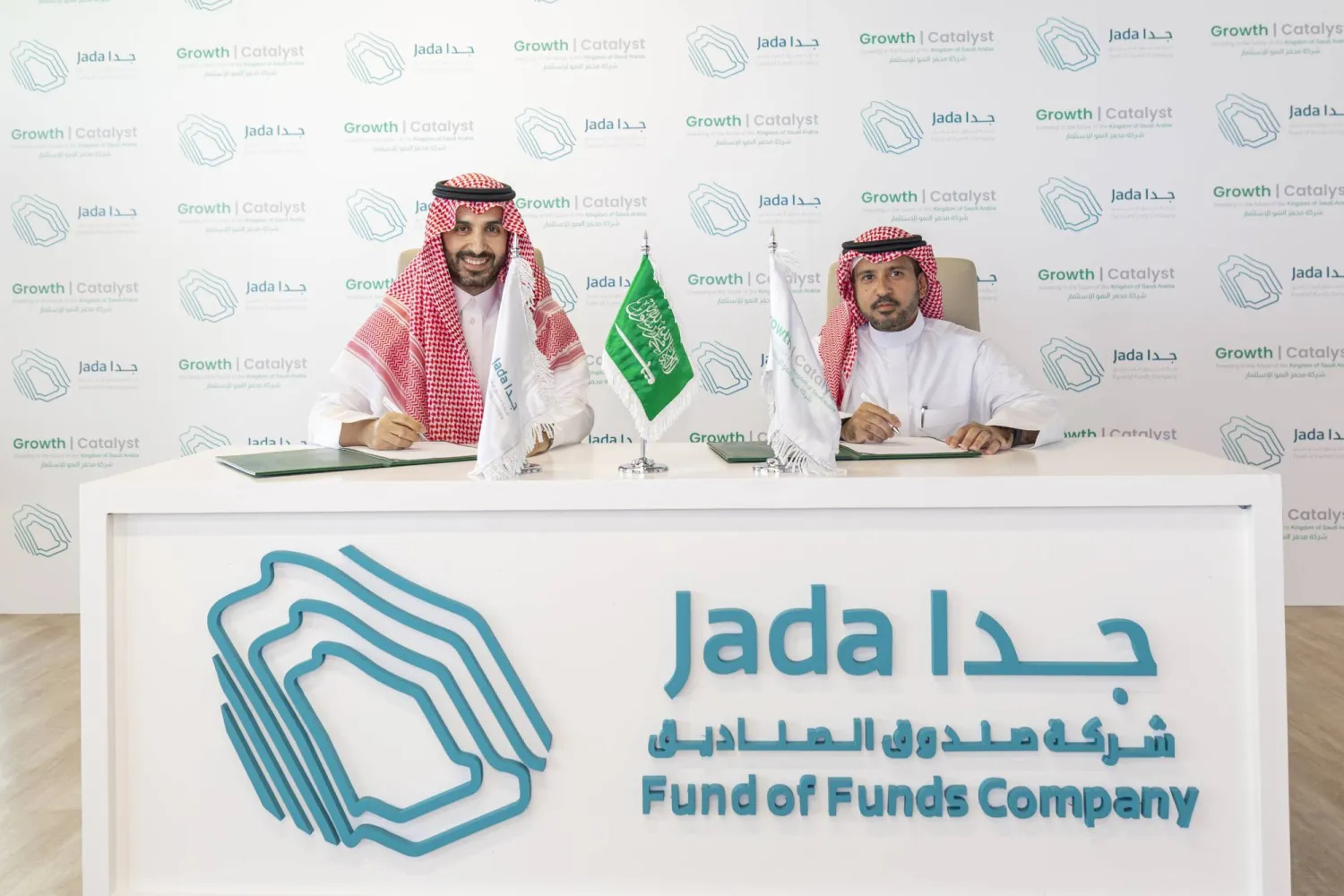

‘Jada’ Invests $200 Million to Expand Growth Equity Capital for Saudi SMEs

Bandr Alhomaly, CEO and Managing Director of Jada, and Turki Aldayel, Founder and CEO of Growth Catalyst, during the signing of the agreement. (Asharq Al-Awsat)
TT

‘Jada’ Invests $200 Million to Expand Growth Equity Capital for Saudi SMEs

Bandr Alhomaly, CEO and Managing Director of Jada, and Turki Aldayel, Founder and CEO of Growth Catalyst, during the signing of the agreement. (Asharq Al-Awsat)

Jada Fund of Funds, a wholly owned subsidiary of Saudi Arabia’s Public Investment Fund, announced its strategic commitment to Growth Catalyst Fund I, a Saudi-based private equity fund licensed by the Capital Market Authority with a targeted fund size of SAR 750 million (USD 200 million), focused on scaling high-potential mid-market companies across the Kingdom.

The commitment reinforces Jada’s continued catalytic role in the private equity ecosystem, with Jada acting as an early institutional backer of Growth Catalyst Fund I in its first close, Jada said in a statement on Monday.

Growth Catalyst Fund is a sector-agnostic private equity vehicle that seeks to support portfolio companies in accelerating growth, strengthening governance frameworks, and enhancing operational capabilities, positioning them for long-term value creation and potential exits through strategic transactions or capital markets.

“Growth equity occupies a vital space in any mature private capital ecosystem, supporting companies that have proven their model and are ready to scale. Our commitment to Growth Catalyst Fund I reflects our confidence in the growth equity opportunities within Saudi Arabia and our deliberate focus on developing the next generation of fund managers who will help shape the Kingdom’s investment landscape,” said Bandr Alhomaly, CEO and Managing Director of Jada.

Jada’s commitment to Growth Catalyst Fund I reflects its ongoing support for emerging fund managers, reinforcing its role in strengthening the private capital ecosystem and developing regional investment talent.

Growth Catalyst’s focus on accelerating high-growth Saudi SMEs aligns with the Kingdom’s economic diversification ambitions under Vision 2030.

“We are pleased to welcome Jada Fund of Funds as an anchor investor in Growth Catalyst Fund I. Their support reflects strong confidence in our strategy and in the opportunity within Saudi Arabia’s mid-market segment,” said Turki Aldayel, Founder and CEO of Growth Catalyst.

“We look forward to partnering with founders and management teams to help scale high-potential Saudi businesses and contribute to the continued development of the Kingdom’s private sector in line with Vision 2030,” he added.

As Saudi Arabia continues to deepen its capital markets and attract increasing levels of foreign and domestic institutional investment, expanding growth equity options is an important step toward supporting a full spectrum of financing solutions for enterprises at every stage of maturity.

Jada Fund of Funds was established to develop the Kingdom’s private capital ecosystem across venture capital, private equity, and private debt.



S&P Global Ratings Affirms Saudi Arabia Credit Rating at A+ with Stable Outlook

An aerial view of the Financial District in Riyadh (SPA)
TT

S&P Global Ratings Affirms Saudi Arabia Credit Rating at A+ with Stable Outlook

An aerial view of the Financial District in Riyadh (SPA)

Credit rating agency S&P Global affirmed Saudi Arabia's credit rating at A+ with a stable outlook, according to its latest report.

It stated that the stable outlook reflects its view that Saudi Arabia will be able to withstand pressures stemming from the ongoing Middle East conflict.

This takes into account the Kingdom's diversified energy export infrastructure, including its ability to redirect crude oil exports to the Red Sea through the East-West oil pipeline, as well as its substantial oil storage and refining capacity both domestically and abroad.

The agency also noted that the stable outlook reflects continued non-oil growth momentum and associated non-oil revenue, together with the government's ability to calibrate investment expenditure linked to Saudi Vision 2030, which should continue to support the economy and fiscal trajectory.

Despite the conflict, non-oil activity has remained reasonably resilient, supported by consumer spending.

S&P expects real GDP to contract by 0.9% in 2026 before rebounding sharply by 8.2% in 2027, supported by an increase in oil production, and to average 3.3% in 2028-2029.

The non-oil sector, including government activities, now accounts for about 70% of GDP, up from 65% in 2018, reflecting continued structural progress in economic diversification.

The agency further highlighted Saudi Arabia's substantial net general government asset position as a key strength and noted that foreign-exchange reserves reached their highest level since early 2020.

It stated that the ongoing recalibration of Saudi Vision 2030 project implementation should support fiscal resilience. S&P also expects the Kingdom to continue adopting a prudent and flexible approach in this regard, having stressed its commitment to achieving Saudi Vision 2030 goals without jeopardizing public finances.

The agency noted that ongoing structural reforms will remain important in supporting non-oil growth.


CEER to Reveal First Flagship Vehicles in Saudi Arabia on Sept. 21

A glimpse of the car's design that CEER aims to launch later this September (Asharq Al-Awsat)
TT

CEER to Reveal First Flagship Vehicles in Saudi Arabia on Sept. 21

A glimpse of the car's design that CEER aims to launch later this September (Asharq Al-Awsat)

CEER, Saudi Arabia's first automotive company and Original Equipment Manufacturer (OEM), has announced the reveal date of the world premiere of its first flagship vehicles, an electric sedan and SUV, on September 21.

Friday’s announcement reflects the Kingdom’s strategic direction toward developing an advanced industrial sector aligned with the objectives of Saudi Vision 2030 and strengthening Saudi Arabia’s position on the global automotive industry map.

“At the beginning of this year, we said that 2026 is the year of CEER. I am happy to announce that we’ve set the date for the reveal of our first flagship vehicles,” said CEO of CEER James DeLuca.

“The world is about to witness a historic moment, the result of an incredible journey from initial design and intensive engineering to the buildup of one of the most advanced manufacturing facilities in the world, in record time.”

CEER was created as a joint venture between the Public Investment Fund and Foxconn. It is the only company in Saudi Arabia to design, engineer, source, validate, manufacture, and soon sell and service a portfolio of aspirational vehicles.

CEER is positioned to be a key enabler of Saudi Arabia's industrial transformation (Asharq Al-Awsat)

Since its inception in 2022, CEER has been focused on building a diverse mix of Saudi talent and global experts that had grown from 20 employees to 2,300; securing key partnerships with renowned international partners including BMW, Hyundai Transys, Rimac, Siemens, Sabelt, Isoclima, ANDRITZ Schuler, Dürr, XYG, Lear, Benteler, Fangxin, Shin Young, JVIS, as well as leading local companies including Zamil Group, Abdul Latiff Jameel Group and APICO (Balubaid Group) that are driving the target of reaching 45% local content by 2034; building one of the most advanced manufacturing complexes in the world; and designing, engineering and testing vehicles that are tailor-made to the specific requirements of Saudi Arabia and the region.

CEER is positioned to be a key enabler of Saudi Arabia's industrial transformation, creating lasting economic impact and supporting the Kingdom's diversification ambitions under Vision 2030.

CEER is projected to contribute $8 billion (around SAR30 billion) to Saudi Arabia’s GDP, $21 billion (around SAR80 billion) to trade balance improvement, and create approximately 30,000 direct and indirect jobs, with 80% of direct jobs held by Saudis. CEER supports the Saudi Green Initiative target of Net-Zero emissions in Saudi Arabia by 2060.


Oil Falls but on Track for 8% Weekly Gain on Supply Concerns; US Diesel Hits Record High

WHITING, INDIANA - SEPTEMBER 08: An aerial view shows the sprawling BP refinery on September 08, 2026 in Whiting, Indiana. (Photo by SCOTT OLSON / GETTY IMAGES NORTH AMERICA / Getty Images via AFP)
TT

Oil Falls but on Track for 8% Weekly Gain on Supply Concerns; US Diesel Hits Record High

WHITING, INDIANA - SEPTEMBER 08: An aerial view shows the sprawling BP refinery on September 08, 2026 in Whiting, Indiana. (Photo by SCOTT OLSON / GETTY IMAGES NORTH AMERICA / Getty Images via AFP)

Oil prices fell on Friday but remained on course for a weekly gain of more than 8% while US diesel prices hit a record high as attacks along Middle East shipping routes stoked concerns about prolonged supply disruptions.

Brent crude futures were down $3.45, or 3.21%, to $104.18 a barrel at 1132 GMT.

US West Texas Intermediate crude fell $2.96, or 2.89%, to $99.52 a barrel. Both benchmarks hit their highest levels since mid-May earlier in the session.

The benchmarks reversed early gains after the Financial Times reported that foreign ministers in the Middle East are trying to work out a temporary deal with Iran to manage shipping through the Strait of Hormuz.

Brent and WTI rose more than 6% on Thursday after an escalation in shipping attacks in the region.

"Some headlines of possible new talks in the Middle East are weighing moderately on oil prices today," said UBS energy analyst Giovanni Staunovo. "I keep seeing near-term risks to the upside for oil prices, but we should expect ongoing high price volatility too."

In a further potentially significant development for Riyadh, satellite imagery showed smoke on Thursday in the vicinity of Saudi Arabia's East-West Pipeline, which has become a vital means for the kingdom to divert its crude exports away from Hormuz.

Saudi Arabia's crude supply fell by 2.3 million barrels per day on the month to 6 million bpd in August, the lowest level in more than three decades, the International Energy Agency said on Friday, citing attacks on Saudi energy facilities.

Adding to concerns over regional oil flows, Yemen's Iran-aligned Houthis on Friday reached the island of Perim in the Bab el-Mandeb Strait, four Yemeni government sources told Reuters, potentially tightening their grip on one of the world's vital shipping routes.

Iran said it had attacked 10 ships near the Strait of Hormuz on Wednesday, after the US hit five Iranian oil tankers. Iran's Islamic Revolutionary Guard Corps said it would escalate its response to any further attacks.

Vessel transits at the Strait of Hormuz fell to seven on Thursday from 11 the previous day, preliminary ship-tracking data showed on Friday.

The strait handled about 125 commodity vessels and one-fifth of global daily oil and liquefied natural gas supplies before the Iran war began in late February.

Meanwhile, two European Central Bank policymakers opened the door on Friday to further interest rate increases if a war-fuelled rise in energy prices continues and pushes up other prices in the euro zone.

SUPPLY DISRUPTIONS LIFT FUEL PRICES

Oil supply disruptions due to the Iran war, along with Ukrainian attacks on Russia's refineries, pushed the US national average diesel price past $6 a gallon for the first time on Thursday, according to price tracker GasBuddy.

"Refined products, particularly diesel, are feeling a one-two punch right now," said Tim Waterer, chief market analyst at KCM Trade.

"As long as both the Gulf shipping constraints and Russian refining outages remain in play, diesel and other refined products are likely to show a higher upside tendency than the broader crude market," he added.

Commerzbank raised its year-end Brent crude forecast to $85 a barrel from $75, while increasing its diesel forecast to $1,200 a ton from $950 and its jet fuel forecast to $1,230 a ton from $980.