



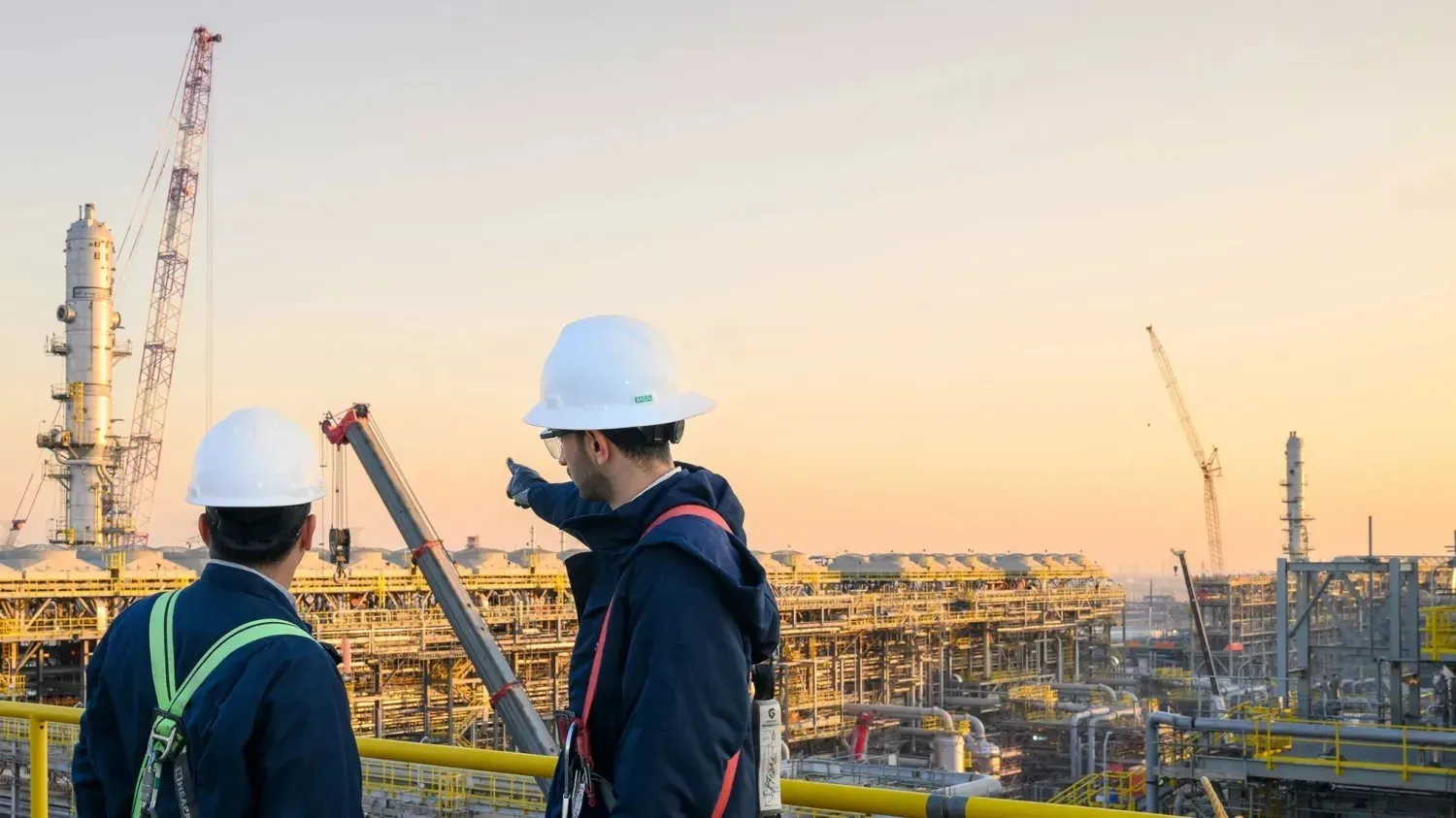

Saudi Aramco’s second-quarter 2026 results underscored the company’s ability to maintain strong financial and operational performance despite geopolitical uncertainty and volatile energy markets.
Adjusted net income reached SAR125.2 billion ($33.4 billion) in the second quarter, while adjusted net income for the first half totaled SAR251.9 billion ($67.2 billion).
Cash flow from operating activities stood at SAR95.4 billion ($25.4 billion) in the second quarter and SAR210.6 billion ($56.2 billion) in the first half. Free cash flow reached SAR46 billion ($12.3 billion) during the quarter and SAR115.9 billion ($30.9 billion) in the first six months of the year.
The company’s board also approved a base dividend of SAR82.1 billion ($21.9 billion) for the second quarter, to be paid in the third quarter.
Cash flow enhances investment appeal
Mohammed Farraj, Senior Director of Asset Management at Arbah Capital, told Asharq Al-Awsat that Aramco’s results demonstrate the company has entered a new stage of operational and financial maturity. The quarterly performance, he said, reflects not merely strong numbers but the outcome of a long-term strategy and carefully planned investments in infrastructure and supply chains.
He continued that Aramco has shown exceptional resilience in navigating geopolitical challenges and energy market volatility, supported by diversified export routes, a strong financial position, and production costs that remain among the lowest in the industry. Those advantages have enabled the company to maintain stable, efficient operations.
Farraj cited first-half free cash flow of SAR115.9 billion ($30.9 billion) as a key indicator of Aramco’s robust cash-generating ability. He added that the temporary pressure from higher working capital in the second quarter was mainly related to inventory and receivables management and represented a short-term operational challenge with no impact on the company’s business quality or financial fundamentals.
He also said geopolitical uncertainty and declining global oil inventories have made markets more sensitive to potential supply disruptions, raising the risk premium. Highly efficient producers such as Aramco, he added, are well positioned to benefit from this environment while maintaining reliable energy supplies.
Dividends and growth projects
For his part, Dr. Hussein Al-Attas told Asharq Al-Awsat that the results reflect the resilience of Aramco’s business model and its ability to sustain strong profitability despite recent challenges in energy markets.
He attributed the performance to low production costs, integration across upstream, refining and petrochemical operations, and disciplined cost management.
He said Aramco’s ability to continue meeting global energy demand during a period of rapid geopolitical change demonstrates that it operates one of the world’s most integrated and reliable energy operations, reinforcing its position as a trusted supplier supporting global energy security.
On dividends, Al-Attas noted that maintaining the base payout at SAR82.1 billion ($21.9 billion) reflects the strength of the company’s cash flows and management’s confidence in its future ability to generate liquidity. The payout also enhances the stock’s appeal to investors seeking stable, long-term returns.
Highest yield among energy majors
Al-Attas highlighted that Saudi Aramco offers the highest dividend yield among the world’s energy majors, at around 5%, exceeding the 3.5% average dividend yield of the Saudi benchmark Tadawul All Share Index (TASI) and slightly surpassing the three-month Saudi Interbank Offered Rate (SAIBOR).
He added that the company increased its dividend by about 2% year on year, supported by earnings growth and its ability to maintain energy supplies, further enhancing the stock’s attractiveness for income-focused investors.
Al-Farraj noted that Aramco’s growing focus on natural gas, strategic investments, advanced technologies, and emissions-reduction solutions marks a significant shift in its strategic identity, transforming it from a traditional oil producer into an integrated global energy company.
He stressed that the expansion is aimed at diversifying growth drivers and reducing reliance on crude oil, in line with global shifts in the energy sector while strengthening the company’s long-term sustainability prospects.
Business continuity amid changing conditions
"Aramco's first-half performance in 2026 has been defined by the remarkable resilience of our people and the agility of our business and operations to withstand and respond to rapidly changing market conditions,” said Aramco President and CEO Amin Nasser.
“Despite the unprecedented supply disruption through the Strait of Hormuz, we continued to demonstrate our ability to maintain business continuity by capitalizing on our diverse asset base and multi-decade planning, including strategic infrastructure such as the East-West Pipeline, storage capacity, and export terminals. That enabled us to sustain production and exports while advancing key projects, despite the challenging regional environment,” he added.
He stated that geopolitical uncertainty and declining global inventories underscore the importance of energy security and the development of additional energy sources more than ever.
“Our role in swiftly responding to short-term market dynamics, coupled with our ability to ramp up production and focus on strategic investment and technology deployment, reinforce our continued position in the global economy,” he added.


