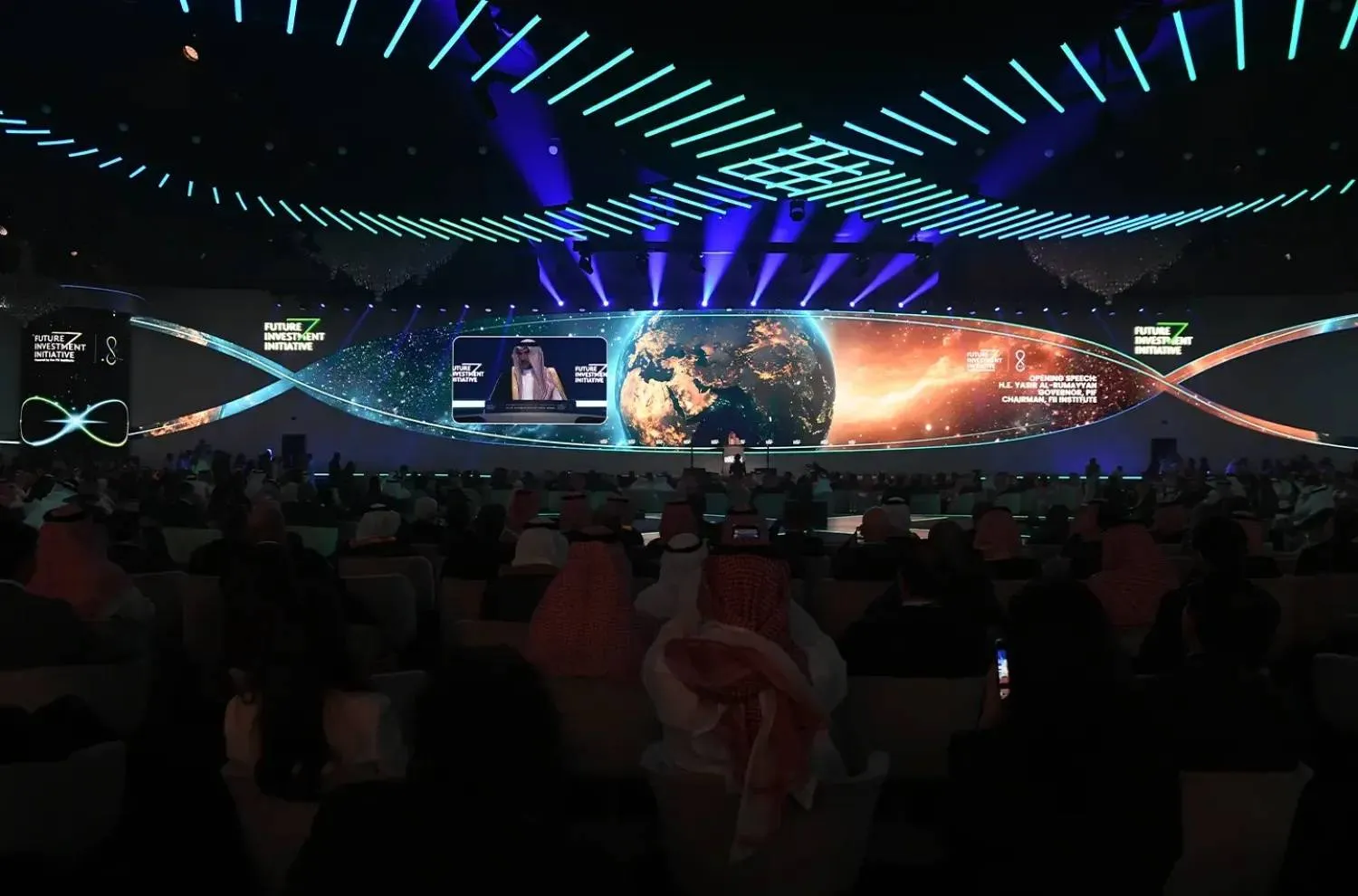
Riyadh to Host 10th Future Investment Initiative Conference in October

Participants during a previous edition of the conference. (SPA)
TT

Riyadh to Host 10th Future Investment Initiative Conference in October

Participants during a previous edition of the conference. (SPA)

Under the patronage of the Custodian of the Two Holy Mosques, King Salman bin Abdulaziz Al Saud, the tenth edition of the Future Investment Initiative (FII) Conference will take place in Riyadh from October 26 to 29.

Held under the theme “The Power of Legacy,” FII10 will bring together heads of state, investors, policymakers, innovators and business leaders to explore how today’s decisions can create lasting prosperity for future generations, said the FII Institute in a statement on Monday.

The program will focus on four pillars: capital that builds, technology that elevates, societies that thrive and leadership that inspires.

Princess Dr. Maha bint Mishari Al Saud, Chief Executive Officer of FII Institute, expressed her appreciation for the generous Royal Patronage of the tenth edition.

She noted that the Saudi leadership’s continued support for the Institute’s events and activities, together with the guidance of Prince Mohammed bin Salman bin Abdulaziz Al Saud, Crown Prince and Prime Minister, constitutes a fundamental pillar in advancing the comprehensive development envisioned by Saudi Vision 2030 and shaping a prosperous and sustainable economic future.

“For ten years, FII has brought together leaders who recognize the power of investment to advance human progress. FII10 invites our global community to consider the legacy of the choices we make, the partnerships we build and the innovations we support. Our goal is to turn these choices into lasting impact for people and future generations,” she added.

Across four days, FII10 will bring together a diverse global community of leaders, investors, policymakers, innovators, and changemakers for a wide-ranging program addressing the world’s most pressing economic and investment priorities.

Since its launch, FII has evolved into a leading global platform for dialogue, collaboration, and action, convening influential voices from around the world. Major agreements and commitments have been announced through the platform, further reinforcing Riyadh’s position as a global center for investment, collaboration, and action.


Crypto Dips on Democrat Midterm Wins, Binance Hack Dents Optimism

Representation of cryptocurrencies are seen in this illustration taken September 10, 2025. (Reuters)
TT

Crypto Dips on Democrat Midterm Wins, Binance Hack Dents Optimism

Representation of cryptocurrencies are seen in this illustration taken September 10, 2025. (Reuters)

Cryptocurrencies briefly dipped on Wednesday as Democrats won majorities in both the Senate and House in the US midterm elections, a potential blow to an industry that has pushed for faster deregulation for digital assets.

The sector has spent more than $300 million backing crypto-friendly Democrats and Republicans in roughly equal measure during the current and previous election cycles, hoping to pass legislation US crypto companies say will ‌put them on ‌a solid legal footing and allow them to thrive.

Bitcoin ‌briefly ⁠touched a six-week ⁠low before recovering to trade roughly flat by 0715 GMT at $78,070. Ether traded at $2,292, up just 1%.

Bitcoin has fallen by around 41% since hitting record highs above $122,000 in October 2025, bringing the value of the broader crypto market to around $2.61 trillion, according to CoinMarketCap.

The market has lost some $300 billion in value in the last month alone, as deepening concern about future returns from AI and the ⁠strain of rising borrowing costs pushed investors into less risky ‌assets such as government bonds and ‌safe-haven currencies.

Sentiment has also been hurt by the $6 billion hack of the Binance platform last ‌week, the largest heist in history.

On Tuesday, Binance customers had withdrawn ‌a net $4.72 billion from the world's largest cryptocurrency exchange since it reopened following the hack at the weekend.

"The market may be re-evaluating the risk-reward profile of crypto assets. On one hand, the string of security incidents is forcing investors to re-examine the ‌industry's security infrastructure and custody risks," Tim Sun, senior researcher at HashKey, said.

"On the other hand, potential shifts in ⁠the US political landscape ⁠could stall the progress of structural crypto legislation and institutional framework development. All of these factors leave the crypto market facing strong headwinds," he said.

US President Donald Trump, who vowed to make the United States the "crypto capital of the world" during his 2024 presidential campaign, has made his own forays into digital assets, with the launch of his "Trump" meme coin, plus his family's World Liberty Financial crypto platform, among other ventures.

The sector has seen sweeping reforms in the almost two years since Trump returned to office, including lighter enforcement and the creation of a strategic bitcoin reserve.

Washington has also allowed for easier access to banking and exchange-traded products and passed a federal stablecoin law that could help these assets move into the mainstream payments and money transfer systems.


Saudi Non-Oil Sector Expands for Seventh Straight Month

A view of Riyadh, Saudi Arabia. (Getty Images file)
TT

Saudi Non-Oil Sector Expands for Seventh Straight Month

A view of Riyadh, Saudi Arabia. (Getty Images file)

Saudi Arabia’s non-oil private sector continued to expand in October, with business activity and output growth accelerating despite a decline in the Riyad Bank Purchasing Managers’ Index (PMI) to 54.0 from 55.3 in September, according to data compiled by S&P Global.

The seasonally adjusted index remained above the neutral 50-point threshold for the seventh consecutive month, signaling continued improvement in operating conditions. Although it eased from September’s seven-month high, October’s reading was the second-highest since February.

Output growth accelerated to a strong pace from the previous month, supported by improving underlying demand and increased sales and marketing efforts. New orders also continued to rise, although more slowly than in September and at a rate below the survey’s historical average.

Domestic demand remained the main driver of growth, while export orders declined for the eighth consecutive month, with the contraction accelerating.

Survey respondents cited shipping disruptions, higher transport and insurance costs, and competitive market conditions as factors weighing on overseas sales. About a quarter of firms reported a decline in export orders in October.

Employment increased for the fourth consecutive month, although hiring remained modest and slowed from September. Backlogs of work rose slightly for the second straight month, reflecting higher sales and some delays in supplier deliveries.

Supplier delivery times improved only marginally, marking the weakest improvement since April, as disruptions to maritime routes continued to affect shipments. Some businesses consequently increased their reliance on domestic suppliers to secure production inputs.

Cost pressures intensify

Cost pressures mounted at the start of the final quarter, with purchase prices rising at their fastest pace in six months, driven by higher shipping, insurance, raw material and energy costs. Staff cost inflation also reached its highest level since February.

Despite rising input costs, the rate of increase in selling prices slowed to a nine-month low as companies offered larger discounts amid intensifying competition. Nevertheless, selling prices continued to rise at a strong pace.

Commenting on the findings, Naif Al-Ghaith, chief economist at Riyad Bank, said the non-oil private sector demonstrated resilience in October, supported by sustained domestic demand, stronger business activity and continued employment growth.

He noted that the PMI’s position above the 50-point threshold indicated improving operating conditions despite its decline from the previous month.

Al-Ghaith explained that faster output growth reflected Saudi businesses’ ability to respond to domestic demand through operational efficiency, marketing initiatives and increased sales activity.

New orders maintained strong growth, although demand had become more selective, he added.

Continued hiring, inventory accumulation and purchasing activity reflected companies’ readiness to meet demand, while expectations for output over the coming year remained only mildly positive and below the survey’s historical average.


Growth in Non-Oil Revenue Bolsters Saudi Budget Resilience

 A general view of Riyadh city during the early hour of evening at Riyadh, Saudi Arabia, May 28, 2025. (Reuters)
A general view of Riyadh city during the early hour of evening at Riyadh, Saudi Arabia, May 28, 2025. (Reuters)
TT

Growth in Non-Oil Revenue Bolsters Saudi Budget Resilience

 A general view of Riyadh city during the early hour of evening at Riyadh, Saudi Arabia, May 28, 2025. (Reuters)
A general view of Riyadh city during the early hour of evening at Riyadh, Saudi Arabia, May 28, 2025. (Reuters)

Saudi Arabia’s non-oil revenue surpassed oil revenue in the third quarter of 2026 for the first time since 2020, highlighting progress in diversifying government income and strengthening the budget’s resilience to energy market volatility.

The shift came as the Kingdom continued to control spending and allocate resources according to priorities, while maintaining funding for essential services and development projects in support of Vision 2030.

According to the Saudi Ministry of Finance, total revenue fell 4% year on year to SAR 259.1 billion ($69.1 billion) in the third quarter, while expenditure declined by the same percentage to SAR 343.4 billion ($91.6 billion), resulting in a deficit of SAR 84.3 billion ($22.5 billion).

For the first nine months of the year, revenue totaled SAR 858.9 billion ($229 billion), against expenditure of SAR 1.103 trillion ($294.2 billion), representing about 84% of the approved annual budget of SAR 1.3128 trillion.

Non-oil revenue strengthens revenue diversification

Non-oil revenue rose 20% in the third quarter to SAR 142.6 billion ($38 billion), helping offset a 23% decline in oil revenue to SAR 116.5 billion ($31.1 billion).

Over the first nine months, non-oil revenue reached SAR 412.5 billion ($110 billion), up 8% year on year, reflecting the expanding government revenue base and the growing contribution of non-oil sources to public finances.

Among non-oil revenue components, other revenue recorded the strongest growth in the third quarter, rising 68% to SAR 49.1 billion ($13.1 billion), from approximately SAR 29.3 billion a year earlier.

Taxes on international trade and transactions increased 26% to SAR 7.2 billion ($1.9 billion), while taxes on income, profits and capital gains rose 16% to SAR 7.7 billion ($2.1 billion). Taxes on goods and services totaled SAR 75.2 billion ($20.1 billion).

Essential and development sectors

Health and social development accounted for the largest share of cumulative government spending through the end of the third quarter, receiving SAR 230.8 billion ($61.5 billion), or 89% of the sector’s allocated budget.

The military sector ranked second, with spending of SAR 187.5 billion ($50 billion), followed by education at SAR 159.3 billion ($42.5 billion) and security and regional administration at SAR 99.4 billion ($26.5 billion).

Spending on economic resources reached SAR 75.7 billion ($20.2 billion), up 11% from the same period last year, reflecting continued allocation of resources to economic and development-related activities.

The figures show that funding for priority sectors was maintained despite the decline in overall quarterly expenditure, underscoring the importance of managing spending and balancing operational needs with development priorities.

Reserves and debt management

Saudi Arabia’s general reserve balance stood at SAR 399.5 billion ($106.5 billion) at the end of the third quarter, while the current account balance reached SAR 50.8 billion ($13.5 billion).

Total public debt amounted to approximately SAR 1.774 trillion ($473 billion), comprising SAR 1.136 trillion ($302.9 billion) in domestic debt and SAR 637.6 billion ($170 billion) in external debt.

New debt issuance during the period totaled SAR 298.3 billion, as part of efforts to finance the planned budget deficit, manage funding requirements and support development and strategic projects.

Dr. Salem Baajajah, professor of economics at King Abdulaziz University, told Asharq Al-Awsat that the first nine months of 2026 reflected the government’s continued support for economic activity and development projects, with expenditure rising 8% to approximately SAR 1.1 trillion, compared with revenue growth of 3% to SAR 858.9 billion.

The widening gap between revenue and expenditure underscored the need to balance development spending with fiscal sustainability, he explained.

Government expenditure remains an important driver of growth by financing projects and infrastructure, supporting non-oil sectors and strengthening the private sector’s contribution to economic activity, Baajajah noted.

However, the next phase requires greater emphasis on spending efficiency and maximizing the economic returns of projects to ensure their long-term development impact.

Baajajah stressed that assessing fiscal performance should go beyond revenue and expenditure growth rates to examine revenue sources, the size of the deficit and how it is financed, and the extent to which spending generates economic growth and jobs.

Overall, the third-quarter results reflect a two-pronged approach to fiscal management: expanding non-oil revenue to broaden the income base while aligning expenditure with available resources, without neglecting essential sectors or development projects.

This approach strengthens the budget’s ability to withstand fluctuations in oil revenue while supporting economic diversification targets and maintaining fiscal discipline.