

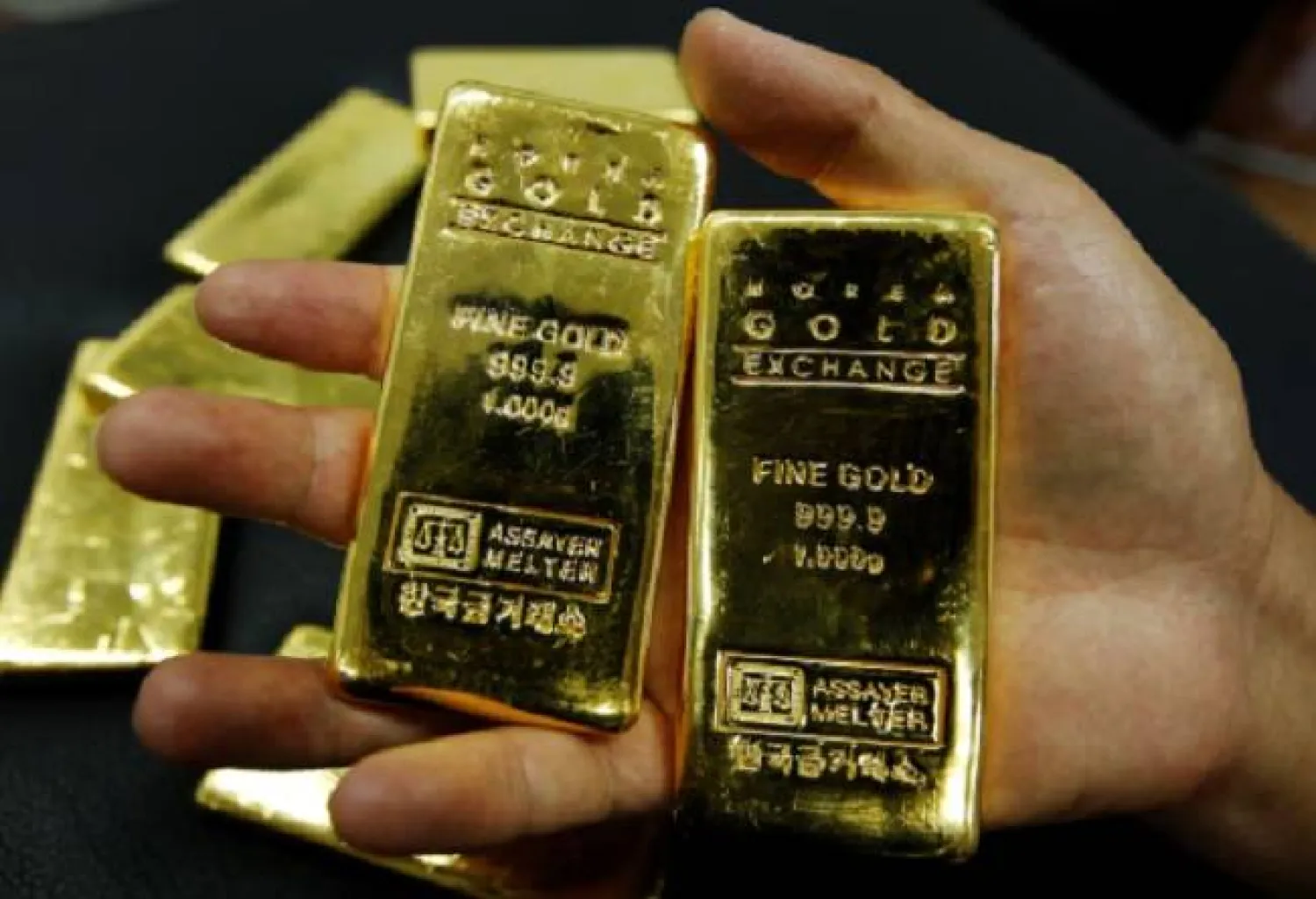

Gold Heads for Weekly Loss as Investors Unwind Inflation-fueled Rally

An employee displays gold bars at the Korea Gold Exchange in Seoul (Reuters)
TT

Gold Heads for Weekly Loss as Investors Unwind Inflation-fueled Rally

An employee displays gold bars at the Korea Gold Exchange in Seoul (Reuters)

Gold prices slipped on Friday and were headed for a weekly loss as investors locked in profits a day after bullion was propelled to its highest level in more than two months on mild US inflation data that weakened the case for a near-term Federal Reserve rate hike.

Spot gold was down 0.5% at $4,330.70 per ounce, as of 0714 ‌GMT. US gold futures ‌for December delivery slid 0.7% to $4,387.40, said Reuters.

Bullion climbed to ‌its ⁠highest point since ⁠June 5 on Thursday, before settling lower, setting it on track for a weekly loss.

"There is some episodic and more speculative capital that's maybe taking a bit of profit in gold, because there's not a near-term catalyst quite so potent immediately in front of us," said Ilya Spivak, head of global macro at finance content network Tastylive.

"Gold ⁠may be setting up, with some choppy trading ‌along the way, for a meaningful ‌rally now. And if we can take out $4,400, I don't think $5,000 by year-end ‌is any kind of a sketch."

The non-yielding metal got ‌a boost after an unexpected drop in US July nonfarm payrolls last week, followed by softer inflation data this week, sharply reducing expectations of a rate hike next month.

US producer prices were unchanged in July, following a revised ‌0.1% drop in June, while US consumer prices barely increased in July as the cost of ⁠gasoline declined ⁠for a second consecutive month.

Traders are now pricing only a 33% chance of a rate hike in September, down from about 55% last week, according to the CME FedWatch Tool.

Lower interest rates make gold more attractive relative to yield-bearing assets.

On the geopolitical front, Washington on Thursday threatened to maintain a naval blockade of Iran indefinitely, ratcheting up economic pressure on Tehran as ceasefire talks have floundered.

In other metals, spot silver slipped 0.3% to $64.25 per ounce.

Platinum was steady at $1,717.40, while palladium inched 0.3% lower at $1,303.50, both touching their lowest levels since August 4 earlier in the session. Both metals were headed for a weekly drop.



Oil Extends Losses on Hopes Middle East Talks Could Ease Supply Woes

A worker rests next to an oil pump on a sunny day in Baku, Azerbaijan, June 16 , 2015. (Reuters)
TT

Oil Extends Losses on Hopes Middle East Talks Could Ease Supply Woes

A worker rests next to an oil pump on a sunny day in Baku, Azerbaijan, June 16 , 2015. (Reuters)

Oil prices fell more than $1 on Thursday, extending a streak of losses, on expectations that talks between Iran and Qatar might open the Strait of Hormuz and reduce supply disruptions from the Middle East war.

Brent crude futures were down $1.36, or 1.55%, to $86.48 a barrel at 0800 GMT, in line for a fourth day of declines. West Texas Intermediate crude futures fell $1.40, or 1.7%, to $80.83, in line for a fifth ‌day of ‌losses, Reuters reported.

"Oil has weakened again today as the market prices ‌in ⁠rising expectations that a ⁠deal could materialize which would increase shipping numbers through the Strait of Hormuz," KCM chief market analyst Tim Waterer said.

"If Hormuz were to reopen more fully, a further leg lower in crude is possible, but the market is unlikely to price a complete return to pre-conflict levels overnight."

Qatar's prime minister will head to Iran on Thursday to relaunch diplomatic talks to end the conflict, which is nearly six ⁠months old.

The visit comes as the war nears its ‌sixth month with fighting largely paused but ‌no diplomatic breakthrough in sight. Both sides are at odds over control of the Strait ‌of Hormuz, a chokepoint for global oil supplies that Tehran has used ‌as leverage.

The strait, which handled about one-fifth of global daily oil and liquefied natural gas supplies before the conflict began in late February, has been at the center of concerns over global energy supplies because of its critical role as a transit route for exports ‌from major Gulf producers. Shipping traffic at the strait rose slightly on Wednesday despite the standoff, data showed.

A senior Iranian ⁠source on Wednesday ⁠said Iran and Oman were working on finalizing details of an agreement to control the Strait of Hormuz, after Iran's Revolutionary Guards said the two countries had agreed how to share the waterway.

The US has halted its attacks on Iran for about a month and is seeking to impose greater economic pressure on Iran, which has raised investors' expectations for an easing of the Gulf supply disruptions.

"At the heart of the dispute remains Iran's nuclear program and that is unlikely to be resolved quickly ... Iran also understands the importance of its geographical position and the leverage that the Strait of Hormuz provides, so the risk of prolonged uncertainty remains," said Priyanka Sachdeva, head of market insights at Phillip Nova.


Gold Drifts Higher, Eyes on Fed Chair Warsh's Comments

AFP_A worker displays a one kilogram gold bullion bar at the ABC Refinery in Sydney
TT

Gold Drifts Higher, Eyes on Fed Chair Warsh's Comments

AFP_A worker displays a one kilogram gold bullion bar at the ABC Refinery in Sydney

Gold prices drifted higher on Thursday as so-called dollar debasement fears lingered, while attention shifted to highly anticipated remarks from US Federal Reserve Chair Kevin Warsh this week.

Spot gold was up 0.4% at $4,611.16 per ounce by 0630 GMT. US gold futures rose 0.3% to $4,664.50, Reuters reported.

The dollar-debasement narrative, coupled with concerns about the US budget deficit, remains supportive of gold in the medium term, said Kelvin Wong, a ‌senior market ‌analyst at OANDA.

Gold prices rose over 5% ‌last ⁠week after the ⁠US Treasury's move to expand buybacks of older long-dated bonds, which renewed dollar-debasement fears.

Warsh's remarks at the annual Jackson Hole symposium in Wyoming on Friday are expected to be closely watched for further direction.

"The market is awaiting the speech for greater clarity on how the Fed will navigate the current economic landscape. ⁠If he does not provide specific forward-looking monetary ‌policy guidance, current market pricing for ‌rate hikes is likely to remain largely unchanged," Wong said.

Markets see ‌a 36.1% probability of a September US rate hike and ‌a 72.1% chance by December, according to the CME FedWatch Tool.

Data on Wednesday showed that annual US inflation held steady in July, well above the Fed's 2% target, and the unexpected pause in the ‌decline from a recent Iran war-induced peak is likely to intensify the central bank's debate ⁠over whether rates ⁠should be lifted or held steady. On the geopolitical front, Qatar's prime minister will visit Tehran to relaunch diplomacy after the US and Iran traded recriminations over Washington's promise to increase economic pressure on Tehran.

Gold is considered a hedge against geopolitical and economic risks, but higher interest rates can diminish its appeal as it pays no interest.

"The $4,700 area remains an important short-term barrier. Gold may need to consolidate within the $4,500–$4,700 range before developing fresh momentum," said Linh Tran, market analyst at XS.com.

Spot silver gained 1% to $68.77, platinum rose 0.5% to $1,837.48 and palladium firmed 0.1% to $1,329.81.


Shipping Traffic Through Strait of Hormuz Rises Slightly, Data Shows

Vessels in the Strait of Hormuz are visible near the beach of Bandar Abbas, Iran, August 26, 2026. Majid Asgaripour/WANA (West Asia News Agency) via REUTERS
TT

Shipping Traffic Through Strait of Hormuz Rises Slightly, Data Shows

Vessels in the Strait of Hormuz are visible near the beach of Bandar Abbas, Iran, August 26, 2026. Majid Asgaripour/WANA (West Asia News Agency) via REUTERS

Shipping ‌traffic at the Strait of Hormuz rose slightly even as a geopolitical standoff persisted between the United States and Iran, while the market also monitored Iran-Oman talks about the waterway, data showed on Thursday.

Visible commodity vessel transits at Hormuz totaled 10 on Wednesday, up slightly from eight on Tuesday, data from Kpler showed. This remained ‌below a ‌10-day moving average of ‌about ⁠15 vessels.

Two medium-range fuel ⁠tankers, a liquefied petroleum gas carrier, a Panamax-sized tanker, and three handymax-sized tankers entered the strait from the Gulf of Oman.

A medium-range fuel tanker, a bitumen tanker and a bulk carrier exited ⁠the waterway from the Gulf.

Iran ‌and Oman are ‌still working on the details of an agreement ‌on the Strait of Hormuz, a ‌senior Iranian source said on Wednesday, after Iran's Revolutionary Guards said the two countries had agreed how to share the waterway and ‌its revenue.

Meanwhile, traffic slowed for a second day at the ⁠other ⁠key waterway of the Bab el-Mandeb strait.

A total of 19 commodity vessels passed through Bab el-Mandeb on Wednesday, with six tankers that exited, including a very large crude carrier, down from 24 on the previous day, the Kpler data showed.

Some vessels may be sailing at the key waterways with their transponders turned off and may be missed in the counts.