


South Korea to Send First Container Ship Through Arctic Route

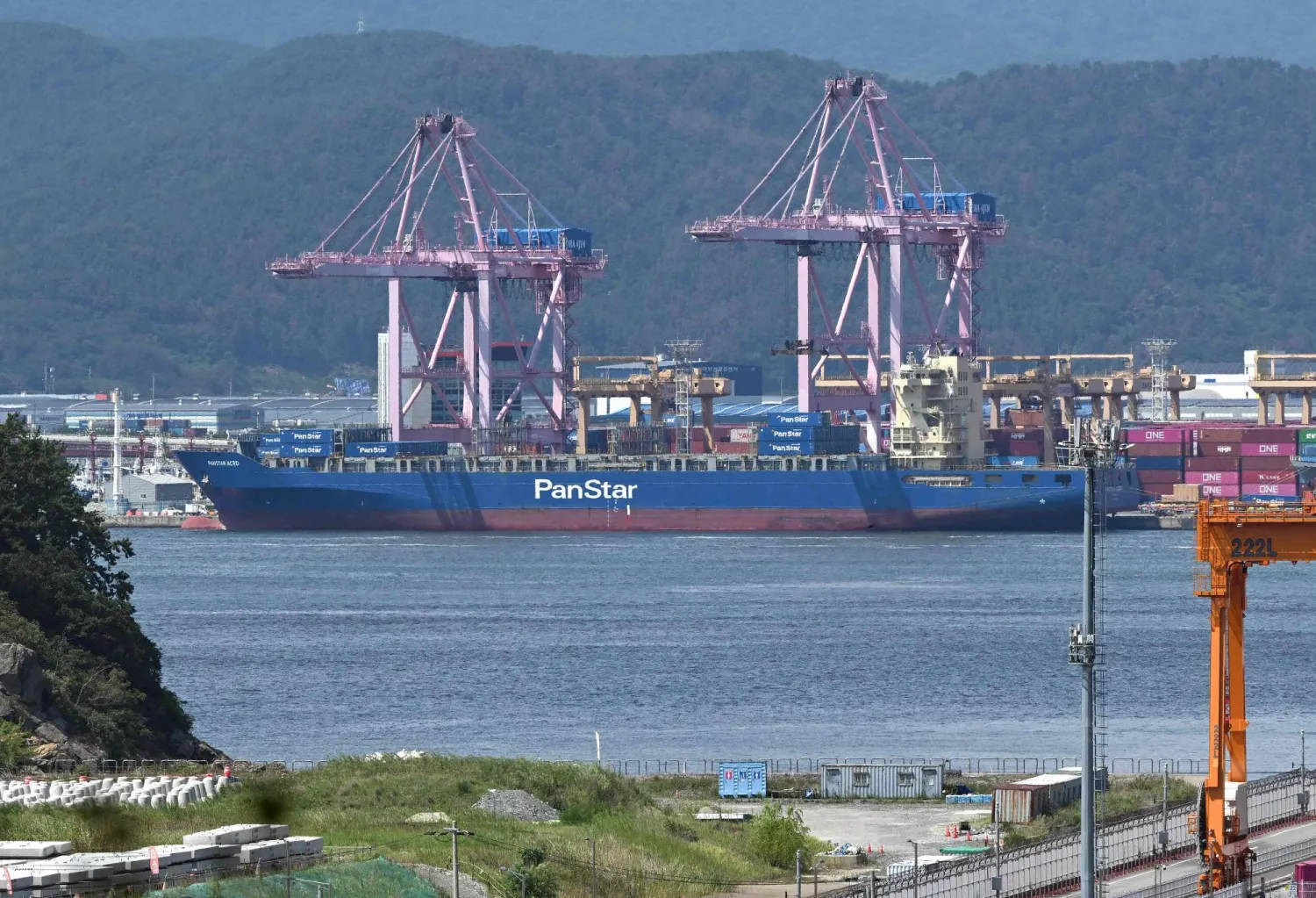
The container ship "Panstar Acro" is anchored to load containers at Busan New Port in Busan on August 22, 2026, as the vessel is scheduled to sail to Europe via the Arctic to test the commercial viability of the shipping route opened by melting ice. (AFP)
TT

South Korea to Send First Container Ship Through Arctic Route

The container ship "Panstar Acro" is anchored to load containers at Busan New Port in Busan on August 22, 2026, as the vessel is scheduled to sail to Europe via the Arctic to test the commercial viability of the shipping route opened by melting ice. (AFP)

South Korea was set Saturday to send its first trial container through the Arctic, as the Middle East war rattles global shipping, while environmental groups warned the route could accelerate polar ice melt.

The Middle East conflict, sparked by US-Israeli strikes on Iran in February, has roiled global shipping, sending governments and shipping firms scrambling to seek alternative routes.

Sailing from Busan New Port, the container ship -- the "PanStar Acro" -- will sail to Europe via the Arctic, testing whether a route opened by melting sea ice can be commercially viable.

"The ship will depart at 8 pm (1100 GMT) today unless there are unforeseen circumstances, such as bad weather," an oceans ministry official told AFP on Saturday.

The ship will leave for Felixstowe in Britain, Rotterdam in the Netherlands and Gdansk in Poland before returning, with the voyage expected to take about 45 days, according to the ministry.

The voyage follows that of the Chinese container ship "Dubai Tower", which left the eastern port city of Ningbo for Europe this month, heading north through the Bering Strait before turning west along Russia's Arctic coast.

The usual maritime route between Asia and Europe runs through the Suez Canal, but travelling through the Arctic can cut the journey by around 7,000 kilometers (4,300 miles) and about 10 days, according to the Korea Institute for International Economic Policy.

South Korea's Vice Oceans Minister Nam Jae-hon said the Arctic route was "bound to become an alternative" to Middle Eastern shipping lanes -- as geopolitical risks and technological advances make it increasingly competitive.

Marc Lanteigne, a political science professor at the Arctic University of Norway, said the voyage -- coming soon after China's "Dubai Tower" began its own Arctic journey -- showed the Northern Sea Route (NSR) was becoming normalized as a "secondary maritime transit corridor".

A successful voyage would demonstrate South Korea's interest in "developing alternative shipping sea lanes", he told AFP, with concerns that it could fall behind as Chinese firms expand regular services through the increasingly viable Arctic route.

- Russia issue -

Some experts warn South Korean ships using the Arctic route could risk breaching Western sanctions on Russia -- currently a key security ally of North Korea -- as they would receive Russian navigation and weather services involving payments, albeit small ones.

South Korea's foreign ministry declined to comment when asked by AFP about the concerns involving Russia.

The oceans ministry said this week that "consultations with key relevant countries and agencies" have been completed to "implement administrative procedures necessary" for the voyage.

Vladimir Tikhonov, Korean Studies professor at the University of Oslo, said "strictly speaking, US and EU sanctions are not international law, unlike UN sanctions".

"And with continued uncertainty in the Middle East - itself driven in part by US actions - South Korea may have few alternatives if the Arctic route proves economically viable," he told AFP.

Lanteigne said China's Northern Sea Route ambitions were more politically driven than South Korea's, with Beijing viewing the polar regions as "strategic new frontiers", raising Western security concerns.

Meanwhile, environmental groups warned growing traffic along the shorter NSR could accelerate Arctic sea ice loss already driven by global warming.

Major carriers including CMA CGM, MSC and Hapag-Lloyd have pledged to avoid Arctic shipping routes.

The NSR is believed to be accessible only during the time of year when the ice is melted enough to allow transits without icebreakers.

"The Northern Sea Route has become increasingly viable as the Arctic warms about four times faster than the global average, leading to a sharp decline in sea ice," South Korean environmental group Paran Ocean Citizen Science Center said in a statement last year.

"But making the route commercially viable would require further warming, putting the policy at odds with efforts to combat climate change."



IMF: AI Could Boost EU Growth But Increase Economic Strains

AI Artificial intelligence words, miniature of robot and EU flag are seen in this illustration taken December 21, 2023. REUTERS/Dado Ruvic/Illustration/File Photo
TT

IMF: AI Could Boost EU Growth But Increase Economic Strains

AI Artificial intelligence words, miniature of robot and EU flag are seen in this illustration taken December 21, 2023. REUTERS/Dado Ruvic/Illustration/File Photo

Artificial intelligence could lift European productivity by about 1% over five years, but risks widening inequality, straining power networks and increasing dependence on foreign technology unless governments deepen economic integration, an International Monetary Fund paper said.

The background note, prepared for an informal meeting of European Union finance ministers in Dublin on September 18-19, said the benefits and costs ⁠of AI were likely to be distributed unevenly across countries, regions and workers, according to Reuters.

It said completing the EU single market would help spread AI adoption and its gains more evenly across the 27-nation bloc.

The paper echoes concerns raised by former European Central Bank President Mario Draghi and the European Commission that Europe's fragmented capital, labor and energy markets are holding back investment and innovation.

The IMF estimated that around 60% of workers in advanced European economies are employed in occupations highly exposed to AI. While some could become more productive through AI tools, others faced displacement as routine tasks become automated, it ⁠said, particularly in jobs where AI is more likely to replace labor than complement it.

The paper said Europe's data centers already consume roughly 3% of the continent's electricity and that demand would rise sharply as AI use expands.

Major technology hubs such as Frankfurt, London, Amsterdam, Paris and Dublin are among the areas most ⁠exposed, with data-center clusters already putting pressure on local power networks.

To address that, the EU should invest in cross-border grid infrastructure and deepen integration of the European energy market, the IMF said.

The paper also warned that Europe ⁠risks developing another strategic dependency because the US and China dominate the development of AI models.

It said Europe would need significant investment in its own AI industry to avoid becoming reliant ⁠on foreign technology.

AI's gains are also likely to be unevenly distributed across and within the EU, the paper said. More advanced economies are expected to benefit disproportionately because they are better prepared for and more exposed to the technology.


Bolivia Approves $1.9 Billion IMF Deal, Eliminates Diesel Subsidies

A person is counting dollars in La Paz, Bolivia, 10 July 2026. (EPA)
TT

Bolivia Approves $1.9 Billion IMF Deal, Eliminates Diesel Subsidies

A person is counting dollars in La Paz, Bolivia, 10 July 2026. (EPA)

Bolivian lawmakers approved a $1.9 billion loan agreement with the International Monetary Fund on Friday, delivering the conservative government a key victory in its efforts to ease the country's deep economic crisis as unions threatened renewed protests.

Just hours after Congress approved the loan, President Rodrigo Paz announced an immediate end to subsidies for the diesel powering Bolivia’s trucks, buses and tractors — a step toward meeting IMF demands. Gasoline, used mainly in private cars, would remain subsidized for now, though Paz had already scaled back that support in recent months, The Associated Press said.

The Senate ratified the IMF agreement a day after the lower house approved it, clearing the final legislative hurdle for the three-year financing program aimed at replenishing dwindling foreign reserves and stabilizing the ailing economy marked by high inflation and weak growth. The IMF first announced the staff-level agreement in July after months of negotiations with Paz’s market-friendly government, which took power last year after nearly two decades of socialist rule as part of a wave of new Latin American leaders allied with the Trump administration.

The program still requires approval from the IMF’s executive board before funds can be disbursed. Economy Minister Christian Morales told senators that the deal would give other lenders, including the World Bank and the Inter-American Development Bank, greater confidence in the government and help it secure about $5 billion in additional financing.

But the assistance is conditioned on tough economic measures, including the elimination of fuel subsidies, that threaten to reignite unrest in Bolivia, where weeks of road blockades in June and July paralyzed much of the South American nation as demonstrators demanded Paz’s resignation. Congress on Thursday extended for another 90 days a state of emergency that Paz had declared to clear roads during the protests. It allows for military intervention and the suspension of some civil liberties.

The Bolivian Workers’ Central, the country’s main labor federation, and other unions have voiced fierce opposition to the IMF loan, warning that the government spending cuts required under the deal would drive up living costs and deepen hardship for struggling families.

Although Paz’s Christian Democratic Party lacks a majority in Congress, the centrist and right-wing lawmakers that dominate both chambers rallied behind the deal. The Movement Toward Socialism, the party that dominated Bolivian politics after the former coca growers’ union leader Evo Morales won the presidency in 2005, now holds just two of the 130 seats in the lower house and none in the 36-member Senate.

Declining natural gas exports have deprived Bolivia of dollars needed to import gasoline and diesel, contributing to chronic fuel shortages that began in 2023 and have persisted under Paz. The Iran war has pushed up global fuel costs, making fuel subsidies an even greater burden on public finances.

“No one can buy something expensive and sell it cheap,” Paz said in his late-night declaration that diesel in Bolivia would now be sold at international prices.

To cushion the blow, he announced about $79 million in cash assistance for 2.9 million Bolivians, along with loans on preferential terms for truckers, small businesses and producers facing higher diesel costs. He pledged to redirect subsidy spending toward schools, hospitals and roads.


IMF Says Lebanon Economic Activity to Contract Sharply in 2026 as Conflict Weighs

FILE PHOTO: A view of the International Monetary Fund logo at its headquarters in Washington, D.C., US, November 24, 2024. REUTERS/Benoit Tessier/File Photo
TT

IMF Says Lebanon Economic Activity to Contract Sharply in 2026 as Conflict Weighs

FILE PHOTO: A view of the International Monetary Fund logo at its headquarters in Washington, D.C., US, November 24, 2024. REUTERS/Benoit Tessier/File Photo

The International Monetary Fund said on Friday that Lebanon's economic activity is expected to contract significantly in 2026 ‌as the ‌conflict in ‌the ⁠Middle East and broader ⁠regional security tensions continue to damage economic activity, infrastructure ⁠and living conditions, Reuters reported.

The ‌IMF ‌said inflation ‌remained in ‌the double digits and the country's current account deficit ‌had widened, largely due to higher ⁠energy ⁠costs, while infrastructure damage, internal displacement, and deteriorating living standards had added to economic pressures.