


Brazil’s Lula Urges Tariffs Resolution in Call with Trump

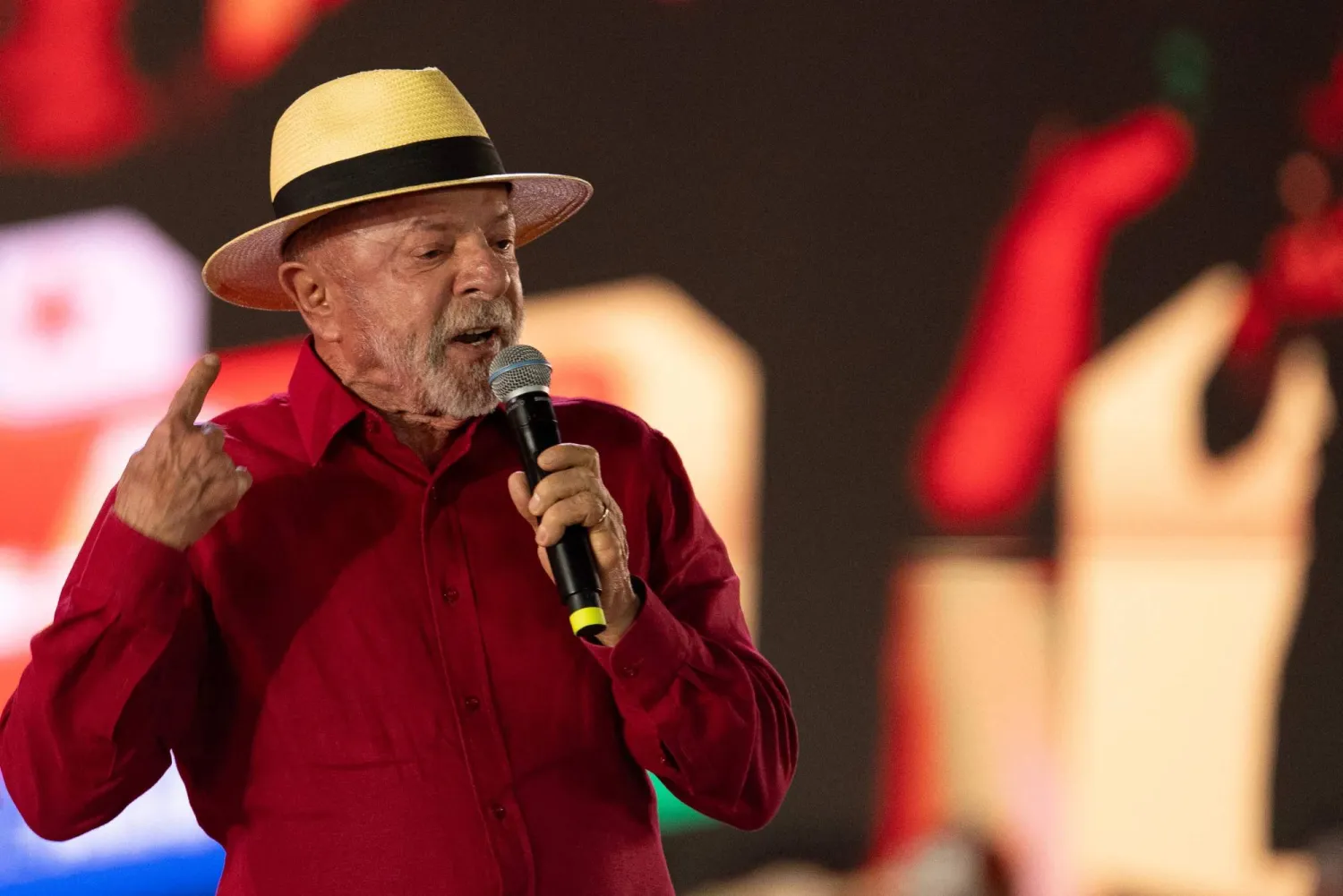
Brazil's President Luiz Inacio Lula da Silva speaks during a campaign rally at Praca da Estacao in Belo Horizonte, Minas Gerais state, Brazil on August 21, 2026. (AFP)
TT

Brazil’s Lula Urges Tariffs Resolution in Call with Trump

Brazil's President Luiz Inacio Lula da Silva speaks during a campaign rally at Praca da Estacao in Belo Horizonte, Minas Gerais state, Brazil on August 21, 2026. (AFP)

Brazilian President Luiz Inacio Lula da Silva urged US counterpart Donald Trump in a phone call Friday to resolve their countries' trade dispute, saying US tariffs were imposed on "baseless" grounds.

Washington imposed two new sets of tariffs on the Latin American giant in July, a move that has become a key campaign issue ahead of Brazil's presidential election in October.

Lula -- seeking a fourth and final term -- told Trump that the tariffs "negatively affect both Brazil and the United States," according to a statement from his office.

"To remain at the negotiating table is the best option for both countries," he said.

Relations between Trump and the leftist Lula have blown hot and cold in recent months, but diplomatic tensions have flared as the election approaches.

Trump has backed several victorious right-wing candidates in recent Latin American elections. He is an ally of Brazil's jailed far-right former president Jair Bolsonaro, whose son Flavio is Lula's main election rival.

The Brazilian presidency statement said the conversation between Trump and Lula lasted an hour and 20 minutes and "took place in a friendly and cordial tone."

During a campaign event in the southeastern state of Minas Gerais, Lula said Trump asked Commerce Secretary Howard Lutnick to contact his Brazilian counterpart Marcio Elias Rosa "and they already scheduled a meeting."

He added that Trump acknowledged during their call that the tariffs on Brazil are "based on a lie."

Lula, who like Trump is 80, has made national sovereignty a key theme of his campaign.

In an interview last week, he warned Trump: "Don't meddle in Brazil's affairs, especially regarding the election. If you do meddle, you'll lose."

"I said, 'Hey Trump, if you want to fight organized crime, let's fight organized crime,'" Lula told the crowd in Minas Gerais. "We want to work together. What we don't want is interference in Brazil."

- 'Daily terror'-

The two leaders have often appeared to get on well one-on-one, with Trump last year hailing an "excellent chemistry" with Lula.

The US last year dropped punitive tariffs it imposed over the trial against Jair Bolsonaro, which Trump labelled a "witch hunt," after diplomatic efforts by Lula's government.

However, Lula then suffered a blow after a May visit to the White House by Flavio Bolsonaro.

Two days later, the US designated Brazil's two largest drug cartels as terrorist organizations, which Flavio has said was a personal request.

"These criminal groups inflict daily terror on the most vulnerable populations, but they are not the same as terrorist organizations," Lula told Trump.

Security is the main concern of Brazilians heading into this year's elections, polls have shown.

Flavio Bolsonaro is pushing for a tough-on-crime model like that of El Salvador's President Nayib Bukele, whose sweeping crackdown on gangs and mass detentions have drawn controversy.

- Deforestation and PIX -

The United States imposed a 25-percent tariff on a range of Brazilian goods over policies it argued harm US commerce, such as deforestation and a free electronic payments system known as PIX.

Brazilian data shows deforestation in the Amazon fell last year to its lowest point since 2016.

Brazil was also impacted under a separate global tariff regime against US trading partners accused of using forced labor.

Lula has repeatedly said he believes it was US Secretary of State Marco Rubio and not Trump who was behind the tariffs against Brazil.

"Trump is the best of the lot, and the one who talks most seriously with me," he said last week.



Saudi Arabia Outlines 3 Pathways to Explore Uranium Resources Locally

Saudi Minister of Energy, Minister of Industry and Mineral Resources Prince Abdulaziz bin Salman bin Abdulaziz speaks at the IAEA conference in Vienna on Monday. (SPA)
TT

Saudi Arabia Outlines 3 Pathways to Explore Uranium Resources Locally

Saudi Minister of Energy, Minister of Industry and Mineral Resources Prince Abdulaziz bin Salman bin Abdulaziz speaks at the IAEA conference in Vienna on Monday. (SPA)

Saudi Arabia is moving forward with integrating nuclear energy into its national mix while developing its domestic uranium resources and building an integrated mineral value chain.

This chain spans from exploration and mining to processing, separation, refining, and the production of yellowcake, in an approach aimed at maximizing the economic value of its natural resources and boosting security of supply.

Speaking at the 70th General Conference of the International Atomic Energy Agency (IAEA) in Vienna, Saudi Minister of Energy, Minister of Industry and Mineral Resources Prince Abdulaziz bin Salman bin Abdulaziz said: “Over the decades, the Kingdom has established its position as a reliable energy supplier and an active partner in the stability of global energy markets.”

“Along with this role, the Kingdom is moving forward with developing a national energy mix from different energy sources that is more diverse and sustainable, based on integrated economic and development considerations,” he added.

“This includes introducing nuclear energy into this mix, within a well-established regulatory framework and in accordance with the Kingdom's international obligations,” he stressed.

“Our meeting today comes at a time when the world is witnessing rapid growth in energy demand, driven by economic, technological and industrial expansion. Amid these developments, diversifying energy sources and enhancing their reliability and sustainability have become essential to supporting economic growth and ensuring security of supply,” he said.

Prince Abdulaziz bin Salman said that the National Atomic Energy Project is advancing a program to explore uranium resources and assess opportunities for their economic utilization through several interconnected tracks.

The first involves recovering uranium associated with phosphoric acid produced in phosphate fertilizer operations in the north of the Kingdom, taking into account Saudi Arabia's position as the world's second-largest exporter of phosphate fertilizers.

He noted that pilot work carried out in cooperation with the French company Orano has yielded promising economic indicators for uranium recovery from these operations. This cooperation culminated in the signing of a memorandum of understanding during the visit of Prince Mohammed bin Salman, Crown Prince and Prime Minister, to France in August.

“Exploration and geological studies at the Jabal Sayid project in Madinah Region have identified estimated resources of around 114 million tons of ore containing high concentrations of rare earth elements, particularly heavy rare earth elements, alongside promising concentrations of uranium,” revealed Prince Abdulaziz bin Salman.

“This places the project among the most significant rare earth resource sites currently under development globally. This direction gained further momentum during the visit of the Crown Prince to the United States in November 2025, when the two countries signed a framework for cooperation on critical minerals and securing supply chains,” he went on to say.

This was followed by a partnership between the Saudi Arabian Mining Company, Ma'aden, and the American company MP Materials to develop capabilities for the processing and separation of rare earth elements and the production of associated uranium.

Prince Abdulaziz bin Salman stated that the Kingdom is continuing its efforts, through the Sedimentary Cover Survey Initiative, to explore additional uranium ores from conventional sources.

He added that these resources take on particular significance when viewed in the context of the Kingdom's broader advantages. The Kingdom combines promising mineral resources, competitive energy supplies, advanced infrastructure, growing industrial and investment capabilities, a strategic location, and effective international partnerships.

The Kingdom's ambition does not stop at producing raw materials or exporting concentrates, rather it extends to building an integrated economic and industrial value chain for all these minerals, he said.

This begins with exploration and mining and progressing through processing, separation and refining; the production of rare earth oxides; the recovery and purification of associated uranium; and the production of yellowcake and the development of its value chain, subject to economic feasibility, in accordance with the highest standards of transparency and within the framework of the Kingdom's international obligations, he noted.

Prince Abdulaziz bin Salman stressed that the Kingdom's exercise of its choices regarding the peaceful uses of nuclear energy goes hand in hand with the highest levels of responsibility and transparency.

This is consistent with the inherent right of States Parties to the Treaty on the Non-Proliferation of Nuclear Weapons to develop and use nuclear energy for peaceful purposes without discrimination.

He noted that, in exercising these rights, the Kingdom follows a clear approach founded on transparency, openness and international cooperation. It does not seek to develop its peaceful nuclear program in isolation from the international community, nor through activities conducted in secrecy or facilities concealed deep within mountains.

Rather, the Kingdom is developing its capabilities through trusted international partnerships that strengthen confidence and support the nuclear non-proliferation ecosystem, said the minister.

The Kingdom continues to strengthen its national framework and regulatory ecosystems governing nuclear energy and its applications, based on its conviction that confidence rests on strong national institutions, well-established regulatory frameworks and national capabilities said Prince Abdulaziz bin Salman.

The Kingdom also continues to boost its preparedness for nuclear and radiological emergencies, reinforce a culture of nuclear safety and security, and strengthen technical cooperation with the agency and international partners, he stressed.

He reaffirmed the Kingdom's full support for the IAEA and its commitment to continuing constructive cooperation with the agency and its member states in a manner that strengthens international confidence and contributes to a more secure, sustainable and prosperous future for all.


Chevron Eyes Argentina, Mediterranean for Global LNG Growth, Deal with India

Freeman Shaheen, the president of Chevron Global Gas, participates in a discussion at the Gastech conference in Houston, Texas, US, September 18, 2024. REUTERS/Callaghan O'Hare
TT

Chevron Eyes Argentina, Mediterranean for Global LNG Growth, Deal with India

Freeman Shaheen, the president of Chevron Global Gas, participates in a discussion at the Gastech conference in Houston, Texas, US, September 18, 2024. REUTERS/Callaghan O'Hare

Chevron is looking to expand its global gas portfolio from Argentina to the Mediterranean to meet growing demand from buyers concerned about energy security due to the crisis in the Middle East, President of Global Gas Freeman Shaheen said.

Global gas markets have experienced two major disruptions in the past four years as the Ukraine war in 2022 and the Iran conflict this year cut off supplies from top producers Russia and Qatar and drove liquefied natural gas prices higher.

"What we're seeing from this crisis is that it just reinforces the need for diversity — diversity of supply and diversity of different contracting structures," Shaheen said, adding, "and not leaving yourselves susceptible to a spot market that's not really as liquid ⁠as crude and ⁠products."

Chevron will have about 20 million metric tons per annum of LNG supply capacity comprising 16 million tons of net gas production from its projects and 4 million tons contracted from the US Gulf Coast that commenced in February this year and will ramp up over the next few years in line with agreements.

"We're looking to continue to expand that portfolio," Shaheen said in an interview on the sidelines of the Gastech conference in Bangkok.

"There's great prospects out of ⁠Argentina with the development of crude and gas in that marketplace. The East Mediterranean is a very exciting area for us as well."

He also sees further opportunities in Australia and Africa, provided the projects offer the right capital, fiscal and regulatory terms, adding that the US-Iran war has reinforced the need for a diversified gas portfolio.

Shaheen did not elaborate on where in Africa, Australia or the eastern Mediterranean the company might expand. In June, Chevron won approval to become operator and lead gas exploration in an offshore block off Greece, expanding its presence there.

However, these opportunities have to be weighed against Venezuela, where Chevron and its partners would invest more than $7 billion to more than double oil output by 2031.

"I've been hearing that ⁠Venezuela has a lot ⁠of capital that's going to have to go that way coming up," Shaheen told Reuters.

"Everything is going to get analyzed in our project queue and it gets ranked."

Chevron already has significant operations in Australia, running the country's largest LNG project, Gorgon, and the Wheatstone project. A large portion of its Australian supply goes to Japan.

"Japan continues to be our home base, and we have nice structural opportunities into Singapore," Shaheen said, adding that China and Korea remain attractive markets.

In Singapore, Chevron inked a deal in 2024 to supply Sembcorp Industries up to 0.6 million tons per annum of LNG from 2028.

LNG buyers are also changing the way they secure supply, he said, with state-backed importers increasingly willing to sign contracts with portfolio suppliers rather than relying on government-to-government arrangements.

"I'd love to have a deal in India. It's just they're very, very headline-price driven," Shaheen said. "I think India is still evolving. There's going to be great opportunities over time."


Maersk, Hapag-Lloyd Resume Further Services Through Suez Canal

FILE PHOTO: Shipping containers sit on a Maersk vessel docked at the port of Los Angeles in Long Beach, California, US, March 10, 2026. REUTERS/Caroline Brehman/File Photo
TT

Maersk, Hapag-Lloyd Resume Further Services Through Suez Canal

FILE PHOTO: Shipping containers sit on a Maersk vessel docked at the port of Los Angeles in Long Beach, California, US, March 10, 2026. REUTERS/Caroline Brehman/File Photo

Shipping group Maersk said on Monday it will resume four further of its container services with Germany's Hapag-Lloyd through the Suez Canal, as they gradually ⁠return to using the ⁠shortcut between Asia and Europe.

The Asia-Europe trade corridor through the Suez Canal was abandoned ⁠by most shippers earlier this decade after attacks in the Red Sea by Yemen's Houthis, forcing ships to take the much longer trip around Africa's Cape of Good Hope.

The two ⁠companies ⁠in early July and later again in August announced that they would resume some services connecting Asia, the Mediterranean and Europe through the Suez Canal.