HUMAIN, Mistral Collaborate to Advance Sovereign AI in Saudi Arabia and Regionallyhttps://english.aawsat.com/business/5310876-humain-mistral-collaborate-advance-sovereign-ai-saudi-arabia-and-regionally
HUMAIN, Mistral Collaborate to Advance Sovereign AI in Saudi Arabia and Regionally
Guests at the booth of Saudi AI company HUMAIN during the Future Investment Initiative conference in Riyadh (Company photo)
Saudi Arabia’s HUMAIN and French Artificial Intelligence company Mistral have announced a strategic collaboration spanning AI infrastructure, advanced model development, and the deployment of AI solutions in Saudi Arabia and across the region.
“Together, the companies will pursue the development and localization of advanced AI models, with initial areas of focus including cybersecurity and voice,” HUMAIN said in a statement on Monday.
“The companies also plan to develop frontier models that perform strongly in Arabic language to help support the broader region. This represents a collaboration in the hundreds of millions of Euros.”
“As part of the collaboration, Mistral will explore using HUMAIN's data center infrastructure to support growing local compute needs,” said the statement.
It added that the two companies also plan to develop a joint go-to-market strategy in the Kingdom focused on bringing advanced AI solutions to regulated industries.
CEO of HUMAIN Tareq Amin said on X that “the collaboration spans AI infrastructure, advanced model development and AI solutions, including plans to develop and localize frontier models with strong Arabic-language capabilities.”
According to the HUMAIN statement, “the collaboration is designed to meet growing demand for sovereign AI: AI that keeps data, intelligence, compute, and operations under the customer's control.”
“That means data can remain within customer-defined boundaries, models can be adapted and owned on open weights, training and inference can run on infrastructure and in jurisdictions the customer chooses, and AI systems can be deployed, governed, observed, and improved over time without ceding control of the learning loop to an external platform.”
The statement stressed its importance in financial services, manufacturing, telecommunications, cybersecurity, and the public sector.
EU Officially Limits Imports of Chinese Hybrid Vehicleshttps://english.aawsat.com/business/5345013-eu-officially-limits-imports-chinese-hybrid-vehicles
Vehicles identified as a Chinese-manufactured Chery Jaecoo J5 EV and an Omoda 9 plug-in hybrid are parked at a lot in Toronto, Ontario, Canada, May 4, 2026. (Reuters)
TT
TT
EU Officially Limits Imports of Chinese Hybrid Vehicles
Vehicles identified as a Chinese-manufactured Chery Jaecoo J5 EV and an Omoda 9 plug-in hybrid are parked at a lot in Toronto, Ontario, Canada, May 4, 2026. (Reuters)
The European Union on Tuesday officially put in place import quotas on hybrid vehicles to protect domestic industry, following a deal struck with China last month.
Brussels and Beijing agreed to limit exports of Chinese plug-in hybrids and other hybrid vehicles to the 27-nation bloc as part of a deal to avoid a trade war.
The EU said the import cap would kick in from December 1.
"These restrictions are needed to protect EU industry against a sharp recent increase in imports of such vehicles," the European Commission said.
While mainly aimed at Chinese cars, the measure will apply to all hybrid imports regardless of their origin, in compliance with international trade rules.
Brussels has long accused China of unfair trade practices, including price dumping, currency manipulation and state subsidies.
Officials and companies say the measures undermine EU companies and lead to job losses.
"The surge in imports of hybrid passenger vehicles into the EU has been driven by growing global production overcapacity," the commission said.
"It is also prompted by increased use of trade-restrictive measures in other major markets."
Hybrid vehicles are among the most popular EV models for European consumers, and Chinese makers have profited from their lower-price models to gain huge market shares at the expense of European producers.
For major exporters the EU import quota was set at just over 15 percent above the level of imports from those countries in 2025.
Brussels said in October that hybrid vehicles from China would be capped to 350,000 a year, after previously forecasting imports of up to 800,000 units in 2026.
West Africa’s Rush to Refine Its Own Gold Unleashes Flood of Capacityhttps://english.aawsat.com/business/5344937-west-africa%E2%80%99s-rush-refine-its-own-gold-unleashes-flood-capacity
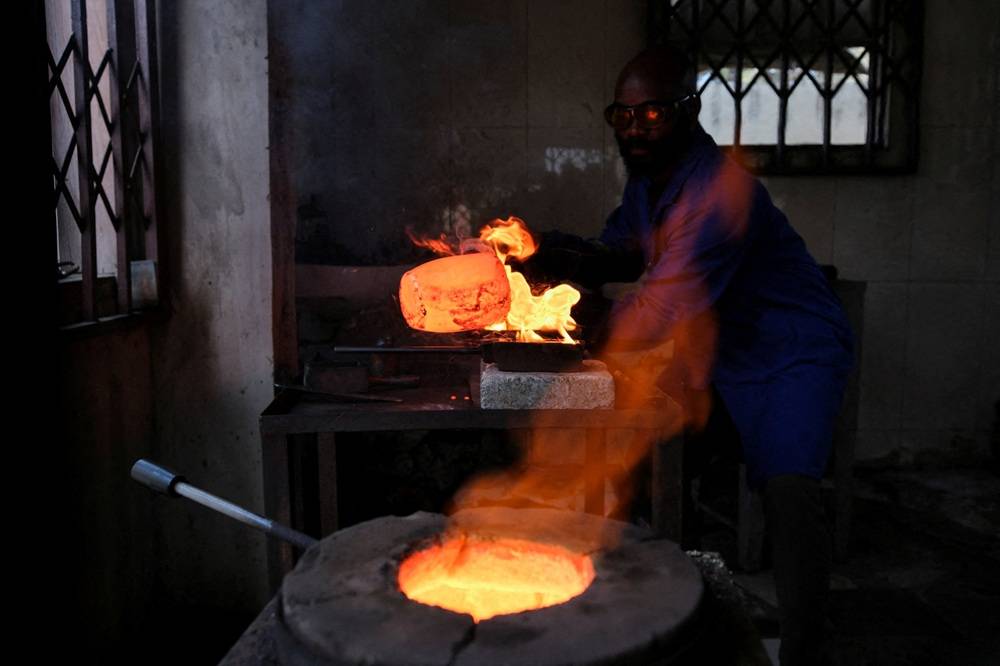
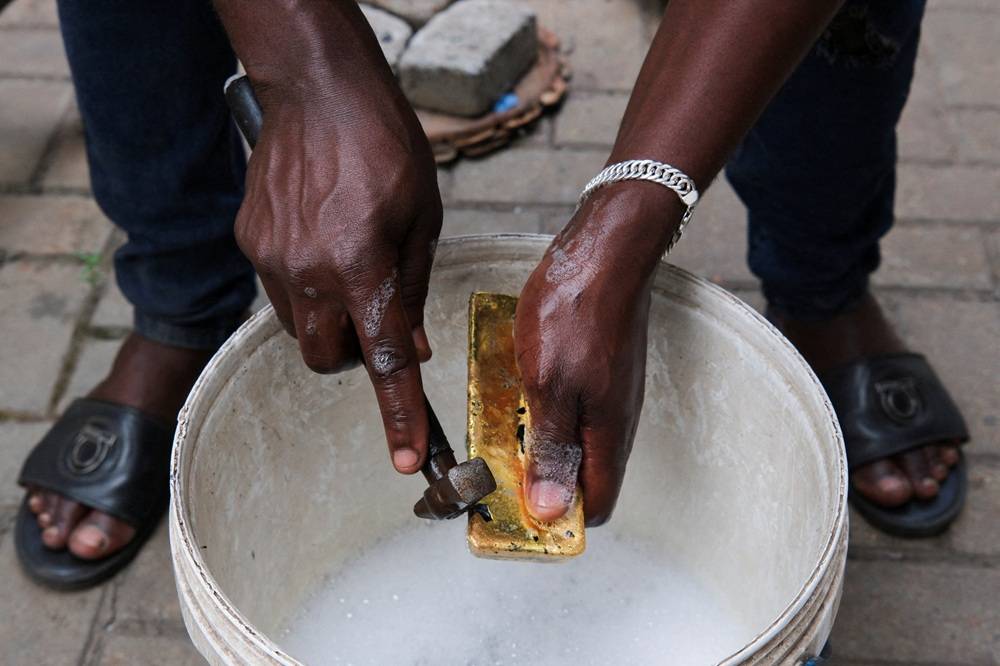
A worker washes off excess impurities during a gold smelting process at a facility in Accra, Ghana August 22, 2024. (Reuters)
TT
TT
West Africa’s Rush to Refine Its Own Gold Unleashes Flood of Capacity
A worker washes off excess impurities during a gold smelting process at a facility in Accra, Ghana August 22, 2024. (Reuters)
West African governments are racing to refine gold at home to capture more mining revenue from soaring prices and reduce reliance on foreign hubs.
But miners and investors warn the region may be building more refining capacity than it has gold to process, raising the risk of idle plants and weaker returns for investors and governments. Producers could face lower prices if local refineries lack access to major bullion markets.
Since 2024, Ghana, Guinea, Mali and Burkina Faso have launched or announced projects with combined annual capacity that is nearly double West Africa's gold output.
Unlike bauxite or iron ore, where processing can significantly increase value, gold's worth is largely realized before refining. Four mining executives said that leaves refiners competing in a low-margin business where commercial success depends more on scale, accreditation and access to global markets.
A worker smelts gold at a facility in Accra, Ghana August 22, 2024. (Reuters)
MORE REFINERIES THAN GOLD
"There is already overcapacity in terms of gold refining across Africa and globally," Rand Refinery chief executive Dean Subramanian told Reuters.
"The risk is additional processing capacity competing for the same accessible, responsibly sourced feedstock."
Since 2024, West African governments have launched or commissioned at least four major gold refineries with combined annual capacity of more than 1,000 metric tons, compared with estimated regional output of about 585 tons.
Despite operating several underutilized refineries, Ghana, Africa's largest gold producer, plans a new 600-ton-per-year refinery in 2027.
The CEO of the Ghana Chamber of Bullion Traders, Dan Krampah, said there is no "economically compelling case for another refinery."
THERE'S MORE TO DOMESTIC REFINING THAN MARGINS
Governments argue that refining projects should be judged on broader economic and strategic objectives rather than refining margins alone.
Supporters of local refining argue it could help formalize artisanal mining, gold mining carried out by individual miners or small groups, and give central banks greater access to domestic gold supplies.
Ghana has expanded domestic gold purchases as part of efforts to strengthen foreign-exchange reserves, an approach other African governments are studying.
Yet investors caution that localization does not guarantee commercial viability.
"Governments are increasingly pushing for local processing and refining, which is a noble goal, but many countries still lack the power, infrastructure, skills and capital required to support it at scale," said Appian Capital Advisory CEO Michael Scherb.
A worker washes off excess impurities during a gold smelting process at a facility in Accra, Ghana August 22, 2024. (Reuters)
CERTIFICATION HEADACHES
Another issue facing some of the new refiners is their lack of certification under the London Bullion Market Association (LBMA), complicating access to key markets.
LBMA Good Delivery accreditation allows refiners to access the world's largest bullion-trading networks and is often a prerequisite for selling to major banks, traders and central banks.
In Guinea, miners are already stockpiling gold as they adapt to new local refining requirements.
Three executives said refining fees, settlement terms and marketing arrangements remain unclear, raising fears locally refined gold could trade at a discount.
Guinea's Mines Minister Bouna Sylla remains bullish, saying the country is aiming to build a broader domestic gold ecosystem centered on traceability and central-bank reserves, in order to compete with the region's dominant gold market, Dubai.
"We need to make Guinea competitive and create a transparent system that can attract business," he said.
Gold Edges Lower as Markets Await US Inflation Datahttps://english.aawsat.com/business/5344936-gold-edges-lower-markets-await-us-inflation-data
A 5-gram and a 10-gram, 24-karat gold bar featuring Disney characters and marked with the logo of BTC (Bullion Trading Center) are displayed at a gold retailer in Cairo, Egypt, November 23, 2026. (Reuters)
TT
TT
Gold Edges Lower as Markets Await US Inflation Data
A 5-gram and a 10-gram, 24-karat gold bar featuring Disney characters and marked with the logo of BTC (Bullion Trading Center) are displayed at a gold retailer in Cairo, Egypt, November 23, 2026. (Reuters)
Gold prices inched lower on Tuesday as investor focus shifted to US inflation data for fresh clues to the Federal Reserve’s rate outlook.
Spot gold fell 0.3% to $3,619.95 per ounce by 0635 GMT after touching its lowest level since September 2025 on Friday. US gold futures dropped 0.9% to $3,619.00.
"Last week, hawkish signals from the Federal Reserve coincided with a rout in AI stocks, and investors sold bullion to cover losses and raise cash. Some of that pressure has faded, although the metal could remain under pressure amid monetary policy tightening expectations," said Bas Kooijman, CEO and asset manager of DHF Capital S.A.
Although gold is seen as an inflation hedge, higher interest rates reduce its appeal by increasing the opportunity cost of holding the non-yielding asset.
Markets currently see a 93.5% chance of a 25-basis-point rate increase at the Fed's policy meeting in December, while a larger 50-bp hike is priced in at 6.5%, according to CME's FedWatch tool. The US central bank last raised rates in September.
New York Fed President John Williams said on Monday that persistently high inflation continues to point the US central bank towards tighter monetary policy, while stressing that the pace of future rate hikes will depend on incoming economic data.
The US Personal Consumption Expenditures (PCE) Index, a key gauge closely watched by the central bank as it targets a 2% inflation rate, is due on Wednesday.
Data showed US business activity growth slowed further in November as high prices held back new orders and capacity constraints restrained output, but overall activity remained resilient.
Among other metals, spot silver fell 1.9% to $42.23 per ounce, platinum slid 2.7% to $1,288.75 and palladium dropped 1.2% to $882.35.
لم تشترك بعد
انشئ حساباً خاصاً بك لتحصل على أخبار مخصصة لك ولتتمتع بخاصية حفظ المقالات وتتلقى نشراتنا البريدية المتنوعة