


Gold Extends Gains to Scale One-week High as Crude Prices Ease

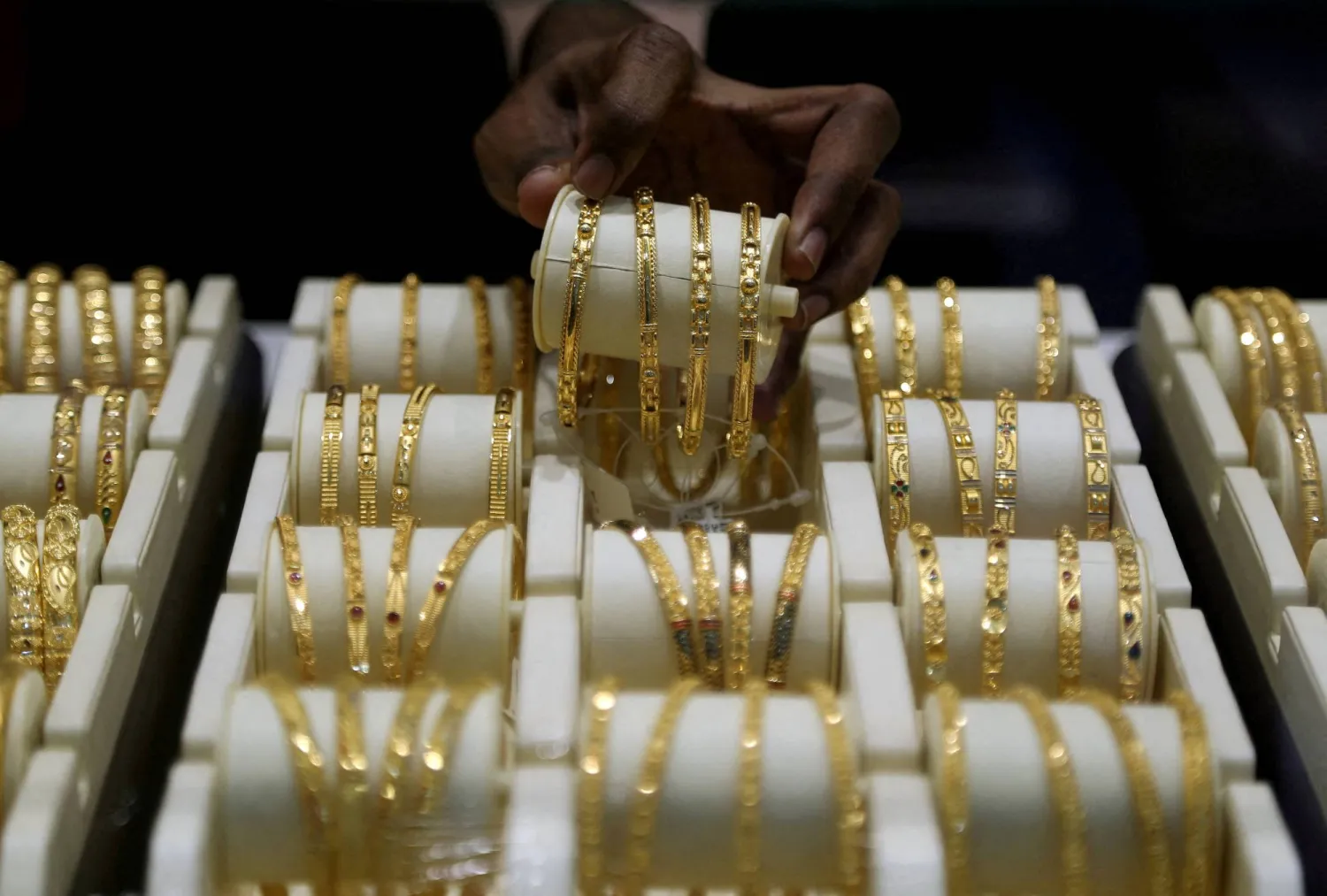
FILE PHOTO: A salesman arranges gold bangles inside a jewelry showroom on the occasion of Akshaya Tritiya, a major gold buying festival, in Mumbai, India, May 7, 2019. REUTERS/Francis Mascarenhas/File Photo/File Photo
TT

Gold Extends Gains to Scale One-week High as Crude Prices Ease

FILE PHOTO: A salesman arranges gold bangles inside a jewelry showroom on the occasion of Akshaya Tritiya, a major gold buying festival, in Mumbai, India, May 7, 2019. REUTERS/Francis Mascarenhas/File Photo/File Photo

Gold rose for a second straight session on Friday, hitting a one-week high, as oil prices fell, while investors kept a close watch on developments in the Middle East conflict.

Spot gold was up 1.1% at $4,387.69 per ounce by 0829 GMT, and was on track for a weekly gain ‌of 1%.

US ‌gold futures rose 0.6% to $4,428.

Oil prices fell ‌for ⁠a third straight ⁠session, as easing concerns over supply disruptions outweighed anxiety about a widening Middle East conflict.

"The precious metal appears to have taken the Fed's hawkish signals in stride, instead finding immediate relief from falling oil prices amid hopes that the Fed's hiking cycle will prove shallow," said Han Tan, chief market analyst ⁠at Bybit.

Although gold is traditionally viewed as ‌a hedge against inflation, higher rates ‌can curb its demand by increasing the appeal of yield-bearing assets.

The ‌US Federal Reserve raised interest rates on Wednesday and flagged ‌more hikes in the coming months.

Goldman Sachs said in a note that it expects "the impact of tighter monetary policy to be felt primarily through a slower near-term appreciation path rather than a lower ‌terminal gold price."

Meanwhile, the Bank of Japan raised interest rates to a 31-year high and signaled ⁠its readiness ⁠to keep pushing up borrowing costs, joining other major central banks in fighting persistent inflation pressures.

"Looking ahead, the state of the conflict in the Middle East will be a key factor influencing gold prices. If the conflict prolongs and oil prices remain high well into next year, that could prompt central banks to raise rates more than investors expect, which would put downward pressure on gold prices," said Hamad Hussain, a climate and commodities economist at Capital Economics.

Spot silver rose 2.7% to $66.98, platinum gained 2.6% to $1,814.95 and palladium added 3.1% at $1,330.95. All metals were headed for a weekly gain.



5 Countries Want Smaller Growth of Next EU Budget, Spain Offers Ideas

FILE PHOTO: European Union flags flutter outside the European Commission headquarters in Brussels, Belgium April 29, 2026. REUTERS/Yves Herman/File Photo
TT

5 Countries Want Smaller Growth of Next EU Budget, Spain Offers Ideas

FILE PHOTO: European Union flags flutter outside the European Commission headquarters in Brussels, Belgium April 29, 2026. REUTERS/Yves Herman/File Photo

Germany, Denmark, Finland, the Netherlands and Austria said on Friday the European Union's budget for 2028-2034 must be "several hundred billion euros" smaller than the €2 trillion proposed by the European Commission, drawing battle lines before EU budget talks come to a head in the next three months.

The leaders of the five countries, among the biggest net contributors to the budget, wrote in a joint op-ed in Politico that EU taxpayers ⁠cannot keep paying ⁠more to pay for both old and new priorities.

"It (the budget) is too focused on subsidies and transfers allocated largely in advance, leaving too little room for what Europe urgently needs: common investment in security and defense, competitiveness, innovation, and the fight against irregular migration," the five leaders said.

Net beneficiaries of the EU budget are concerned that ⁠would reduce EU funds for farmers and for equalizing standards of living between the poorer and richer regions of Europe -- a major political concern before parliamentary elections next year in France, Italy, Spain, Poland, Greece, Finland, Slovakia and Estonia.

The European Commission has proposed the budget should amount to €2 trillion or 1.26% of EU Gross National Income (GNI), of which some 168 billion, or 0.11% of GNI, is to service the EU's borrowing for the post-pandemic recovery fund. The five leaders called the proposed nominal increase of around 60% over the 2021-2027 budget "simply not ⁠realistic."

"This is ⁠why we call for a balanced cut to the Commission’s proposal of several hundred billion euros," Reuters quoted them as saying.

To help find a solution, Spain proposed to change the repayment schedule of part of the EU post-pandemic borrowing, linking it to economic growth and spreading it out over a longer period. This, according to Spanish Economy Minister Carlos Cuerpo, would free up some €70 billion.

"An annual payment of about 0.06% of EU GDP would retire the debt by 2058, the deadline agreed by member states," Cuerpo said.

EU governments will discuss the next EU budget at summits in October, November and December in an effort to get a deal before the end of the year.


State Street: Saudi Arabia Has ‘Unique Opportunity’ to Build Modern Digital Financial Infrastructure

A keyboard and robotic hands are pictured in front of the words “Artificial Intelligence” (Reuters) 
TT

State Street: Saudi Arabia Has ‘Unique Opportunity’ to Build Modern Digital Financial Infrastructure

A keyboard and robotic hands are pictured in front of the words “Artificial Intelligence” (Reuters) 

As global financial market infrastructure undergoes rapid change, digital assets are moving beyond blockchain proof-of-concept experiments toward institutional implementation, driven by evolving regulatory frameworks, growth in digital money solutions and increasing interest among major investment institutions in asset tokenization and new approaches to settlement and liquidity management.

Angus Fletcher, State Street’s global head of Digital Solutions, told Asharq Al-Awsat that digital assets had moved beyond the technology proof-of-concept stage toward redesigning how financial markets operate.

He said the convergence of digital assets, digital money and artificial intelligence was paving the way for a new operating model for the financial sector, adding that Saudi Arabia had a unique opportunity to build modern financial infrastructure that harnesses these shifts as part of its Vision 2030 goals.

From experimentation to implementation

Fletcher explained that financial institutions are no longer focused on blockchain experiments or simply demonstrating the feasibility of asset tokenization. Instead, they are increasingly looking to leverage these technologies to enhance capital markets, investment and settlement processes, liquidity management, and cross-border activities.

Recent years have brought significant developments, including clearer regulatory frameworks, growth in digital money solutions, the launch of tokenized investment products and greater participation by financial institutions, he noted.

Tokenization as an infrastructure catalyst

According to Fletcher, asset tokenization was not an end in itself but rather a catalyst for developing financial market infrastructure.

Its real value, he said, lies in making assets more efficient and useful by improving settlement, collateral management, distribution and liquidity. Tokenized money market funds, government securities and private assets are among the categories most likely to see wider adoption in the coming years.

Faster payments, more efficient capital flows

Digital money, including stablecoins and tokenized deposits, could help integrate the movement of assets, cash and data into a more unified system than the current financial system, he remarked.

This could make cross-border investment flows more efficient, reduce trapped liquidity and improve collateral mobility between different markets.

AI, meanwhile, will play an increasingly important role in liquidity management and improving settlement and financing decisions in a financial environment increasingly operating in real time.

Regulatory and operational challenges

Fletcher noted that the industry still needed greater regulatory consistency, stronger interoperability among different market infrastructures and operating models capable of handling digital assets on a broad institutional scale.

Many institutions continue to rely on systems and infrastructure designed for a different financial era, limiting their ability to fully benefit from tokenization.

AI could help overcome some of these obstacles by automating reconciliation, streamlining operational processes and improving risk management and compliance requirements, he added.

Fletcher stressed that regulatory frameworks were fundamental to institutional investor confidence. Financial institutions were not seeking a less regulated environment, but clear rules providing legal certainty, investor protection and operational flexibility.

Such regulations give institutions the confidence needed to move from pilot projects to actual implementation, he said.

Three layers for digital market growth

Fletcher identified three main infrastructure layers needed to support the next phase of growth.

The first is digital money, including tokenized deposits, regulated stablecoins and other forms of digital cash used for settlement.

The second encompasses identity, governance, compliance, cybersecurity and operational resilience systems. The third is an “intelligence layer” that uses AI to improve liquidity and collateral management, risk monitoring and operational efficiency.

Opportunities for Saudi Arabia

The State Street executive said Saudi Arabia had a unique opportunity to build modern financial infrastructure under Vision 2030, benefiting from its ability to integrate modern technologies and digital financial services into its long-term plans.

Among the Kingdom’s biggest opportunities are tokenizing investment funds and private markets, developing digital money solutions, and improving collateral mobility and cross-border investment flows.

AI-enabled financial services could also help strengthen Saudi Arabia’s position as a more efficient and interconnected global financial center, he added.

A more interconnected financial system

Fletcher expects the divide between traditional and digital finance to gradually diminish over the next five to 10 years, giving rise to a more interconnected financial system spanning multiple asset classes, forms of money and settlement models.

Markets will become more connected, programmable, and dynamic, while AI will play an increasingly important role in supporting decision-making and managing growing market complexity.

Asset tokenization will help connect assets, digital money will connect financial value, and AI will enhance decision-making, Fletcher concluded, accelerating the emergence of a more efficient and interconnected global financial system.

A keyboard and robotic hands are pictured in front of the words “Artificial Intelligence” (Reuters)


Shipping Traffic Via Strait of Hormuz Stays Below 10-day Average, Data Shows

Vessels transit the Hormuz Strait off the coast of Iran's southern port city of Bandar Abbas on September 7, 2026. (Photo by ATTA KENARE / AFP) /
TT

Shipping Traffic Via Strait of Hormuz Stays Below 10-day Average, Data Shows

Vessels transit the Hormuz Strait off the coast of Iran's southern port city of Bandar Abbas on September 7, 2026. (Photo by ATTA KENARE / AFP) /

Four commodity vessels transited the Strait of Hormuz in the Gulf on Thursday, down from six a day earlier and below the 10-day average of about 16, preliminary shipping data showed on Friday.

The figures could change as some ships typically switch off their transponders during the voyage to avoid the risk of detection in the conflict zone, said Reuters.

Of the four vessels, three were entering ‌the strait ‌heading into the Gulf and one ‌was ⁠exiting, the data ⁠from shiptracker Kpler showed at 0200 GMT.

The vessels included two Panamax tankers, one Supramax ship and one Kamsarmax vessel. The waterway carried a fifth of the world's oil and gas before the Iran conflict.

Meanwhile, 23 commodity vessels transited ⁠the Bab el-Mandeb Strait on Thursday, another ‌maritime chokepoint on ‌the southwest tip of Yemen and a vital trade route ‌for oil between the Red Sea and ‌the Gulf of Aden.

The data showed 13 vessels heading towards the Red Sea and 10 towards the Gulf of Aden. They included a Panamax and ‌a Suezmax tanker, four Supramax vessels and six Aframax tankers.

The number compares with ⁠an ⁠average of around 26 ships using the strait in the past 10 days.