



Bolivia Approves $1.9 Billion IMF Deal, Eliminates Diesel Subsidies

A person is counting dollars in La Paz, Bolivia, 10 July 2026. (EPA)
TT

Bolivia Approves $1.9 Billion IMF Deal, Eliminates Diesel Subsidies

A person is counting dollars in La Paz, Bolivia, 10 July 2026. (EPA)

Bolivian lawmakers approved a $1.9 billion loan agreement with the International Monetary Fund on Friday, delivering the conservative government a key victory in its efforts to ease the country's deep economic crisis as unions threatened renewed protests.

Just hours after Congress approved the loan, President Rodrigo Paz announced an immediate end to subsidies for the diesel powering Bolivia’s trucks, buses and tractors — a step toward meeting IMF demands. Gasoline, used mainly in private cars, would remain subsidized for now, though Paz had already scaled back that support in recent months, The Associated Press said.

The Senate ratified the IMF agreement a day after the lower house approved it, clearing the final legislative hurdle for the three-year financing program aimed at replenishing dwindling foreign reserves and stabilizing the ailing economy marked by high inflation and weak growth. The IMF first announced the staff-level agreement in July after months of negotiations with Paz’s market-friendly government, which took power last year after nearly two decades of socialist rule as part of a wave of new Latin American leaders allied with the Trump administration.

The program still requires approval from the IMF’s executive board before funds can be disbursed. Economy Minister Christian Morales told senators that the deal would give other lenders, including the World Bank and the Inter-American Development Bank, greater confidence in the government and help it secure about $5 billion in additional financing.

But the assistance is conditioned on tough economic measures, including the elimination of fuel subsidies, that threaten to reignite unrest in Bolivia, where weeks of road blockades in June and July paralyzed much of the South American nation as demonstrators demanded Paz’s resignation. Congress on Thursday extended for another 90 days a state of emergency that Paz had declared to clear roads during the protests. It allows for military intervention and the suspension of some civil liberties.

The Bolivian Workers’ Central, the country’s main labor federation, and other unions have voiced fierce opposition to the IMF loan, warning that the government spending cuts required under the deal would drive up living costs and deepen hardship for struggling families.

Although Paz’s Christian Democratic Party lacks a majority in Congress, the centrist and right-wing lawmakers that dominate both chambers rallied behind the deal. The Movement Toward Socialism, the party that dominated Bolivian politics after the former coca growers’ union leader Evo Morales won the presidency in 2005, now holds just two of the 130 seats in the lower house and none in the 36-member Senate.

Declining natural gas exports have deprived Bolivia of dollars needed to import gasoline and diesel, contributing to chronic fuel shortages that began in 2023 and have persisted under Paz. The Iran war has pushed up global fuel costs, making fuel subsidies an even greater burden on public finances.

“No one can buy something expensive and sell it cheap,” Paz said in his late-night declaration that diesel in Bolivia would now be sold at international prices.

To cushion the blow, he announced about $79 million in cash assistance for 2.9 million Bolivians, along with loans on preferential terms for truckers, small businesses and producers facing higher diesel costs. He pledged to redirect subsidy spending toward schools, hospitals and roads.

Saudi Minister of Energy Signs Energy Cooperation MoUs with Kuwait, Qatar and Egypt

Saudi Minister of Energy and Minister of Industry and Mineral Resources Prince Abdulaziz bin Salman bin Abdulaziz and Kuwait’s Minister of Electricity, Water and Renewable Energy Dr. Subaih Abdulaziz Abdulmohsen Al-Mukhizim. (SPA)
TT

Saudi Minister of Energy Signs Energy Cooperation MoUs with Kuwait, Qatar and Egypt

Saudi Minister of Energy and Minister of Industry and Mineral Resources Prince Abdulaziz bin Salman bin Abdulaziz and Kuwait’s Minister of Electricity, Water and Renewable Energy Dr. Subaih Abdulaziz Abdulmohsen Al-Mukhizim. (SPA)

Saudi Minister of Energy and Minister of Industry and Mineral Resources Prince Abdulaziz bin Salman bin Abdulaziz signed on Sunday three memoranda of understanding with ministers from Kuwait, Qatar and Egypt, expanding cooperation across a broad range of energy fields.

Prince Abdulaziz signed an MoU on electricity and renewable energy cooperation with Kuwait’s Minister of Electricity, Water and Renewable Energy Dr. Subaih Abdulaziz Abdulmohsen Al-Mukhizim.

The MoU establishes a framework for cooperation between Saudi Arabia and Kuwait in electricity, renewable energy, power grid interconnection and electricity exports, as well as energy efficiency, energy storage and smart grids. It also covers related areas including digital transformation, innovation, cybersecurity and artificial intelligence.

The two countries will also work to develop strategic partnerships between their institutions, localize energy-related materials, products and services, and strengthen cooperation between companies operating in these fields.

The MoU further provides for cooperation on technologies and solutions related to climate change mitigation, including Circular Carbon Economy technologies and solutions.

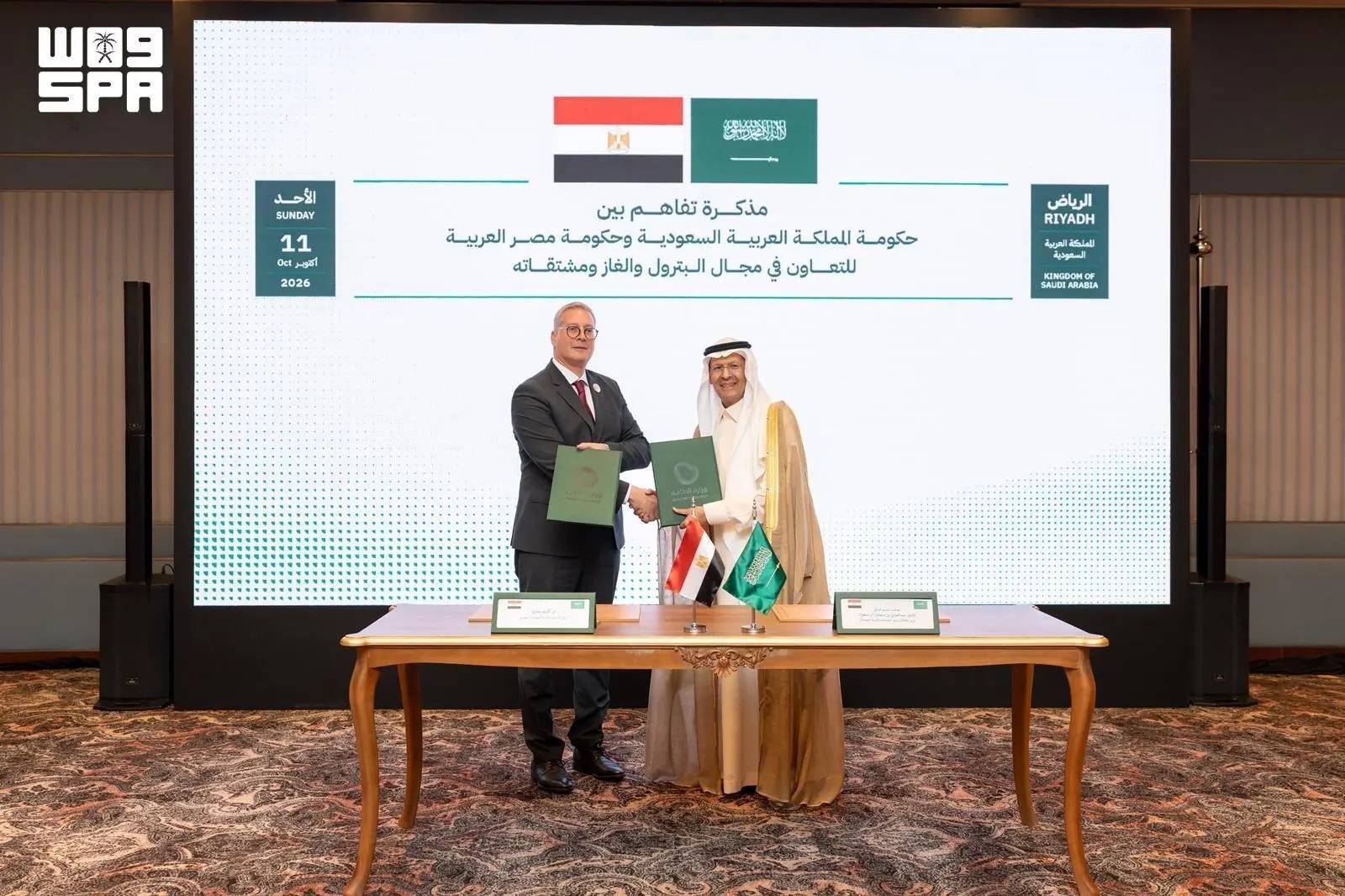
Saudi Minister of Energy and Minister of Industry and Mineral Resources Prince Abdulaziz bin Salman bin Abdulaziz and Egypt’s Minister of Petroleum and Mineral Resources Eng. Karim Badawi. (SPA)

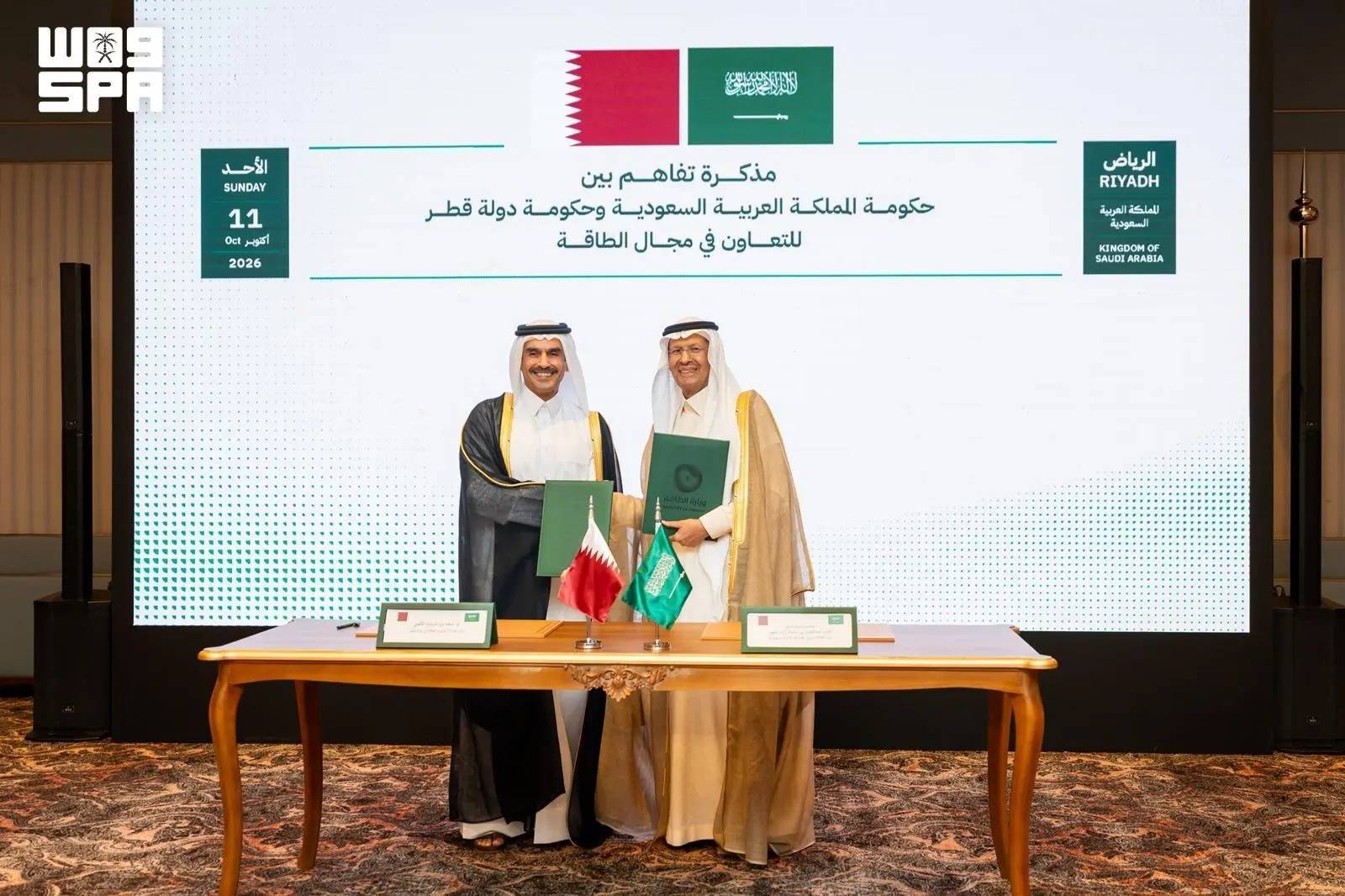
Prince Abdulaziz signed an MoU on energy cooperation with Qatar’s Minister of State for Energy Affairs Eng. Saad bin Sherida Al-Kaabi.

The MoU establishes a framework for cooperation between Saudi Arabia and Qatar across oil and petroleum products, gas and its derivatives, refining, petrochemicals, electricity, clean hydrogen and its derivatives, renewable energy, energy efficiency and energy storage.

It provides for the two countries to explore opportunities for joint projects involving pipelines for the transportation and export of oil and gas; the development and use of sustainable petrochemical materials in construction and other sectors; and cooperation on infrastructure to support access to energy.

The MoU covers cooperation in international negotiations, forums and organizations addressing energy transitions and climate change, including the United Nations Framework Convention on Climate Change, the Paris Agreement and the Intergovernmental Negotiating Committee tasked with developing an international legally binding instrument on plastic pollution, among others.

Prince Abdulaziz also signed an MoU with Egypt’s Minister of Petroleum and Mineral Resources Eng. Karim Badawi on cooperation in oil, gas and their derivatives.

Saudi Minister of Energy and Minister of Industry and Mineral Resources Prince Abdulaziz bin Salman bin Abdulaziz and Qatar’s Minister of State for Energy Affairs Eng. Saad bin Sherida Al-Kaabi. (SPA)

The MoU establishes a framework for Saudi-Egyptian cooperation in crude oil, petroleum products and natural gas, including their trade, handling, transportation, storage and distribution, as well as the development of related infrastructure and logistics.

The cooperation will strengthen energy market integration and supply chain resilience and reliability, enhance energy security, and help meet demand across domestic, regional and international markets. Activities will be carried out in accordance with the laws and regulations of both countries and on commercial terms that advance their mutual interests.

The agreement also covers the exchange of Saudi expertise in fuel station and service center qualification, operation and maintenance, as well as the Kingdom’s experience in opening the liquefied petroleum gas sector to competition. It expands cooperation in petrochemicals and investment in ongoing and planned projects.


Abdulaziz bin Salman: Riyadh is the Capital of Energy Security

Saudi Energy Minister Prince Abdulaziz bin Salman speaks at the opening of the ministerial meeting of the International Energy Forum (IEF) in Riyadh (Turki Al-Agili)
TT

Abdulaziz bin Salman: Riyadh is the Capital of Energy Security

Saudi Energy Minister Prince Abdulaziz bin Salman speaks at the opening of the ministerial meeting of the International Energy Forum (IEF) in Riyadh (Turki Al-Agili)

Saudi Energy Minister Prince Abdulaziz bin Salman stressed on Sunday that Riyadh represents the capital of energy security, noting that this status reflects the Kingdom's efforts, as well as those of the men and women working in the energy sector, to ensure reliable energy supplies and fulfill Saudi Arabia’s commitments to the world.

Achieving energy security requires cooperation among all countries, he said.

Speaking at the opening of the ministerial meeting of the International Energy Forum (IEF) in Riyadh, at the start of Riyadh Energy Week, the minister expressed hope that the gathering would help direct attention toward the most important issues that energy stakeholders should focus on.

He noted that the current period makes dialogue on energy security more important than ever and that in-person meetings enable participants to exchange assessments directly, discuss concerns, and build the understanding necessary for practical cooperation among nations.

He emphasized that Saudi Arabia will continue implementing its plans, meeting its domestic needs, and honoring its commitments to the world regardless of circumstances, stressing the Kingdom’s resilience and ability to continue advancing toward its objectives.

Prince Abdulaziz said that Saudi Arabia’s commitment to energy security is one of its defining characteristics and expressed hope that the event would help more participants understand the depth of that commitment.

“I am proud to say that this country, and the city of Riyadh, is the capital of energy security,” he said, attributing this standing to the efforts of the women and men working in the energy sector and to the work they undertake to ensure the continuity of supplies and the fulfillment of the Kingdom’s obligations.

He pointed to the significant amount of work Saudi Arabia has accomplished over the past eight months, stressing that the Kingdom continues to reassure its partners that it will meet its commitments to the world and will not fail to do so.

Abdulaziz bin Salman also noted that Saudi Arabia has demonstrated its ability to support the reliability of energy supplies under challenging circumstances through investment, preparedness, and decisive action.

He cited the East-West Pipeline as a clear example, explaining that it connects production centers in the Eastern Province with export facilities in Yanbu on the Red Sea, providing an alternative route for oil to reach international markets.

He further spoke about ongoing work on additional pipeline routes, expressing hope that the Kingdom’s commitments in this area would become clearer soon, ensuring the continuation of its efforts and strengthening its role in global energy markets.


International Energy Forum: Security of Supply Requires Ensuring Energy Access for Consumers

International Energy Forum (IEF) Secretary General Jassim Alshirawi speaks with Asharq Al-Awsat on the sidelines of the 17th Ministerial Meeting of the International Energy Forum (IEF) in Riyadh. Asharq Al-Awsat
TT

International Energy Forum: Security of Supply Requires Ensuring Energy Access for Consumers

International Energy Forum (IEF) Secretary General Jassim Alshirawi speaks with Asharq Al-Awsat on the sidelines of the 17th Ministerial Meeting of the International Energy Forum (IEF) in Riyadh. Asharq Al-Awsat

International Energy Forum (IEF) Secretary General Jassim Alshirawi stressed on Sunday that supply security remains a top priority amid growing global energy demand, driven by population growth, industrial expansion, and the increasing needs of data centers and artificial intelligence applications.

He emphasized that the challenge goes beyond producing energy and includes ensuring that it is delivered reliably to consumers.

In remarks to Asharq Al-Awsat on the sidelines of the 17th Ministerial Meeting of the International Energy Forum in Riyadh, Alshirawi praised Saudi Arabia for hosting Riyadh Energy Week, which opened with the forum's ministerial meeting.

He noted that these gatherings provide an opportunity to strengthen dialogue between energy-producing and energy-consuming nations and to explore ways of safeguarding energy security amid the ongoing transformations in the energy sector.

He explained that the forum comprises around 70 countries representing the majority of the world's energy producers and consumers. It also includes an industry advisory board that enables companies to participate in the dialogue between governments, helping to bridge perspectives among stakeholders and address challenges related to energy availability.

Alshirawi added that population growth, industrial needs, and the new demand generated by the expanding use of artificial intelligence are increasing the importance of ensuring adequate energy supplies and the infrastructure needed to transport them to consumers.

He stressed that energy security is not only about a country's ability to produce energy, but also about ensuring that supplies reach their destinations in order to meet the needs of economies and industries.
