Oil Gains after Trump Denies He Is Willing to Ease Sanctions on Iran

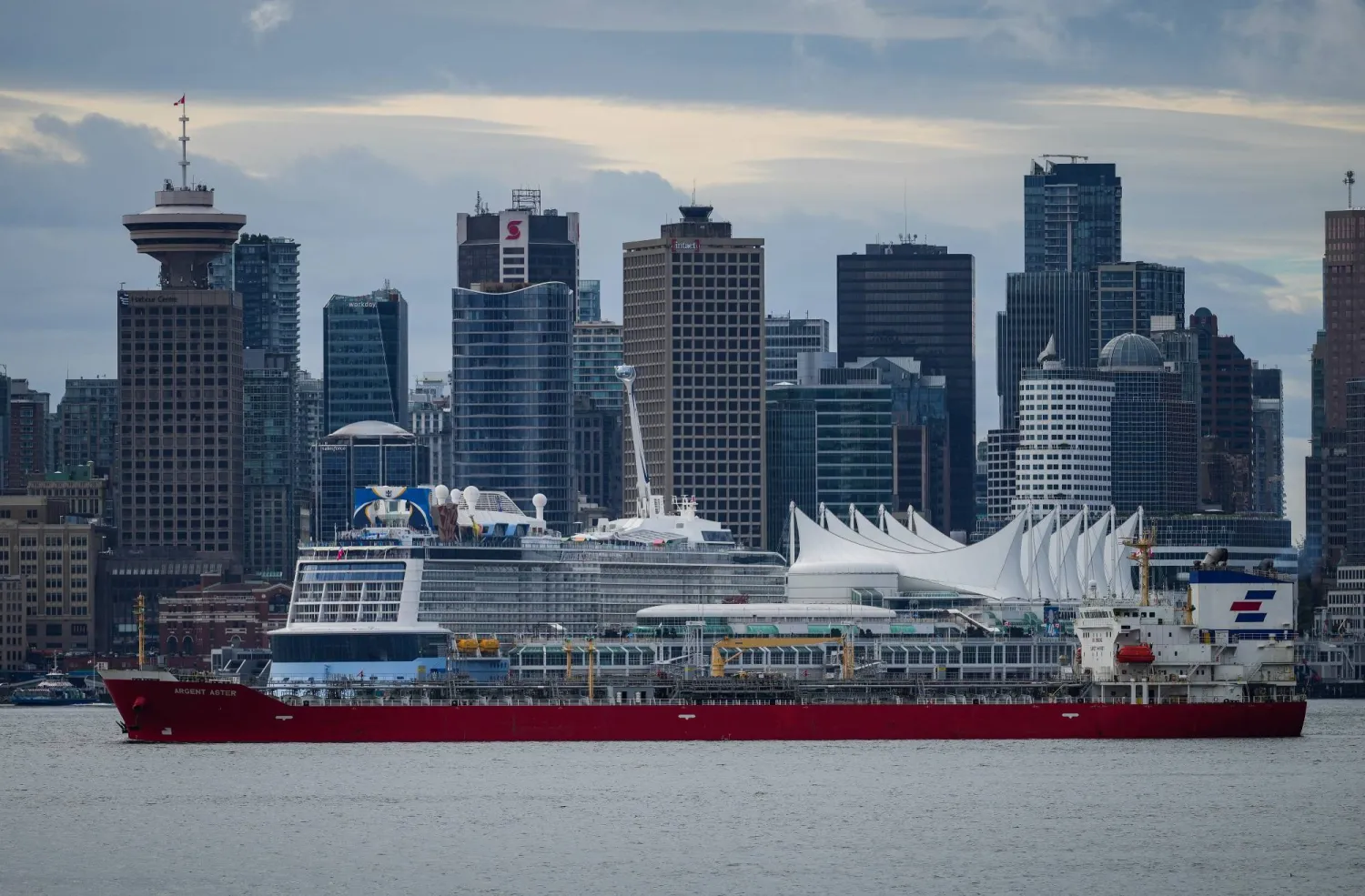
The Argent Aster oil tanker passes the downtown Vancouver skyline as it travels on the harbour into port, on Tuesday, Sept. 29, 2026. (Darryl Dyck/The Canadian Press via AP)
TT

Oil Gains after Trump Denies He Is Willing to Ease Sanctions on Iran

The Argent Aster oil tanker passes the downtown Vancouver skyline as it travels on the harbour into port, on Tuesday, Sept. 29, 2026. (Darryl Dyck/The Canadian Press via AP)

Oil prices rose on Wednesday after US President Donald Trump denied he would be willing to ease sanctions on Iran while Qatar pushed for peace talks, after falling in the previous session on a recovery in crude supply from the Middle East.

The Brent futures November contract, which is expiring on Wednesday, rose 71 cents, or 0.69%, to $103.30 a barrel by 0408 GMT. The more active December contract rose 35 cents to $96.51. US West Texas Intermediate crude gained 43 cents, or 0.48%, to $89.81.

Brent is ‌headed for a ‌monthly gain of around 14%, its biggest climb since July, ‌while ⁠WTI is on ⁠track for a 4% rise after having breached $106 for the first time since May.

The spread between the two benchmarks this month also expanded to its widest in four months as traders watched potential plans by the US to restrict diesel exports, which could create an oversupply in the domestic market and lead US refiners to process less crude.

US President Donald Trump is considering allowing sales of red-dyed diesel, instead of an export ban, to offer ⁠some price relief to consumers as the November midterm elections loom.

"Continued ‌uncertainty over sanctions relief and negotiations is keeping a ‌geopolitical risk premium embedded in prices," said Sugandha Sachdeva, founder of SS WealthStreet, a New Delhi-based ‌research firm.

"Improving supplies could cap further gains, but renewed disruption or an escalation in ‌tensions could trigger another rally," she added.

Qatar said on Tuesday it hopes that shuttle diplomacy between Iran and the US can lead to a breakthrough.

However, Trump denied an Axios report that cited US officials as saying he was willing to give Iran sanctions relief and release frozen Iranian ‌funds in return for "concrete" steps by Tehran on its nuclear program.

Crude oil exports from Middle East producers have rebounded in September to 16.328 million barrels per day, the highest since the US-Israeli war with Iran started in late February.

Over the past five days, the 10-day average for total oil exports has held at 20.5 million barrels per day, or 89% of 2025 levels, J.P. Morgan estimated.

In the US, crude oil and gasoline inventories rose, while distillate stocks fell last week, market sources said on Tuesday, citing data from the American Petroleum Institute.

Official inventory data from the US Energy Information Administration is due at 10:30 a.m. EDT (1430 GMT). Analysts polled by Reuters expect crude and product inventories to have fallen.


HUMAIN: Saudi Arabia Allocates 14 GW for AI Factories

A panel discussion at the forum (Asharq Al-Awsat)
TT

HUMAIN: Saudi Arabia Allocates 14 GW for AI Factories

A panel discussion at the forum (Asharq Al-Awsat)

Saudi Arabia is betting on abundant energy supplies and expanding digital infrastructure to build an integrated artificial intelligence ecosystem, allocating about 14 gigawatts of power capacity to support what HUMAIN calls “AI factories.”

The move comes as companies and countries race to secure the computing capacity needed to train and operate advanced models amid growing constraints on the availability of energy, chips and data centers.

HUMAIN CEO Tareq Amin said the Kingdom has the resources needed to build such an ecosystem, explaining that the company is focusing not only on providing computing capacity and infrastructure, but also on developing software and systems in-house. This would allow it to build an integrated chain extending from energy and data centers to models and applications.

Speaking at Servcorp’s inaugural economic forum in Riyadh, Amin said his previous experience in the energy sector had given him early insight into the scale of the challenges involved in securing advanced computing capacity. Access to graphics processing units could in some cases take several months, he noted, prompting him to consider building an integrated AI ecosystem within Saudi Arabia.

14 GW to Support Infrastructure

Amin explained that since its establishment, HUMAIN has focused on building “AI factories” by providing the ecosystem’s core components, including energy, computing and digital infrastructure, alongside developing software, models, applications and consulting services and investing in startups.

He added that cooperation with the Energy Ministry and several government entities had helped accelerate the allocation of land and infrastructure required for the project, noting that about 14 GW of power capacity had been allocated to the site the company is working on.

Infrastructure development is proceeding in parallel with efforts to attract global companies to make use of it, Amin noted. The company has signed agreements with international companies, including Amazon, while work on a joint project with AMD is progressing. Other companies are also being attracted to operate within the AI ecosystem being developed in Riyadh.

Beyond Generative AI

Amin said current uses of AI still represent only a limited portion of the technology’s available potential. Global attention is currently focused on generative AI and its applications within companies, while AI applications connected to the physical world, industry and infrastructure remain at an early stage.

The next phase will require greater computing capacity, energy and data center infrastructure, he explained, predicting a significant expansion in the scope of AI use as the supporting infrastructure develops.

Amin added that the company has managed, in about 15 months, to build operations spanning several sectors, stressing that fully harnessing AI is not simply a matter of adding new technological tools, but requires redesigning how organizations operate.

From Buying Software to Developing It In-House

Amin noted that the biggest challenges the company faced were not so much technological as related to changing corporate culture and working methods. HUMAIN made a strategic decision not to buy off-the-shelf software and instead to develop its systems internally.

The approach has included building agentic workflows, systems of record and a number of applications used in daily operations. Amin said the future of work will gradually move toward models in which users need only specify the task they want performed, while intelligent models automatically carry out the necessary steps and procedures.

He stressed that these changes are not intended to eliminate employees, but rather to increase their productivity and enable them to perform their work more efficiently. Some employees, he noted, are now able to complete tasks that previously required much larger teams.

The experience has also extended to human resources and other departments, where team members are now able to develop workflows and AI agents themselves without having to rely entirely on IT departments.

AI and Geopolitics

Amin’s remarks came during Servcorp’s inaugural economic forum, which brought together about 150 business leaders, investors and policymakers to discuss shifts reshaping the economies of Saudi Arabia, the Middle East, North Africa and Türkiye.

Opening the forum, Walid Abukhaled, chairman of EMIR in Saudi Arabia, said the global economy faces a combination of overlapping challenges, including geopolitical tensions and accelerating technological change, noting that Saudi Arabia’s importance is growing given its pivotal position in the global energy sector.

He added that AI has become a major factor reshaping the labor market as automation and modern technologies expand across manufacturing, consulting and programming, creating new challenges related to the skills that will be required in the future.

For his part, David Godchaux, Servcorp’s CEO for the Middle East, Europe and the Americas, said Saudi Arabia has undergone a major transformation in recent years, moving from an emerging market to a major economy with growing global influence.

He explained that the abundance of information has not made decision-making easier, but has instead increased the need to distinguish valuable information from the noise generated by the vast flow of data. One of the forum’s objectives, he noted, is to provide a platform that helps business leaders and investors interpret economic trends more clearly and make more precise decisions.


Saudi Minister Says AIIB Success Measured by Development Impact, Not Financing

Saudi Finance Minister Mohammed al-Jadaan at the 11th annual meeting of the Asian Infrastructure Investment Bank’s Board of Governors (X)
TT

Saudi Minister Says AIIB Success Measured by Development Impact, Not Financing

Saudi Finance Minister Mohammed al-Jadaan at the 11th annual meeting of the Asian Infrastructure Investment Bank’s Board of Governors (X)

Saudi Finance Minister Mohammed al-Jadaan urged the Asian Infrastructure Investment Bank to judge its success by the impact of its projects, saying financing volumes and approvals alone do not show whether the bank is improving services, strengthening institutions, or building economic resilience.

Speaking at the 11th annual meeting of the bank’s Board of Governors, which concluded on Tuesday in Doha, al-Jadaan said the AIIB had built strong foundations in its early years.

Progress on regional connectivity, cooperation and private-sector participation had strengthened its ability to meet member countries’ infrastructure needs, he said.

As the bank expands, progress “should not be measured by financing volumes or project approvals alone, but by development impact,” he said.

Success should mean “better infrastructure services, stronger institutions, greater economic resilience and broader private-sector participation,” al-Jadaan said, as the bank enters its second decade and seeks to expand infrastructure financing and mobilize more private capital.

He called for earlier engagement with member countries to better understand their circumstances, infrastructure gaps and priorities, and for multiyear programs aligned with national strategies.

Al-Jadaan also urged the bank to broaden partnerships with multilateral development banks and international organizations to share expertise, avoid duplicating efforts and mobilize more public and private resources.

He said the bank should remain guided by member countries’ needs, taking account of differences in institutional capacity, fiscal space and levels of infrastructure development.

The Doha meeting, held under the theme “Future Infrastructure: Impact and Innovation,” comes as the bank prepares for a new phase of expansion.

The AIIB has said it aims to nearly double annual financing to about $20 billion by 2030, focusing on infrastructure linked to climate resilience, renewable energy, digital transformation and regional connectivity, while mobilizing more private capital.

Saudi Arabia is a founding member of the AIIB, a multilateral development finance institution established in Beijing in 2016.


African Leaders to Gather in Egypt for Business Summit

Friday's forum is expected to bring together more than 20 heads of state and government representatives in the Mediterranean city of Alamein, alongside business leaders, bankers and development institutions. © KHALED DESOUKI / AFP/File
TT

African Leaders to Gather in Egypt for Business Summit

Friday's forum is expected to bring together more than 20 heads of state and government representatives in the Mediterranean city of Alamein, alongside business leaders, bankers and development institutions. © KHALED DESOUKI / AFP/File

African leaders will meet in Egypt on Friday for a business summit that Cairo hopes will bolster its clout across the continent.

Friday's forum is expected to bring together more than 20 heads of state and government representatives in the Mediterranean city of Alamein, alongside business leaders, bankers and development institutions.

"This is an African platform," Egypt's deputy foreign minister for African affairs Mohamed Abu Bakr Saleh told AFP.

"A country in East Africa should be able to sign an agreement with a country in West, North or southern Africa through this platform."

Saleh said the forum would become a biennial event under an African Union mandate, focusing on infrastructure, trade, agriculture, healthcare, mining, technology and renewable energy.

Officials estimate Egyptian investments across Africa at around $14 billion. Among Egypt's flagship ventures is Tanzania's $3 billion Julius Nyerere Hydropower Project, built by a consortium led by Egyptian companies.

Yet trade within Africa remains limited, totalling just $192 billion in 2023 and only accounting for around 15 percent of the continent's total trade, compared with more than 55 percent in Asia and over 70 percent in Europe.

Africa also attracted about $70 billion in foreign direct investment in 2025, a fraction of the roughly $1.6 trillion invested globally, according to the UN.

"Africa possesses vast resources, but they are still not being exploited to the level we would like to see," Saleh said.

The gathering also takes place against the backdrop of an unresolved dispute between Egypt and Ethiopia over the $5 billion GERD, Africa's largest hydroelectric project.

Ethiopia says the dam, inaugurated last year, is vital for economic growth, while Egypt says it could threaten Nile water supplies without a binding operating agreement.

More than a decade of negotiations have failed to yield a settlement.

"Our position on Egypt's water security has not changed and will not change," Saleh said. "It is an existential issue for Egypt."