HUMAIN: Saudi Arabia Allocates 14 GW for AI Factories

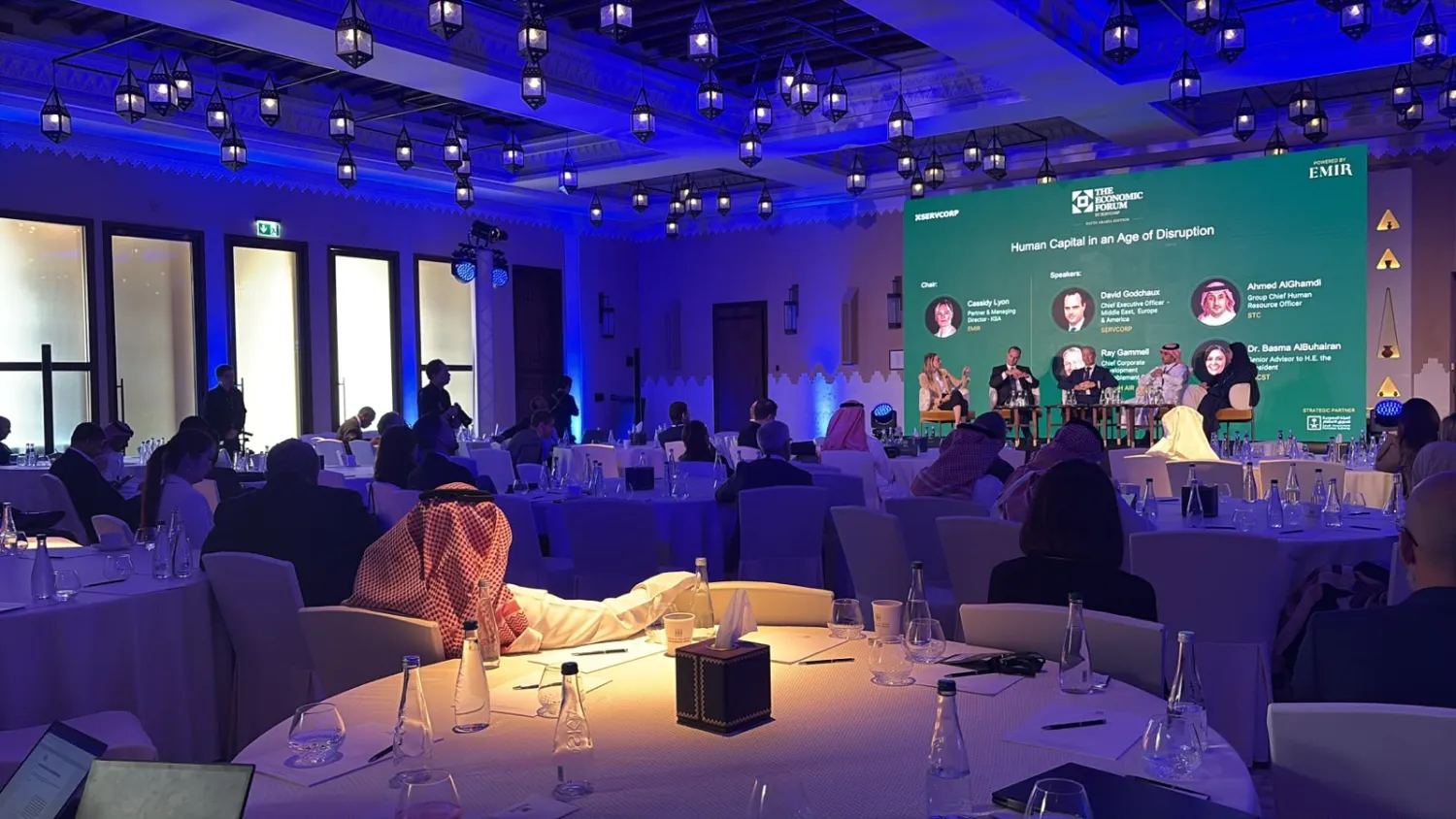
A panel discussion at the forum (Asharq Al-Awsat)
TT

HUMAIN: Saudi Arabia Allocates 14 GW for AI Factories

A panel discussion at the forum (Asharq Al-Awsat)

Saudi Arabia is betting on abundant energy supplies and expanding digital infrastructure to build an integrated artificial intelligence ecosystem, allocating about 14 gigawatts of power capacity to support what HUMAIN calls “AI factories.”

The move comes as companies and countries race to secure the computing capacity needed to train and operate advanced models amid growing constraints on the availability of energy, chips and data centers.

HUMAIN CEO Tareq Amin said the Kingdom has the resources needed to build such an ecosystem, explaining that the company is focusing not only on providing computing capacity and infrastructure, but also on developing software and systems in-house. This would allow it to build an integrated chain extending from energy and data centers to models and applications.

Speaking at Servcorp’s inaugural economic forum in Riyadh, Amin said his previous experience in the energy sector had given him early insight into the scale of the challenges involved in securing advanced computing capacity. Access to graphics processing units could in some cases take several months, he noted, prompting him to consider building an integrated AI ecosystem within Saudi Arabia.

14 GW to Support Infrastructure

Amin explained that since its establishment, HUMAIN has focused on building “AI factories” by providing the ecosystem’s core components, including energy, computing and digital infrastructure, alongside developing software, models, applications and consulting services and investing in startups.

He added that cooperation with the Energy Ministry and several government entities had helped accelerate the allocation of land and infrastructure required for the project, noting that about 14 GW of power capacity had been allocated to the site the company is working on.

Infrastructure development is proceeding in parallel with efforts to attract global companies to make use of it, Amin noted. The company has signed agreements with international companies, including Amazon, while work on a joint project with AMD is progressing. Other companies are also being attracted to operate within the AI ecosystem being developed in Riyadh.

Beyond Generative AI

Amin said current uses of AI still represent only a limited portion of the technology’s available potential. Global attention is currently focused on generative AI and its applications within companies, while AI applications connected to the physical world, industry and infrastructure remain at an early stage.

The next phase will require greater computing capacity, energy and data center infrastructure, he explained, predicting a significant expansion in the scope of AI use as the supporting infrastructure develops.

Amin added that the company has managed, in about 15 months, to build operations spanning several sectors, stressing that fully harnessing AI is not simply a matter of adding new technological tools, but requires redesigning how organizations operate.

From Buying Software to Developing It In-House

Amin noted that the biggest challenges the company faced were not so much technological as related to changing corporate culture and working methods. HUMAIN made a strategic decision not to buy off-the-shelf software and instead to develop its systems internally.

The approach has included building agentic workflows, systems of record and a number of applications used in daily operations. Amin said the future of work will gradually move toward models in which users need only specify the task they want performed, while intelligent models automatically carry out the necessary steps and procedures.

He stressed that these changes are not intended to eliminate employees, but rather to increase their productivity and enable them to perform their work more efficiently. Some employees, he noted, are now able to complete tasks that previously required much larger teams.

The experience has also extended to human resources and other departments, where team members are now able to develop workflows and AI agents themselves without having to rely entirely on IT departments.

AI and Geopolitics

Amin’s remarks came during Servcorp’s inaugural economic forum, which brought together about 150 business leaders, investors and policymakers to discuss shifts reshaping the economies of Saudi Arabia, the Middle East, North Africa and Türkiye.

Opening the forum, Walid Abukhaled, chairman of EMIR in Saudi Arabia, said the global economy faces a combination of overlapping challenges, including geopolitical tensions and accelerating technological change, noting that Saudi Arabia’s importance is growing given its pivotal position in the global energy sector.

He added that AI has become a major factor reshaping the labor market as automation and modern technologies expand across manufacturing, consulting and programming, creating new challenges related to the skills that will be required in the future.

For his part, David Godchaux, Servcorp’s CEO for the Middle East, Europe and the Americas, said Saudi Arabia has undergone a major transformation in recent years, moving from an emerging market to a major economy with growing global influence.

He explained that the abundance of information has not made decision-making easier, but has instead increased the need to distinguish valuable information from the noise generated by the vast flow of data. One of the forum’s objectives, he noted, is to provide a platform that helps business leaders and investors interpret economic trends more clearly and make more precise decisions.


Port Security and Trade Continuity: A New Formula for Saudi Competitiveness

A panel discussion featuring Professor Waheed Sami Abu Shanab (Conference)
TT

Port Security and Trade Continuity: A New Formula for Saudi Competitiveness

A panel discussion featuring Professor Waheed Sami Abu Shanab (Conference)

Port competitiveness is no longer just about handling more ships and containers. Keeping trade moving and infrastructure secure against physical and cyber threats has become just as critical, as ports grow more reliant on digital systems and supply chains become increasingly complex.

The economic fallout from port disruptions and their impact on global trade took center stage at a session titled "Securing Infrastructure" during the Saudi Maritime and Logistics Congress 2026, which opened Wednesday in Jeddah with maritime and infrastructure security experts in attendance.

Discussions focused on threats facing ports and shipping companies, particularly cyberattacks capable of crippling operations and disrupting trade, and the need to strengthen port readiness to keep services running and limit economic losses.

Professor Waheed Sami Abu Shanab, a professor of marine engineering at King Abdulaziz University's Faculty of Maritime Studies, said Saudi ports now face a challenge that goes beyond expanding capacity: withstanding disruptions while keeping trade flowing at the lowest possible cost.

Speaking to Asharq Al-Awsat on the sidelines of the session, Abu Shanab said Saudi Arabia's ports on the Red Sea and Arabian Gulf gave the kingdom a strategic advantage as international trade routes shift. But making the most of that position requires greater investment in operational resilience, logistics connectivity and cybersecurity.

Investments top $3.7 billion

The challenges come as Saudi Arabia ramps up investment in port infrastructure. Its ports now have 34 logistics centers, including 17 at Jeddah Islamic Port, backed by investments exceeding 14 billion riyals ($3.7 billion), alongside projects to upgrade container terminals and boost handling capacity.

Abu Shanab said the investments include more than 2 billion riyals to develop a container terminal at Jubail Port and an initial 1.6 billion riyals for a fourth container terminal at Jeddah Islamic Port. Other projects involve upgrading cargo-handling equipment and expanding the use of modern operating systems.

He said future investment must focus on operational efficiency, reserve capacity and stronger links between ports, roads, railways and logistics hubs to absorb sudden surges in shipping volumes and redirect cargo when routes are disrupted.

Abu Shanab floated a preliminary proposal for an additional 10 billion to 20 billion riyals in investment over five years to strengthen strategic ports' readiness.

He stressed that the figure was a proposed planning scenario, not an official assessment of the sector's needs or an approved budget.

Cyberattacks threaten trade beyond ports

Abu Shanab warned that growing reliance on digital systems exposes ports to cyber threats whose economic impact could ripple through factories, markets and supply chains.

He pointed to the 2017 cyberattack on global shipping group Maersk, which the company estimated cost it between $200 million and $300 million after widespread disruption to its operations and systems.

A failure of digital systems managing containers, vessel schedules and cranes could leave cargo stranded, drive up delay and insurance costs, and undermine shipping companies' commitments and customer confidence, he said.

To illustrate the potential costs, Abu Shanab offered a hypothetical scenario: a delay affecting 5,000 twenty-foot equivalent units (TEUs), each incurring an additional 1,000 riyals in costs, would generate a direct bill of 5 million riyals before indirect losses.

He stressed that the calculation did not reflect actual losses at Saudi ports but illustrated the potential cost of disruptions. Investing in prevention and business continuity, he argued, could be cheaper than shutting down a strategic port.

Competitiveness goes beyond handling fees

Abu Shanab said regional ports should be judged not simply by their handling charges but by the total cost of getting goods from ships to markets, including customs clearance, storage, inland transport and schedule reliability.

Saudi ports overseen by the Saudi Ports Authority handled about 8.3 million TEUs in 2025, up 10.58% from a year earlier, highlighting growing activity and the need to expand capabilities without compromising service efficiency.

Artificial intelligence could help schedule vessel arrivals and allocate berths, while upgraded handling equipment could cut waiting times and fuel, storage and transportation costs, making services more reliable for shipping lines, he said.

"The most competitive port is not necessarily the one with the lowest fees, but the one offering the lowest total logistics cost, the greatest reliability and the fastest access to markets," Abu Shanab said.

Simulating crises before they strike

Abu Shanab called for a national simulation model using digital twins and artificial intelligence to test how ports and supply chains would respond to facility shutdowns or shifting maritime routes, and measure the time and cost of restoring operations.

He also urged stronger protection for critical infrastructure, including submarine cables, energy and telecommunications facilities, alongside improved vessel monitoring systems, disaster recovery centers and backup operating plans to keep essential services running.

Saudi Arabia's ports on two coastlines, coupled with expanding logistics services and transport networks, offer a foundation for more reliable supply chains, he said. But realizing that potential depends on matching existing investments with operational and technological readiness.

Protecting maritime infrastructure, Abu Shanab concluded, is no longer a standalone security or technical concern. It is central to port competitiveness and Saudi Arabia's ability to keep trade flowing, attract shipping lines and secure long-term investment.


Türkiye Cuts Key Interest Rate to 36%, First Cut in Months

Central Bank of Türkiye (Official Website)
TT

Türkiye Cuts Key Interest Rate to 36%, First Cut in Months

Central Bank of Türkiye (Official Website)

Türkiye's central bank cut its key interest rate on Thursday to 36 percent in the first cut in nine months, pointing to a recent slowdown in inflation.

At a policy meeting, the bank "decided to reduce the policy interest rate ... from 37 percent to 36 percent," it said in a statement.

It was the first cut since January when the bank cut the key rate from 38 to 37 percent, a rate which it held until Thursday's meeting.

"Despite monthly fluctuations, recent inflation figures and leading indicators confirm the downward trend," a bank statement said.

"Data on economic activity and the limited impact of supply shocks on domestic prices suggest that the weak trend in domestic demand continues," it added.

However, ongoing geopolitical tensions were keeping energy prices high, which could push inflation higher, it warned, saying the effects of such geopolitical developments "are being closely monitored".

Türkiye's annual inflation rate eased to 29.7 percent in September from 31.5 percent in August - the first time it had fallen below 30 percent in nearly five years, official figures showed.

At the time, Finance Minister Mehmet Simsek said it was at its lowest level since November 2021. "Disinflation is spreading across the board, excluding transportation," he wrote on X.

The official figures are disputed by the ENAG group of independent economists that publishes its own data, which said its figures showed year-on-year inflation stood at 46.6 percent in September.


Saudi Stock Market Drops 2.3% to Lowest Close Since 2021

A person stands in front of a screen showing falling stock prices (Reuters)
TT

Saudi Stock Market Drops 2.3% to Lowest Close Since 2021

A person stands in front of a screen showing falling stock prices (Reuters)

Saudi Arabia's benchmark stock index ended Thursday's session down 2.3 percent, shedding 231 points to close at 9,696, its lowest closing level since 2021, with total trading turnover reaching approximately SAR 4.9 billion.

The Tadawul All Share Index (TASI) fluctuated between an intraday low of 9,640 points and a high of 9,888 points.

Thursday's decline brought the index's weekly losses to more than 400 points, or 4.1 percent, marking its eighth consecutive week of declines.

Most stocks fell during the session, led by Saudi National Bank, which dropped more than 5 percent to SAR 34.62, with approximately 9 million shares traded.

Saudi Aramco and Al Rajhi Bank each declined 1 percent, closing at SAR 25.40 and SAR 59.80, respectively, while Maaden fell 5 percent to SAR 55.90.

Shares of Retal, Al Yamamah Steel, East Pipes, Jahez, Gulf Training and Saudi Steel Pipe ended the session with losses ranging from 5 to 9 percent.

Meanwhile, Electrical Industries, Abo Moati, Umm Al-Qura Cement, Saleh Al-Rashed, Wafrah, Saudi Vitrified Clay Pipe and Watani Iron Steel each fell 10 percent.

On the upside, Al-Etihad rose 10 percent to SAR 6.16, followed by JAZADCO with gains exceeding 9 percent. Shares of Al Arabia, UCIC and Saudi Kayan advanced between 1 and 3 percent.