Italian Official to Asharq Al-Awsat: We Will Work with Saudi Arabia to Enter Third Markets

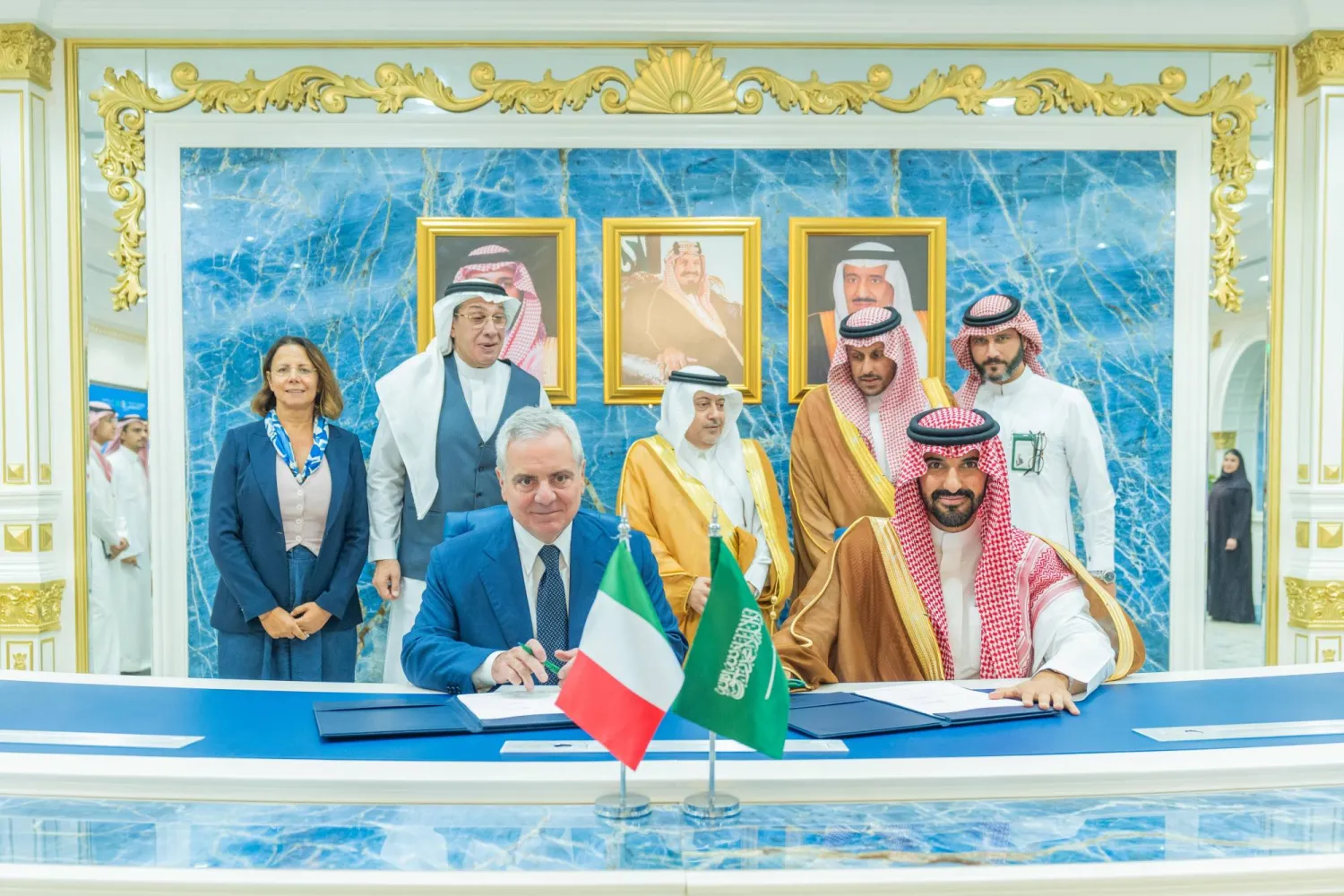
Signing of a cooperation agreement between the Federation of Saudi Chambers and Italy's national promotional and development institution (X)
TT

Italian Official to Asharq Al-Awsat: We Will Work with Saudi Arabia to Enter Third Markets

Signing of a cooperation agreement between the Federation of Saudi Chambers and Italy's national promotional and development institution (X)

Riyadh and Rome are moving their economic relations toward a more practical track, with plans for joint cooperation in third markets, alongside expanding channels of cooperation between Saudi and Italian companies, particularly small and medium-sized enterprises.

The move comes as Italy's national promotional institution, Cassa Depositi e Prestiti (CDP), signed two agreements in Riyadh, one with Saudi Arabia's National Development Fund and another with the Federation of Saudi Chambers, aimed at expanding financing and investment cooperation and facilitating companies' access to opportunities in both countries.

A senior Italian official told Asharq Al-Awsat that cooperation between Riyadh and Rome is not limited to the Saudi and Italian markets, but also extends to working together in "third markets." He noted that Saudi Arabia's economic diversification offers broad opportunities for Italian companies, given Italy's diverse industrial base and expertise across multiple sectors.

On Wednesday, the Federation of Saudi Chambers and CDP signed an agreement in Riyadh aimed at activating the Saudi-Italian strategic partnership launched in AlUla, opening financing channels for joint projects, integrating small and medium-sized enterprises into cooperation between the two countries, and strengthening the federation's role as the institutional representative of the Saudi private sector in cooperation with its Italian counterpart.

The agreement provides a practical framework for strengthening partnerships between the business sectors of the two countries by supporting a business-matching platform that connects Saudi companies with their Italian counterparts, introducing projects and investment opportunities, and establishing communication channels to help Italian companies explore the Saudi market and facilitate their entry.

CDP is part of the Saudi-Italian strategic partnership launched in AlUla, while the agreement enables the Federation of Saudi Chambers and its Saudi-Italian Business Council to play a greater role in advancing private-sector cooperation between the two countries and turning partnership opportunities into joint projects and business ventures.

Joint Strategic Cooperation

Dario Scannapieco, President of CDP (Cassa Depositi e Prestiti), told Asharq Al-Awsat that cooperation between Italy and Saudi Arabia "is not limited to bringing the two countries closer together or working within the Saudi market, but also includes cooperation in other countries and third markets."

He explained that the Italian delegation's visit to Riyadh has several objectives, foremost among them meeting with investors and strengthening cooperation with Saudi institutions. He said the meeting with the National Development Fund was "very fruitful" and had paved the way for excellent cooperation with it in many fields.

He added that the agreement signed with the Federation of Saudi Chambers represents "a further step" toward moving from institutional cooperation to more operational cooperation, with the aim of helping Italian SMEs that want to explore the possibility of entering Saudi Arabia, providing them with direct contacts and facilitating their access to the market.

"We are launching and revamping a platform that will put Italian SMEs in contact with Saudi SMEs. So business opportunities may develop from this new opportunity. This is another signal that Italy and Saudi Arabia must cooperate more," Scannapieco said.

He noted that there are many opportunities for cooperation between Italy and Saudi Arabia through Cassa Depositi e Prestiti, Italy's national promotional institution, adding that CDP is working to foster this cooperation and expand its scope.

Regarding the agreement's details, Scannapieco said its first objective is to support and expand the business-matching platform, which will connect Saudi SMEs with Italian SMEs and help them identify potential partners.

"The second is the idea to work on selected projects here in Saudi Arabia and allow Italian companies to know about these projects. The Expo is one of this kind where clearly Italian projects may be involved," he said.

"The third is to create a contact point between these two organizations, so to iron out all the doubts and to clearly push developing this relationship." He explained that when an Italian company wants to enter the Saudi market, it needs support in obtaining authorizations and handling other requirements.

"So it's very concrete, goes in the direction to make easier the access to Saudi Arabia for Italian companies," he said.

On the extent to which the strategic relationship between the two countries can help address challenges that may arise in the region, Scannapieco said Italy has "a very diversified industrial base" and produces a wide range of products.

"We are the third most diversified industry after China and the United States," he said.

This diversity, he added, enables Italian companies to provide specialized technical expertise and become useful partners in efforts to diversify the Saudi economy. "We could be extremely valuable partners."

He said the next phase requires bringing the Italian business sector's presence in Saudi Arabia to a broader level. Many large companies are already present in the Kingdom, he noted, but "now is the time to also give the opportunity to SMEs to internationalize in this region," thereby expanding the base of economic cooperation between the two countries.

Saudi-Italian Partnership Moves Toward Implementation

Kamel Al-Munajjed, Chairman of the Saudi-Italian Business Council, told Asharq Al-Awsat that the agreement is a direct extension of the meeting held in AlUla in January 2025 between Crown Prince and Prime Minister Mohammed bin Salman and Italian Prime Minister Giorgia Meloni, which elevated relations between the two countries to the level of a strategic partnership and made economic relations one of its main pillars.

He added that the agreement signed Wednesday between CDP and the Federation of Saudi Chambers represents a practical step toward strengthening cooperation between the business sectors of the two countries and provides a new channel for turning existing relations into commercial and investment partnerships and projects.

Al-Munajjed said the agreement strengthens the partnerships built by the Saudi-Italian Business Council with Confindustria and CNA through delegations, forums, and direct business meetings. He noted that CDP's capabilities and the scope of the Federation of Saudi Chambers' work would help turn these links into more sustained business opportunities.

He said the agreement offers two main advantages. The first is CDP's business-matching platform, which allows Saudi and Italian companies to enter information about their capabilities and business interests and then identify potential partners whose needs match those capabilities.

The platform can shorten the path for companies seeking suitable partners. A Saudi industrial company looking for Italian technology, for example, can identify companies capable of meeting its needs, while an Italian company seeking to enter the Saudi market can search for a local partner. The federation and the business council will work to encourage companies to use the platform and follow up on cooperation opportunities that emerge through it.

The second advantage, Al-Munajjed said, is strengthening cooperation with SIMEST, a subsidiary of the CDP Group. Its presence in Riyadh and support for the international expansion of Italian companies could help more companies, particularly SMEs, establish and expand their businesses in Saudi Arabia.

He added that the joint channel provided by the agreement will enable Saudi companies seeking to trade, invest, or operate in Italy to reach suitable Italian partners and identify new opportunities. He called on the Saudi business community to take advantage of the partnership and work to turn it into sustainable projects and shared growth opportunities.

Al-Munajjed said Italian companies have specialized expertise in engineering, technology, and manufacturing, while Saudi companies provide knowledge of the local market and the ability to expand. Opportunities for cooperation extend to trade, infrastructure, telecommunications, industry, energy, tourism, and other sectors.

He added that Expo 2030 Riyadh represents an important opportunity to bring these capabilities together and open new areas for companies in both countries. He stressed that the priority now is to move to implementation by bringing companies onto the platform, identifying priority sectors, establishing clear points of contact, and following promising opportunities through to actual projects.


Saudi Arabia, US Sign MoU on Strengthening Trade, Investment Cooperation

The agreement was signed during a session on Saudi-US innovation and economic cooperation on the sidelines of the B20 Summit in Washington, DC. (SPA)
TT

Saudi Arabia, US Sign MoU on Strengthening Trade, Investment Cooperation

The agreement was signed during a session on Saudi-US innovation and economic cooperation on the sidelines of the B20 Summit in Washington, DC. (SPA)

The Federation of Saudi Chambers of Commerce and the US Chamber of Commerce signed on Tuesday a memorandum of understanding aimed at strengthening trade and investment cooperation and expanding opportunities for collaboration between the business sectors between their countries.

The signing took place on the sidelines of the B20 Summit in Washington, DC.

The agreement was signed during a session on Saudi-US innovation and economic cooperation, organized by the US Chamber of Commerce, with the participation of Deputy Chief of Mission at the Saudi Embassy in the United States Nawaf Alissa, Secretary-General of the Federation of Saudi Chambers of Commerce Sultan Al-Musallam, and several US Chamber of Commerce officials and representatives of companies and the business sector.

Alissa highlighted the depth of economic relations between Saudi Arabia and the US.

The partnership has continued to evolve, expanding from traditional sectors into new fields, including artificial intelligence, digital technologies, advanced manufacturing, and infrastructure, amid the economic transformation underway in the Kingdom under Saudi Vision 2030, he remarked.

He noted that the total value of investment activities by the Public Investment Fund in the United States has reached approximately $170 billion since 2017, stressing the importance of sustaining the investment partnership between the two countries and strengthening cooperation in future economic sectors.

The event coincides with the B20 Summit, being held in Washington from November 9 to 11, with the participation of business leaders and international economic institutions to discuss priorities related to economic growth, trade, investment, and innovation.


China’s Trade Surplus Soars Past $1 Trillion as AI Boom Powers Exports

 In this aerial photo, new Tesla electric vehicles wait for shipment to overseas markets in a port in Shanghai on Tuesday, Nov. 10, 2026. (Chinatopix via AP)
In this aerial photo, new Tesla electric vehicles wait for shipment to overseas markets in a port in Shanghai on Tuesday, Nov. 10, 2026. (Chinatopix via AP)
TT

China’s Trade Surplus Soars Past $1 Trillion as AI Boom Powers Exports

 In this aerial photo, new Tesla electric vehicles wait for shipment to overseas markets in a port in Shanghai on Tuesday, Nov. 10, 2026. (Chinatopix via AP)
In this aerial photo, new Tesla electric vehicles wait for shipment to overseas markets in a port in Shanghai on Tuesday, Nov. 10, 2026. (Chinatopix via AP)

China's trade surplus surged past $1 trillion in the first 10 months as a global race to build AI infrastructure buoyed sales of high-tech products and helped offset weak domestic demand, a dynamic likely to sharpen tensions with major trading partners.

The data comes ahead of next week's Asia-Pacific Economic Cooperation summit in Shenzhen, where Chinese President Xi Jinping and US President Donald Trump are expected to meet for the third time this year, putting broader economic ties and tariff policy squarely in focus.

The figures highlight Beijing's growing reliance on overseas demand to support an economy hobbled by subdued consumption and a protracted property slump. But while the global AI investment boom is expected to keep demand for Chinese technology products strong into 2027, analysts warn that deeper dependence on external markets could leave China more vulnerable to protectionist measures abroad while masking persistent weakness at home.

Exports rose sharply by 35.2% in October from the ‌same month last year ‌in US dollar terms, customs data showed on Tuesday, only a touch slower than the ‌36.3% ⁠surge in September ⁠and comfortably ahead of economists' forecast for an increase of 33.5%.

That helped lift China's trade surplus to $1.04 trillion in the first 10 months, topping $1 trillion for a second consecutive year and reaching the milestone a month earlier than in 2025.

The swelling surplus could fuel further tensions with the European Union, where leaders have called for more trade curbs with China after reaching an agreement with Beijing to limit Chinese exports of hybrid vehicles to the bloc over the next few years. Because the measures have yet to take effect, factories are expected to bring forward shipments, bolstering exports in the near term.

"The risk of additional tariffs and other trade barriers will remain elevated ⁠in 2027, particularly as Chinese manufacturers continue expanding their presence in overseas markets," said Joe ‌Peissel, lead macroeconomist at Trivium China.

China's trade surplus with the US narrowed slightly ‌to $32.71 billion in October from $34.01 billion the previous month, though the broader imbalance remains a source of friction between the world's two largest ‌economies.

Beijing and Washington on Monday formally extended by two months a trade truce that had been due to expire ‌on Tuesday. China said last week that any expansion of purchases of US farm goods would hinge on the implementation of agreed reciprocal tariff reductions.

Imports rose 41.6% in October from a year earlier, beating the 32% increase forecast in the Reuters poll and accelerating from the 31% growth in September. Customs data also showed rare-earth exports edged higher from the previous month, while crude oil imports climbed to their highest level ‌since March as buyers adjusted to supply disruptions in the Middle East.

"The contraction in rare-earth export volumes eased last month, suggesting that China may have begun to relax enforcement of ⁠some export controls," said ⁠Nguyen Hoang Nam, China economist at Capital Economics. "This may reflect continued pressure from the US on Beijing to improve rare-earth supplies."

The data elicited little market response, with China's blue-chip CSI300 Index and the Shanghai Composite Index both edging up 0.1% by the lunch break.

HEADWINDS

One big worry for Beijing is that consumers remain reluctant to spend, constrained by a property market downturn that has battered household wealth and dented confidence in the economic outlook.

Sluggish demand at home has pushed Chinese automakers to seek sales in overseas markets. China's car exports maintained a solid pace of growth in October, while domestic vehicle sales recorded a 12th straight month of declines, separate data released by an industry association showed.

Greater reliance on exports, however, leaves China's economy increasingly exposed to any slowdown in global demand, with some analysts cautioning that shipment growth could cool once the AI investment cycle matures.

For now, most industry observers expect AI-related demand to remain robust. China's exports of semiconductors surged 111.1% year-on-year in the first 10 months in US dollar value terms, while overall shipments of high-tech products jumped 47.9%.

"We may see trade growth moderate next year, given the base effect," said Lynn Song, chief economist for Greater China at ING.

"But AI-related trade is expected to remain strong in the months ahead despite recent equity market volatility."


Tech Leads Stock Rally as Traders Track Wall St Rebound

Chip titans SK hynix and Samsung rallied as Seoul led gains across Asian stock markets. GREG BAKER / AFP
TT

Tech Leads Stock Rally as Traders Track Wall St Rebound

Chip titans SK hynix and Samsung rallied as Seoul led gains across Asian stock markets. GREG BAKER / AFP

Stocks rallied Tuesday to extend a Wall Street surge led by technology firms as investors took advantage of lower prices following last week's rout, while another plunge in oil prices added to the upbeat mood.

AI-linked firms led gains across the region, in stark contrast to the battering in reaction to last Tuesday's Democratic sweep of Congress that stoked regulatory concerns.

However, traders remain on edge about profitability in light of the vast sums pumped into the sector, while they were also keeping tabs on Nvidia after boss Jensen Huang's admission of an affair amid speculation of a Chinese espionage plot.

Titans including Amazon, Microsoft and Apple were among the big gainers Monday in New York as tech bounced back with help from bargain-hunting, with observers pointing out that confidence in the AI outlook remained solid.

The Nasdaq's 2.7 percent spike led a strong day on Wall Street, and Asian investors took up the baton.

Seoul surged 4.5 percent thanks to strong advances in chipmakers SK hynix and Samsung, while Tokyo jumped almost three percent on the back of rallies in Kioxia, SoftBank and Tokyo Electron.

Taiwan's TSMC and MediaTek climbed more than two percent to drag the Taiex 2.5 percent higher.

Hong Kong, Shanghai, Sydney, Singapore, Bangkok, Jakarta and Wellington were also higher.

London, Paris and Frankfurt opened with big gains to extend Monday's jump.

However, SPI Asset Management's Stephen Innes said the gains did not suggest markets were back in rude health.

"The market rallied because the sellers stepped away, not because the entire buy-side suddenly rediscovered its courage," he wrote in a commentary.

"For the second consecutive session, the companies receiving the enormous capital expenditure cheques dramatically outperformed the businesses writing them. That is a potentially important development after last week's indiscriminate liquidation," he said.

- 'Positive momentum' -

"The hyperscalers remain central to the AI investment cycle, but the market is increasingly questioning the returns on the extraordinary sums being committed to new infrastructure.

"Equipment providers, optical networking companies and selected data-center suppliers can still benefit from existing spending programs, even as investors become more selective about the ultimate economics for the companies funding those projects."

Oil prices continued their retreat on hopes the United States and Iran will eventually bring an end to the Middle East crisis.

Both main contracts fell around one percent Tuesday, extending the previous day's drop that saw Brent give up almost six percent.

They have lost around 20 percent this month as traders bet on a resolution to the seven-month-old conflict, which has sent inflation soaring and forced central banks to hike interest rates.

US President Donald Trump said Monday there was "positive momentum" towards ending the war after meeting Qatar's prime minister at the White House.

"I had an excellent conversation with Sheikh Mohammed bin Abdulrahman bin Jassim Al Thani," Trump said on Truth Social, adding that "much was discussed with respect to the Islamic Republic of Iran".

While expectations had grown ahead of last week's midterms that he would resume strikes on Iran this month, Trump has talked down such a move while leaving the door open to them.

In his post on Monday, Trump reiterated that the United States was "locked and loaded", but that he believed further strikes were "quite unlikely" given that key US allies in the Gulf "would prefer the status quo".

His comments echoed early statements to CNN over the weekend when he said it was "highly unlikely" fighting would resume.