


Saudi Arabia Prepares New Pathways for Its Companies to Enter the Syrian Market

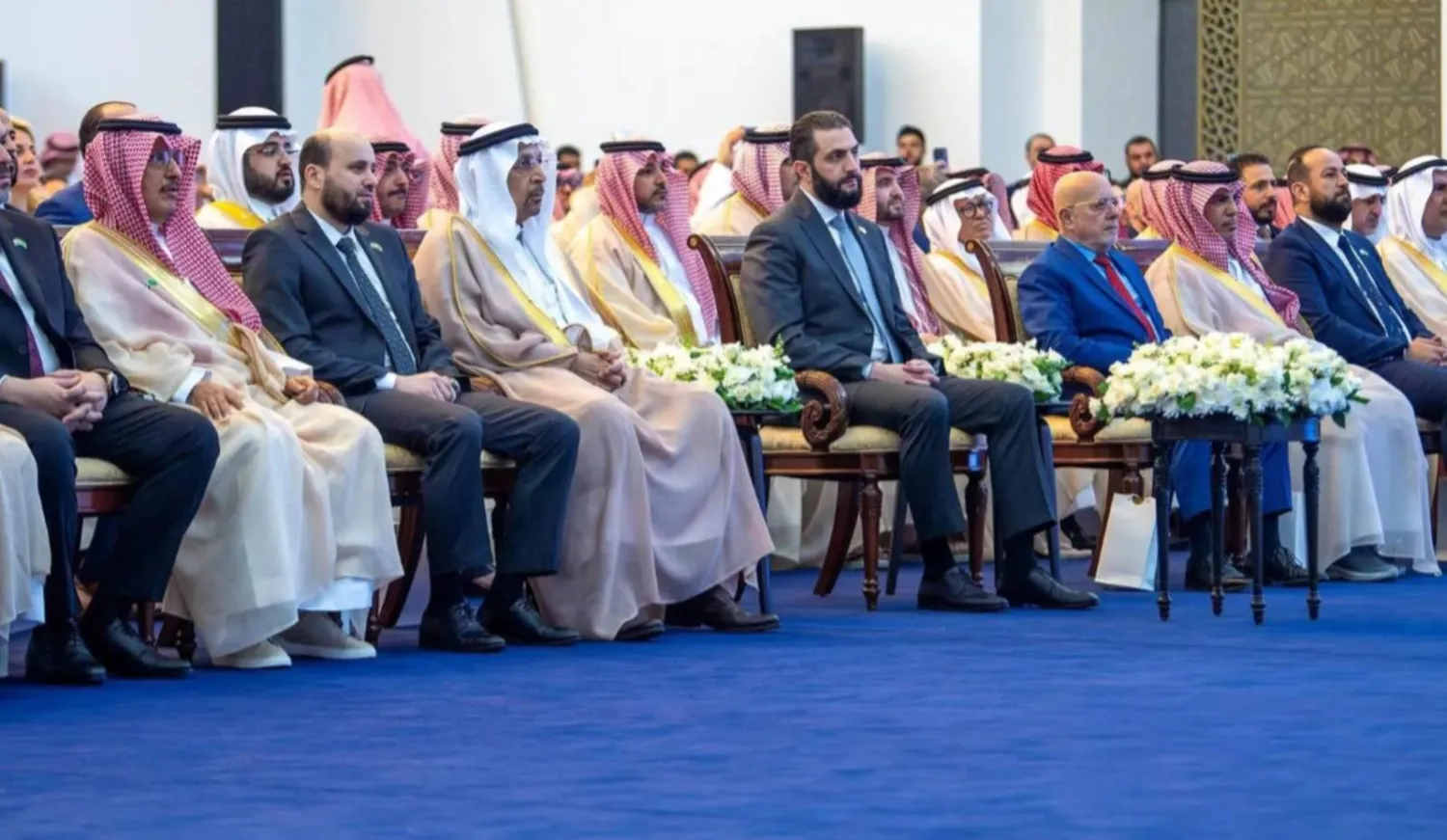
Syrian President Ahmed Al-Sharaa with businesspeople during the Saudi-Syrian Investment Forum in Damascus (SPA)
TT

Saudi Arabia Prepares New Pathways for Its Companies to Enter the Syrian Market

Syrian President Ahmed Al-Sharaa with businesspeople during the Saudi-Syrian Investment Forum in Damascus (SPA)

Asharq Al-Awsat has learned that the Saudi-Syrian Business Council is currently working on around three new pathways that are still being developed as part of an institutional framework aimed at facilitating the entry of Saudi companies into the Syrian market and paving the way for new sector-specific projects in the coming stages.

Saudi-Syrian economic relations have developed since last year, following the arrival in Damascus of a high-level Saudi delegation led by then Investment Minister Khalid Al-Falih. The delegation included more than 130 businesspeople and investors, reflecting the scale of official and economic interest in strengthening trade and investment ties between the two countries.

The visit saw the signing of more than 47 agreements and memorandums of understanding across 11 vital sectors, with total investments exceeding $6.4 billion. They covered real estate, infrastructure, telecommunications and information technology, industry, and other sectors.

Coordination with the “Syrian Sovereign Fund”

According to the information, a mechanism has been established to coordinate with the Syrian Investment Authority to form a joint team to study the development of land and sea logistics corridors. This would include facilitating direct access for exports and temporary admission procedures for equipment used to carry out projects.

In parallel, the Federation of Saudi Chambers has opened a direct channel with the Syrian sovereign fund to follow up on investment opportunities available to the Saudi private sector and support communication with relevant authorities in the Syrian market.

The council was established as Syria prepares for a new phase of reconstruction and development, creating opportunities for the Saudi private sector to participate in investment projects and various economic sectors, drawing on its financing and investment capabilities and its experience in project development.

Since its establishment, the council has begun preparing an action plan for 2025-2030 aimed at strengthening sustainable economic cooperation between Saudi Arabia and Syria, highlighting investment opportunities, supporting strategic partnerships, and facilitating trade and logistics procedures for Saudi companies' exports.

The plan focuses on enabling the Saudi private sector to benefit from reconstruction and development opportunities in Syria by supporting exports, simplifying procedures, and strengthening regulatory frameworks that provide a more favorable environment for investors. It focuses on sectors including infrastructure, trade and export development, real estate development, tourism, industry, and food security.

New Investments

In this context, Mohammed bin Abdullah Abu Nayyan, chairman of the Saudi-Syrian Business Council, said the council includes a number of senior Saudi officials and investors with international business activities, strengthening its ability to support trade and investment relations between the two countries and achieve its objectives.

The Saudi-Syrian Business Council delegation visited the Syrian capital, Damascus, last August, with the participation of 180 Saudi businesspeople. It held joint meetings and more than 15 meetings with government officials, in addition to eight sector-focused meetings and workshops addressing investment opportunities, challenges, and areas of cooperation.

During the visit, the delegation announced the “Sham View” project by Saudi real estate development and investment company Tharaa, with investments exceeding $1 billion. It also launched construction work on the Narcissus Damascus Hotel, owned by Saudi hotel and resort group Boudl.



China, US Discuss Tariffs, Farm Trade at First Trade Council Meeting

US and Chinese flags are seen in this illustration taken March 20, 2025. (Reuters)
TT

China, US Discuss Tariffs, Farm Trade at First Trade Council Meeting

US and Chinese flags are seen in this illustration taken March 20, 2025. (Reuters)

China and the United States held their first trade council meeting under a bilateral economic and trade consultation mechanism via ‌video link ‌on Friday, China's ‌commerce ⁠ministry said on ⁠Saturday.

The two sides held "candid, in-depth and constructive discussions" on implementing outcomes ⁠from previous trade consultations, ‌including ‌tariffs, a reciprocal ‌tariff-reduction arrangement involving $30 ‌billion on each side, agricultural trade and other issues of ‌note, the ministry said.

Both sides will ⁠continue ⁠to use the council to address trade concerns, expand cooperation and reduce outstanding issues, it added.


IMF Says More Work Needed on Lebanon Reforms

A man walks past Lebanon's Central Bank headquarters in Beirut on November 10, 2026. (AFP)
TT

IMF Says More Work Needed on Lebanon Reforms

A man walks past Lebanon's Central Bank headquarters in Beirut on November 10, 2026. (AFP)

The International Monetary Fund said on Friday that more work was needed to reach an agreement on restructuring Lebanon's banking sector, one of the steps towards unlocking billions of dollars in financial assistance.

An IMF staff-level agreement reached in April 2022 laid out conditions to unlock assistance, including a law on the distribution of losses in the banking sector, known as the financial gap law, which parliament has still not voted on.

In a statement at the end of meetings that began on Tuesday, the IMF said "there was progress in further clarifying the approaches under consideration by the Banque du Liban (BdL) and the Government regarding banking sector reform, the draft financial regulation law and the recovery of deposits, and aligning them with international standards".

It however noted that "further work is needed to reach an agreement on a strategy for an effective and durable restructuring of Lebanon's banking sector, leading to a sound and resilient system".

The cabinet submitted a draft of the law to parliament in 2025, but the text is contested by the banking sector and political parties, preventing a vote.

Differences over estimates of losses and their distribution have stalled negotiations with the IMF.

In 2022, the government estimated losses resulting from the 2019 financial crisis at around $70 billion, a figure believed to have increased over the last seven years during which the crisis has remained unresolved.

Lebanese Finance Minister Yassin Jaber said during a news conference that he hoped to "achieve progress that would allow us to reach an agreement on a program with the IMF and sign it during the first quarter of next year, and by its end at the latest".

Lebanon's economic crisis, which the World Bank has ranked among the worst since 1850, has deprived depositors of access to all of their funds, destroyed confidence in the banking sector and led to greater reliance on cash liquidity in various economic and commercial activities.


Silver Demand Seen Down 5% This Year Due to Weaker Jewellery Purchases

Silver bars are stacked in the safe deposit boxes room of the Pro Aurum gold house in Munich, Germany, January 10, 2025. (Reuters)
TT

Silver Demand Seen Down 5% This Year Due to Weaker Jewellery Purchases

Silver bars are stacked in the safe deposit boxes room of the Pro Aurum gold house in Munich, Germany, January 10, 2025. (Reuters)

Silver demand is expected to fall by 5% in 2026 due to weaker jewellery demand and lower consumption in solar cells, where high prices have accelerated substitution, research showed on Friday.

Research done by consultancy Metals Focus for the Silver Institute puts demand at 1.08 billion troy ounces this year.

Silver, used in jewellery, electronics, electric vehicles and solar panels as well as for investment, is ‌down 59% ‌to $50 an ounce since retail buying drove prices ‌to ⁠a record high ⁠of $121.6 in January.

The base for that rally was created in 2025, when silver surged 147%, as massive inflows of the metal to US inventories due to tariff uncertainty and into silver-backed exchange-traded products (ETPs) tightened liquidity in the London market.

This year, expectations for higher interest rates, a stronger dollar and higher bond yields have weighed on investment ⁠sentiment.

Silver released through ETP selling, outflows from stocks ‌in the US and a smaller ‌market deficit improved liquidity in the physical market, the Silver Institute and ‌consultancy Metals Focus said on Friday.

Metals Focus sees net ETP ‌outflows of 45 million ounces this year after 278 million ounces of inflows in 2025.

As of early November, ETP holdings stood at 1.25 billion ounces.

Industrial demand is expected to fall by 3% in 2026 as installations ‌in photovoltaics have fallen short of expectations, particularly in China, while January's record silver prices accelerated ⁠substitution.

Meanwhile, demand ⁠for jewellery and silverware is forecast to decline by 22% and 17%, respectively, as higher prices and weaker rural spending in India encouraged purchases of smaller, lighter products.

Demand in China and the US is also subdued. Strong retail investment in late 2025 and early 2026 gave way to far more subdued buying from March as silver prices fell, Metals Focus said.

It expects global bar and coin demand to fall 2% this year, with US retail investment hitting its lowest level since 2010.