


Stocks Fall Further as Oil Spike Fans Fresh Inflation Worries

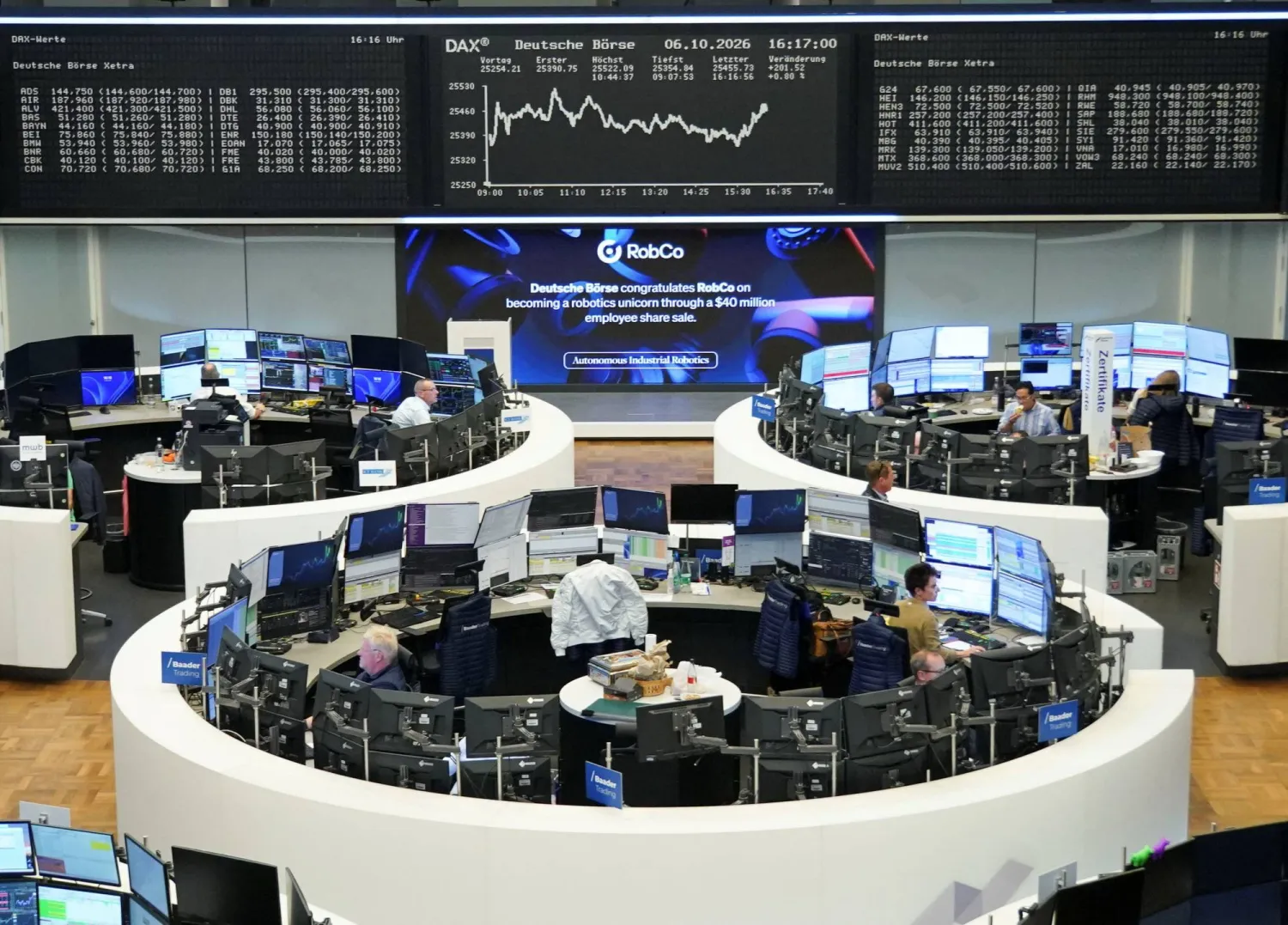
Chart of German share price DAX (Deutscher Aktienindex) at the stock exchange in Frankfurt, Germany, October 6, 2026.  REUTERS/Staff
Chart of German share price DAX (Deutscher Aktienindex) at the stock exchange in Frankfurt, Germany, October 6, 2026. REUTERS/Staff
TT

Stocks Fall Further as Oil Spike Fans Fresh Inflation Worries

Chart of German share price DAX (Deutscher Aktienindex) at the stock exchange in Frankfurt, Germany, October 6, 2026.  REUTERS/Staff
Chart of German share price DAX (Deutscher Aktienindex) at the stock exchange in Frankfurt, Germany, October 6, 2026. REUTERS/Staff

Equities extended losses Thursday as inflation fears were stoked by a fresh jump in oil prices following a report that said Donald Trump was considering more Iran strikes ahead of next month's US midterm elections.

The selling tracked a retreat on Wall Street, where tech firms pulled back from recent gains, having weathered concerns over spiking borrowing costs and geopolitical uncertainty, said AFP.

Crude had started the week on the back foot thanks to signs that exports from the Middle East were heading back towards pre-war levels and that G7 nations had agreed to tap their stockpiles.

But anxiety returned as figures showed Tehran had increased strikes on tankers in the Strait of Hormuz, Houthis rebutted claims they had lost key territory and top oil officials warned that global reserves were running worryingly low.

And on Wednesday, The Atlantic reported that the White House had asked the Pentagon to draw up options to hit sites in Iran ahead of the midterms, with Trump's Republicans in danger of losing both houses of Congress.

The article said the size and targets were still being discussed, but added that a wider operation could be in the works after the polls on November 3.

It added that even its proponents did not think the attacks would bring Tehran to talks or see Hormuz reopened, but hoped they would show strength leading into the vote.

Both main crude contracts rose more than one percent Thursday, with supplies also hit by the loss of more than 500,000 barrels of Gulf of Mexico output owing to producers shutting up shop as Tropical Storm Isaias approaches.

News that International Energy Agency members were ready to tap more oil from reserves did little to assuage worried traders.

The spike in oil prices fanned inflation fears again and put fresh upward pressure on government bond yields to multi-year highs.

After all three main indexes on Wall Street dropped -- with the S&P 500 and Nasdaq off records -- Asia followed suit.

Tokyo, Hong Kong, Sydney, Singapore, Seoul, Wellington, Taipei and Manila were all well down, though Shanghai edged up as investors returned from a week-long break.

- Tech earnings -

US Federal Reserve officials expect to hike interest rates again before the end of the year, according to minutes of their September meeting, where everyone agreed to the first increase since July 2023.

"With regard to the outlook for monetary policy beyond the current meeting, most participants assessed that another increase in the target range for the federal funds rate would likely be appropriate by year end," the minutes said.

Several participants said they viewed the previous policy rate as not being adequately restrictive of economic activity, while they saw signs of renewed strength in the economy.

Investors are also gearing up for earnings season, with tech firms in the spotlight as questions over their profitability and elevated valuations swirl in light of the vast sums they have pumped into the AI sector.

"The headline earnings numbers may still be very strong. But with expectations elevated, valuations demanding and Treasury yields near multi-decade highs, the investment hurdle has become higher as well," warned Charu Chanana at Saxo Markets.

"This season should therefore be less about simply identifying who beat consensus by the largest amount," she said.

"The stronger businesses may be those that can deliver growth above expectations, convert that growth into cash, fund future investment from a strong balance sheet and still offer enough earnings upside to justify their valuation."

South Korean titan Samsung's shares fell as it forecast a more than 780 percent leap in third-quarter operating profit -- thanks to high memory chip prices -- but missed expectations.

It estimated July-September profit of 107.4 trillion won ($80.3 billion), up 782.5 percent on-year, but analysts on average had tipped 108.7 trillion won.

On currency markets, the euro remains wedged at lows last seen in June last year following another heavy fall amid worries about France's high debt levels, which have spooked bond markets.



Silver Demand Seen Down 5% This Year Due to Weaker Jewellery Purchases

Silver bars are stacked in the safe deposit boxes room of the Pro Aurum gold house in Munich, Germany, January 10, 2025. (Reuters)
TT

Silver Demand Seen Down 5% This Year Due to Weaker Jewellery Purchases

Silver bars are stacked in the safe deposit boxes room of the Pro Aurum gold house in Munich, Germany, January 10, 2025. (Reuters)

Silver demand is expected to fall by 5% in 2026 due to weaker jewellery demand and lower consumption in solar cells, where high prices have accelerated substitution, research showed on Friday.

Research done by consultancy Metals Focus for the Silver Institute puts demand at 1.08 billion troy ounces this year.

Silver, used in jewellery, electronics, electric vehicles and solar panels as well as for investment, is ‌down 59% ‌to $50 an ounce since retail buying drove prices ‌to ⁠a record high ⁠of $121.6 in January.

The base for that rally was created in 2025, when silver surged 147%, as massive inflows of the metal to US inventories due to tariff uncertainty and into silver-backed exchange-traded products (ETPs) tightened liquidity in the London market.

This year, expectations for higher interest rates, a stronger dollar and higher bond yields have weighed on investment ⁠sentiment.

Silver released through ETP selling, outflows from stocks ‌in the US and a smaller ‌market deficit improved liquidity in the physical market, the Silver Institute and ‌consultancy Metals Focus said on Friday.

Metals Focus sees net ETP ‌outflows of 45 million ounces this year after 278 million ounces of inflows in 2025.

As of early November, ETP holdings stood at 1.25 billion ounces.

Industrial demand is expected to fall by 3% in 2026 as installations ‌in photovoltaics have fallen short of expectations, particularly in China, while January's record silver prices accelerated ⁠substitution.

Meanwhile, demand ⁠for jewellery and silverware is forecast to decline by 22% and 17%, respectively, as higher prices and weaker rural spending in India encouraged purchases of smaller, lighter products.

Demand in China and the US is also subdued. Strong retail investment in late 2025 and early 2026 gave way to far more subdued buying from March as silver prices fell, Metals Focus said.

It expects global bar and coin demand to fall 2% this year, with US retail investment hitting its lowest level since 2010.


Gold Rises on Bargain Hunting but Heads for Weekly Decline

Gold necklaces are on display inside a jewellery showroom on the occasion of Akshaya Tritiya, a major gold buying festival, in Mumbai, India April 18, 2018. (Reuters)
TT

Gold Rises on Bargain Hunting but Heads for Weekly Decline

Gold necklaces are on display inside a jewellery showroom on the occasion of Akshaya Tritiya, a major gold buying festival, in Mumbai, India April 18, 2018. (Reuters)

Gold rose on Friday as bargain hunting emerged after prices hit a more than one-year low in the previous session, while market focus shifted to upcoming US inflation data.

Spot gold climbed 1% to $3,915.31 per ounce by 0322 GMT but was down 3.5% so far this week. US gold futures for December delivery gained 0.9% to $3,919.60.

"Today's move is ‌more of a ‌positioning adjustment, given that several intraday short-term ‌momentum ⁠indicators had kind ⁠of hit an extreme oversold level after yesterday's dramatic fall," said Kelvin Wong, a senior market analyst at OANDA.

"A short-term driver that could be bullish for gold will be a sudden turn of the US Treasury yield, that would potentially slow down the US dollar."

Spot gold prices hit their lowest level since ⁠October 2025 on Thursday as oil prices climbed ‌on fading hopes for peace ‌in the Middle East, spurring fears of higher inflation and elevated interest ‌rates.

Markets see an 89% chance of a 25-basis-point US ‌rate hike in December, while the probability of a larger 50-basis-point move is priced at 11%, according to CME's FedWatch tool.

Although gold is typically seen as an inflation hedge, higher interest rates increase the ‌opportunity cost of holding non-yielding bullion, reducing its appeal to investors.

Federal Reserve Bank of New York ⁠President John ⁠Williams said on Thursday more rate hikes are likely as the US central bank seeks to lower high levels of inflation in an otherwise healthy economy.

Data showed the number of Americans filing new claims for unemployment benefits increased more than expected last week, but remained at a level consistent with a stable labor market.

Market participants now await the US Producer Price Index data due at 1330 GMT.

Among other metals, spot silver rose 1% to $50.49 per ounce and palladium climbed 2.1% to $1,014.50, but both were headed for weekly declines.

Spot platinum gained 1.3% to $1,538.22 and was on track for a modest weekly gain.


Dollar Set for Best Week in Two Months, Yen Tests 160

US dollar banknotes are seen in this illustration taken March 24, 2026. (Reuters)
TT

Dollar Set for Best Week in Two Months, Yen Tests 160

US dollar banknotes are seen in this illustration taken March 24, 2026. (Reuters)

The dollar held near 19-month highs on Friday and was set for its biggest weekly rise in two months as bets on a larger rate hike pushed up US yields and the yen hovered below the 160 mark, prompting Tokyo to warn it would respond to excessive moves.

Treasury yields rose after President Donald Trump's comment that the US did not need a deal with Iran stoked worries about Middle Eastern oil supply, lifting crude prices and, with them, inflation expectations.

The move, together with hawkish comments from Federal Reserve officials and this week's stronger-than-expected ‌US inflation data, has ‌left traders weighing the prospect of a larger-than-usual Fed rate hike ‌next ⁠month.

Two-year Treasury yields ⁠have risen 33 basis points so far this week to around 4.85%, on course for their biggest weekly jump since 2024.

The biggest risk to dollar strength is a Middle East peace deal, said Nick Rees, head of macro research at Monex, as that would diminish the support it draws from high energy prices and its safe-haven status.

"Absent that happening, we think the dollar is likely to continue to at least remain around current levels if not strengthen slightly as we look ahead," Rees said.

The ⁠euro edged up 0.1% to $1.1065, after hitting its lowest level against the ‌dollar since April 2025. For the week, it is ‌down 0.7%, on track for its largest weekly loss since late September.

Fed officials this week warned that US ‌inflation remains stubbornly elevated, with some signalling openness to a 50-basis-point rate increase if price pressures ‌fail to ease. Traders are pricing in a 12.1% chance of such a hike next month, up from 0% last week, the CME FedWatch tool showed.

The dollar index, which measures the greenback against a basket of currencies, was at 103.17, near its highest since April 2025. For the week, the dollar is set ‌to gain 0.9%, the most since September.

YEN INTERVENTION IN FOCUS

The yen was steady at 159.90 per dollar, around its weakest since early September, ⁠fuelling concerns about possible intervention. ⁠The currency has weakened 0.9% this week, on track for its biggest weekly loss since September.

Japanese Finance Minister Satsuki Katayama said on Friday the government would respond appropriately to currency volatility.

Japan spent 15.4 trillion yen ($96.5 billion) to bolster the currency after it sank to a four-decade low of 163.99 per dollar in late July.

Markets will be cautious around this level, said Monex's Rees, adding that he expects the trigger for intervention somewhere a little higher than 160.

The Australian dollar has fallen about 3.4% so far this month, making it the worst-performing G10 currency against the greenback. Australia is the only G10 country for which markets are pricing a rate cut next year. The Aussie was last at $0.6794.

The dollar was little changed against the Swiss franc at 0.836, hovering near a one-month high.

Among cryptocurrencies, bitcoin fell 3.8% to $68,759, dropping below the key $70,000 level to its lowest since August. Ether also dropped 4% to $1,933.49.