


World Bank in Talks with Dozens of Countries about Crisis Aid, Banga Says

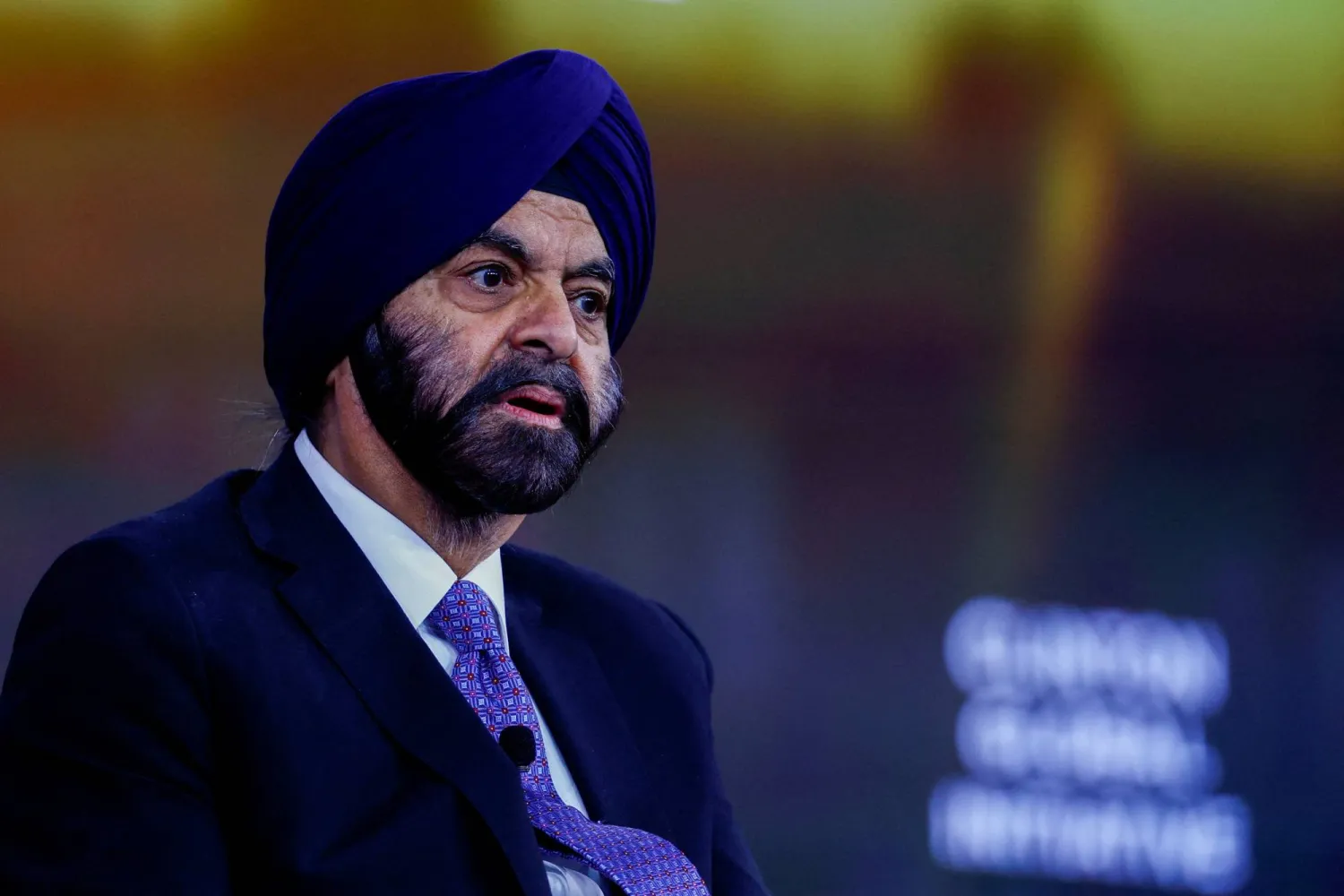
FILE PHOTO: Ajay Banga, President of the World Bank Group, reacts during the Clinton Global Initiative 2026 Annual Meeting in New York City, US, September 23, 2026. REUTERS/Jeenah Moon/File Photo/File Photo
TT

World Bank in Talks with Dozens of Countries about Crisis Aid, Banga Says

FILE PHOTO: Ajay Banga, President of the World Bank Group, reacts during the Clinton Global Initiative 2026 Annual Meeting in New York City, US, September 23, 2026. REUTERS/Jeenah Moon/File Photo/File Photo

The World Bank is in discussions with 30 to 40 countries about potential crisis aid to help them manage energy shocks and price increases triggered by the war in the Middle East, its president, Ajay Banga, told Reuters in an interview.

Banga said the global economy had proven fairly resilient, in part due to big AI investments and adjustments in supply and demand for oil, which meant that few countries had sought the initial $25 billion in crisis funds that the World Bank had made available when the war began in late February.

However, a sharp spike in diesel and fertilizer prices and other factors, including the looming super El Niño weather effect, were adding to challenges facing developing countries, Banga said in an interview ahead of this week's annual meetings of the International Monetary Fund and World Bank.

"There is pressure, and so I think maybe over the coming months, more countries will come for some slice of that first $50 to $60 billion," Banga said, referring to the initial $25 billion plus ‌another $35 billion that countries ‌could tap by diverting resources from already approved World Bank projects.

"We'll see, but we're ready. ‌We're ⁠engaged. We're having conversations ⁠with a number of them, you know, 30 to 40 countries are in dialogue with us," he said.

Many developing countries have been hit hard by the spike in energy prices and high interest rates that have increased borrowing costs at a time when their fiscal coffers are still depleted by measures taken during the COVID-19 pandemic and the spike in inflation following Russia's invasion of Ukraine.

World Bank estimates show that developing countries owe external creditors about $400 billion in 2026, with interest payments alone comprising one-third of the total.

Banga said more countries had shown interest in retooling existing projects than in tapping the immediate crisis window to address their liquidity needs. If the situation worsened, the Bank could ⁠make available as much as $100 billion in funds, he said, exceeding the $70 billion disbursed during ‌the pandemic.

The World Bank last month announced that it attracted a record $112 billion in ‌private capital in the year ended June versus $69 billion a year earlier, and more than triple the 2022 total before Banga, a former Mastercard ‌CEO, became president.

That was on top of the $123 billion invested from the bank's own resources for that year, for a ‌combined $235 billion, Banga said, underscoring the importance of tapping all available resources, especially at a time when Western countries have sharply cut official bilateral development aid.

"There is no one answer that fits when the world has these kinds of issues. What you need to do is figure out how to cut your coat to suit your cloth," Banga said.

Banga said he expected further gains in private capital flows in coming years, aided by expanded ‌political risk guarantees from the bank's Multilateral Investment Guarantee Agency, growth in local currency financing, and continued work on regulatory reforms that made it easier for foreign investors.

The private capital jump ⁠was biggest in projects in upper-middle-income ⁠countries like Argentina or India, which accounted for $50 billion of the private capital, and lower-middle-income countries including Bangladesh and Angola, which accounted for $37 billion. But more work was needed to boost the roughly $3 billion in private capital flowing to low-income countries.

"In the smaller countries, it hasn't multiplied enough, and there are challenges," he said, noting the bank would announce some new initiatives this week aimed at ensuring micro-, small- and medium-sized businesses also had access to private capital.

Banga said private capital growth was also regionally spread, with the largest increase seen in Latin America and the Caribbean, which accounted for $36.3 billion of last year's total, followed by Europe and Central Asia with $21.3 billion, South Asia with $19.2 billion and Africa with $22 billion.

The top 10 recipient countries were Brazil, India, Türkiye, Romania, Nigeria, Argentina, South Africa, Bangladesh, Mexico and Chile, the Bank said.

Banga said the World Bank and IMF were working together to address the high debt levels plaguing many developing countries through a series of initiatives, including efforts to boost countries' domestic revenue collections.

The Bank had already set up some debt-for-development swaps for Angola and Ivory Coast, and a portfolio-based guarantee for Argentina, and was working on over a dozen more projects.

"We've got 14 or 15 in the pipeline, helping them rotate out higher-priced old debt for newer-priced debt with our guarantees," with the difference then targeted at education, healthcare, water, or nature programs, he said.



World Food Prices Dip in October, but Remain Higher Than a Year Ago

A worker carries loaves of bread for sale at a bakery in the capital city of Cairo, Egypt November 4, 2026. (Reuters)
TT

World Food Prices Dip in October, but Remain Higher Than a Year Ago

A worker carries loaves of bread for sale at a bakery in the capital city of Cairo, Egypt November 4, 2026. (Reuters)

World food prices edged lower in October as weaker import demand contributed to monthly declines in cereal, dairy and meat prices, but were still nearly 6% higher than a year earlier, the United Nations' Food and Agriculture Organization said on Friday.

The FAO Food Price Index, which tracks monthly changes in international prices for a basket of food commodities, ‌averaged 133.9 points ‌in October, down from a revised ‌135.6 ⁠in September.

The index ⁠was 5.9% higher than a year earlier, but remained 16.4% below its March 2022 peak.

FAO's cereal price index fell 4.5% from September and was 12.6% lower than a year ago, as wheat and maize quotations declined. Wheat prices eased on weak import demand ⁠and improved production prospects, especially in Argentina.

"Expectations of ‌easing constraints on Black ‌Sea export flows added to the downward pressure on prices, ‌although continued disruptions to Black Sea logistics limited the decline," ‌FAO said in a statement.

Maize prices also eased after reaching a three-year high in September, pressured by the US harvest, expectations of ample supplies in South America and renewed ‌prospects of easing tensions in the Black Sea region.

Vegetable oil prices edged up 0.3%, ⁠as ⁠higher soybean and sunflower oil prices more than offset a fall in rapeseed oil prices.

Sugar prices rose 6.6%, their fourth straight monthly increase, to the highest level since December 2024, after rainfall disrupted harvesting in Brazil. They were now 28.8% above a year ago.

The dairy index fell 1.1%, as lower butter and cheese prices linked to ample supplies and subdued demand outweighed gains in milk powder.

The meat index declined 1.2%, while still slightly above its year-earlier level, as ovine and bovine meat prices fell.


Copper Falls, Set for Worst Week Since March on AI Rout

Copper at the Aurubis copper smelting and refining plant in Hamburg, Germany. (Reuters)
TT

Copper Falls, Set for Worst Week Since March on AI Rout

Copper at the Aurubis copper smelting and refining plant in Hamburg, Germany. (Reuters)

Copper dropped on Friday and was set for its biggest weekly drop in London since March, as a rout in technology stocks battered markets.

Benchmark three-month copper on the London Metal Exchange was down 1.3% at $13,663 a metric ton by 0700 GMT. That placed it on track to fall 3.44% in the week, Reuters said.

The most-traded copper contract on the Shanghai Futures Exchange fell 1.08% to 106,830 yuan ($16,018.17) a ton.

The weakness reflects worries over AI investment, ‌with copper increasingly ‌influenced by "sentiment towards data center expansion," said ‌Craig ⁠Lang, principal analyst ⁠at CRU.

Technology shares were battered after Democratic wins in the US midterms fueled concerns that new regulatory oversight could cap the AI buildout.

On the other hand, supply constraints cushioned copper's decline.

"I would be cautious about calling this a sustained correction, given ongoing mine supply challenges and exceptionally tight ⁠metal availability outside the US," Lang said.

Copper stocks ‌in SHFE-monitored warehouses <CU-STX-SGH> fell by ‌over 24% this week to just 33,848 tons — the lowest ‌in almost three years. The closely watched Yangshan copper ‌premium <SMM-CUYP-CN>, a gauge of appetite for imports into key consumer China, increased to $210 a ton on Thursday, matching its record high.

Smelters in the country are facing a double squeeze of negative treatment ‌charges and lower sulfuric acid prices.

Meanwhile, warehouse inventories outside the US have been drawn ⁠down as ⁠material was pulled into the country ahead of a potential tariff on imports of refined copper.

"These physical constraints should provide some support against weaker investor sentiment," Lang said.

Among LME metals, aluminium lost 0.54%, zinc lost 1.42%, lead lost 0.45%, nickel dipped 0.23% and tin gained 0.83%.

On the SHFE, aluminium nudged down only 0.04%, zinc lost 1.35%, lead was little changed, down only 0.03%, nickel rose 2.14% and tin dropped 3.45%.

SHFE inventories were down across the board this week, led by sharp drops in aluminium <AL-STX-SGH> and lead <PB-STX-SGH>.


Emerging Economies Set to Match Advanced Nations’ Renewable Capacity Additions, IEA Says

Workers walk at Kalyon Karapinar solar power plant in Karapinar, Konya province, Türkiye, Oct. 14, 2026. (AP)
TT

Emerging Economies Set to Match Advanced Nations’ Renewable Capacity Additions, IEA Says

Workers walk at Kalyon Karapinar solar power plant in Karapinar, Konya province, Türkiye, Oct. 14, 2026. (AP)

Emerging ‌and developing economies outside China are expected to add as much new renewable energy capacity as advanced economies for the first time over the next five years, driven by the current energy crisis, the International Energy Agency said on Friday.

Gas and oil prices have soared this year as the US-Iran war disrupts traffic through the Strait of Hormuz, a key route for global oil and gas trade.

Global renewable energy ‌capacity is forecast ‌to increase by almost 4,800 gigawatts ‌between ⁠2026 and 2031, ⁠the IEA said in its annual outlook.

Emerging and developing economies are expected to add about 1,100 GW, roughly the same as advanced economies, with China adding around 2,550 GW, the agency said.

Capacity growth in Southeast Asia, Africa and the Middle East is ⁠expected to triple over the period, ‌led mainly by solar installations, ‌the IEA said.

China will remain the biggest contributor to ‌global renewable energy growth, although its share is ‌forecast to fall to 53% by 2031 from 60% in 2025.

India is emerging as the world's second-fastest deployer of renewables and is expected to more than double its contribution ‌to global growth by 2031 to nearly 8.5%.

Grid connection delays remain ⁠a major ⁠challenge, with projects awaiting connections worldwide rising 60% over the past year, equivalent to four times the wind and solar capacity connected to grids during the same period.

Grid constraints are expected to slow growth in advanced economies, with annual additions in Europe through 2031 forecast to remain broadly in line with 2025 levels.

Renewable energy is expected to meet 6% of global transport energy demand by 2031, while higher fuel-blending mandates prompted the IEA to raise its biofuels forecast by 40% from last year's report.