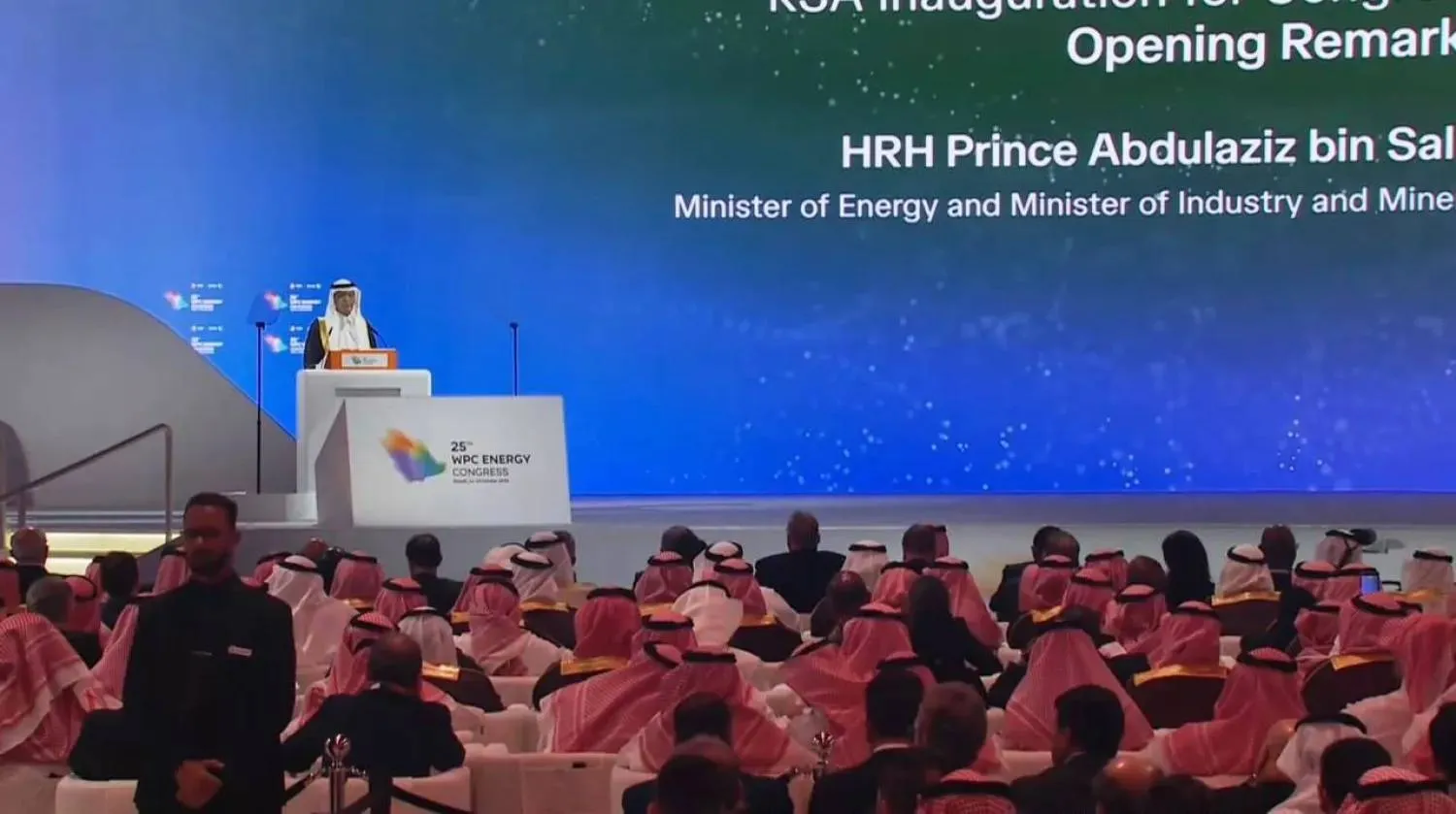
Saudi Energy Minister: No Room for Fear in Our Dictionary…No Wasted Opportunities to Realize Our Vision

Saudi Energy Minister Prince Abdulaziz bin Salman speaks at the opening of the WPC Energy Congress (Asharq Al-Awsat)
TT

Saudi Energy Minister: No Room for Fear in Our Dictionary…No Wasted Opportunities to Realize Our Vision

Saudi Energy Minister Prince Abdulaziz bin Salman speaks at the opening of the WPC Energy Congress (Asharq Al-Awsat)

Saudi Energy Minister Prince Abdulaziz bin Salman said there was no room for fear in the dictionary of Saudis, stressing that the resilience of the kingdom’s energy system and the determination of its people strengthened its ability to weather crises, ensure uninterrupted supplies and continue its transformation drive toward the goals of Vision 2030.

He also highlighted the importance of long-term investment in infrastructure, developing supply chains and localizing industries to help Saudi Arabia navigate global challenges and changes while preserving opportunities for future generations in a more sustainable future.

Prince Abdulaziz made the remarks in his opening address at the 25th WPC Energy Congress, held as part of Riyadh Energy Week on Monday, in the presence of a large number of ministers, officials and industry leaders.

He said recent experiences had demonstrated the importance of advance preparedness and building an energy system capable of adapting to different circumstances. Resilience, he added, was measured not only by a system’s ability to withstand disruptions, but also by its capacity to repair damage, restore operations and continue meeting market needs.

Prince Abdulaziz stressed that energy system resilience and reliable supplies were fundamental to addressing global challenges and changing conditions. He said the kingdom would continue investing in energy infrastructure, developing supply chains and strengthening human capabilities and modern technologies to ensure uninterrupted supplies under all circumstances.

He said the conference was being held at a pivotal moment for the global energy sector, adding that Saudi Arabia’s hosting of participants in its capital reflected the kingdom’s commitment to providing a safe environment and that the safety of its guests was a top priority.

The meeting, he said, embodied a commitment to prudent decision-making, practical cooperation and a shared sense of responsibility within the energy community, as the sector faces mounting challenges related to energy security and supply stability that are testing the resilience and adaptability of countries and economic systems.

Prince Abdulaziz said Saudi Arabia had invested over the years in developing infrastructure, improving supply chain efficiency and building human capabilities to ensure the energy system was prepared to cope with exceptional circumstances.

He cited the East-West oil pipeline as a key example of infrastructure that provides alternative routes for transporting oil to markets, strengthening the kingdom’s ability to manage risks that could disrupt traditional supply routes.

These capabilities, he said, had not been developed overnight, but were the result of years of planning, development and operational experience, supported by Saudi Aramco’s technical and operational expertise, industrial capabilities and transportation and supply networks, which help ensure business continuity under varying conditions.

Localizing supply chains

Prince Abdulaziz bin Salman stressed the importance of localizing supply chains and increasing local content, describing them as strategic objectives for Saudi Arabia. He cited Saudi Aramco’s announcement that it had achieved a 70% local content rate, a milestone reflecting the growing capabilities of national industries and their role in strengthening the sector’s resilience.

The minister said the value of these investments becomes more apparent when global supply chains are disrupted, as advanced systems and domestic capabilities help address gaps and mitigate the impact of interruptions, supporting energy system stability and ensuring continued operations.

He said resilience depends on skilled personnel, technical expertise and rapid response, enabling critical facilities to recover from damage and maintain services.

The energy minister reaffirmed the kingdom’s commitment to continued investment across the energy sector, developing new technologies and reducing emissions, while also investing in national talent and preparing future generations.

Implementing the vision

Prince Abdulaziz bin Salman said Saudi Arabia aims to build an energy system capable of sustained success and adapting to changing circumstances while safeguarding the security and sustainability of supplies.

He stressed that the kingdom has the resources needed to sustain economic growth and pursue its development vision, supporting the prosperity of its people and strengthening international partnerships.

While no one can predict when current conditions will end, recent experience underscores the importance of preparing for the future, developing solutions before they are needed and strengthening the ability to respond to rapidly changing demands, he said.

Prince Abdulaziz called for Riyadh to serve as a platform for deeper cooperation and translating international partnerships into practical action, with discussions focused on meeting global energy needs, reducing emissions and strengthening resilience to crises and challenges.

He said the world needed reliable partners and leaders willing to make long-term strategic decisions, reaffirming that Saudi Arabia would continue to play its role in the energy sector through an approach based on prudence, openness and expanding international partnerships.

He concluded by welcoming participants to Riyadh and calling for joint efforts to build a secure and resilient energy future that ensures reliable supplies and meets the needs of societies and economies worldwide.


Silver Demand Seen Down 5% This Year Due to Weaker Jewellery Purchases

Silver bars are stacked in the safe deposit boxes room of the Pro Aurum gold house in Munich, Germany, January 10, 2025. (Reuters)
TT

Silver Demand Seen Down 5% This Year Due to Weaker Jewellery Purchases

Silver bars are stacked in the safe deposit boxes room of the Pro Aurum gold house in Munich, Germany, January 10, 2025. (Reuters)

Silver demand is expected to fall by 5% in 2026 due to weaker jewellery demand and lower consumption in solar cells, where high prices have accelerated substitution, research showed on Friday.

Research done by consultancy Metals Focus for the Silver Institute puts demand at 1.08 billion troy ounces this year.

Silver, used in jewellery, electronics, electric vehicles and solar panels as well as for investment, is ‌down 59% ‌to $50 an ounce since retail buying drove prices ‌to ⁠a record high ⁠of $121.6 in January.

The base for that rally was created in 2025, when silver surged 147%, as massive inflows of the metal to US inventories due to tariff uncertainty and into silver-backed exchange-traded products (ETPs) tightened liquidity in the London market.

This year, expectations for higher interest rates, a stronger dollar and higher bond yields have weighed on investment ⁠sentiment.

Silver released through ETP selling, outflows from stocks ‌in the US and a smaller ‌market deficit improved liquidity in the physical market, the Silver Institute and ‌consultancy Metals Focus said on Friday.

Metals Focus sees net ETP ‌outflows of 45 million ounces this year after 278 million ounces of inflows in 2025.

As of early November, ETP holdings stood at 1.25 billion ounces.

Industrial demand is expected to fall by 3% in 2026 as installations ‌in photovoltaics have fallen short of expectations, particularly in China, while January's record silver prices accelerated ⁠substitution.

Meanwhile, demand ⁠for jewellery and silverware is forecast to decline by 22% and 17%, respectively, as higher prices and weaker rural spending in India encouraged purchases of smaller, lighter products.

Demand in China and the US is also subdued. Strong retail investment in late 2025 and early 2026 gave way to far more subdued buying from March as silver prices fell, Metals Focus said.

It expects global bar and coin demand to fall 2% this year, with US retail investment hitting its lowest level since 2010.


Gold Rises on Bargain Hunting but Heads for Weekly Decline

Gold necklaces are on display inside a jewellery showroom on the occasion of Akshaya Tritiya, a major gold buying festival, in Mumbai, India April 18, 2018. (Reuters)
TT

Gold Rises on Bargain Hunting but Heads for Weekly Decline

Gold necklaces are on display inside a jewellery showroom on the occasion of Akshaya Tritiya, a major gold buying festival, in Mumbai, India April 18, 2018. (Reuters)

Gold rose on Friday as bargain hunting emerged after prices hit a more than one-year low in the previous session, while market focus shifted to upcoming US inflation data.

Spot gold climbed 1% to $3,915.31 per ounce by 0322 GMT but was down 3.5% so far this week. US gold futures for December delivery gained 0.9% to $3,919.60.

"Today's move is ‌more of a ‌positioning adjustment, given that several intraday short-term ‌momentum ⁠indicators had kind ⁠of hit an extreme oversold level after yesterday's dramatic fall," said Kelvin Wong, a senior market analyst at OANDA.

"A short-term driver that could be bullish for gold will be a sudden turn of the US Treasury yield, that would potentially slow down the US dollar."

Spot gold prices hit their lowest level since ⁠October 2025 on Thursday as oil prices climbed ‌on fading hopes for peace ‌in the Middle East, spurring fears of higher inflation and elevated interest ‌rates.

Markets see an 89% chance of a 25-basis-point US ‌rate hike in December, while the probability of a larger 50-basis-point move is priced at 11%, according to CME's FedWatch tool.

Although gold is typically seen as an inflation hedge, higher interest rates increase the ‌opportunity cost of holding non-yielding bullion, reducing its appeal to investors.

Federal Reserve Bank of New York ⁠President John ⁠Williams said on Thursday more rate hikes are likely as the US central bank seeks to lower high levels of inflation in an otherwise healthy economy.

Data showed the number of Americans filing new claims for unemployment benefits increased more than expected last week, but remained at a level consistent with a stable labor market.

Market participants now await the US Producer Price Index data due at 1330 GMT.

Among other metals, spot silver rose 1% to $50.49 per ounce and palladium climbed 2.1% to $1,014.50, but both were headed for weekly declines.

Spot platinum gained 1.3% to $1,538.22 and was on track for a modest weekly gain.


Dollar Set for Best Week in Two Months, Yen Tests 160

US dollar banknotes are seen in this illustration taken March 24, 2026. (Reuters)
TT

Dollar Set for Best Week in Two Months, Yen Tests 160

US dollar banknotes are seen in this illustration taken March 24, 2026. (Reuters)

The dollar held near 19-month highs on Friday and was set for its biggest weekly rise in two months as bets on a larger rate hike pushed up US yields and the yen hovered below the 160 mark, prompting Tokyo to warn it would respond to excessive moves.

Treasury yields rose after President Donald Trump's comment that the US did not need a deal with Iran stoked worries about Middle Eastern oil supply, lifting crude prices and, with them, inflation expectations.

The move, together with hawkish comments from Federal Reserve officials and this week's stronger-than-expected ‌US inflation data, has ‌left traders weighing the prospect of a larger-than-usual Fed rate hike ‌next ⁠month.

Two-year Treasury yields ⁠have risen 33 basis points so far this week to around 4.85%, on course for their biggest weekly jump since 2024.

The biggest risk to dollar strength is a Middle East peace deal, said Nick Rees, head of macro research at Monex, as that would diminish the support it draws from high energy prices and its safe-haven status.

"Absent that happening, we think the dollar is likely to continue to at least remain around current levels if not strengthen slightly as we look ahead," Rees said.

The ⁠euro edged up 0.1% to $1.1065, after hitting its lowest level against the ‌dollar since April 2025. For the week, it is ‌down 0.7%, on track for its largest weekly loss since late September.

Fed officials this week warned that US ‌inflation remains stubbornly elevated, with some signalling openness to a 50-basis-point rate increase if price pressures ‌fail to ease. Traders are pricing in a 12.1% chance of such a hike next month, up from 0% last week, the CME FedWatch tool showed.

The dollar index, which measures the greenback against a basket of currencies, was at 103.17, near its highest since April 2025. For the week, the dollar is set ‌to gain 0.9%, the most since September.

YEN INTERVENTION IN FOCUS

The yen was steady at 159.90 per dollar, around its weakest since early September, ⁠fuelling concerns about possible intervention. ⁠The currency has weakened 0.9% this week, on track for its biggest weekly loss since September.

Japanese Finance Minister Satsuki Katayama said on Friday the government would respond appropriately to currency volatility.

Japan spent 15.4 trillion yen ($96.5 billion) to bolster the currency after it sank to a four-decade low of 163.99 per dollar in late July.

Markets will be cautious around this level, said Monex's Rees, adding that he expects the trigger for intervention somewhere a little higher than 160.

The Australian dollar has fallen about 3.4% so far this month, making it the worst-performing G10 currency against the greenback. Australia is the only G10 country for which markets are pricing a rate cut next year. The Aussie was last at $0.6794.

The dollar was little changed against the Swiss franc at 0.836, hovering near a one-month high.

Among cryptocurrencies, bitcoin fell 3.8% to $68,759, dropping below the key $70,000 level to its lowest since August. Ether also dropped 4% to $1,933.49.