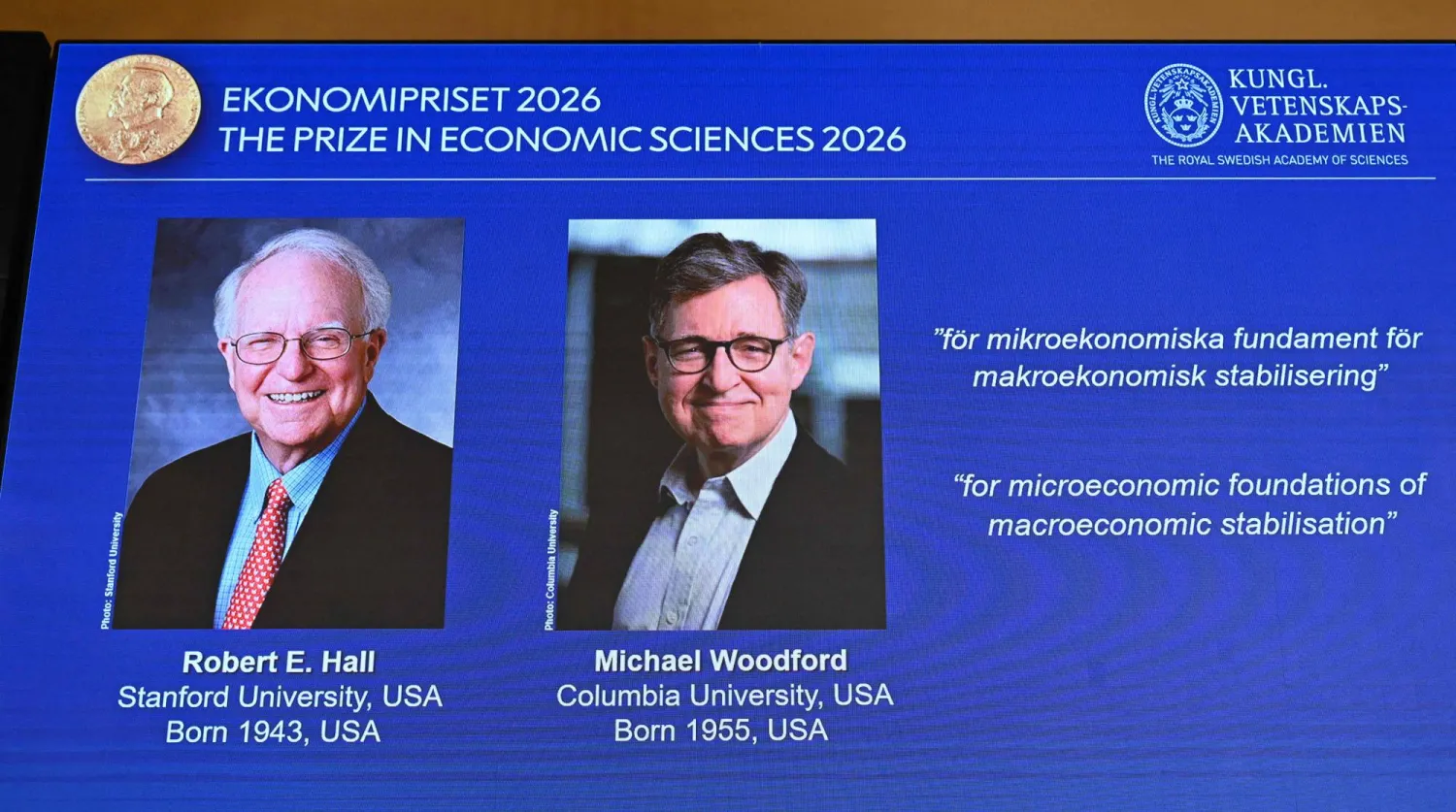
2 American Economists Win Nobel for Work on Managing Economic Shocks

US macroeconomists Robert E Hall and Michael Woodford are seen on a screen as they are announced as the laureates of the 2026 Sveriges Riksbank Prize in Economic Sciences in Memory of Alfred Nobel at the Royal Swedish Academy of Sciences in Stockholm on October 12, 2026. (Photo by Jonathan Nackstrand / AFP)
TT

2 American Economists Win Nobel for Work on Managing Economic Shocks

US macroeconomists Robert E Hall and Michael Woodford are seen on a screen as they are announced as the laureates of the 2026 Sveriges Riksbank Prize in Economic Sciences in Memory of Alfred Nobel at the Royal Swedish Academy of Sciences in Stockholm on October 12, 2026. (Photo by Jonathan Nackstrand / AFP)

American economists Robert E. Hall and Michael Woodford won the Nobel Memorial Prize in economics Monday for their work on models that have helped governments and central banks manage economic shocks, such as energy crises and inflation.

The Royal Swedish Academy of Sciences announced the winners in Stockholm, noting that their work created the theoretical foundation to better understand how consumers decide whether to save or spend, insights that make it easier for policymakers worldwide to stabilize economies after fluctuations, The Associated Press said.

“The laureates’ research has made it possible to manage major macroeconomic crises far more effectively than before,” the Nobel committee wrote in a paper explaining the economists' work. “It has been hugely beneficial during the pandemic and the energy crises of recent years.”

Hall, 83, is affiliated with Stanford University in California. Woodford, who was born in 1955, is affiliated with Columbia University in New York.

Woodford spoke to the committee by phone from New York: “It’s a tremendous honor. It’s a surprise.”

Hall also said the award was a “wonderful surprise.”

“I’ve spent my career trying to understand how the economy works, following interesting questions wherever they led. When I thought I had a new idea, the next step was to find out whether it was actually new, whether it was right, and whether it mattered," he said in a statement released by Stanford.

Duo overturned earlier economic assumptions

For decades, governments responded to economic shocks by following the Depression-era prescriptions of the British economist John Maynard Keynes: Intervene in the economy by lowering interest rates and taxes and hiking government spending, thereby encouraging consumers and businesses to spend and invest and help restart growth.

“This is the Keynesian recipe and it worked well — until it didn’t,” said Timo Boppart of the Nobel economics committee.

Policymakers had thought economic management involved simple trade-offs — unemployment, for instance, would stay low at a time of high inflation and rise when inflation fell. But the “ stagflation ” of the 1970s — when the world economy experienced simultaneous high inflation and high unemployment — proved the formula was simplistic.

Some economists argued that government attempts to intervene in the economy were doomed to fail. But Hall and Woodford, in separate contributions, set about improving the Keynesian model to take into account how consumers and businesses actually make decisions about whether to invest and spend.

“Economic outcomes are the result of millions of decisions made at the microlevel by households and businesses,’’ the Nobel committee wrote. “Using models based upon this approach, rather than simply studying the economy from a macro perspective, like a bird’s eye view,” Hall and Woodford’s research “generated a paradigm shift in the theory of stabilization policy.”

Hall studied consumer choices

Hall studied the way that consumers' decisions about whether and how much to spend depend on what they expect their future income to be.

“If they are optimistic, they will consume more than if they are pessimistic,’’ the committee wrote. But consumer expectations can change unexpectedly as new information about the economy comes in. Hall found that forecasting future consumer spending is virtually impossible.

The idea that consumption is mostly unpredictable “is not good news for forecasters, or policymakers,” Olivier Blanchard, who was chief economist at the International Monetary Fund during the 2008 financial crisis, said by email. “But it is news they must take into account in thinking about the effects of policy.”

Hall also explored the idea that some households are so strapped financially that they can’t borrow or tap savings in response to economic changes. In a 1982 paper with the economist Fredric Mishkin, Hall found that around 80% of households made spending decisions based on their expectations for the future “while the rest lived hand to mouth," the committee wrote.

“The prize is for research that pushes our understanding of macroeconomics from the bottom up, from families and firms making decisions over time, while looking ahead,” Ivan Werning, an economist at the Massachusetts Institute of Technology, said in an email.

Woodford analyzed how businesses make decisions Woodford’s research established that businesses make decisions about prices based on where they think interest rates will go in the future.

“If the business believes that its competitors’ prices and its own costs will increase, it is best to set a higher price than it would with the opposite expectation,” the Nobel committee wrote. “Businesses’ decisions are thus also governed by their expectations."

Therefore, central banks such as the US Federal Reserve, which set short-term interest rates, should provide “clear and credible communication about how they reason and what they plan to do." Central banks have responded to this insight by working harder to explain what they are doing.

The new Fed chair, Kevin Warsh, has said the trend toward such “forward guidance” went too far. He's trying to scale back how much the US central bank talks about its thinking and its intentions.

Woodford's research also offered guidance on how central banks should respond to energy price shocks — like the one that followed the US and Israeli attack on Iran in February — that can both feed inflation and send unemployment higher.

“Unlike the traditional Keynesian models, Woodford’s model recommends a cooling measure, such as increased interest rates, to avoid uncontrolled inflation,” the Nobel committee wrote. “His insight has made it possible to respond to recent supply shocks more effectively than during the oil crises of the 1970s.”

During the phone call broadcast at a news conference, Woodford said his work has stressed “the understanding of the people who are in the markets and making decisions about spending.”

Economics prize is last Nobel announcement this year

The economics prize is formally known as the Bank of Sweden Prize in Economic Sciences in Memory of Alfred Nobel. The central bank established it in 1968 as a memorial to Nobel, the 19th-century Swedish businessman and chemist who invented dynamite and established the five Nobel Prizes.

Nobel purists stress that the economics prize is technically not a Nobel Prize, but it is always presented together with the others on Dec. 10, the anniversary of Nobel’s death in 1896.

Nobel honors were announced last week in medicine, physics, chemistry, literature and peace.

Monday’s award was the second Nobel win for a Stanford University professor this year. Dr. Karl Deisseroth shared the medicine prize with Peter Hegemann and Georg Nagel for their work that led to a tool that uses light to help unravel how the brain works.

The prize money this year is 12 million Swedish kronor (about $1.2 million), whether for an individual, small group of laureates or organization.


Gold Rises on Softer Oil; Markets Parse Fed Signals

A salesman presents gold bars at a jewelry shop inside the Gold Market at the Old Souk in Dubai (EPA)
TT

Gold Rises on Softer Oil; Markets Parse Fed Signals

A salesman presents gold bars at a jewelry shop inside the Gold Market at the Old Souk in Dubai (EPA)

Gold prices bounced on Monday, after a selloff in the previous session, as weaker oil prices tempered inflation concerns, while investors assessed comments from the Federal Reserve for clues on the path of US interest rates.

Spot gold rose 0.8% to $3,903.90 per ounce by 0757 GMT, after hitting a one-year low in the previous session. US gold futures for December delivery gained 0.4% to $3,913.20.

Bullion ‌slumped 3.5% ‌to its lowest since October 2025 on Friday, ‌falling ⁠below its key $4,000 ⁠per ounce level amid a selloff in technology stocks that led to margin calls, and the forced sale of safe-haven assets such as gold.

"We're just getting a bounce after the selloff, along with oil prices coming off to start the week, which is providing a little bit of a relief for ⁠precious metals generally," said Kyle Rodda, senior financial market ‌analyst at Capital.com.

Oil prices fell ‌more than 3% after Reuters reported that Iranian negotiators were in ‌Doha on Sunday for a third consecutive day of talks ‌with Qatari mediators aimed at pushing for a deal to end the US-Israeli war on Iran.

Elevated energy prices often raise the expectation that the Fed will keep interest rates higher for longer, increasing the opportunity ‌cost of holding non-yielding bullion.

Investors are now focusing on the November 3 US midterm elections ⁠and their ⁠potential impact on fiscal policy and broader market sentiment.

Meanwhile, a trio of Fed officials made the case on Friday for more interest rate increases to combat high levels of inflation, in the first round of commentary made by central bankers after last week's monetary policy meeting at which policymakers left short-term borrowing costs steady.

"Gold faces a difficult near-term environment in which technical selling and liquidity concerns are overshadowing its longer-term investment appeal," said Ole Hansen, head of commodity strategy at Saxo Bank, in a note.

Spot silver climbed 2.5% to $50.33 per ounce, platinum steadied at $1,431.50 and palladium gained 0.9% to $986.00.


Trump Floats ‘Concept’ of US-Canada Deal That Includes Pipeline Talking to Carney

President Donald Trump greets Canada's Prime Minister Mark Carney during a summit to support ending the more than two-year Israel-Hamas war in Gaza after a breakthrough ceasefire deal, Oct. 13, 2025, in Sharm El Sheikh, Egypt. (AP)
TT

Trump Floats ‘Concept’ of US-Canada Deal That Includes Pipeline Talking to Carney

President Donald Trump greets Canada's Prime Minister Mark Carney during a summit to support ending the more than two-year Israel-Hamas war in Gaza after a breakthrough ceasefire deal, Oct. 13, 2025, in Sharm El Sheikh, Egypt. (AP)

US President Donald Trump said on Sunday that his administration has the "concept" of a new trade deal with Canada while Prime Minister Mark Carney said the two leaders had a good conversation on the future of trade between their countries.

"I spoke to him again yesterday, and we have the concept of a deal that's going to be great for our farmers, great for our country, and we'll be fine for that," Trump told reporters in Dubuque, Iowa.

Carney earlier on Sunday posted on social media that their exchange "builds on recent constructive ‌discussions on the outlines ‌of a mutually beneficial trade deal" that would create jobs, improve ‌affordability, ⁠and fully respect ⁠Canada’s languages, culture, and sovereignty.

"Our teams will now be working in the coming weeks to deliver that outcome," Carney wrote on X.

Canada and the United States have slapped billions of dollars in tariffs on each other in recent months. The imposition of tariffs on Canada has emerged as an issue in some northern US border states like Michigan and Maine before US midterm elections on Tuesday.

Trump said last week that a trade deal with Canada was coming soon, but Ottawa had previously reported limited ⁠progress in trade talks, despite efforts to ease tariffs on steel ‌and autos.

Trump said the scope of an agreement would include ‌the Keystone XL pipeline project that he supports, though it was not immediately clear how the project would ‌be revived. Former President Joe Biden in 2021 revoked a key permit for the project, which ‌was a private sector initiative.

"They're going to build the Keystone Pipeline," Trump said on Sunday. "They're going to pay for it. ... We're going to give them the route, and it's largely been determined."

A spokesperson for Dominic LeBlanc, Canada's minister responsible for trade with the US, had no further comment on Sunday evening beyond Carney's ‌remarks.

Trump said in August that the pipeline "may be awoken from the grave." The proposed pipeline would have carried 830,000 barrels per day of ⁠oil from the ⁠oil sands of northern Alberta to the major US storage hub at Cushing, Oklahoma, and then on to Gulf Coast refineries.

Canada, the world's fourth-largest oil exporter, sends more than 90% of its crude oil production to the US.

The company behind Keystone XL, Canada's TC Energy, lost billions when the pipeline was canceled. It later spun off its crude pipelines business into a new entity, South Bow, which has proposed a new pipeline project called Prairie Connector, in partnership with US company Bridger Pipeline.

The 550,000-barrel-per-day project would run from Alberta to Wyoming and would use some of the Keystone XL pipe that had been installed on the Canadian side of the border before that project was canceled. South Bow has said it will decide whether or not to go ahead with Prairie Connector in 2027.

South Bow was not immediately available for comment. A spokesperson for Canadian Energy Minister Tim Hodgson declined comment.


London Copper Climbs as Tight Supply, Falling Oil Offer Support

TOPSHOT - Artisanal miners pass bags of copper ore to one another in a human chain inside the 110-meter-deep mine shaft in Kolwezi on September 27, 2026. (Photo by MARIE RUWET / AFP)
TT

London Copper Climbs as Tight Supply, Falling Oil Offer Support

TOPSHOT - Artisanal miners pass bags of copper ore to one another in a human chain inside the 110-meter-deep mine shaft in Kolwezi on September 27, 2026. (Photo by MARIE RUWET / AFP)

London copper recouped some of the previous week's losses on Monday, supported by supply concerns and lower oil prices, as talks to end the US-Israeli war on Iran continued.

Benchmark three-month copper on the London Metal Exchange was up 0.73% at $14,258.5 a metric ton by 0700 GMT. The most-traded copper contract on the Shanghai Futures Exchange edged 0.27% lower to 108,720 yuan ($16,354.53) a ton, reported Reuters.

An inflow of stocks into US warehouses ‌ahead of ‌a potential tariff on imports of refined ‌copper ⁠has created regional bottlenecks ⁠and generated supply fears.

Chile's copper commission Cochilco on Friday sharply lowered its 2026 output forecast from the world's largest copper producer.

In China, the world's biggest consumer, tight supply had the closely watched Yangshan premium <SMM-CUYP-CN> end last week at $200 a ton, near its highest level in ⁠over a decade.

The premium shows good demand ‌for imported copper into China, ‌with inventories in SHFE-monitored warehouses <CU-STX-SGH> down more than 75% in ‌the last six months.

"Underlying fundamentals remain supportive, with ‌signs of tightness still evident across the physical market," analysts from ING said in a note.

Oil prices fell as Iranian and Qatari officials, who are acting as mediators, held a third straight ‌day of talks to end the Iran war.

Lower oil prices could ease the pressure ⁠on economic activity ⁠and on demand for growth-sensitive industrial metals such as copper. Concerns around high oil prices helped make October the first month since June that copper prices fell.

The US dollar index fell ahead of the US midterms, supporting greenback-denominated commodities by making them cheaper for buyers using other currencies.

Among LME metals, aluminium dipped 0.15%, zinc ticked 0.14% higher, lead fell 0.21%, nickel rose 1.5% and tin gained 0.68%.

On the SHFE, aluminium lost 0.93%, zinc fell 1.01%, lead dropped 0.59%, nickel lost 0.5% and tin lost 1.4%.