

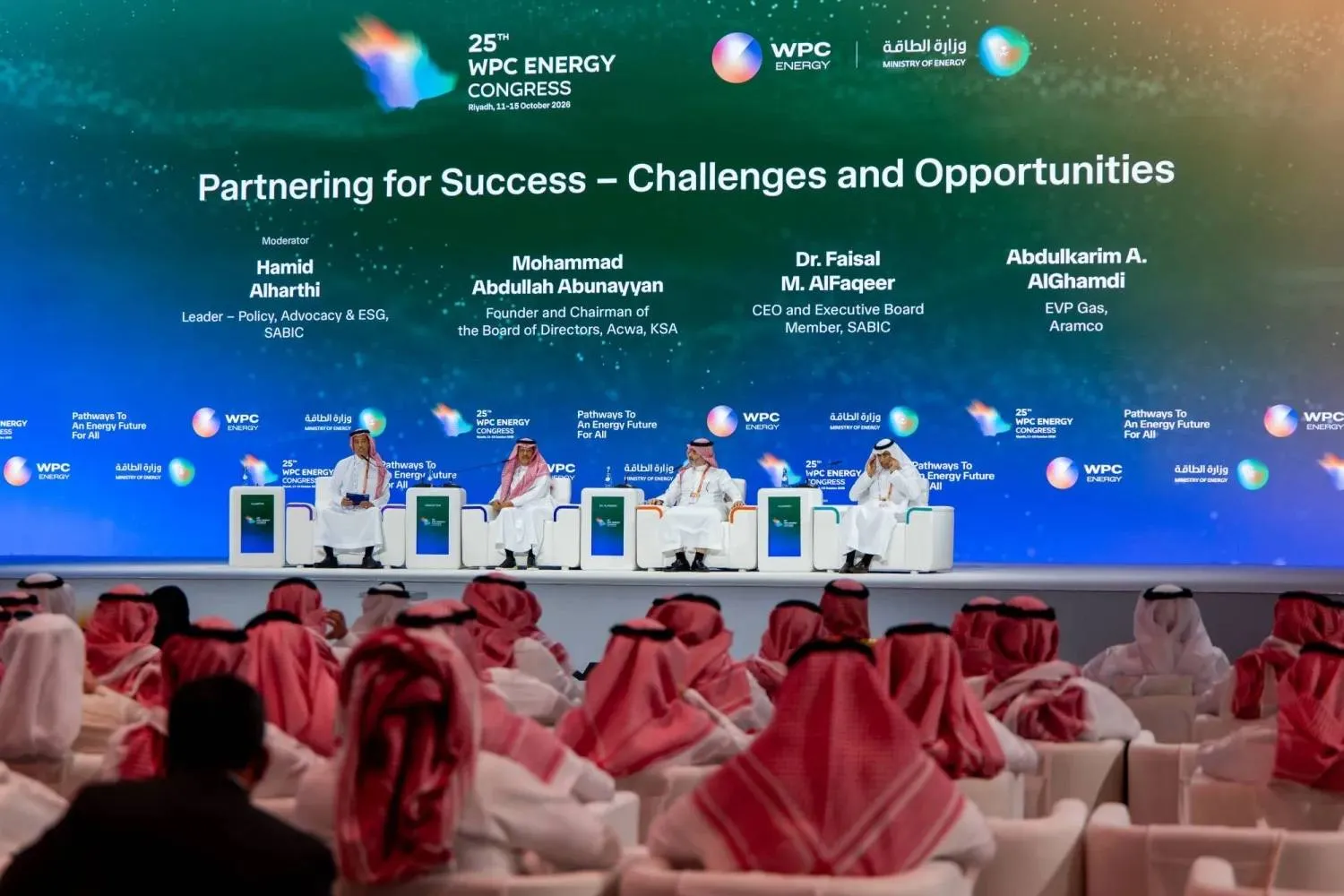

From Hydrogen to AI, Energy Leaders Map the Sector’s Global Future

A panel discussion examines challenges and opportunities at the World Petroleum Congress in Riyadh (Asharq Al-Awsat)
TT

From Hydrogen to AI, Energy Leaders Map the Sector’s Global Future

A panel discussion examines challenges and opportunities at the World Petroleum Congress in Riyadh (Asharq Al-Awsat)

Green hydrogen, artificial intelligence and strategic partnerships took center stage at the World Petroleum Congress in Riyadh, as sessions mapped the energy sector’s future amid rapid technological and industrial change.

Progress on clean energy projects, led by the NEOM Green Hydrogen Project, now 96% complete, intersected with the challenge of cutting emissions from transport, which accounts for about 30% of global energy demand.

The discussions highlighted a widening agenda: developing energy sources and reshaping how energy is produced and used to improve efficiency and sustain supplies.

Saudi Aramco said it plans to increase gas sales by 80% by 2030 compared with 2020 and 2021 levels, and to build and start operating six to seven gas and liquefied gas facilities between 2025 and 2027.

Decarbonization

Transport and logistics account for about 30% of global energy demand, Saudi Vice Minister of Transport and Logistics Services Rumaih Al-Rumaih told a conference session.

Decarbonization is a long journey that requires a broader energy mix, he said, stressing the need for available, reliable, affordable and safe supplies.

The Saudi Green Initiative provides a framework for reaching net-zero emissions by 2060, with transport playing a major role, Al-Rumaih said.

Saudi Arabia is expanding public transport and cutting urban emissions to meet its commitments, he added. The Riyadh Metro network spans 187 kilometers and has 85 stations.

Green hydrogen

National Development Fund Governor Abdulaziz Al-Arifi said the fund had provided financing and strategic support for the NEOM Green Hydrogen Project alongside local banks and other entities and organizations.

That support helped advance one of the clean energy sector’s leading projects, strengthening investment opportunities and local content, he told the conference.

ACWA Power Chairman Mohammad Abunayyan said local resources, knowledge and expertise accounted for about 90% of those used in new projects. He reaffirmed the company’s commitment to expanding investment and overcoming challenges on the ground in major global markets such as China.

At the same session, Saudi Aramco Executive Vice President of Gas Abdulkarim Al-Ghamdi discussed operational readiness and supply chains.

Resource localization under the company’s iktva program had reached levels ranging from more than 75% to 90%, he said, offering strong protection against external disruptions.

Saudi personnel and technological integration are the two pillars of sustained gas-sector growth and future resilience, he said.

Artificial intelligence

A panel at the 25th World Petroleum Congress explored how energy powers artificial intelligence, how the two sectors interact and how AI can sharpen decisions, improve operations and raise energy efficiency.

Speakers said development of the energy and electricity sectors under Vision 2030 aims to meet demand and attract investment, including in AI data centers that need reliable, competitively priced electricity.

The approach involves anticipating sectors’ needs and connecting them with investors. Speakers stressed the need to integrate infrastructure, data, technology and human expertise, drawing on Saudi Arabia’s strengths to develop solutions and bring them to global markets.

Smart meters

AI can improve forecasts of electricity loads and demand and detect grid faults early, helping planners respond faster, speakers said.

Smart meter data can track consumption, forecast bills, show electricity use by appliance and flag unusual usage.

In oil and gas exploration and resource development, particularly drilling, AI can analyze data in real time and combine engineering models with geological information.

This can speed up decisions, improve accuracy, shorten the gap between planning and execution, enhance safety and support risk assessments and investment decisions.

To expand these applications, companies must deliver tangible business value and integrate the tools into operations, speakers said.

They must also ensure data quality and timely collection, train personnel to assess outputs and keep people involved in final decisions, while using digital tools to reduce risks.




Climate Deal Collapses in Chaotic End to COP31

 COP31 President Murat Kurum officially closes the 2026 UN Climate Change Conference (COP31) in Antalya, Türkiye, November 22, 2026. (Reuters)
COP31 President Murat Kurum officially closes the 2026 UN Climate Change Conference (COP31) in Antalya, Türkiye, November 22, 2026. (Reuters)
TT

Climate Deal Collapses in Chaotic End to COP31

 COP31 President Murat Kurum officially closes the 2026 UN Climate Change Conference (COP31) in Antalya, Türkiye, November 22, 2026. (Reuters)
COP31 President Murat Kurum officially closes the 2026 UN Climate Change Conference (COP31) in Antalya, Türkiye, November 22, 2026. (Reuters)

The COP31 climate talks ended in failure Sunday as a contentious deal collapsed over fossil fuels and the summit stretched into record overtime in Türkiye.

The final agreement was dramatically rejected in a chaotic finale to a UN climate summit which ran two days over schedule, underscoring the strains on diplomacy in an increasingly fractured world.

UN Secretary-General Antonio Guterres, who urged nations to send fossil fuels "the way of the dinosaurs" during a fiery appearance at COP31, expressed deep dismay as the talks broke down.

"I share the very profound frustration of all those who expected governments to rise to the moment the climate crisis demands," the outgoing UN chief said in a statement.

COP31 negotiations chair Chris Bowen, who unsuccessfully sought to broker consensus among nearly 200 nations, conceded he could not overcome what he called "unbridgeable red lines".

"Unfortunately, we were unable to reach agreement on a cover decision... And that's disappointing. Very disappointing," Bowen, who is Australia's climate minister, told a throng of reporters.

More than 49 hours after the summit was supposed to end, COP31 President and Turkish Environment Minister Murat Kurum banged the gavel to conclude the marathon talks.

Bowen said the summit backdrop was "the most complicated and fraught geopolitical environment in living memory" as soaring energy prices and fallout from the Middle East war complicated the search for unity.

Under pressure to show progress in a year of climate-linked disasters from Europe to Nepal, Bowen sought an overarching "cover decision" to prove countries were still united in tackling the crisis.

But his plan unraveled as familiar fault lines emerged over fossil fuels.

The negotiations stalled as oil-producing states blocked any mention of phasing out fossil fuels in the final deal.

"We will not endorse a cover decision... that does not even mention fossil fuels, which is the key driver of climate change," said Ireland's climate minister, Darragh O'Brien, whose country holds the rotating EU presidency.

Panama, Vanuatu and the Marshall Islands also objected and as the deal imploded, COP31 became the longest climate summit on record.

- Falling short -

The outcome revived memories of the failed Copenhagen summit of 2009 and raised fresh doubts about the effectiveness of climate diplomacy.

"It certainly fell short today," said UN climate chief Simon Stiell, describing progress over the marathon fortnight of negotiations in Antalya as "limited".

"The world cannot afford a repeat."

Frustrated by the inertia, countries are pushing ahead outside the COP process.

Around 60 countries joined a first-of-its-kind conference in April on phasing out fossil fuels while several nations at COP31 unveiled their own plans to exit coal, oil and gas.

In a last-ditch bid for compromise, COP31 hosts Türkiye and Australia could only muster a veiled reference to fossil fuels in the final text.

But the pact also took fire for retaining a call to expand carbon capture -- a costly technology championed by the fossil fuel industry.

"We believe that climate change requires all solutions on the table," said Mohammad Ayoub, a climate negotiator for oil giant Saudi Arabia.

Facing blowback over the fossil fuels omission, Türkiye and Australia tried to rally support behind a global goal to electrify the world economy.

They said "electrification" could cut heat-trapping emissions and bolster energy security but the target was ultimately torpedoed, along with the rest of the doomed Antalya Pact.

- 'Profound disappointment' -

Countries lamented a missed opportunity to reinforce the Paris agreement's 1.5C target, which scientists expect the world to overshoot in a few years as carbon-cutting goals fall short.

The summit also widened fault lines over science, with a fight over the work of the Intergovernmental Panel on Climate Change (IPCC) spilling into the negotiations.

"We are profoundly disappointed by the substance of the cover decision," said UK climate negotiator Kate Hughes.

"It moves us backwards on the science... It is a lowest common denominator where it should have been, instead, presenting bold collective ambition on climate action."

As always, the summit laid bare the divide between major polluters driving climate change and smaller nations bearing the brunt of its impact.

Developing nations pushed for a $120 billion target climate goal which disappeared from the failed deal.


Inflation, Economic Growth and the Mood of US Consumers in Focus This Week

People shop at a grocery store in Brooklyn in New York City, US, Dec. 12, 2025. (AFP)
TT

Inflation, Economic Growth and the Mood of US Consumers in Focus This Week

People shop at a grocery store in Brooklyn in New York City, US, Dec. 12, 2025. (AFP)

Inflation has become the current that runs through almost all corners of the US economy and there will be more on that front this week.

A key report on inflation will headline a holiday-shortened week, along with a look at the latest gauge of consumer confidence. High prices on everything from groceries to gasoline are changing consumer behavior and there is pressure on policy makers to act.

The data on prices arrives ahead of the next meeting of rate-setters at the Federal Reserve, the unofficial start of the holiday shopping season, as well as Thanksgiving, which may be uncomfortably expensive this year given rising prices for food.

Here’s a look at some of the key reports coming in the week ahead.

US consumer confidence is being tested

Business group The Conference Board on Tuesday will release its consumer confidence survey for November. Economists expect it to show that confidence remains low as inflation puts more pressure on budgets. Overall, consumer confidence is down sharply from two years ago.

The wide-ranging and unpredictable US trade war with much of the world prompted price increases and made planning ahead difficult for both consumers and businesses.

The US war with Iran that started in 2026 fueled inflation throughout the year by curtailing the flow of oil through the Strait of Hormuz and raising energy prices. Higher prices for oil and gasoline boosted shipping costs for a wide range of goods.

The high cost of energy, goods and services has been notably referenced by write-in responses to the monthly consumer confidence surveys.

Inflation data could tip balance toward higher borrowing costs

An inflation update is expected to provide more details on what most Americans know — things have become expensive. The US will release the October personal consumption expenditures report, or PCE, on Wednesday.

The data carries a lot of weight because it is the preferred measure of inflation used by the Federal Reserve, which is attempting to bring inflation down to its target rate of 2%.

Inflation has been rising at a sharp rate since the US and Israel attacked Iran early this year fueling a surge in energy prices. Higher gasoline prices have eaten up a bigger portion of household budgets. Higher costs for shipping and warehousing goods because of soaring diesel prices are leaching into the broader economy.

The Fed's main tool in fighting inflation is raising interest rates and that makes something else more expensive — borrowing money. The central bank is expected to raise its benchmark interest rate at its next meeting to cool down the economy. It's a tough balancing act because the Fed's other mandate is maximum employment. Higher rates can make employers less likely to hire.

The US economy is motoring along

The US Department of Commerce on Wednesday will release an update on the nation's economic growth during the third quarter. The first read showed gross domestic product grew at 3.4% during the third quarter. GDP is a measure of the nation's output of goods and services.

The economy has proven resilient despite inflation. Economic growth accelerated from the 2.2% increase in the second quarter.

Much of that growth has been driven by an AI investment boom, but that is a sector that has been rattled in recent weeks. The tech-heavy Nasdaq tumbled more than 8% last week, with particularly sharp declines to end the week.

Low-hire, low-fire employment in the US

The latest weekly update on unemployment claims, which are a proxy for layoffs, will be released Wednesday in a scheduling shift ahead of the Thanksgiving holiday. Economists watch this weekly report closely because it can provide signals about where the job market is headed.

Claims have remained at historically low levels amid a broader jobs market that has remained a strong point in an economy pressured by rising inflation. Layoffs remain modest by historic standards.


US Seeks Answers on Nvidia’s Sale of Chips to China, Bessent Says

US Treasury Secretary Scott Bessent testifies during a House Financial Services Committee hearing on the state of the international financial system on Capitol Hill in Washington, DC, on September 15, 2026. (AFP)
TT

US Seeks Answers on Nvidia’s Sale of Chips to China, Bessent Says

US Treasury Secretary Scott Bessent testifies during a House Financial Services Committee hearing on the state of the international financial system on Capitol Hill in Washington, DC, on September 15, 2026. (AFP)

US Treasury Secretary Scott Bessent said on Sunday that the Trump administration still needs information on Nvidia's chip sales and ‌will find ‌out who led ‌compliance ⁠at the company ⁠formerly led by Jensen Huang, who resigned following an affair with a ⁠suspected Chinese spy.

"We've ‌been ‌in touch ‌with the temporary ‌management, with the lead directors, with their lawyers, and we ‌do need answers... it behooves Nvidia ⁠to ⁠move quickly on this because we want to know what the culture was," Bessent told CBS' "Face the Nation" program.