Oil Prices Retreat as Investors Weigh Supply Outlook, Middle East Tensions

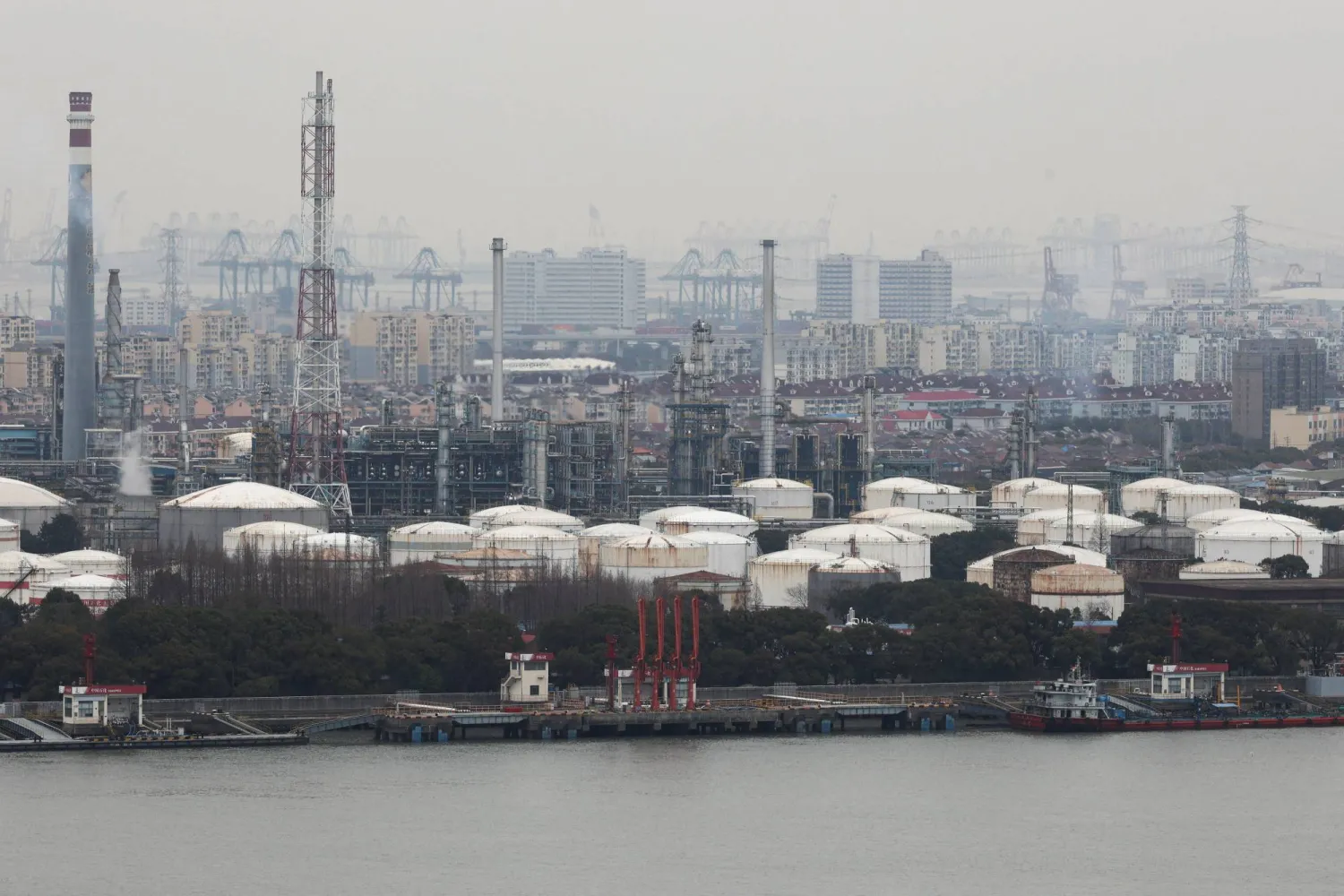
FILE PHOTO: Oil storage tanks and facilities of a Sinopec plant in Shanghai, China, March 26, 2026.  REUTERS/Go Nakamura/File Photo
FILE PHOTO: Oil storage tanks and facilities of a Sinopec plant in Shanghai, China, March 26, 2026. REUTERS/Go Nakamura/File Photo
TT

Oil Prices Retreat as Investors Weigh Supply Outlook, Middle East Tensions

FILE PHOTO: Oil storage tanks and facilities of a Sinopec plant in Shanghai, China, March 26, 2026.  REUTERS/Go Nakamura/File Photo
FILE PHOTO: Oil storage tanks and facilities of a Sinopec plant in Shanghai, China, March 26, 2026. REUTERS/Go Nakamura/File Photo

Oil prices fell more than 1% on Thursday as investors weighed risks to supply from attacks on shipping through the Strait of Hormuz against US efforts to cut petroleum shipping costs by easing sanctions on vessels.

Brent crude futures fell $1.64, or 1.6%, to $104.42 a barrel by 0337 GMT, while US West Texas Intermediate crude futures were down 98 cents, or 1%, to $94.11, reversing gains from the previous session.

WTI rose to a three-week high in the prior session after Iran said it was deploying new tactics to target ships in the Strait ‌of Hormuz and ‌keep oil prices high.

A container ship and a dry bulk ‌carrier ⁠both sank near ⁠the strait in the past 24 hours after being hit by projectiles in separate incidents, maritime officials said on Wednesday.

Attacks around the waterway have surged over the past 10 days, with Iran saying it is stepping up strikes in response to the US blockade of its ports and tougher sanctions introduced last month.

With the Iran war having disrupted shipping and driven up freight costs to record highs, the Trump administration is considering easing sanctions on so-called shadow-fleet vessels that have ⁠transported oil and petroleum products from countries including Russia, Iran and ‌Venezuela to help ease prices, a US official said ‌on Wednesday.

The new talks center on the United States potentially allowing "legal oil" to flow on previously sanctioned ‌vessels, the US official said.

Increased output from Russia and the Middle East has kept ‌a lid on prices. Russia's crude oil production rose by 65,000 barrels per day in September to 8.43 million bpd but remained down 870,000 bpd year over year, the International Energy Agency said on Wednesday.

The IEA also said crude oil exports from Middle East Gulf producers rose by 4.4 million bpd ‌in September to around 75% of prewar levels.

"While there is little concrete evidence of a near-term peace deal, oil continues to find ⁠its way to ⁠buyers through alternative routes and logistical arrangements," said Phillip Nova's head of market insights, Priyanka Sachdeva, in a client note.

"These workarounds have helped prevent a more severe supply shock, although they come at a higher cost and leave global flows vulnerable to further disruption."

In the US, crude oil and distillate inventories fell, while gasoline stocks rose last week, market sources said on Wednesday, citing data from the American Petroleum Institute.

Crude stocks fell by 11.1 million barrels in the week ended October 9, sources said. That was a much bigger draw than analysts polled by Reuters expected.

"Despite the sharp inventory draw, oil prices barely reacted. The failure to rise on bullish news suggests investors are cautious about chasing prices higher at current levels," said Haitong Futures in a note on Thursday.

Official numbers from the US Energy Information Administration are due at 12 p.m. EDT (1600 GMT), delayed by a day following the Columbus Day holiday on Monday.



Gold Jumps Over 2% on Softer Dollar After Democratic Midterm Wins

UK gold bullion bars are stacked at Baird & Co in Hatton Garden in London, Britain, October 8, 2025. (Reuters)
TT

Gold Jumps Over 2% on Softer Dollar After Democratic Midterm Wins

UK gold bullion bars are stacked at Baird & Co in Hatton Garden in London, Britain, October 8, 2025. (Reuters)

Gold prices rose 2% on Wednesday, supported by a weaker US dollar after Democrats secured key victories in midterm elections, while investors looked ahead to non-farm payrolls data later this week for clues on the Federal Reserve's policy path.

Spot gold climbed 2.2% to $4,016.01 per ounce by ‌0619 GMT, while US ‌gold futures for December delivery rose 2.2% ‌to $4,026.90.

"A ⁠weaker USD and ⁠a punchy decline in both nominal and real US Treasury yields are clearly providing support for gold," said Chris Weston, head of research at Pepperstone.

Additionally, "the demand for protection against a potentially more unpredictable and confrontational Trump administration looks to be providing a compelling backdrop for gold buyers," Weston added.

Global stocks slumped, and the ⁠dollar softened on Wednesday as Democrats scored a ‌decisive win in the US ‌midterm elections.

A softer dollar makes greenback-priced bullion more affordable for buyers ‌overseas.

On the geopolitical front, Iran and the United States ‌are still far from a deal to end their war, a senior Iranian official told Reuters on Tuesday, as Trump declined to rule out resuming US combat operations after the elections.

Traders currently see a ‌79% chance that the Fed will raise rates in December, according to CME's FedWatch tool. Higher interest ⁠rates increase ⁠the opportunity cost of holding non-yielding bullion, reducing its appeal to investors.

Markets now await the US non-farm payrolls report due on Friday.

"$4,000 is the obvious resistance level — and a break (on) either side of that range could dictate gold's next decent move," said Matt Simpson, senior market analyst at StoneX.

India's gold demand is expected to fall to a six-year low in 2026, as elevated prices weigh on jewellery sales and investment demand moderates, the World Gold Council (WGC) said on Tuesday.

Among other metals, spot silver gained 3.8% to $51.67, platinum 2.8% to $1,455.71 and palladium climbed 3.8% to $969.49.


Oil Rises on Iran War Uncertainty After Trump’s Republicans Face Election Rout

An oil and gas well stands in a corn field before the November midterm elections in the Tuscarawas County village of Bolivar, Ohio, US, October 25, 2026. (Reuters)
TT

Oil Rises on Iran War Uncertainty After Trump’s Republicans Face Election Rout

An oil and gas well stands in a corn field before the November midterm elections in the Tuscarawas County village of Bolivar, Ohio, US, October 25, 2026. (Reuters)

Oil prices rose on Wednesday in a volatile session as investors awaited Washington's next move in the war with Iran, with Democrats capturing control of US Congress from President Donald Trump's Republicans in midterm elections.

Brent futures rose 82 cents, or 0.8%, to $104.42 a barrel at 0510 GMT. US West Texas Intermediate crude futures gained 50 cents, or 0.5%, to $96.59, reversing earlier declines.

In the previous session, Brent settled at its lowest level in nearly four weeks as traders weighed talks to end ‌the wars ‌in Ukraine and Iran.

Vote counting was underway in the US ‌midterm ⁠elections, with Democrats snaring ⁠majorities in both houses of Congress for the rest of Trump's second term.

"President Trump's conflicting signals, with military strikes continuing alongside statements downplaying further escalation, have made it difficult for traders to build strong directional conviction," said Priyanka Sachdeva, head of market insights at Phillip Nova.

"I believe some profit-taking and reduction in speculative long positions are justified, particularly after the sharp rally in October," said Sachdeva.

"However, the underlying supply disruption ⁠risks around the Strait of Hormuz have not disappeared. An ‌unexpected drawdown in US crude inventories is also ‌offering some fundamental support," she added.

The US had carried out "defensive" strikes on Iran's Qeshm island targeting ‌surface-to-air missiles used against US assets, a US official said on Tuesday. ‌Another official said the strikes appeared limited and did not signal a return to major combat operations.

Markets remained on watch for any progress in talks to end the US-Israeli war with Iran, as Qatar stepped up mediation efforts to avert an escalation of attacks after ‌the US elections.

A senior Iranian official told Reuters on Tuesday that Iran and the United States remain far from a ⁠deal to end ⁠their war.

US President Donald Trump told the Financial Times on Tuesday that the United States had no immediate plans to strike Iran.

Meanwhile, crude stocks fell by 5.27 million barrels in the week ended October 30, market sources said on Wednesday, citing data from the American Petroleum Institute.

Eight analysts polled by Reuters had expected, on average, a rise of about 880,000 barrels in crude inventories.

Gasoline stocks rose by 1.43 million barrels, while distillate inventories fell by 1.19 million barrels from a week earlier, the sources said.

"Diesel inventories remain tight, while gasoline stocks rose more than expected. The data are broadly supportive of oil prices," Haitong Futures said in a note on Wednesday.


Aramco Begins East-West Pipeline Expansion to Boost Oil Export Flexibility

Aramco CEO Amin Nasser speaks at a press conference. (Reuters)
TT

Aramco Begins East-West Pipeline Expansion to Boost Oil Export Flexibility

Aramco CEO Amin Nasser speaks at a press conference. (Reuters)

Saudi Aramco President and CEO Amin H. Nasser said on Tuesday that preliminary engineering had already started on a planned expansion of the kingdom's vital East-West pipeline as part of plans to increase oil flows through existing infrastructure, assess alternative export routes and explore expanding crude storage capacity at major demand centers. 

"Preliminary engineering is underway for an expansion of the East-West pipeline," Nasser said in an earnings call. The CEO said last month that Aramco hoped to increase the capacity of the pipeline network from 7 million to 10 million barrels a day.

Aramco reported a 9% year-on-year increase in adjusted net profit to 117 billion riyals ($31.2 billion) in the third quarter of this year, beating analysts’ expectations of $30.66 billion.

Nasser said the pipeline played a key role in providing additional oil export options during the disruptions, adding that the company was also considering expanding crude oil storage capacity at major demand centers and along export routes.

He said the long-term value of the East-West Pipeline investment had become evident amid the current disruptions to regional trade, noting that the company had recovered the pipeline’s entire construction cost in about 15 days.

Production Capacity

Nasser said Aramco was exploring additional oil export routes and storage capacity outside the Kingdom, while using Gulf export terminals and ship-to-ship transfers to deliver supplies to customers.

He added that the company could raise its maximum sustainable production capacity above 12 million barrels per day if the government decides to do so.

Biggest Supply Shock in the Energy Industry

He described the regional conflict as the biggest supply shock in the energy industry, saying Aramco maintained customer commitments by diversifying export routes, restoring facilities and optimizing operations.

The company’s resilience, he said, stemmed from decades of planning, robust infrastructure, skilled employees, local supply chains and technological innovation, enabling it to continue delivering major projects safely and on schedule despite disruptions.

Zuluf Field Production Expansion

The CEO said work to expand production at the Zuluf field had begun as planned, with additional capacity of up to 600,000 barrels per day expected by the end of the year. He added that Aramco was continuing to advance major crude-to-chemicals projects both inside and outside the Kingdom.

He said the upstream segment delivered stable results, reflecting continued price strength despite a decline from the previous quarter. Meanwhile, adjusted earnings before interest and taxes (EBIT) in the downstream segment rose by more than $4 billion quarter on quarter.

Ability to Restore Production Within Weeks

Nasser said supplies had become indispensable, and demand remained strong, adding that Aramco could rapidly ramp up production. This capability positioned the company to generate significant financial gains.

More Than 90% of Restart Materials Sourced Locally

Aramco faced significant challenges during the disruptions but managed them through flexibility, speed, multiple options and operational excellence, he stated.

He explained that the company’s integrated response center coordinates management teams with specialized, multidisciplinary rapid-assessment teams, enabling a swift response to incidents and disruptions.

Nasser said Aramco’s local supply chains enabled the rapid sourcing and rerouting of critical materials to ensure operational continuity. The company also uses drones for real-time damage assessments, with more than 90% of restart materials sourced domestically. Independent benchmarks show Aramco completes emergency repairs six times faster than the industry average.

Capital Expenditure

Aramco remained disciplined in its capital spending, maintaining its 2026 capital expenditure guidance at $50 billion-$55 billion, Nasser undescored. The forecast includes costs to restore assets to service and a $2.6 billion cash investment in HUMAIN.

Aramco Invests $2.6 Billion in HUMAIN

He described Aramco’s 49% stake in HUMAIN, backed by a $2.6 billion cash investment and the transfer of key AI assets, as a strategic move to strengthen its competitive advantage and accelerate AI-driven growth.

The investment combines Aramco’s technology infrastructure, more than 90 years of operational experience and low-cost, lower-carbon energy to meet growing demand for AI computing.

HUMAIN aims to develop an integrated AI platform spanning data centers, cloud infrastructure, models and applications, with plans to reach 3 gigawatts of data center capacity by 2030 and become a leading global exporter of AI services.