


IEA to Speed up Oil Stocks Release Including Over 20 Million Barrels of Diesel

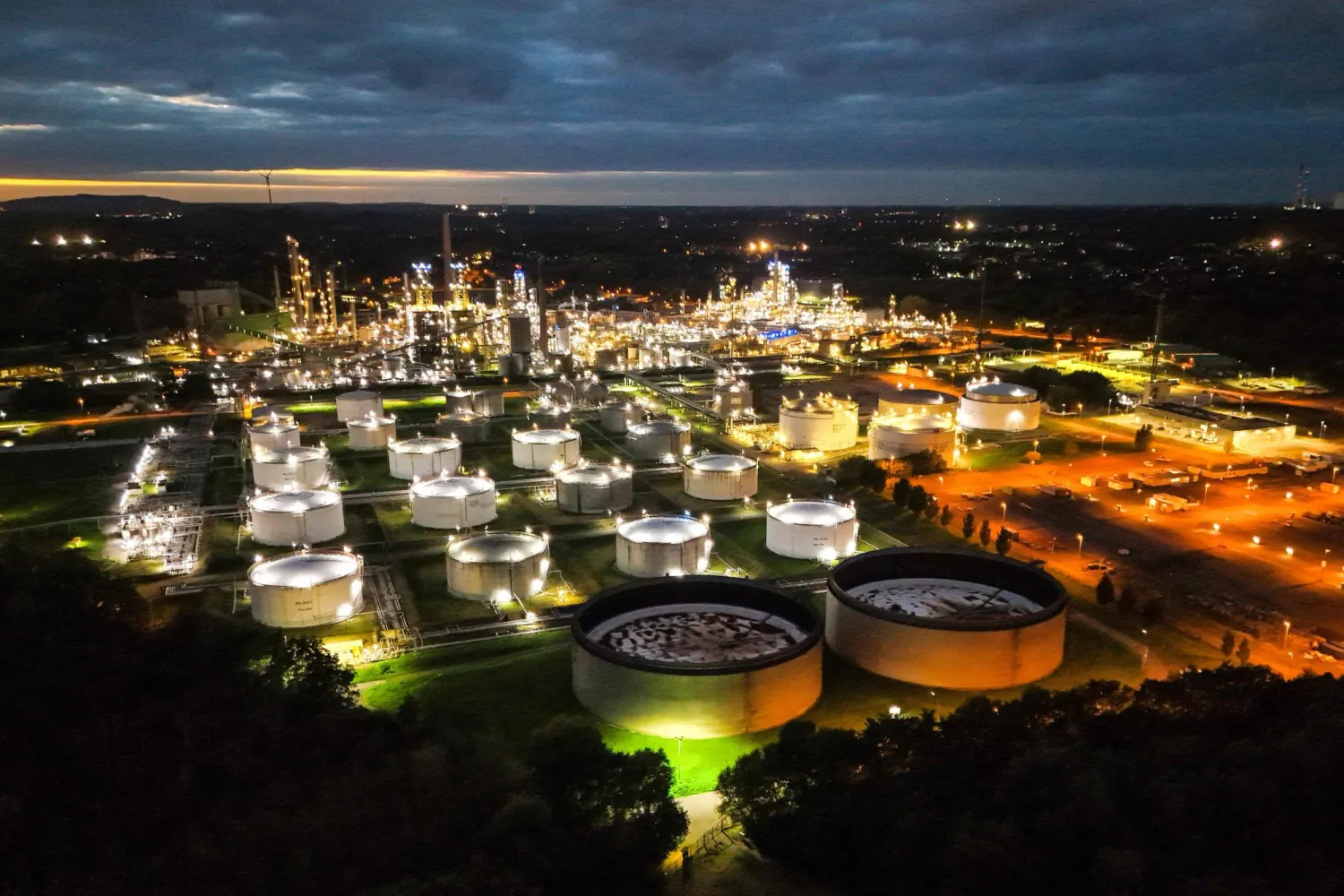
An aerial view shows the fuel depot of Aral at the Ruhr Oel petroleum refineries of BP Gelsenkirchen GmbH in Gelsenkirchen, western Germany on October 15, 2026. (AFP)
TT

IEA to Speed up Oil Stocks Release Including Over 20 Million Barrels of Diesel

An aerial view shows the fuel depot of Aral at the Ruhr Oel petroleum refineries of BP Gelsenkirchen GmbH in Gelsenkirchen, western Germany on October 15, 2026. (AFP)

The International Energy Agency agreed on Thursday to release over 20 million barrels of diesel to the market and any oil remaining from a record emergency reserves release pledged in March to boost supply and cool soaring prices.

US President Donald Trump has pressed European Union countries to draw down reserves or face a potential US diesel export ban as he seeks to lower prices ahead of November 3 midterm elections.

Diesel prices have surged to record highs in many markets due to disrupted supply ‌because of the ‌Iran war and the Russia-Ukraine conflict, posing inflation and cost-of-living threats ‌to ⁠governments and consumers.

The ⁠32-nation IEA's board met on Thursday to discuss the scale and timing of stock releases.

"The IEA governing board reaffirmed its commitment to continue delivering on the March 2026 Collective Action in response to the Strait of Hormuz crisis," it said in a statement after the meeting.

In March, countries had pledged to release more than 400 million barrels of crude and oil products as prices soared.

On Thursday, members "agreed to accelerate the release of the ⁠remaining volumes, with specific plans already in place, including over 20 ‌million barrels of diesel as soon as possible."

SOME ‌DISAPPOINTMENT OVER LACK OF EXTRA BARRELS

Reuters reported this month that EU governments were discussing a French ‌proposal for the release of 50 million barrels of diesel alongside 50 million ‌barrels of crude from IEA members.

"The IEA announcement is a step in the right direction, but falls short on the details the market was looking for," said Abhishek Kumar, an analyst at Sparta Commodities. "The 20+ million barrels of diesel appear to be an acceleration of existing commitments rather ‌than genuinely new volumes."

The IEA, which coordinates industrialized nations' releases of oil from emergency stocks, said some members had already released ⁠more than they ⁠pledged in March and that others planned to do so.

Members have released approximately 330 million barrels so far, the IEA said.

The US Energy Department said further IEA releases, with a focus on diesel, are under review and in progress, citing the IEA statement.

But the Trump administration "continues to hold European nations accountable for failing to fulfill their previous commitments to minimize supply disruptions in global energy markets and to help lower energy prices," the Energy Department spokesperson added.

The White House, when asked if it was unhappy with the IEA's commitment to draw down reserves, provided the IEA's statement from Thursday on the releases.

Spain said on Thursday it would release 4.4 million barrels from strategic reserves in October.

Spain has released 3.7 million of the 11.5 million barrels it pledged in March.


Saudi Merchandise Trade Surplus Grows by 74.5%

Cargo containers at Jeddah Islamic Port (Mawani)
TT

Saudi Merchandise Trade Surplus Grows by 74.5%

Cargo containers at Jeddah Islamic Port (Mawani)

Merchandise exports increased by 14.2% in September 2026 compared to the same month in 2025, driven by a 25.6% rise in oil exports, while imports declined by 4.3% and the merchandise trade surplus grew by 74.5%, according to the trade bulletin issued by the General Authority for Statistics (GASTAT).

The bulletin showed that oil exports accounted for 75.4% of total merchandise exports in September 2026, up from 68.6% in September 2025.

Plastics, rubber, and related products accounted for the largest share of non-oil exports at 22.0%, followed by chemical industries and their products at 19.6%.

Among trading partners, South Korea was the leading destination for the Kingdom’s merchandise exports, accounting for 18.9% of the total, followed by India at 14.3% and China at 12.9%.

China was also the Kingdom’s largest import partner, accounting for 24.9% of the total, followed by the United States at 8.2% and Egypt at 6.2%.

The figures are based on administrative records provided by the relevant authorities, namely the Zakat, Tax and Customs Authority for non-oil data and the Ministry of Energy for oil data, which are processed and reviewed in accordance with GASTAT’s approved statistical methodologies to ensure quality and accuracy prior to publication.


EU Plans 50-bn-euro Fund for AI, Quantum

FILE PHOTO: European Commission Executive Vice-President Henna Virkkunen holds a press conference on strengthening Frontex and the digitalisation of the return process, in Brussels, Belgium October 27, 2026. REUTERS/Yves Herman/File Photo
TT

EU Plans 50-bn-euro Fund for AI, Quantum

FILE PHOTO: European Commission Executive Vice-President Henna Virkkunen holds a press conference on strengthening Frontex and the digitalisation of the return process, in Brussels, Belgium October 27, 2026. REUTERS/Yves Herman/File Photo

The EU on Wednesday announced plans to create a fund starting with 50 billion euros ($55 billion) to invest in "critical technologies" including artificial intelligence and quantum computing in Europe.

The fund would "ensure access to innovative funding instruments, not only for quantum technologies, but more widely for all critical technologies which are necessary to our tech sovereignty and economic security", EU tech chief Henna Virkkunen told reporters at the European Parliament in Strasbourg.

The draft Quantum Act aims to help Europe, which lags behind the United States and China in AI development, chips and cloud computing, reduce its dependency on third countries.

Its proposal also comes ⁠as worries over ⁠US companies' ability to use so-called "kill switches" to block their products from functioning in Europe have spurred EU efforts to develop local products and services.

"Quantum technologies will shape the future of industry, security and innovation, and they will have a ⁠profound impact on our societies. Europe needs to accelerate now," Virkkunen said in a statement.

The draft legislation will need to be ironed out with EU countries and the European Parliament in the coming months before it can become law.

Around one third of the world's quantum companies are based in the European Union, according to the Commission. Public quantum funding amounted to €8.6 billion last ⁠year versus €5.3 billion ⁠in the United States and €13.6 billion in China.

Europe's private funding for quantum startups at €1.1 billion, however, trailed the United States' €7 billion.

"Given the possible impact of quantum technologies for security and the Union's strategic interests and technological autonomy, it is necessary to restrict procurement procedures to products, systems and services that are provided by Union controlled entities," the draft legislation said.

It said entities from third countries with which the EU has a respective reciprocal partnership could also bid for tenders.


China Warns US Against Imposing New Tariffs

HANDOUT - 19 November 2026, China, Shenzhen: Chinese President Xi Jinping and US President Donald Trump attend a trilateral meeting with Russian President Vladimir Putin at Kylin Villa, on the sidelines of the APEC Summit. Photo: -/Kremlin/dpa
TT

China Warns US Against Imposing New Tariffs

HANDOUT - 19 November 2026, China, Shenzhen: Chinese President Xi Jinping and US President Donald Trump attend a trilateral meeting with Russian President Vladimir Putin at Kylin Villa, on the sidelines of the APEC Summit. Photo: -/Kremlin/dpa

Beijing urged the United States on Wednesday to "uphold the stable development" of trade relations, after media reports said Washington was planning to announce new tariffs on China and other countries.

The reports said that Washington's new levies would affect major US trading partners including China, the European Union, Japan and South Korea.

"Tariff wars and trade wars are not in anyone's interest," Chinese foreign ministry spokesman Guo Jiakun said, when asked about Washington's reported plans.

He told a regular briefing that the world's two top economies, which in 2025 agreed a tenuous truce in their trade war, "should resolve relevant issues through consultation".

He added that accusations of overcapacity -- mass production at a loss to flood overseas markets and undercut local rivals -- was a "false premise" and a "pretext for political manipulation".

"China and the United States should work together to effectively implement the important consensus reached by the two heads of state and uphold the stable development of China-US economic and trade relations," AFP quoted him as saying.

President Donald Trump has long criticized China's yawning trade surplus with the United States, which he has blamed for a decline in local manufacturing prowess and jobs.

After starting a second term in office last year, Trump imposed new tariffs on Chinese goods, kicking off a tit-for-tat escalation with Beijing that at one point saw duties soar as high as 145 percent.

The trade ceasefire struck by Trump and Chinese President Xi Jinping in October 2025 is due to expire in January, after a two-month extension was agreed in September.

The two men met last week at an APEC summit in Shenzhen in southern China and are due to see each other again in December at a G20 summit in the United States.

During their meeting at APEC, which came just before a historic trilateral with Russian President Vladimir Putin, Xi hailed China's "stable and improved" ties with the United States.

The Chinese leader also said that his country should cooperate in the field of artificial intelligence, keeping the technology "under human control" and guarding against safety risks.
