


25th WPC Energy Congress in Riyadh Draws Record Attendance of More than 33,000 Visitors

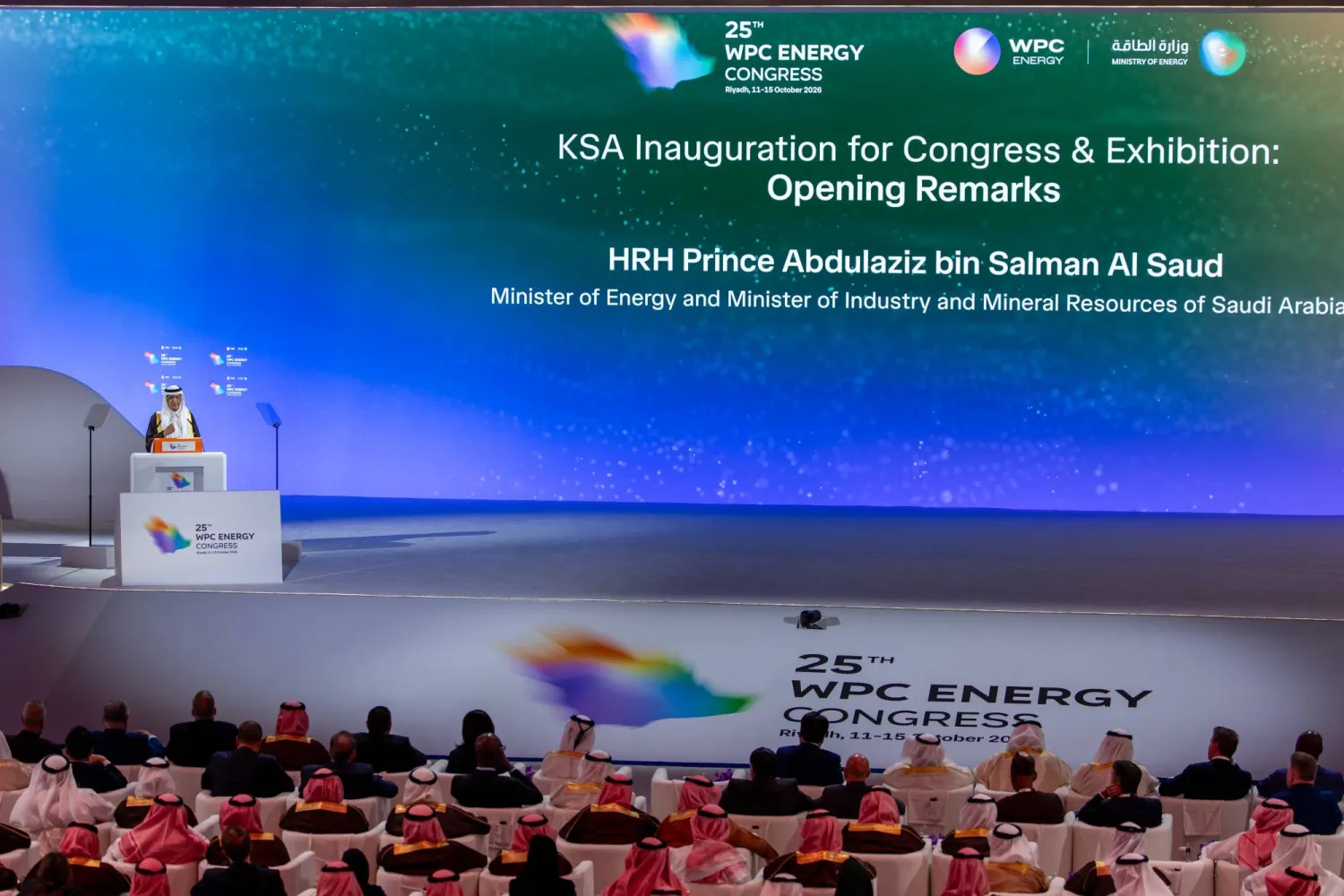
Prince Abdulaziz bin Salman during the opening of the World Petroleum Congress in Riyadh (Asharq Al-Awsat)
TT

25th WPC Energy Congress in Riyadh Draws Record Attendance of More than 33,000 Visitors

Prince Abdulaziz bin Salman during the opening of the World Petroleum Congress in Riyadh (Asharq Al-Awsat)

The 25th WPC Energy Congress in Saudi Arabia drew a record audience of more than 33,000 visitors, alongside participants from 135 countries and 489 media representatives, making it the most attended edition in the event’s more than 90-year history.

Saudi Arabia hosted the congress for the first time from October 11 to 15 as part of Riyadh Energy Week, under the theme “Pathways to an Energy Future for All.” The event brought together ministers, officials, company executives and energy experts to discuss supply security, investment, innovation and the future of oil and gas markets.

Prince Abdulaziz bin Salman bin Abdulaziz, Minister of Energy and Minister of Industry and Mineral Resources, officially opened the congress alongside Pedro Miras, president of the WPC.

The sessions explored key issues shaping the future of the energy sector, including artificial intelligence, digital transformation, energy efficiency, transport technologies, financing and resilient infrastructure. Discussions also examined the policies and investments needed to enhance energy security and foster international partnerships across the energy value chain.

Ministerial discussions also examined the future of global oil and gas markets, priorities for developing Saudi Arabia’s energy sector under Vision 2030, and ways to build more resilient systems capable of responding to crises and meeting the needs of different countries.

In recognition of achievements in the sector, the Dewhurst Award was presented to Vicki Hollub, a board member and former chief executive of Occidental Petroleum, making her the first woman to receive the award, according to the statement.

The congress also hosted the inaugural Energy Hackathon, launched by the Ministry of Energy as part of Riyadh Energy Week, attracting more than 6,700 participants from over 40 Saudi cities. Prince Abdulaziz bin Salman honored six winning teams across three categories: operational efficiency, innovative vision and smart control.

Alongside the congress, Riyadh hosted the 16th meeting of the Arab Ministerial Council for Electricity, which discussed updates to the two agreements governing the Arab Common Electricity Market and a pilot electricity exchange project involving Saudi Arabia, Egypt and Jordan. The meeting also addressed cooperation in renewable energy, energy efficiency, and clean hydrogen.

Riyadh Energy Week also featured the 17th Clean Energy Ministerial (CEM17) and the 11th Mission Innovation Ministerial (MI-11), as part of efforts to strengthen international cooperation in the energy sector.

At the close of the congress, Kazakhstan was named host of the 26th edition, which will take place in the capital, Astana, from June 11 to 15, 2028. It will mark the first time the congress has been held in Central Asia.



Saudi Merchandise Trade Surplus Grows by 74.5%

Cargo containers at Jeddah Islamic Port (Mawani)
TT

Saudi Merchandise Trade Surplus Grows by 74.5%

Cargo containers at Jeddah Islamic Port (Mawani)

Merchandise exports increased by 14.2% in September 2026 compared to the same month in 2025, driven by a 25.6% rise in oil exports, while imports declined by 4.3% and the merchandise trade surplus grew by 74.5%, according to the trade bulletin issued by the General Authority for Statistics (GASTAT).

The bulletin showed that oil exports accounted for 75.4% of total merchandise exports in September 2026, up from 68.6% in September 2025.

Plastics, rubber, and related products accounted for the largest share of non-oil exports at 22.0%, followed by chemical industries and their products at 19.6%.

Among trading partners, South Korea was the leading destination for the Kingdom’s merchandise exports, accounting for 18.9% of the total, followed by India at 14.3% and China at 12.9%.

China was also the Kingdom’s largest import partner, accounting for 24.9% of the total, followed by the United States at 8.2% and Egypt at 6.2%.

The figures are based on administrative records provided by the relevant authorities, namely the Zakat, Tax and Customs Authority for non-oil data and the Ministry of Energy for oil data, which are processed and reviewed in accordance with GASTAT’s approved statistical methodologies to ensure quality and accuracy prior to publication.


EU Plans 50-bn-euro Fund for AI, Quantum

FILE PHOTO: European Commission Executive Vice-President Henna Virkkunen holds a press conference on strengthening Frontex and the digitalisation of the return process, in Brussels, Belgium October 27, 2026. REUTERS/Yves Herman/File Photo
TT

EU Plans 50-bn-euro Fund for AI, Quantum

FILE PHOTO: European Commission Executive Vice-President Henna Virkkunen holds a press conference on strengthening Frontex and the digitalisation of the return process, in Brussels, Belgium October 27, 2026. REUTERS/Yves Herman/File Photo

The EU on Wednesday announced plans to create a fund starting with 50 billion euros ($55 billion) to invest in "critical technologies" including artificial intelligence and quantum computing in Europe.

The fund would "ensure access to innovative funding instruments, not only for quantum technologies, but more widely for all critical technologies which are necessary to our tech sovereignty and economic security", EU tech chief Henna Virkkunen told reporters at the European Parliament in Strasbourg.

The draft Quantum Act aims to help Europe, which lags behind the United States and China in AI development, chips and cloud computing, reduce its dependency on third countries.

Its proposal also comes ⁠as worries over ⁠US companies' ability to use so-called "kill switches" to block their products from functioning in Europe have spurred EU efforts to develop local products and services.

"Quantum technologies will shape the future of industry, security and innovation, and they will have a ⁠profound impact on our societies. Europe needs to accelerate now," Virkkunen said in a statement.

The draft legislation will need to be ironed out with EU countries and the European Parliament in the coming months before it can become law.

Around one third of the world's quantum companies are based in the European Union, according to the Commission. Public quantum funding amounted to €8.6 billion last ⁠year versus €5.3 billion ⁠in the United States and €13.6 billion in China.

Europe's private funding for quantum startups at €1.1 billion, however, trailed the United States' €7 billion.

"Given the possible impact of quantum technologies for security and the Union's strategic interests and technological autonomy, it is necessary to restrict procurement procedures to products, systems and services that are provided by Union controlled entities," the draft legislation said.

It said entities from third countries with which the EU has a respective reciprocal partnership could also bid for tenders.


China Warns US Against Imposing New Tariffs

HANDOUT - 19 November 2026, China, Shenzhen: Chinese President Xi Jinping and US President Donald Trump attend a trilateral meeting with Russian President Vladimir Putin at Kylin Villa, on the sidelines of the APEC Summit. Photo: -/Kremlin/dpa
TT

China Warns US Against Imposing New Tariffs

HANDOUT - 19 November 2026, China, Shenzhen: Chinese President Xi Jinping and US President Donald Trump attend a trilateral meeting with Russian President Vladimir Putin at Kylin Villa, on the sidelines of the APEC Summit. Photo: -/Kremlin/dpa

Beijing urged the United States on Wednesday to "uphold the stable development" of trade relations, after media reports said Washington was planning to announce new tariffs on China and other countries.

The reports said that Washington's new levies would affect major US trading partners including China, the European Union, Japan and South Korea.

"Tariff wars and trade wars are not in anyone's interest," Chinese foreign ministry spokesman Guo Jiakun said, when asked about Washington's reported plans.

He told a regular briefing that the world's two top economies, which in 2025 agreed a tenuous truce in their trade war, "should resolve relevant issues through consultation".

He added that accusations of overcapacity -- mass production at a loss to flood overseas markets and undercut local rivals -- was a "false premise" and a "pretext for political manipulation".

"China and the United States should work together to effectively implement the important consensus reached by the two heads of state and uphold the stable development of China-US economic and trade relations," AFP quoted him as saying.

President Donald Trump has long criticized China's yawning trade surplus with the United States, which he has blamed for a decline in local manufacturing prowess and jobs.

After starting a second term in office last year, Trump imposed new tariffs on Chinese goods, kicking off a tit-for-tat escalation with Beijing that at one point saw duties soar as high as 145 percent.

The trade ceasefire struck by Trump and Chinese President Xi Jinping in October 2025 is due to expire in January, after a two-month extension was agreed in September.

The two men met last week at an APEC summit in Shenzhen in southern China and are due to see each other again in December at a G20 summit in the United States.

During their meeting at APEC, which came just before a historic trilateral with Russian President Vladimir Putin, Xi hailed China's "stable and improved" ties with the United States.

The Chinese leader also said that his country should cooperate in the field of artificial intelligence, keeping the technology "under human control" and guarding against safety risks.