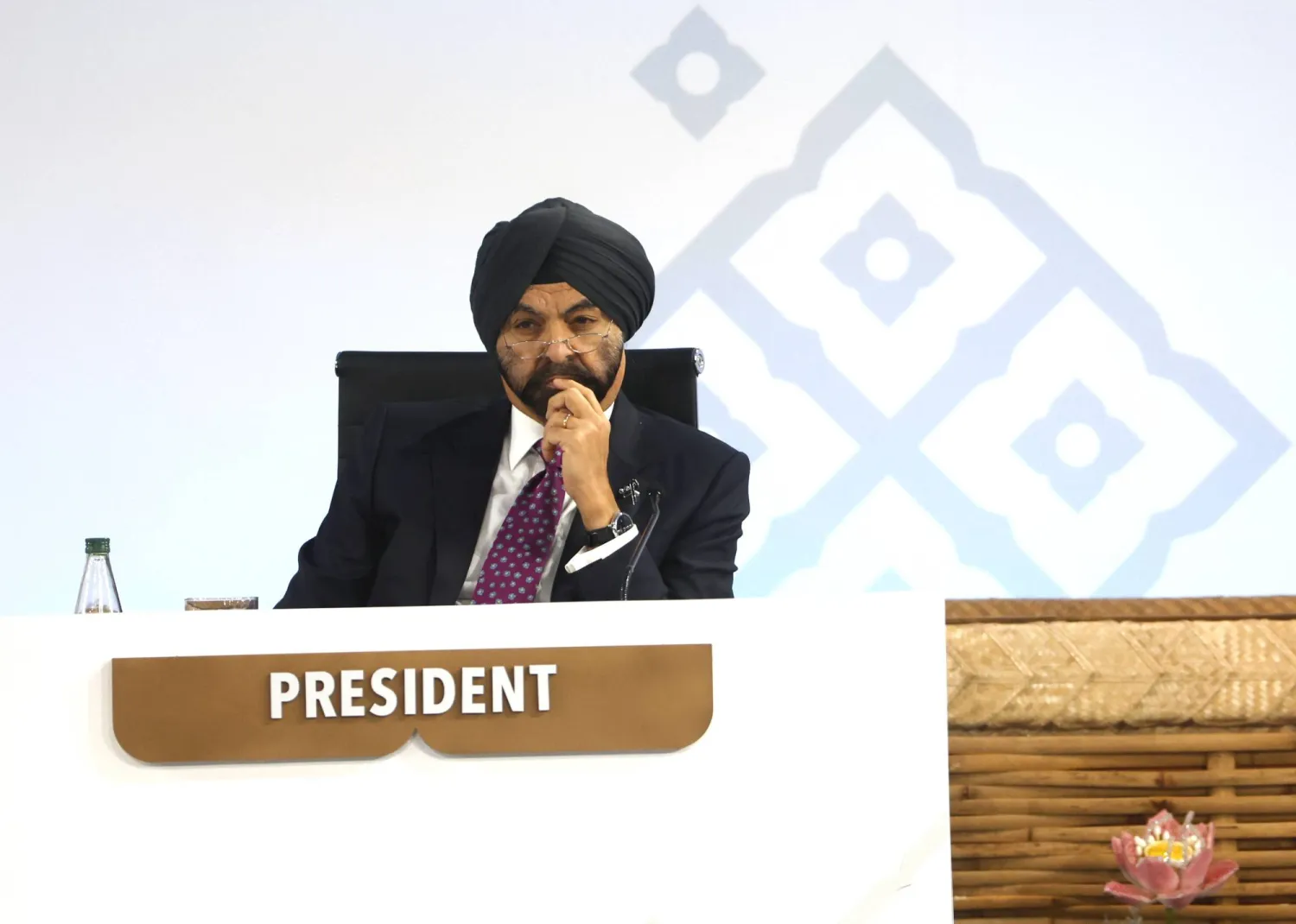
World Bank: 800 Million Jobs Needed to Absorb Young Workers Over the Next 15 Years

World Bank Group President Ajay Banga gestures during the Annual Meetings Plenary at the 2026 Annual Meetings of the IMF and the World Bank Group in Bangkok, Thailand, 16 October 2026. EPA/RUNGROJ YONGRIT
TT

World Bank: 800 Million Jobs Needed to Absorb Young Workers Over the Next 15 Years

World Bank Group President Ajay Banga gestures during the Annual Meetings Plenary at the 2026 Annual Meetings of the IMF and the World Bank Group in Bangkok, Thailand, 16 October 2026. EPA/RUNGROJ YONGRIT

World Bank Group President Ajay Banga has warned of mounting challenges in creating jobs worldwide, noting that around 1.2 billion young people will enter the labor market over the next 10 to 15 years, while the market is expected to generate only about 400 million jobs. This places job creation at the forefront of economic development priorities.

Speaking at the plenary session of the World Bank Group’s 2026 Annual Meetings in Bangkok on Friday, Banga said the institution faces two interconnected challenges: making the most of limited resources and helping countries create jobs at scale. Addressing both, he said, requires combining public financing, private investment, philanthropy and technology according to each country’s needs.

He added that ongoing conflicts, shrinking fiscal space, rising debt burdens and persistently high commodity costs, including energy and fertilizers, are making development and job creation more difficult.

He stressed that a job is more than a statistic: it represents dignity and the ability to build a future. He warned that failing to harness the potential of young people would have consequences extending beyond national borders.

Banga said the World Bank Group has made changes to the way it operates over the past three years to strengthen its capacity to finance development and accelerate project implementation. These changes include reducing project preparation time from 19 months to nine months, cutting performance assessment indicators from 153 to 22 with a greater focus on impact, and increasing results-based financing from around one-third to one-half.

The Group also restructured the International Bank for Reconstruction and Development’s balance sheet, unlocking more than $100 billion in additional lending capacity over a decade.

As part of efforts to strengthen the role of the private sector, Banga said the Group had mobilized around $112 billion in private capital last year, compared with approximately $35 billion in fiscal year 2022, an increase of nearly threefold. When financing provided by the Group itself is included, the total exceeded $230 billion.

He said private capital mobilization had nearly tripled in lower-middle-income countries and quadrupled in upper-middle-income countries, while more than doubling in Africa. However, he noted that attracting commercial financing to low-income countries remains difficult, with mobilized capital holding steady at around $3 billion.

He emphasized the importance of supporting micro, small and medium-sized enterprises as a key means of expanding economic activity and creating jobs.

Banga stressed that the World Bank Group’s jobs strategy rests on three main pillars: developing physical and human infrastructure, strengthening regulatory and policy certainty, and removing barriers to private investment, including foreign-exchange risks and difficulties in accessing finance.

He said the Group allocated $40 billion last year to infrastructure and essential services, while 30 percent of its public-sector financing supported policy and institutional reforms.

In key sectors, Banga said the Mission 300 initiative, in partnership with the African Development Bank, aims to provide electricity access to 300 million people in Africa by 2030, with 59 million people having benefited so far.

The Group and its partners also aim to improve water security for up to one billion people, with the World Bank Group committed to reaching 400 million people. In addition, it is supporting 200 million smallholder farmers as part of broader efforts to reach 300 million farmers by 2030.

He added that the Health Works initiative aims to provide high-quality, affordable healthcare services to 1.5 billion people by 2030 and has already reached around 600 million. The Group is also expanding investments in critical minerals and economic corridors, with the goal of developing local industries, improving the movement of goods to markets and creating jobs.

Banga said technology, particularly practical applications of artificial intelligence, can help farmers, teachers, healthcare workers and entrepreneurs improve productivity and expand access to markets, provided they have the necessary electricity, connectivity, devices and skills.

He concluded by stressing that the next phase requires scaling up project implementation and strengthening cooperation between multilateral development banks and investors. This would allow investments to be transferred to long-term financing institutions, freeing up capital to fund new projects.

Banga said the projected jobs gap is not inevitable, and that building a future capable of generating more employment opportunities will require a development model that brings together public financing, private capital, technology and international partnerships.


Trump Threatens to Double Tariffs on Mexico if it Does Not Halt Migrants

ARLINGTON, VIRGINIA - NOVEMBER 11: US President Donald Trump delivers remarks during a ceremony in honor of Veterans Day at Arlington National Cemetery on November 11, 2026 in Arlington, Virginia. Kevin Dietsch/Getty Images/AFP
TT

Trump Threatens to Double Tariffs on Mexico if it Does Not Halt Migrants

ARLINGTON, VIRGINIA - NOVEMBER 11: US President Donald Trump delivers remarks during a ceremony in honor of Veterans Day at Arlington National Cemetery on November 11, 2026 in Arlington, Virginia. Kevin Dietsch/Getty Images/AFP

President Donald Trump threatened on Thursday to double tariffs on Mexico if it does not stop more than a thousand migrants walking north toward the United States after last week's US election, warning that they would not be allowed to enter.

"Here we go again!" the Republican president wrote on social media. "They will not be accepted! MEXICO MUST STOP THEM, NOW, and if they do not do so, the Tariffs on Mexico will be IMMEDIATELY DOUBLED. MEXICO, THE GOVERNOR OF TEXAS, THE VERY LIBERAL NEW GOVERNOR OF TEXAS, OUR GREAT BORDER PATROL, & ICE, HAVE BEEN SO INFORMED. There will be no leniency!"

An estimated 1,500 people, ⁠mostly from Central ⁠America, set off on Tuesday from the southern city of Tapachula near the Guatemalan border. The migrants are hoping that the election victory by Democrats that gives the party control of Congress starting in January could open pathways for them to live and work in the United States.

Mexican President Claudia Sheinbaum recognized that a group of people were walking northward toward the United States, but said that no migrant caravans have arrived at the US border since Trump returned to power last year.

People in the migrant caravan ⁠have been informed of how difficult it is to enter the US, and Mexico is looking to return them to their countries of origin, Sheinbaum told a regular press conference.

"There will be no acts of repression," Sheinbaum added.

Some local media have reported that authorities in the southern state of Chiapas have turned back migrants as they sought to join the group this week.

Mexico's migration institute and the Chiapas state government did not immediately respond to requests for comment.
"We will utilize all assets to make sure our borders are secure," US Homeland Security Secretary Markwayne Mullin wrote on social media following Trump's tariff threat. "This illegal migrant caravan will NOT be allowed to enter our country. Full stop."

The United States and Mexico are negotiating a trade agreement after Trump chose in July to not extend the US-Mexico-Canada trade ⁠pact.

The Trump administration's ⁠tough immigration policies mostly stopped the flow of migrants to the US southern border, leaving many Mexican migrant shelters empty.

Trump was elected to a second term as president in 2024 in part over concern among US voters about the border. Since then, Trump has highlighted some migrant caravans but also said in recent months the issue has become less politically potent for him and his fellow Republicans.

"I am sure the new governor is going to want to have security at the Texas border," Trump told reporters after the November 3 midterm election, referencing the newly elected Texas governor, Democrat Gina Hinojosa.

Trump also has acknowledged political backlash from his administration's deportation program through US Immigration and Customs Enforcement.

On Sunday, Trump told the CBS program "60 Minutes" that the deportation force had been "too tough" and that he was open to making an immigration deal with Democrats after they take control of Congress.


Saudi Transport Firms' Profits Rise 21% as Trade Disruptions Reshape Opportunities

King Abdulaziz Port in Dammam (Mawani)
TT

Saudi Transport Firms' Profits Rise 21% as Trade Disruptions Reshape Opportunities

King Abdulaziz Port in Dammam (Mawani)

Saudi Arabia's transportation and logistics sector recorded growth in revenue and profits during the first nine months of 2026, driven by stronger performance among logistics and port operators, increased cargo-handling activity and narrower losses at some companies.

Combined revenue at the sector's nine listed companies rose 13% to SAR 18.08 billion ($4.82 billion), while net profits increased 20.7% to SAR 1.063 billion ($283.5 million), despite continued pressure on profitability among car rental companies and aviation-related service providers.

The results come amid significant shifts in global trade routes caused by geopolitical tensions in the region. War-related disruptions to shipping through the Strait of Hormuz and the Red Sea have prompted shipping companies to seek alternative routes for transporting goods.

These developments have highlighted Saudi Arabia's strategic geographical position, with ports on both the Arabian Gulf and the Red Sea, as well as its overland transportation networks, offering alternative trade routes and strengthening the resilience of regional supply chains.

Disruptions to maritime traffic have also accelerated efforts to develop logistics corridors and connect Saudi ports with Gulf trading hubs and international markets, creating opportunities for growth in cargo handling, warehousing, transportation and integrated logistics services.

At the company level, financial results revealed considerable differences in how businesses benefited from increased activity. Logistics and port operators led earnings growth, while several car rental companies and aviation service providers reported declining profits, reflecting varying abilities to translate higher revenue into stronger earnings.

Sector Performance

The transportation sector comprises nine companies listed on the Saudi Exchange's main market: SAL Saudi Logistics Services, Saudi Ground Services (SGS), Budget Saudi, Theeb Rent a Car, Lumi Rental, SAPTCO, SISCO Holding, flynas and Cherry Trading.

SAL Saudi Logistics Services led the sector in net profit during the first nine months of the year, posting a 16.9% increase to approximately SAR 579.9 million, compared with SAR 496.2 million during the same period in 2025.

The company accounted for around 54.6% of the sector's combined net profits, while its revenue rose 28.2% to approximately SAR 1.54 billion.

United International Transportation Company (Budget Saudi) ranked second, reporting net profits of about SAR 199.6 million, down 19.7% from SAR 248.7 million a year earlier.

The company attributed the decline to lower utilization rates in its short-term rental fleet, slower renewals of long-term leasing contracts and customers shifting toward less expensive vehicle categories. Revenue nevertheless increased 11% to approximately SAR 1.91 billion.

SISCO Holding ranked third, with net profit surging 140.7% to approximately SAR 148.5 million, compared with SAR 61.7 million in the corresponding period of 2025.

The increase was driven by improved performance in its ports business, higher cargo-handling volumes and growth in logistics operations.

SAPTCO also recorded strong earnings growth, with net profit rising approximately 521% to SAR 81.5 million from SAR 13.1 million a year earlier, alongside a 13.8% increase in revenue.

Car rental companies, meanwhile, continued to face pressure on profitability.

Theeb Rent a Car reported a 52.2% decline in net profit to approximately SAR 68.4 million, despite a 15.5% increase in revenue.

Its performance was affected by lower fleet utilization, higher provisions for expected credit losses, increased financing costs and weaker profit margins on used-car sales.

Lumi Rental's net profit fell 61.3% to approximately SAR 61.9 million, reflecting weaker short-term rental activity and higher operating expenses and provisions.

Cherry Trading reported earnings of approximately SAR 47.6 million, down 10.7%, despite revenue growth of 39%.

In aviation, flynas narrowed its net losses by 83.9% to approximately SAR 95.7 million, compared with losses of SAR 594.4 million during the same period in 2025. Revenue rose 6.3% to approximately SAR 6.44 billion.

Saudi Ground Services, however, swung to a net loss of approximately SAR 28.6 million from a profit of SAR 298.5 million in the first nine months of the previous year, as revenue declined 7.4%.

For the third quarter of 2026, the nine companies posted combined net profits of approximately SAR 413.1 million ($110.2 million), reflecting mixed performances across the sector.

SAL led quarterly earnings with approximately SAR 231.9 million, up 28% year-on-year, followed by Budget Saudi, which recorded profits of SAR 71.8 million despite a 10.6% decline.

SISCO Holding's quarterly earnings rose more than 271% to approximately SAR 63.1 million, while flynas returned to profitability with net income of around SAR 27 million, reversing losses recorded in the second quarter of the year.

Saudi Ground Services, meanwhile, posted a quarterly loss of approximately SAR 32.5 million, while Theeb, Lumi and Cherry recorded year-on-year declines in earnings.

The quarterly figures underscore persistent differences in financial performance across the sector, with logistics and port operators reporting stronger profits while car rental businesses and aviation-related services continue to face pressure.

Assessing the Results and Sector Outlook

Financial and economic expert and market analyst Dr. Suleiman Al-Humaid Al-Khaldi, a member of the Saudi Economic Association, said revenue growth had not translated into improved earnings at the same pace across all transportation and logistics companies.

"Logistics and port operations drove profit growth, while car rental companies and aviation-related service providers continued to face pressure on their profit margins," he said.

Speaking to Asharq Al-Awsat, Al-Khaldi said the increase in combined earnings "reflects an expansion in the sector's operating activity, supported by growth in cargo handling and logistics services, alongside narrower losses at flynas."

He added that expanding trade, freight movements and supply chain activities "create new growth opportunities, particularly for companies capable of improving operational efficiency and capitalizing on rising demand."

Al-Khaldi said SAL's position as the sector's most profitable company, alongside strong earnings growth at SISCO Holding and improved results at SAPTCO, highlighted "the importance of diversifying revenue streams and strengthening integration between transportation, logistics and infrastructure activities."

Conversely, he said declining earnings at several car rental companies, despite revenue growth at some of them, demonstrated that "higher business volumes do not necessarily guarantee stronger profitability. Results remain dependent on efficient fleet management, contract structures, financing costs and the ability to control operating expenses."

Al-Khaldi also pointed to contrasting performances in aviation-related businesses, with flynas narrowing its losses while Saudi Ground Services slipped into the red.

"This divergence reflects the extent to which these activities are affected by changes in operating volumes, demand levels and operating costs," he said.

He stressed that sustaining the sector's growth in the coming period would depend on "companies' ability to translate business expansion into tangible improvements in profit margins by increasing productivity, diversifying services and improving cost management efficiency."

Expansion of Development Projects

Looking ahead, Mohammed Hamdi Omar, chief executive of G World Studies, expects Saudi Arabia's transportation and logistics sector to maintain its growth momentum, supported by expanding development projects, infrastructure investment and efforts to establish the Kingdom as a logistics hub connecting three continents.

He said the sector was undergoing a transformation that extended beyond increasing transportation and storage capacity toward developing an integrated logistics and supply chain management ecosystem supported by modern technologies.

Speaking to Asharq Al-Awsat, Omar explained that the expansion of ports, logistics zones, airports and transportation networks, alongside growth in e-commerce, industrial activity, tourism and major development projects, was boosting demand for warehousing, distribution, supply chain management, multimodal transportation and specialized logistics services.

He identified digital transformation as a major driver of future growth, citing the increasing use of artificial intelligence, data analytics and the Internet of Things in fleet management, shipment tracking, route optimization and inventory management.

According to Omar, these technologies can "reduce operating costs, improve asset utilization and enhance operational efficiency and profit margins."

He noted that growth opportunities would not be distributed evenly across the sector's different activities.

"Port operators and logistics companies are expected to benefit from expanding trade, industrial activity and exports, while e-commerce growth will support demand for road transportation, delivery and distribution services," he said.

"Car rental companies, meanwhile, will benefit from increased tourism and commercial activity, although their profitability will remain dependent on efficient fleet management, utilization rates and financing costs."

Omar also warned of challenges stemming from rising costs for assets, fuel, maintenance, labor and financing, as well as intensifying competition.

He stressed that investment and infrastructure expansion did not necessarily generate immediate returns.

"Achieving returns requires careful risk management and ensuring that operating volumes and demand levels are commensurate with the scale of investment," he said.

Omar expects investment opportunities in the sector to continue through 2027, "alongside the growing importance of integration between transportation, logistics and digital technologies."

He said companies developing integrated solutions for their customers would be better positioned to diversify revenue streams and strengthen their competitiveness.

Omar concluded that the sector's most significant transformation was "the shift from a model centered on asset ownership and traditional transportation services toward one focused on supply chain management and smart logistics solutions, improving operational efficiency and strengthening the sector's contribution to economic diversification and the objectives of Saudi Vision 2030."



Saudi Stocks Rise 0.2%, Supported by Aramco Gains

An investor monitors stock market data on a screen at the Saudi Exchange (Tadawul) in Riyadh (Reuters)
TT

Saudi Stocks Rise 0.2%, Supported by Aramco Gains

An investor monitors stock market data on a screen at the Saudi Exchange (Tadawul) in Riyadh (Reuters)

Saudi stocks ended Thursday's session with modest gains amid mixed performance among heavyweight shares, as Saudi Aramco and several other companies advanced, offsetting declines in banking stocks and shares affected by third-quarter earnings.

The benchmark Tadawul All Share Index (TASI) rose 0.2% to close at 10,326 points, gaining 18 points, with total trading value reaching approximately SAR 4.1 billion ($1.09 billion).

Saudi Aramco shares climbed 1.5% to SAR 26.40, with around 12 million shares changing hands in trades worth more than SAR 300 million.

Meanwhile, Al Rajhi Bank shares declined 0.6%, while ACWA Power fell 0.5%.

United Carton Industries Company (UCIC) jumped nearly 6% after announcing a cash dividend distribution to shareholders. Shares of Al-Omran Industrial Trading, Azm and Saudi Industrial Development Company (SIDC) also rose between 5% and 8%.

On the losing side, Raoom led the decliners, falling 8% to SAR 73.90, with approximately 2.2 million shares traded for a total value of SAR 170 million.

Among stocks affected by third-quarter 2026 financial results, Saudi Arabian Refineries Company dropped 4.6%, Ladun Investment fell 3.9%, and Al Jouf Cement declined 0.7%.