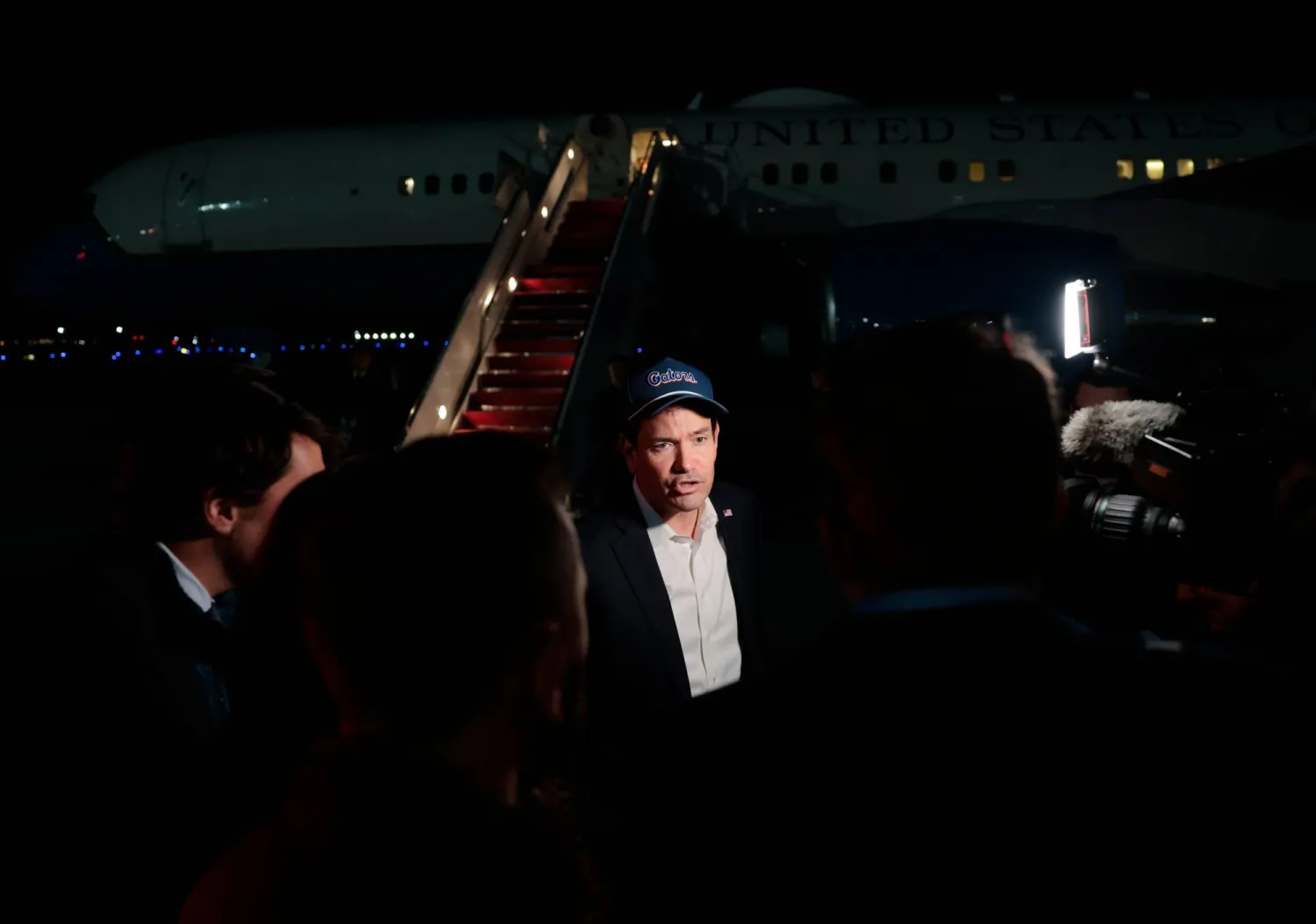
US Goes on the Offensive in Central Asia

 US Secretary of State Marco Rubio speaks with members of the media before boarding a plane en route to Uzbekistan, at Joint Base Andrews, Md., Saturday, Oct. 17, 2026. (Kylie Cooper/Pool Photo via AP)
US Secretary of State Marco Rubio speaks with members of the media before boarding a plane en route to Uzbekistan, at Joint Base Andrews, Md., Saturday, Oct. 17, 2026. (Kylie Cooper/Pool Photo via AP)
TT

US Goes on the Offensive in Central Asia

 US Secretary of State Marco Rubio speaks with members of the media before boarding a plane en route to Uzbekistan, at Joint Base Andrews, Md., Saturday, Oct. 17, 2026. (Kylie Cooper/Pool Photo via AP)
US Secretary of State Marco Rubio speaks with members of the media before boarding a plane en route to Uzbekistan, at Joint Base Andrews, Md., Saturday, Oct. 17, 2026. (Kylie Cooper/Pool Photo via AP)

It's dealmaking time: despite the roiling geopolitical tensions embroiling Washington on several fronts, US Secretary of State Marco Rubio headed to Central and South Asia late Saturday to boost commercial ties -- and gain an edge over Russia and China.

With the United States mired in its war with Iran, and the conflict in Ukraine showing no signs of abating, Rubio has stepped up his foreign travel with recent trips to Europe and Latin America, smack in the middle of the US midterm election campaign.

He has largely ceded control of the contentious Iran, Ukraine and Gaza situations to US President Donald Trump's special envoys Steve Witkoff and Jared Kushner.

Rubio was instead leading a massive delegation of 200 business leaders to Uzbekistan, where he will take part on Monday in a ministerial meeting of five Central Asian countries.

"This is an important relationship," Rubio said shortly before his departure, calling the trip a strategic visit. "There's countries you'd like to get to because we want to build our relationships with them."

A senior State Department official told reporters on Friday that Rubio was demonstrating Washington's goodwill toward the "deepening partnership across Central Asia," especially in the energy sector.

Central Asia is a resource-rich region as vast as the European Union but only boasts a population of about 80 million people.

"We've been planning this for several months, and it's an incredible opportunity to bring the United States into a region of the world that is vitally important," said a second senior US official, on condition of anonymity.

During his visit to the Uzbek city of Samarkand, an emblematic stop on the historic Silk Road, Rubio will participate in a C5+1 meeting with ministers from Kazakhstan, Kyrgyzstan, Tajikistan, Turkmenistan and Uzbekistan.

In November 2025, Trump welcomed the leaders of those countries to the White House.

The former Soviet republics remain linked to Moscow by energy pipelines, as well as security and migratory networks, but Russian influence has eroded since the start of the war in Ukraine -- with China reaping the benefits.

Beijing is the main trade partner of all five Central Asian nations.

Chinese companies have signed a number of energy-related deals, seeking to buy natural gas in Turkmenistan, uranium in Kazakhstan and rare earths in Tajikistan.

The United States also has made sourcing rare earths and improving its energy mix key parts of its foreign policy.

The US ambassador to India, Sergio Gor -- who also serves as the special envoy for Central and South Asia -- has repeatedly emphasized the need for Washington to have better ties across the region.

- Trade deal -

After his visit to Uzbekistan, Rubio will head to India, with stops in Mumbai and Jamnagar in Gujarat state. Both are industrial hubs and major international port cities.

It will be the secretary of state's second official visit to India this year, after a May trip to New Delhi and Kolkata, signifying Washington's push in the region.

"We're very close" to a trade deal with India, the second senior US official said of negotiations that have dragged on for months.

Last February, the two sides reached a provisional agreement aimed at reducing US tariffs on Indian products.

But just a few days later, the US Supreme Court struck down many of Trump's tariffs, which fueled uncertainty about when a bilateral trade deal could take effect.

Ever since, Washington and Delhi have been locked in negotiations.

Relations were rattled when Trump imposed 25 percent tariffs on Indian goods in retaliation for Delhi's purchases of Russian oil, but those duties have since been lifted.

In Mumbai and Jamnagar, Rubio will offer the new US brand of so-called "commercial diplomacy" in his meetings with Indian business leaders.

He will notably raise plans by the Indian conglomerate Reliance Industries to finance a refinery in Texas. Reliance is led by billionaire Indian tycoon Anant Ambani.


How Will Saudi Arabia’s Consumer Protection Law Reshape Relations Between Buyers and Sellers?

 Centria Mall in Riyadh (Saudi Tourism)
Centria Mall in Riyadh (Saudi Tourism)
TT

How Will Saudi Arabia’s Consumer Protection Law Reshape Relations Between Buyers and Sellers?

 Centria Mall in Riyadh (Saudi Tourism)
Centria Mall in Riyadh (Saudi Tourism)

Saudi Arabia’s new consumer protection law could reshape everyday transactions in the kingdom, promising greater transparency, safeguards against harmful business practices and easier access to redress.

But its real test will be whether effective enforcement and swift complaint resolution turn legal guarantees into tangible protection.

Lawyer and legal consultant Dr. Tael bin Fahm told Asharq Al-Awsat that the law could strengthen relations between consumers and businesses by making transactions more transparent and clarifying mutual rights and obligations, creating a more reliable and consistent shopping and service experience.

For consumers, the biggest change would be a shift from seeking redress after suffering harm to preventing it in the first place, he said. That would require clear information on products, services, prices, warranties, contract terms and complaint procedures.

Making Consumer Rights Easier to Enforce

Consumers have long faced hurdles in asserting their rights, from difficulties proving violations and navigating multiple authorities to lengthy disputes, particularly over warranties and defective products, Bin Fahm said.

For some, the cost of pursuing a complaint outweighs the damage itself, discouraging them from seeking compensation.

The solution, he said, lies in simpler complaint procedures, faster decisions, clearer escalation channels and digital tools to track cases.

Recognizing consumer rights is not enough; consumers must be able to exercise them.

Stronger legal protections could also push businesses to improve service quality, ensure credible advertising, strengthen after-sales support and resolve customer complaints more quickly, Bin Fahm said.

Beyond tackling violations, he said, the law could bolster consumer confidence and foster a more competitive market where respect for consumer rights becomes a core measure of business performance.

Enforcement Holds the Key

The law offers an opportunity to strengthen consumer protection as Saudi Arabia’s e-commerce sector expands and the range of goods and services grows. But Bin Fahm cautioned that its impact would depend on enforcement, not merely enactment.

Legislation lays the groundwork, he said, but effective oversight, enforcement procedures and public awareness are what turn legal protections into reality.

He identified clear implementing regulations, effective market oversight, swift complaint resolution, meaningful penalties and accessible compensation for valid claims as critical to success. Greater awareness of rights and responsibilities among consumers and businesses would also be essential.

To gauge whether the law is delivering, Bin Fahm called for measurable benchmarks, including average complaint resolution times, dispute settlement rates, consumer satisfaction and reductions in repeat violations.

Ultimately, he said, success would be measured not by the number of legal provisions or penalties, but by whether consumers feel safe and confident in everyday transactions and can secure their rights without complicated procedures or costs disproportionate to the harm suffered.

The goal is a market where consumer rights are respected as a matter of course and fair business practices are the rule, not the exception.


Hapag-Lloyd Raises Outlook for Third Time on Strong Freight Rates

Hapag-Lloyd containers at a loading terminal at the harbor in Hamburg, Germany, July 13, 2025. (Reuters)
TT

Hapag-Lloyd Raises Outlook for Third Time on Strong Freight Rates

Hapag-Lloyd containers at a loading terminal at the harbor in Hamburg, Germany, July 13, 2025. (Reuters)

German container shipping company Hapag-Lloyd on Wednesday raised its full-year earnings outlook for the third time this year, citing strength in freight rates and a stronger-than-expected performance ‌in the ‌fourth quarter.

The stock was ‌up ⁠2.4% at 0925 ⁠GMT.

The upgrade adds to a series of positive outlook revisions across the European logistics sector, where resilient global trade, elevated shipping ⁠rates and persistent ‌supply-chain disruptions have ‌supported earnings and boosted profitability.

Hapag-Lloyd ‌now expects full-year earnings ‌before interest and tax of $2.0 billion to $2.4 billion, up from previous expectations of $1.25 billion to $1.75 ‌billion.

The company also lifted its 2026 earnings before ⁠interest, tax, ⁠depreciation and amortization guidance to $4.6 billion to $5.0 billion, from $3.9 billion to $4.4 billion previously.

The latest increase follows earlier upgrades in July and September, reflecting sustained strength in container shipping markets and management's improved expectations for year-end trading.


Gold Gains After Steep Drop, but Hawkish Central Bank Signals Weigh

People buy gold jewellery on the occasion of 'Dhanteras' as part of Diwali celebrations, the Hindu festival of lights, in Kolkata on November 6, 2026. (AFP)
TT

Gold Gains After Steep Drop, but Hawkish Central Bank Signals Weigh

People buy gold jewellery on the occasion of 'Dhanteras' as part of Diwali celebrations, the Hindu festival of lights, in Kolkata on November 6, 2026. (AFP)

Gold prices climbed on Wednesday, but remained anchored near the $4,000 level after a sharp selloff in the previous session following a hot US inflation print and hawkish policymakers' comments that tilted market expectations towards further and larger ‌rate hikes.

Spot ‌gold rose 0.5% to $4,051.31 per ounce ‌by ⁠0916 GMT after dropping ⁠as much as 3% to $4,013.29 on Tuesday. US gold futures for December delivery gained 0.7% to $4,059 per ounce.

"Gold is seeing some slight relief after its post-CPI declines," said Han Tan, chief market analyst at Bybit.

"However, it's a tough ask for gold bulls to keep pushing prices higher, given ⁠the prospects of more Fed rate ‌hikes in the pipeline."

Data released on ‌Tuesday showed US consumer prices rose more than expected in ‌October, with the CPI increasing 0.4%. Economists polled by Reuters ‌had forecast a 0.3% rise.

Traders raised the odds of a December Federal Reserve rate hike to 100% from 84% before the data, as per CME's FedWatch tool. Expectations of a ‌larger, half-percentage-point hike also increased.

Ahead of the data, Fed Governor Christopher Waller said a core inflation ⁠reading ⁠of 0.3% in October would prompt him to consider a half-point hike at the December meeting.

Other policymakers also maintained a hawkish tone, with Fed Bank of Philadelphia President Anna Paulson signaling further US rate hikes and Fed Vice Chair for Supervision Michelle Bowman reaffirming the central bank's focus on curbing price pressures.

Although gold is typically seen as an inflation hedge, higher interest rates diminish its appeal, as gold bullion pays no interest.

Among other metals, spot silver climbed 2.7% to $52.87 per ounce, and palladium gained 4.1% to $1,066.66 per ounce.