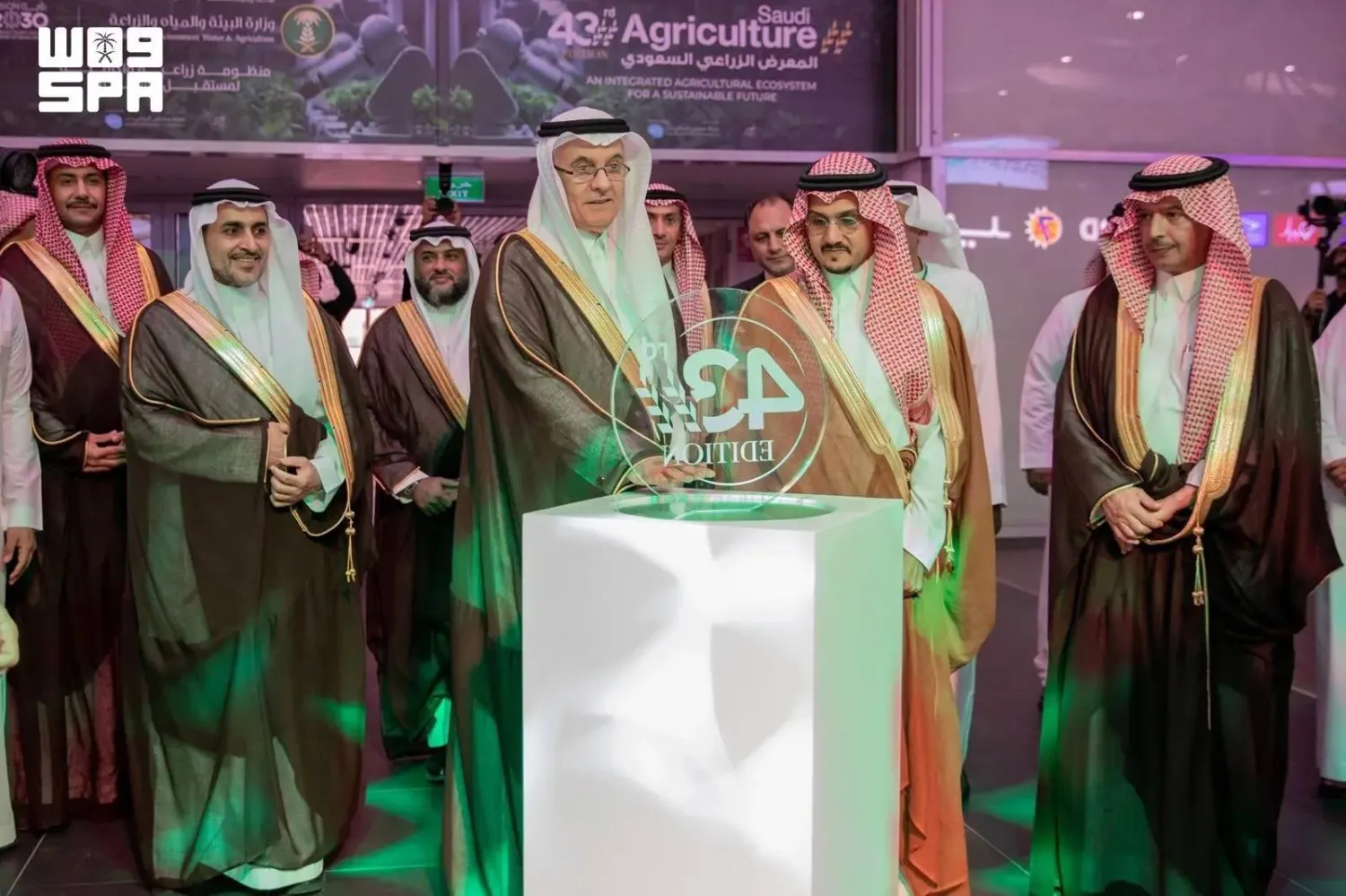
Environment Minister Opens Saudi Agriculture Exhibition 2026

Minister of Environment, Water and Agriculture Abdulrahman Alfadley inaugurates the Saudi Agriculture Exhibition 2026 in Riyadh on Monday. (SPA)
TT

Environment Minister Opens Saudi Agriculture Exhibition 2026

Minister of Environment, Water and Agriculture Abdulrahman Alfadley inaugurates the Saudi Agriculture Exhibition 2026 in Riyadh on Monday. (SPA)

Minister of Environment, Water and Agriculture Abdulrahman Alfadley inaugurated on Monday the Saudi Agriculture Exhibition 2026, held at the Riyadh International Convention and Exhibition Center from October 19 to 22 under the theme "An Integrated Agricultural System for a Sustainable Future."

The 43rd edition of the exhibition brings together a broad range of local and international participants, including government entities, private sector companies, decision-makers, investors, and industry professionals, to strengthen the agricultural sector's contribution to food security in line with Saudi Vision 2030.

Riyadh Exhibitions Company Chairman Prince Saud bin Turki bin Faisal bin Abdulaziz said the exhibition's continued success over more than four decades reflects its international standing as a leading platform for bringing together local and international expertise, fostering partnerships, and promoting innovation in agriculture and food production.

He noted that this year's edition highlights the latest solutions and technologies aimed at increasing productivity, improving resource-use efficiency, and supporting food security. These efforts also strengthen the sector's ability to address environmental and climate challenges while advancing its development and sustainability.

Alfadley toured the exhibition's pavilions, which cover several sectors, including agricultural and organic food, poultry, livestock, mills, animal feed, and animal health, as well as aquaculture, food processing and packaging, innovation and entrepreneurship, and veterinary services.

The exhibition hosted the signing of agreements and memoranda of understanding among government and semi-government entities, private sector organizations, and international agricultural companies to support the food and agriculture sector, stimulate economic growth, and promote the adoption of modern agricultural technologies.

Held alongside the exhibition, the Saudi International Conference on the Future of Agriculture brings together leading experts and specialists from Saudi Arabia and abroad to discuss key issues related to agricultural technologies and food security.

The conference examines emerging opportunities in the Kingdom's agricultural sector, agricultural initiatives, advanced technologies, and their role in strengthening food security, as well as climate change, project financing, biotechnology, soil science, and water management.

For more than 40 years, the Saudi Agriculture Exhibition has kept pace with developments in agriculture, food production, and related technologies, serving professionals and stakeholders across the industry. This year's edition focuses on promoting innovative solutions to advance agricultural development and strengthen food security in line with Saudi Vision 2030.


EU Proposes Tax on Big Tech to Boost Budget

European Council President Antonio Costa arrives at the EU Council for a EU-UK Summit, in Brussels on November 20, 2026. (Photo by NICOLAS TUCAT / AFP)
TT

EU Proposes Tax on Big Tech to Boost Budget

European Council President Antonio Costa arrives at the EU Council for a EU-UK Summit, in Brussels on November 20, 2026. (Photo by NICOLAS TUCAT / AFP)

The EU put forward plans to tax the world's biggest digital companies to fund its next budget Saturday, as it seeks to bridge divisions among member states over the bloc's long-term funding.

European Council President Antonio Costa unveiled a new spending proposal that slashes by 204 billion euros ($224 billion) a plan initially put forward by the European Commission, which some countries had slammed as too onerous.

"I believe this proposal can bring us closer to a final agreement," Costa told a press conference in Brussels.

EU countries have been squabbling over the size of the next budget, with Germany leading calls for major cuts after the commission last year proposed a two-trillion-euro budget for the 2028-2034 period.

Berlin criticized a revised proposal published last month that suggested slashing the bloc's future seven-year budget by 140 billion euros.

Costa, who represents the EU's 27 states, is seeking to reach a deal by the end of the year balancing contributions from member states with new sources of revenue for the bloc.

Among these could be a tax on digital firms that the draft Costa presented Saturday says will concern companies with an annual turnover for digital activities of at least 50 million euros in the EU as well as a global turnover of more than 750 million euros.

They would be subjected to "an annual contribution corresponding to 3 percent of the annual net turnover from online advertising, digital intermediation services and user-generated data", according to documents shared by the council.

The plan is likely to provoke US President Donald Trump's ire since his administration has reacted angrily to EU fines and moves against Big Tech under its content and competition rules in recent years.

The draft also includes plans for a levy on electronic waste and higher tobacco taxes, AFP reported.

The document will be at the center of hours of fraught talks when EU leaders meet in Brussels next week.

Costa is pushing for a deal in December, amid EU fears that a delay would push talks into a fraught election year in 2027 with worries about what potential Eurosceptic victories in France and elsewhere would mean for future dealmaking.

Once EU states find an agreement, they will have to negotiate with parliament -- a task that also promises to be difficult.

Key budget lawmaker Siegfried Muresan warned the EU Parliament would block the spending plan if member states continued to ignore its concerns.

"We think that the debate... is focused too much on cuts," he said this week.

Germany is part of a grouping with five other so-called "frugal" EU members, including Sweden, which expressed skepticism this week over new taxes.

"It's money taken from somewhere else. It won't solve the financial equation," Swedish Europe Minister Jessica Rosencrantz said.

"The focus should be on the expenditure side, where the volume needs to go down" and the national contribution "needs to go down", she added on Thursday.

Costa does not only have to contend with the frugals' demands.

France, the second-biggest EU economy and a net contributor to the budget, argues the bloc needs sufficient means to match the rising challenges it faces.

Meanwhile, 17 countries from southern, central and eastern Europe have formed a group known as the "Friends of Cohesion" and are pushing for greater funding to support agriculture and regional development.


Saudi Arabia Agrees to Store Additional 16 Million Barrels of Crude in Japan

The Saudi Minister of Energy and Minister of Industry and Mineral Resources met with the Turkish Minister of Environment, Urbanization and Climate Change on the sidelines of the 31st Conference of the Parties to the United Nations Framework Convention on Climate Change (COP31) in Antalya. SPA
TT

Saudi Arabia Agrees to Store Additional 16 Million Barrels of Crude in Japan

The Saudi Minister of Energy and Minister of Industry and Mineral Resources met with the Turkish Minister of Environment, Urbanization and Climate Change on the sidelines of the 31st Conference of the Parties to the United Nations Framework Convention on Climate Change (COP31) in Antalya. SPA

Saudi Minister of Energy and Minister of Industry and Mineral Resources Prince Abdulaziz bin Salman bin Abdulaziz and Japan’s Minister of Economy, Trade and Industry Akazawa Ryosei have reaffirmed the strong and longstanding strategic partnership between the two countries and discussed ways to further strengthen bilateral cooperation, particularly in the energy sector.

The ministers held a virtual meeting on November 9.

Following discussions within the joint task force established in May 2026, the two countries confirmed that the Kingdom regards Japan as a strategic partner and attaches great importance to supporting Japan's long term energy security through reliable and stable crude oil supplies.

Japan expressed its deep appreciation to Saudi Arabia for its stable and reliable supply of crude oil.

The Kingdom has already begun to replenish the joint oil stockpiling tanks in Japan.

Recognizing the longstanding importance of the Joint Crude Oil Stockpiling Project since its establishment in 2010 and the effectiveness it recently demonstrated, Japan intends to lend the Kingdom crude oil storage capacity of 16 million barrels, alongside the existing 8 million barrels storage, using Japan's national stockpiling facilities on a time-bound basis.

Japan also intends to purchase up to 8 million barrels of crude oil from Saudi Arabia for its national stockpile reserves, subject to favorable market conditions and the completion of necessary internal procedures.

Japan and the Kingdom will cooperate under “POWERR Asia,” announced by Japan, to enhance energy security in Asia, based on the AZEC Ministerial Work Program for Strengthening Oil Stockpiling presented at the AZEC Ministerial Meeting held on October 8.

The Work Program outlines future measures, including the development of both institutional frameworks and infrastructure for oil stockpiling in Asia, cooperation with oil-producing countries, and coordinated emergency responses.

The ministers welcomed the continued engagement between the two countries and expressed their shared aspiration to further strengthen the strategic energy partnership between Japan and Saudi Arabia.

Both ministries will continue their constructive engagement to explore further energy cooperation and avenues for further enhancing the existing joint crude oil stockpiling scheme and maximizing its potential.

Meanwhile, Prince Abdulaziz met with Turkish Minister of Environment, Urbanization and Climate Change Murat Kurum on the sidelines of the 31st Conference of the Parties to the United Nations Framework Convention on Climate Change (COP31) in Antalya, Türkiye.

The two ministers explored ways to strengthen cooperation on climate action, reviewed developments at COP31 and discussed efforts to meet the goals of the Paris Agreement in a manner that takes into account countries’ national circumstances and contributes to balanced and inclusive outcomes.


Türkiye Says It Is Starting Offshore Hydrocarbon Exploration in Pakistan, Plans Drilling Next Year

This handout photograph taken on November 10, 2026 and released by Türkiye's Ministry of Energy and Natural Resources on November 12, 2026 shows Türkiye's Minister of Energy and Natural Resources Alparslan Bayraktar (C) during a session at the 31st United Nations Climate Change Conference (COP31) at the Antalya Expo Center in Antalya. (Handout / Turkish Energy Ministry / AFP)
TT

Türkiye Says It Is Starting Offshore Hydrocarbon Exploration in Pakistan, Plans Drilling Next Year

This handout photograph taken on November 10, 2026 and released by Türkiye's Ministry of Energy and Natural Resources on November 12, 2026 shows Türkiye's Minister of Energy and Natural Resources Alparslan Bayraktar (C) during a session at the 31st United Nations Climate Change Conference (COP31) at the Antalya Expo Center in Antalya. (Handout / Turkish Energy Ministry / AFP)

Türkiye's Oruc Reis seismic research vessel will begin exploration for hydrocarbon resources in offshore fields in Pakistan, Turkish Energy Minister Alparslan Bayraktar said on Friday, adding that drilling was expected to start in 2027.

Last year, Türkiye's state oil company TPAO ‌signed hydrocarbon exploration ‌and production agreements ‌with ⁠Pakistani companies including Mari ⁠Energies, Fatima, OGDCL, PPL, Prime and GHDL for three offshore and two onshore fields in Pakistan.

Bayraktar, who attended a ceremony to welcome Oruc ⁠Reis at Karachi Port alongside ‌Pakistan's Foreign ‌Minister Ishaq Dar and Petroleum Minister ‌Ali Pervaiz Malik, said on ‌X the vessel would carry out two- and three-dimensional seismic survey operations in the Indus and Makran basins ‌to "uncover the potential there".

The step marked a "strong ⁠turning ⁠point" in energy cooperation between the two countries, he said, noting that it came at a time of turbulence in global oil and gas markets.

Last month, Bayraktar said the planned operations off Pakistan had been delayed by about six months due to the war in Iran.