Saudi Arabia to Store Oil in Singapore to Bolster Asia Supply Security Starting 2027

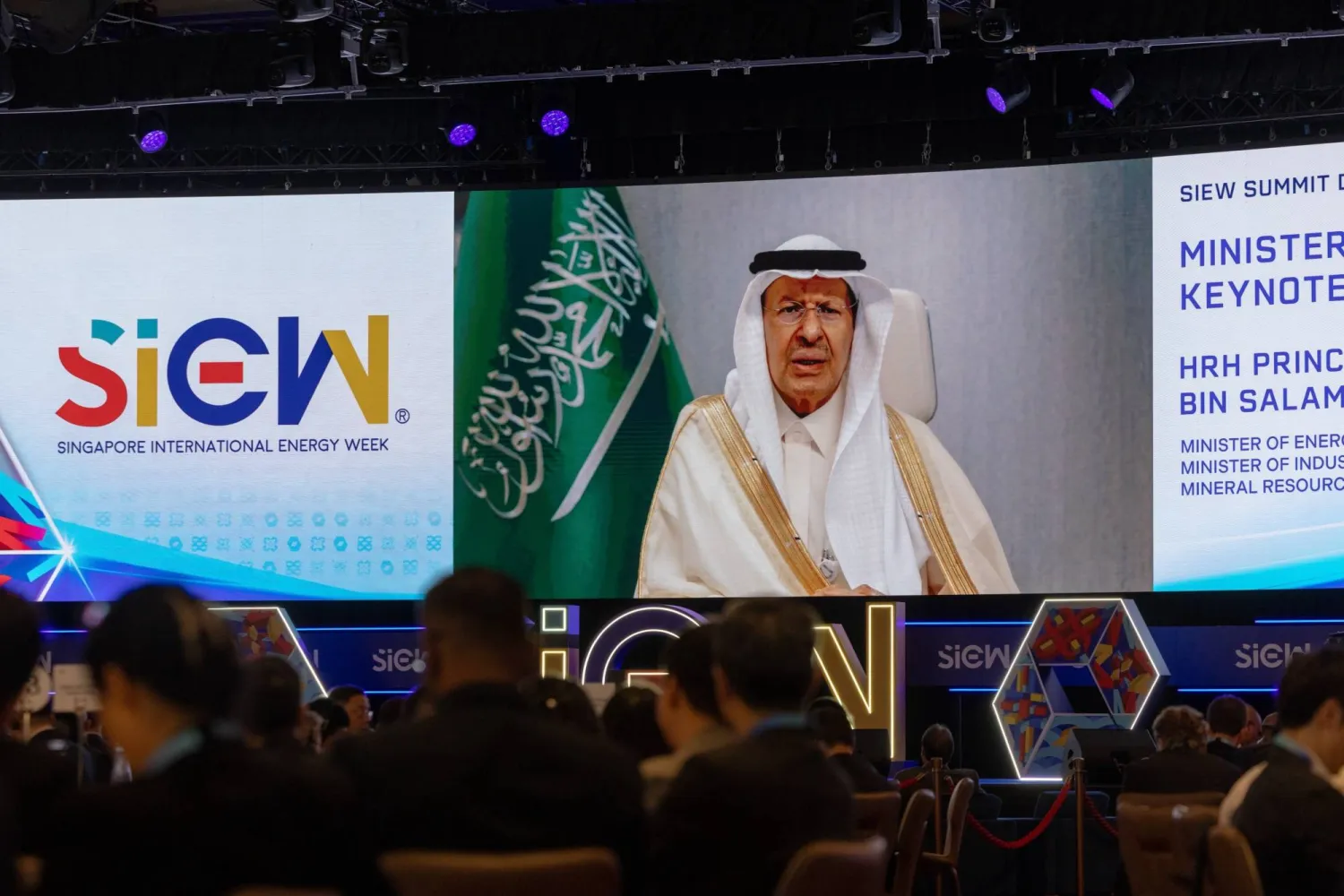
 Saudi Arabia's Energy Minister Prince Abdulaziz ‌bin Salman Al-Saud speaks in a video recording at the conference. (X)
Saudi Arabia's Energy Minister Prince Abdulaziz ‌bin Salman Al-Saud speaks in a video recording at the conference. (X)
TT

Saudi Arabia to Store Oil in Singapore to Bolster Asia Supply Security Starting 2027

 Saudi Arabia's Energy Minister Prince Abdulaziz ‌bin Salman Al-Saud speaks in a video recording at the conference. (X)
Saudi Arabia's Energy Minister Prince Abdulaziz ‌bin Salman Al-Saud speaks in a video recording at the conference. (X)

Saudi Arabia plans to store crude oil at Singapore's Jurong Rock Caverns from the second half of 2027 to strengthen supply security in the region, energy ministers from both countries said on Monday.

The move comes after the US-Israeli war with Iran severely disrupted energy supplies to Asia shipped through the Strait of Hormuz, prompting countries to draw down inventories and raising concerns about stockpile levels globally. Asia imported two-thirds of its oil supplies from the Middle ‌East before ‌the war.

"Saudi Arabia and Singapore are announcing our joint intent to ‌establish ⁠an arrangement for ⁠Saudi crude oil to be stored at the Jurong Rock Caverns from the second half of 2027," Tan See Leng, minister for energy, trade and industry, told the Singapore International Energy Week conference.

"This arrangement enhances the resilience of the Saudi crude oil supply chain in Southeast Asia, as well as contributes to Singapore's energy security and resilience in the event of supply disruptions."

"Bringing supply closer to key Asian markets would strengthen the flexibility of our supply network ‌and support Singapore's security of supply and preparedness," Saudi Arabia's Energy Minister Prince Abdulaziz ‌bin Salman Al-Saud said in a video recording at the conference.

Located at a depth of 150 meters (492 feet) below the ground, the rock caverns at Jurong Island can store up to 1.47 million cubic meters, or roughly 9 million barrels of liquid hydrocarbons such as crude ‌oil and condensate.

Saudi Aramco currently stores crude in Japan and South Korea where local governments have priority to buy ⁠the supplies in ⁠the tanks in the event of an unexpected shortage.

The crude storage capacity in Okinawa was expanded to 8.2 million barrels in September 2017 in an agreement with Japan Oil, Gas and Metals National Corp (JOGMEC), Aramco Japan said on its website.

In 2023, Aramco inked a deal with Korea National Oil Corp to store 5.3 million barrels of oil in South Korea's reserve facilities in the port of Ulsan for five years.


Aljadaan: Saudi Arabia Implemented 200 Policy and Regulatory Measures This Year

Saudi Finance Minister Mohammed Aljadaan at a press conference on the Kingdom's 2027 state budget (Asharq Al-Awsat)
TT

Aljadaan: Saudi Arabia Implemented 200 Policy and Regulatory Measures This Year

Saudi Finance Minister Mohammed Aljadaan at a press conference on the Kingdom's 2027 state budget (Asharq Al-Awsat)

Saudi Finance Minister Mohammed Aljadaan said the Kingdom had implemented around 200 measures this year in response to disruptions affecting the region. These included policy, procedural and regulatory measures, public awareness initiatives and interventions by national development funds.

The funds provided financing facilities to borrowers and supported businesses requiring funding and working capital liquidity to import additional goods, including food and essential supplies, as well as production inputs. The measures were aimed at addressing challenges affecting not only Saudi Arabia but the wider region, many of which have also had global repercussions.

Speaking at a press conference on Saudi Arabia's 2027 state budget, Aljadaan said the government had taken several steps to cushion the impact of shocks during an exceptional year. These included facilitating the use of airports and ports, expanding transportation and shipping capacity, monitoring the flow of goods and the availability of production inputs, and strengthening the Kingdom's ability to meet demand.

Other measures included establishing a marine insurance pool and the wage support announced Tuesday for Saudi employees at affected businesses through the SANED unemployment insurance program, helping ease employers' wage burdens.


US Tech Stock Rebound Opens Opportunities for Saudi Companies, with HUMAIN in Spotlight

A stock market screen displays Nvidia shares (Reuters)
TT

US Tech Stock Rebound Opens Opportunities for Saudi Companies, with HUMAIN in Spotlight

A stock market screen displays Nvidia shares (Reuters)

Rapid developments in the US technology sector, led by Nvidia, have restored momentum to global stock markets following Jensen Huang's return as the company's chief executive. The move has revived confidence in artificial intelligence stocks and raised questions about how the new wave of investment could affect Gulf markets, particularly Saudi Arabia.

The announcement sparked a strong rally in Nvidia shares, with gains spreading across US equity markets as optimism over AI investment and digital infrastructure returned. The rebound has also brought renewed attention to companies and sectors linked to the AI ecosystem worldwide.

The recovery has extended to the Saudi stock market, where the benchmark Tadawul All Share Index (TASI) rose in early Tuesday trading as investors monitored global market developments and assessed how improving risk appetite could affect local equities.

Mohammed Al Farraj, Senior Director and Head of Asset Management at Arbah Capital, said the renewed momentum in US technology stocks should not be viewed merely as a temporary rebound in share prices, but as a clear indication of a revival in the global investment cycle associated with digital infrastructure.

Speaking to Asharq Al-Awsat, Al Farraj explained that the momentum would not necessarily translate into an automatic rise in Saudi Arabia's benchmark index, given the market's dependence on domestic drivers, including oil prices, government spending and corporate earnings.

He said the impact would be felt through three main channels: improved global liquidity and risk appetite, increased capital expenditure on infrastructure, and a revaluation of local companies connected to the AI ecosystem.

HUMAIN and the AI Value Chain

Discussing the Saudi sectors most likely to benefit from renewed global investment in artificial intelligence, Al Farraj said opportunities span interconnected industries that together form an integrated value chain.

He explained that this would allow Saudi Arabia to move beyond consuming technology toward securing a share in its production.

The opportunities begin with telecommunications and technology services companies such as solutions by stc and extend to the data center sector, driven by major initiatives including Public Investment Fund-backed HUMAIN, which is developing an integrated cloud ecosystem.

Al Farraj added that the benefits would also extend to the energy and electricity sectors, including ACWA Power, Saudi Electricity Company and Saudi Aramco, given the substantial need for reliable power supplies and advanced cooling systems to operate data centers.

Other potential beneficiaries include digital companies such as Elm and supporting industrial sectors that stand to gain from the localization of manufacturing for transformers, cables and backup power equipment.

Contracts and Cash Flow Key to Sustaining Gains

On the sustainability of the rally, Al Farraj stressed the importance of distinguishing between sustained investment in artificial intelligence and continued increases in stock valuations.

He noted that sharp gains in US markets reflect investors' sensitivity to developments in the sector but are not, on their own, sufficient evidence that returns will be sustainable.

He said the real measure of Saudi companies' performance in the sector would not be their announcements of AI adoption, but their ability to meet three fundamental financial conditions.

These include converting contracts into genuine earnings growth, generating returns on invested capital that exceed the cost of capital, and, most importantly, producing tangible free cash flow that is not consumed by substantial capital expenditure.

Ultimately, Al Farraj believes Saudi Arabia has a strategic opportunity to localize supply chains and translate the global investment cycle into added value for its domestic economy.

He emphasized that the strongest investment opportunities would not necessarily lie with companies that merely promote their AI strategies, but with those that possess the infrastructure and assets needed to turn the technological transformation into sustainable profits and cash flows.



EU Officially Limits Imports of Chinese Hybrid Vehicles

Vehicles identified as a Chinese-manufactured Chery Jaecoo J5 EV and an Omoda 9 plug-in hybrid are parked at a lot in Toronto, Ontario, Canada, May 4, 2026. (Reuters)
TT

EU Officially Limits Imports of Chinese Hybrid Vehicles

Vehicles identified as a Chinese-manufactured Chery Jaecoo J5 EV and an Omoda 9 plug-in hybrid are parked at a lot in Toronto, Ontario, Canada, May 4, 2026. (Reuters)

The European Union on Tuesday officially put in place import quotas on hybrid vehicles to protect domestic industry, following a deal struck with China last month.

Brussels and Beijing agreed to limit exports of Chinese plug-in hybrids and other hybrid vehicles to the 27-nation bloc as part of a deal to avoid a trade war.

The EU said the import cap would kick in from December 1.

"These restrictions are needed to protect EU industry against a sharp recent increase in imports of such vehicles," the European Commission said.

While mainly aimed at Chinese cars, the measure will apply to all hybrid imports regardless of their origin, in compliance with international trade rules.

Brussels has long accused China of unfair trade practices, including price dumping, currency manipulation and state subsidies.

Officials and companies say the measures undermine EU companies and lead to job losses.

"The surge in imports of hybrid passenger vehicles into the EU has been driven by growing global production overcapacity," the commission said.

"It is also prompted by increased use of trade-restrictive measures in other major markets."

Hybrid vehicles are among the most popular EV models for European consumers, and Chinese makers have profited from their lower-price models to gain huge market shares at the expense of European producers.

For major exporters the EU import quota was set at just over 15 percent above the level of imports from those countries in 2025.

Brussels said in October that hybrid vehicles from China would be capped to 350,000 a year, after previously forecasting imports of up to 800,000 units in 2026.