


Trump Floats ‘Concept’ of US-Canada Deal That Includes Pipeline Talking to Carney

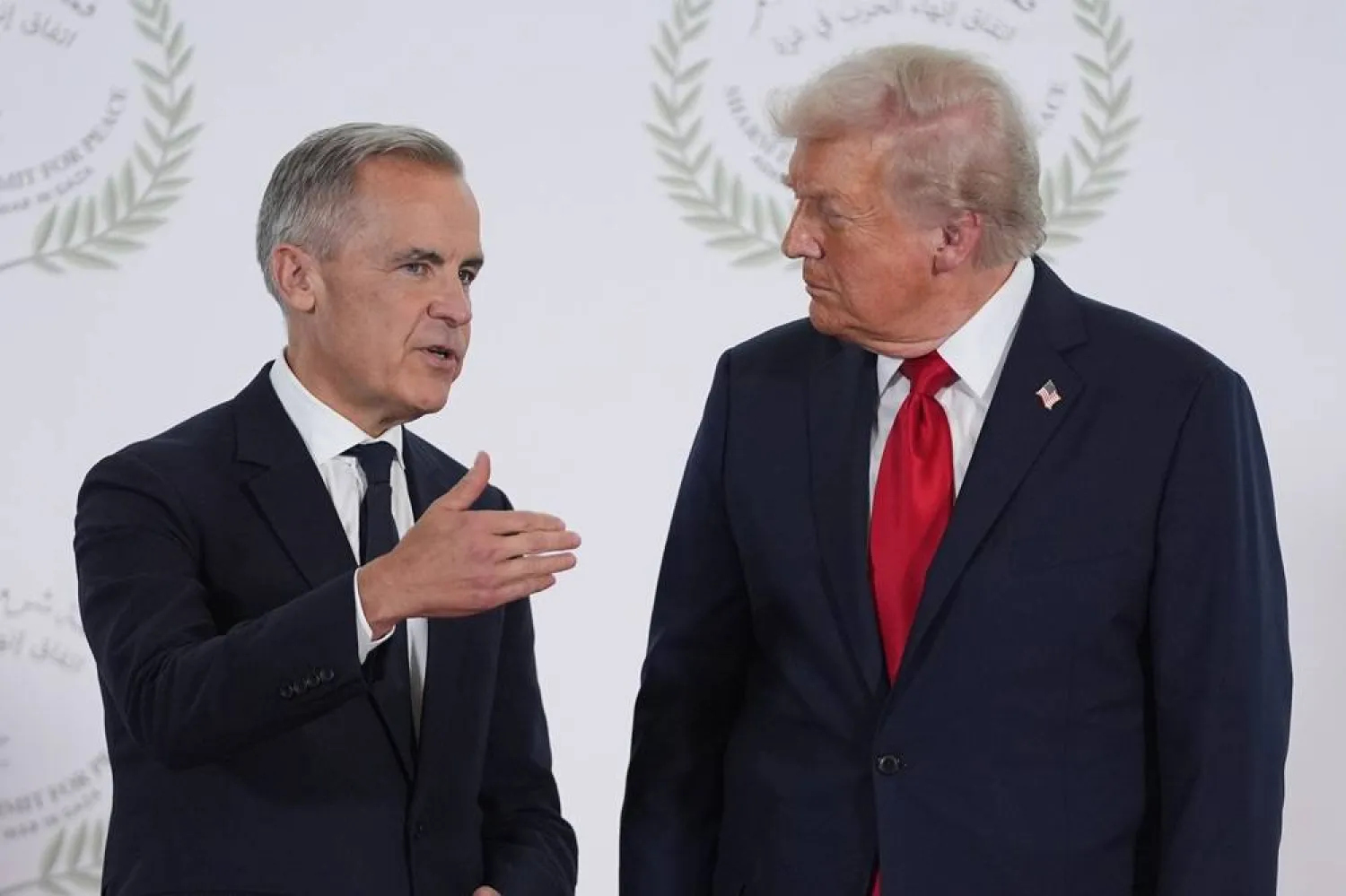
President Donald Trump greets Canada's Prime Minister Mark Carney during a summit to support ending the more than two-year Israel-Hamas war in Gaza after a breakthrough ceasefire deal, Oct. 13, 2025, in Sharm El Sheikh, Egypt. (AP)
TT

Trump Floats ‘Concept’ of US-Canada Deal That Includes Pipeline Talking to Carney

President Donald Trump greets Canada's Prime Minister Mark Carney during a summit to support ending the more than two-year Israel-Hamas war in Gaza after a breakthrough ceasefire deal, Oct. 13, 2025, in Sharm El Sheikh, Egypt. (AP)

US President Donald Trump said on Sunday that his administration has the "concept" of a new trade deal with Canada while Prime Minister Mark Carney said the two leaders had a good conversation on the future of trade between their countries.

"I spoke to him again yesterday, and we have the concept of a deal that's going to be great for our farmers, great for our country, and we'll be fine for that," Trump told reporters in Dubuque, Iowa.

Carney earlier on Sunday posted on social media that their exchange "builds on recent constructive ‌discussions on the outlines ‌of a mutually beneficial trade deal" that would create jobs, improve ‌affordability, ⁠and fully respect ⁠Canada’s languages, culture, and sovereignty.

"Our teams will now be working in the coming weeks to deliver that outcome," Carney wrote on X.

Canada and the United States have slapped billions of dollars in tariffs on each other in recent months. The imposition of tariffs on Canada has emerged as an issue in some northern US border states like Michigan and Maine before US midterm elections on Tuesday.

Trump said last week that a trade deal with Canada was coming soon, but Ottawa had previously reported limited ⁠progress in trade talks, despite efforts to ease tariffs on steel ‌and autos.

Trump said the scope of an agreement would include ‌the Keystone XL pipeline project that he supports, though it was not immediately clear how the project would ‌be revived. Former President Joe Biden in 2021 revoked a key permit for the project, which ‌was a private sector initiative.

"They're going to build the Keystone Pipeline," Trump said on Sunday. "They're going to pay for it. ... We're going to give them the route, and it's largely been determined."

A spokesperson for Dominic LeBlanc, Canada's minister responsible for trade with the US, had no further comment on Sunday evening beyond Carney's ‌remarks.

Trump said in August that the pipeline "may be awoken from the grave." The proposed pipeline would have carried 830,000 barrels per day of ⁠oil from the ⁠oil sands of northern Alberta to the major US storage hub at Cushing, Oklahoma, and then on to Gulf Coast refineries.

Canada, the world's fourth-largest oil exporter, sends more than 90% of its crude oil production to the US.

The company behind Keystone XL, Canada's TC Energy, lost billions when the pipeline was canceled. It later spun off its crude pipelines business into a new entity, South Bow, which has proposed a new pipeline project called Prairie Connector, in partnership with US company Bridger Pipeline.

The 550,000-barrel-per-day project would run from Alberta to Wyoming and would use some of the Keystone XL pipe that had been installed on the Canadian side of the border before that project was canceled. South Bow has said it will decide whether or not to go ahead with Prairie Connector in 2027.

South Bow was not immediately available for comment. A spokesperson for Canadian Energy Minister Tim Hodgson declined comment.




Stocks Extend Losses as Traders Digest Nvidia Fallout

People walk near an electronic signboard showing the benchmark Korea Composite Stock Price Index (KOSPI) at Hana Bank in Seoul, South Korea, 16 November 2026. (EPA)
TT

Stocks Extend Losses as Traders Digest Nvidia Fallout

People walk near an electronic signboard showing the benchmark Korea Composite Stock Price Index (KOSPI) at Hana Bank in Seoul, South Korea, 16 November 2026. (EPA)

Asian stocks mostly fell Monday as the tech sector struggled to recover from the crisis at Nvidia after boss Jensen Huang stepped down, with the company's earnings this week and market debut of Anthropic keeping the AI trade in focus.

Investors will also be keeping close tabs on geopolitical developments, with Chinese President Xi Jinping and his US and Russian counterparts Donald Trump and Vladimir Putin holding their first trilateral summit on the sidelines of the APEC gathering this week.

AI-linked firms continued to fall in early exchanges as the fallout from the upheaval at Nvidia courses through trading floors.

Huang, a pivotal figure in the artificial intelligence boom, resigned Thursday following revelations of extramarital affairs, including with a woman suspected of being a Chinese spy.

The 63-year-old's departure raised concerns about the chip titan, which is at the center of a buildout that has helped propel global markets to record highs and boosted economic growth around the world.

The day looked set for a positive start after the Financial Times reported that Huang was in talks for a spectacular return to the hotseat, while several Silicon Valley titans have backed calls for his return.

Tycoon Elon Musk and Uber co-founder Travis Kalanick were among the more than 158,000 signatories of an open letter demanding the firm's board to "bring Jensen back while an independent investigation establishes the facts".

However, the report did not appear to be having much of an impact in Asia, with Taipei plunging six percent as chip giants TSMC and MediaTek were hammered.

Seoul sank more than three percent owing to steep losses in SK hynix and Samsung, while Tokyo lost more than two percent with Advantest plunging 11.1 percent and Kioxia 7.7 percent.

There were also losses in Shanghai, Sydney, Singapore, Bangkok, Manila and Jakarta, though Hong Kong, Mumbai and Wellington rose.

London, Paris and Frankfurt opened higher.

"After the bombshells dropped on markets last week, investors have had the weekend to digest the developments and reassess risk with a clearer mind," wrote Chris Weston at Pepperstone.

"That said, I'm not convinced we're any closer to pricing the future with a new sense of conviction.

"We'll see whether the reinstatement trade can gather momentum," he added.

However, he said: "Even if Huang were to return, alleviating the immediate key-man risk, the prospect of tighter governance requirements and additional political or regulatory constraints would remain a significant overhang".

Nvidia is due to report its earnings Tuesday, giving a fresh view on the outlook for the AI trade, while the listing of Anthropic -- creator of the Claude chatbot -- will provide some insight into investors' sentiment.

"The reported quarter ended before the leadership upheaval," wrote Saxo Markets' Charu Chanana.

"Strong results would demonstrate the business's momentum going into the transition; the next-quarter outlook will provide a better indication of what comes after it.

"The key questions concern customer commitments, delivery schedules and any changes in order visibility. A headline beat may carry less weight if management becomes more cautious about future demand."

The Xi-Trump-Putin meeting on the sidelines of APEC in southern China will be closely watched, but it is unclear whether the wars in Iran and Ukraine, which have sent energy prices soaring, will be on the agenda.

Also in view this week are the release of US retail sales data and minutes from the Federal Reserve's October meeting, which could provide signals on the outlook for US interest rates.


Chip Tensions Loom Over Trump-Xi Summit, as US and China Push AI Safety Steps

People walk at the Shenzhen Civic Center, ahead of the 33rd Asia-Pacific Economic Cooperation (APEC) Economic Leaders' Meeting, in Shenzhen, China, November 16, 2026. (Reuters)
TT

Chip Tensions Loom Over Trump-Xi Summit, as US and China Push AI Safety Steps

People walk at the Shenzhen Civic Center, ahead of the 33rd Asia-Pacific Economic Cooperation (APEC) Economic Leaders' Meeting, in Shenzhen, China, November 16, 2026. (Reuters)

The prospect of tighter US curbs on China's access to advanced AI chips will likely overshadow talks when US President Donald Trump and President Xi Jinping meet at a summit in Shenzhen this week, analysts said, though the leaders could make some progress on AI safety cooperation.

The meeting on Thursday comes days after Nvidia co-founder Jensen Huang, who starred at the US-China summit in Busan a year ago promoting chip sales, resigned following reports of an affair with a suspected Chinese spy.

The scandal has spurred a push by US lawmakers to tighten China's access to advanced AI chips, a move analysts said Beijing would be bracing for.

"President Xi may not name or mention Jensen Huang, but I'm pretty sure export controls will be high on ‌the agenda when ‌he meets Trump," said George Chen, chair of digital practice at The Asia ‌Group, ⁠a consultancy.

The Chinese ⁠government's key concern, he said, was not just technology controls but whether the US would seek to contain China's broader technological and economic rise.

"If we are moving from strategic stability to strategic containment, that's a big shift and that's what Beijing is watching," Chen said.

Despite their rivalry, Washington and Beijing have been exploring the prospect of cooperation on the risks posed by increasingly powerful AI systems.

Three people briefed on preparations for the talks said the two sides had planned further AI discussions around the Shenzhen summit to cover safeguards against the misuse of the technology.

A proposed emergency ⁠mechanism to notify each other of serious AI incidents, discussed by US Treasury ‌Secretary Scott Bessent and Chinese Vice Premier He Lifeng in September, ‌has yet to become operational, according to several people familiar with the discussions.

They did not say what exactly is delaying ‌the setup of the safety mechanism.

The mechanism is intended to help prevent AI-related incidents or misunderstandings from escalating ‌into national security crises. Communication has so far relied largely on direct contacts between senior officials, the people said.

Bessent said in New York last week that both sides would discuss communication protocols for AI safety incidents at the APEC AI talks and expected to exchange best practices for testing advanced models.

"Right now, I don't think it's in the interest of either side ‌to let the potential export control squeeze sour the leaders' summit," said Bo Zhengyuan, Shanghai-based partner at research consultancy Plenum.

CHINA AIMS FOR PRACTICAL STEPS ON AI

The ⁠US and China will ⁠not announce any further progress on the Board of Trade initiative, agreed at the Trump-Xi summit in Washington in September, to lower reciprocal tariffs on $30 billion worth of goods, a senior US administration official said.

China has identified AI and the digital economy as priorities for the Asia-Pacific Economic Cooperation (APEC) forum in Shenzhen, with Foreign Ministry spokesperson Mao Ning saying Beijing hoped leaders would reach practical agreements in both areas.

China's commerce ministry and the US Treasury did not immediately respond to a request for comment.

Trump is not bringing a formal business delegation, according to the administration official. Elon Musk is the main chief executive travelling with Trump, while other corporate leaders were attending at China's invitation, the official said.

A person familiar with corporate preparations said Musk, Mastercard CEO Michael Miebach and FedEx CEO Raj Subramaniam were expected to attend the summit dinner.

Spokespersons for Tesla, Mastercard and FedEx did not immediately respond to emailed requests for comment outside business hours.

Chinese organizers said more than 2,000 political and business leaders were expected at the APEC CEO Summit on November 17-18 including representatives from 115 Fortune Global 500 companies.


Saudi Arabia Curbs Inflation Despite Geopolitical Developments, Global Trade Disruptions

Data released Sunday by the Kingdom’s General Authority for Statistics showed that the consumer price index rose 0.1 percent on a monthly basis in October compared with the previous month. (SPA)
TT

Saudi Arabia Curbs Inflation Despite Geopolitical Developments, Global Trade Disruptions

Data released Sunday by the Kingdom’s General Authority for Statistics showed that the consumer price index rose 0.1 percent on a monthly basis in October compared with the previous month. (SPA)

Saudi Arabia’s annual inflation rate slowed to 1.7 percent in October, down from 1.9 percent in September, returning to its lowest level this year. The figure reflects the economy’s continued ability to contain price pressures and maintain price stability despite challenges from geopolitical developments and global trade disruptions.

Data released Sunday by the Kingdom’s General Authority for Statistics showed that the consumer price index rose 0.1 percent on a monthly basis in October compared with the previous month. The annual slowdown was driven by price increases across several major categories remaining relatively limited, even as housing costs continued to lead price drivers.

Prices in the housing, water, electricity, gas, and other fuels category rose 3.5 percent year-on-year in October - the same increase recorded in actual housing rents - keeping this category as the largest contributor to inflation.

Prices for insurance and financial services also climbed 3.5 percent, driven by a 6.5 percent rise in insurance service prices, while recreation, sport, and culture prices rose 2.7 percent due to a 4.6 percent increase in package holiday prices.

Food and beverages

Transport prices recorded an annual increase of 2.3 percent, driven by a 9.5 percent surge in passenger transport services, while restaurant and accommodation services rose 1.8 percent and education services climbed 1.3 percent.

Prices for food and beverages - one of the heavily weighted categories in the consumer basket - increased 1.1 percent, while information and communications prices registered a 0.5 percent rise.

Prices for furnishings, household equipment, and routine household maintenance declined 0.5 percent, and clothing and footwear fell 0.2 percent, while the personal care, social protection, and miscellaneous goods and services category edged down 0.6 percent.

Monthly comparison

On a monthly basis, the general index rose 0.1 percent, with prices for housing, water, electricity, gas, and other fuels increasing 0.2 percent, driven by a 0.4 percent rise in actual housing rents. Food and beverage prices also edged up 0.2 percent, while insurance and financial services climbed 1.5 percent.

While these figures reflect an improvement in the inflation landscape, housing and rental costs remain the most prominent challenge for household budgets amid ongoing living pressures, raising questions about the extent to which easing inflation translates into improved purchasing power and quality of life.

Trade disruptions

Financial and economic advisor Hussein Al-Attas the slow inflation rate reflects a combination of domestic factors that reinforced price stability, most notably the riyal’s peg to the US dollar and the relative buffer it provides against import price volatility. He also noted moderate commodity prices, efficient supply chains, and diversified import sources.

Speaking to Asharq Al-Awsat, Al-Attas said that stable monetary policy and exchange rates, together with government and regulatory measures, helped curb the spillover of external inflationary pressures into the domestic market.

While the October reading shows inflation remains contained at moderate levels, its trajectory in the coming period will remain tied to developments in domestic demand, housing costs, and imported goods.

Al-Attas expects inflation to stay within moderate levels through the end of the year, with the potential for limited fluctuations driven by expanding economic activity and mega-projects, as well as risks of higher shipping and insurance costs.

Purchasing power

Economic specialist Ahmed Alshehri views the drop in Saudi Arabia’s inflation rate in October as a positive indicator reflecting a degree of economic stability and the ability to contain price pressures, particularly amid turbulent global conditions and the geopolitical and trade challenges facing markets.

Speaking to Asharq Al-Awsat, he said: “What matters more than the drop in the figure itself is how this stability is reflected in the daily lives of citizens and residents, as well as their purchasing power and cost-of-living expenditures.”

Given housing and rental costs, which represent the most prominent challenge, their continued rise means a broad segment of households still faces financial pressures, even as headline inflation slows, he remarked.

Consumers do not measure the economic situation solely through indicators and percentages, but through what they pay each month for housing, food, transportation, and basic services, making the control of living costs an equal priority alongside maintaining price stability, he stressed.

Alshehri said the next phase requires leveraging the relative stability of inflation to boost purchasing power, continuing to address the drivers of rising rents, and boosting the efficiency of markets and supply chains.

Economic success is measured not only by a decline in the inflation rate, but by the extent to which people feel the results of this drop in their daily lives, he explained.

True economic stability is reflected in quality of life and gives households greater confidence in the future along with a better ability to plan and save, he said.