Emerging Economies Set to Match Advanced Nations’ Renewable Capacity Additions, IEA Says

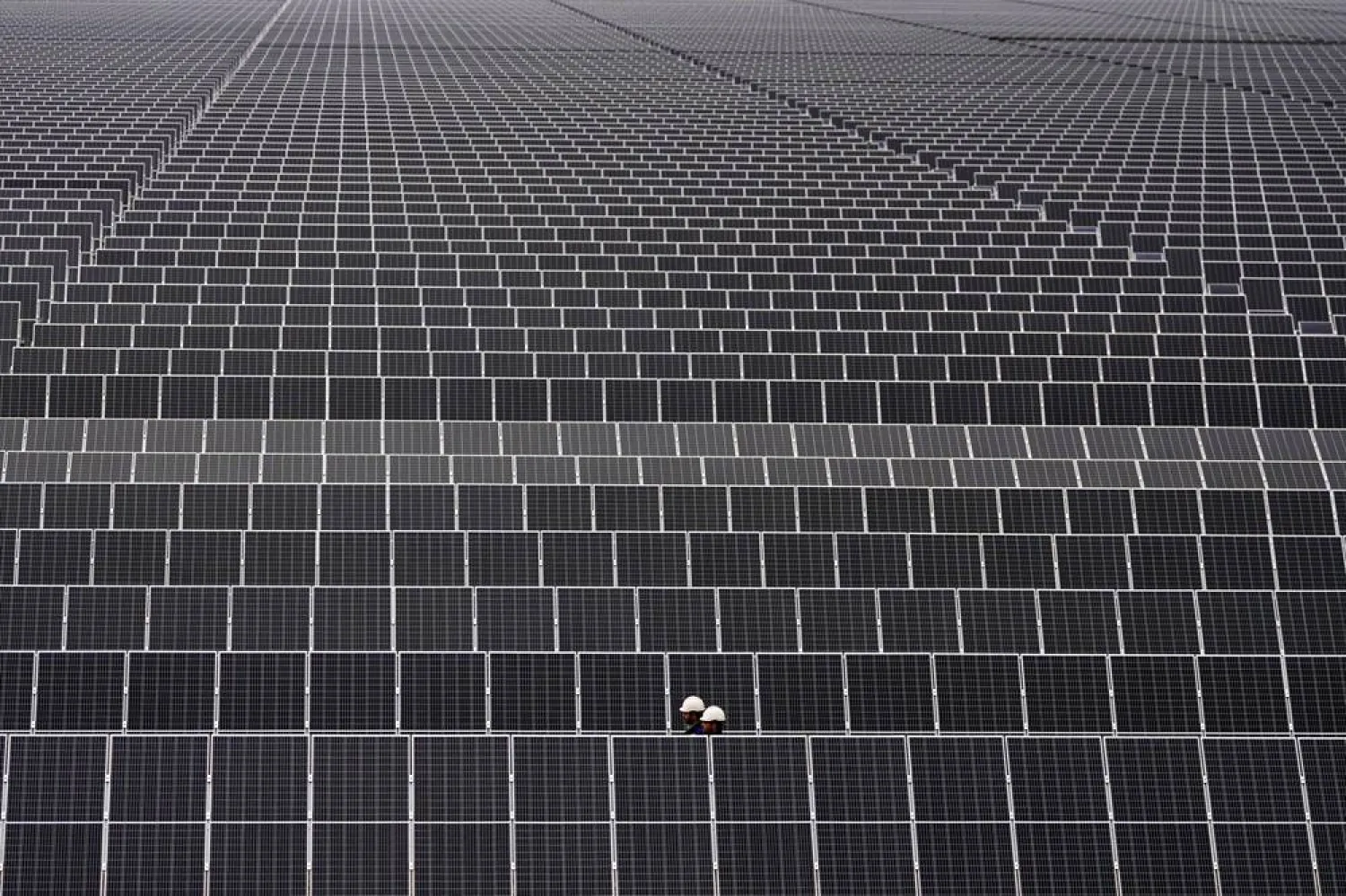
Workers walk at Kalyon Karapinar solar power plant in Karapinar, Konya province, Türkiye, Oct. 14, 2026. (AP)
TT

Emerging Economies Set to Match Advanced Nations’ Renewable Capacity Additions, IEA Says

Workers walk at Kalyon Karapinar solar power plant in Karapinar, Konya province, Türkiye, Oct. 14, 2026. (AP)

Emerging ‌and developing economies outside China are expected to add as much new renewable energy capacity as advanced economies for the first time over the next five years, driven by the current energy crisis, the International Energy Agency said on Friday.

Gas and oil prices have soared this year as the US-Iran war disrupts traffic through the Strait of Hormuz, a key route for global oil and gas trade.

Global renewable energy ‌capacity is forecast ‌to increase by almost 4,800 gigawatts ‌between ⁠2026 and 2031, ⁠the IEA said in its annual outlook.

Emerging and developing economies are expected to add about 1,100 GW, roughly the same as advanced economies, with China adding around 2,550 GW, the agency said.

Capacity growth in Southeast Asia, Africa and the Middle East is ⁠expected to triple over the period, ‌led mainly by solar installations, ‌the IEA said.

China will remain the biggest contributor to ‌global renewable energy growth, although its share is ‌forecast to fall to 53% by 2031 from 60% in 2025.

India is emerging as the world's second-fastest deployer of renewables and is expected to more than double its contribution ‌to global growth by 2031 to nearly 8.5%.

Grid connection delays remain ⁠a major ⁠challenge, with projects awaiting connections worldwide rising 60% over the past year, equivalent to four times the wind and solar capacity connected to grids during the same period.

Grid constraints are expected to slow growth in advanced economies, with annual additions in Europe through 2031 forecast to remain broadly in line with 2025 levels.

Renewable energy is expected to meet 6% of global transport energy demand by 2031, while higher fuel-blending mandates prompted the IEA to raise its biofuels forecast by 40% from last year's report.


Emerging Economies Set to Match Advanced Nations’ Renewable Capacity Additions, IEA Says

Workers walk at Kalyon Karapinar solar power plant in Karapinar, Konya province, Türkiye, Oct. 14, 2026. (AP)
TT

Emerging Economies Set to Match Advanced Nations’ Renewable Capacity Additions, IEA Says

Workers walk at Kalyon Karapinar solar power plant in Karapinar, Konya province, Türkiye, Oct. 14, 2026. (AP)

Emerging ‌and developing economies outside China are expected to add as much new renewable energy capacity as advanced economies for the first time over the next five years, driven by the current energy crisis, the International Energy Agency said on Friday.

Gas and oil prices have soared this year as the US-Iran war disrupts traffic through the Strait of Hormuz, a key route for global oil and gas trade.

Global renewable energy ‌capacity is forecast ‌to increase by almost 4,800 gigawatts ‌between ⁠2026 and 2031, ⁠the IEA said in its annual outlook.

Emerging and developing economies are expected to add about 1,100 GW, roughly the same as advanced economies, with China adding around 2,550 GW, the agency said.

Capacity growth in Southeast Asia, Africa and the Middle East is ⁠expected to triple over the period, ‌led mainly by solar installations, ‌the IEA said.

China will remain the biggest contributor to ‌global renewable energy growth, although its share is ‌forecast to fall to 53% by 2031 from 60% in 2025.

India is emerging as the world's second-fastest deployer of renewables and is expected to more than double its contribution ‌to global growth by 2031 to nearly 8.5%.

Grid connection delays remain ⁠a major ⁠challenge, with projects awaiting connections worldwide rising 60% over the past year, equivalent to four times the wind and solar capacity connected to grids during the same period.

Grid constraints are expected to slow growth in advanced economies, with annual additions in Europe through 2031 forecast to remain broadly in line with 2025 levels.

Renewable energy is expected to meet 6% of global transport energy demand by 2031, while higher fuel-blending mandates prompted the IEA to raise its biofuels forecast by 40% from last year's report.


Gold Drops Over 1% on Higher Oil Prices; US Payrolls Data in Focus

Gold bracelets displayed in a shop window on Green Street, east London, UK, April 30, 2024. (AFP)
TT

Gold Drops Over 1% on Higher Oil Prices; US Payrolls Data in Focus

Gold bracelets displayed in a shop window on Green Street, east London, UK, April 30, 2024. (AFP)

Gold prices slipped on Friday as oil prices rebounded, fanning inflation worries and higher-for-longer interest rate expectations, while investors awaited key US payrolls data later in the day.

Spot gold fell 1.1% to $4,044.09 per ounce by 0501 GMT, but was on track for its best week since late August.

US gold futures for ‌December delivery ‌dropped 1.5% to $4,053.30.

"Crude oil has rebounded mostly over ‌the ⁠past day, which remains ⁠one of the inflationary knockbacks pressuring gold," said Ilya Spivak, head of global macro at Tastylive.

Oil rose more than 1% even as it was on track for a sharp weekly drop on expectations of a de-escalation in the Iran conflict after the US election results, while persistent Middle East supply concerns continued to support prices.

Higher ⁠energy costs can reinforce expectations that the Federal ‌Reserve will keep interest rates ‌elevated for longer, pressuring the non-yielding bullion.

Asia's tech-heavy markets crumbled as fear of ‌increased regulatory scrutiny and a slowdown in AI build-out unleashed ‌the steepest fall in US stocks since the tariff-triggered "Liberation Day" rout in April 2025.

"In risk-off conditions like this, we’re seeing gold positions get liquidated to free up cash and cover margin calls elsewhere. It’s not the ‌first time we’ve watched this dynamic temporarily override gold’s usual safe-haven appeal," said Tim Waterer, chief market ⁠analyst at ⁠KCM Trade.

The US non-farm payrolls report is due at 1330 GMT.

Traders currently see a 68% chance that the Fed will raise rates in December, down from the near certainty expected last month, according to CME's FedWatch tool.

On Thursday, two Fed officials made a case for modest and steady rate increases to tackle above-target inflation.

Elsewhere, Goldman Sachs on Thursday lowered its end-2026 gold price forecast to $4,150 per ounce from $4,650, citing the Fed's more hawkish stance.

Among other metals, spot silver fell 0.5% to $51.51 per ounce; platinum dipped 0.3% to $1,512.83 and palladium dropped 1.1% to $1,020.10.

However, all three metals were headed for weekly gains.


Oil Set for Sharp Weekly Drop but Middle East Supply Concerns Provide Floor

A pumpjack operates near Bakersfield, California, on Oct. 16. (AFP)
TT

Oil Set for Sharp Weekly Drop but Middle East Supply Concerns Provide Floor

A pumpjack operates near Bakersfield, California, on Oct. 16. (AFP)

Oil prices are set for a sharp weekly drop on expectations of a de-escalation of the Iran war after US President Donald Trump's party suffered election losses, but Middle East supply concerns from the conflict continue to provide a floor for the market.

Brent crude futures for January rose on Friday by $1.29, or 1.31%, to $99.58 a barrel as of 0504 GMT. US West Texas Intermediate futures climbed 86 cents, or 0.95%, to $91.38 a barrel. Brent briefly breached the $100-a-barrel mark in ‌morning trade.

Both contracts ‌gained for a second day.

Still, the ‌Brent ⁠contract is on ⁠track to drop by 12% this week after the December contract expired on October 30, while WTI is set to drop 12.1%.

The contracts plunged earlier this week on expectations that US midterm elections on Tuesday, which swung the Senate and House of Representatives to the Democratic Party from Trump's Republicans, could lead to ⁠a de-escalation of the US-Israeli war against Iran, now ‌in its ninth month.

Oil prices ‌fell 8% on Wednesday alone after the Democrats swept the elections, ‌settling at two-month lows.

However, prices rebounded on a surge ‌in tanker attacks on Wednesday and Thursday in the Gulf and the Strait of Hormuz — the crucial sea outlet for a majority of Middle Eastern oil shipments — that renewed the concerns about supply flows from the ‌region.

KCM chief analyst Tim Waterer described Friday's rise as a "technical recovery" from the steep ⁠selloff after ⁠the US elections, but said the underlying driver was a realization that the problem had not disappeared and attacks in the Strait of Hormuz were unaffected by a Democratic win.

"Until there is a credible path to safer, cheaper transit through the Gulf, oil is likely to remain supported on dips and prone to sharp moves on any escalation headlines," he said.

Iran said on Thursday that three more tankers had been attacked in the Strait of Hormuz, and data from Britain's maritime security agency UKMTO suggested that attacks on oil-carrying ships are still running at close to record pace.