Two More Victims of Volcano Eruption Found in Roman Ruins of Pompeii 

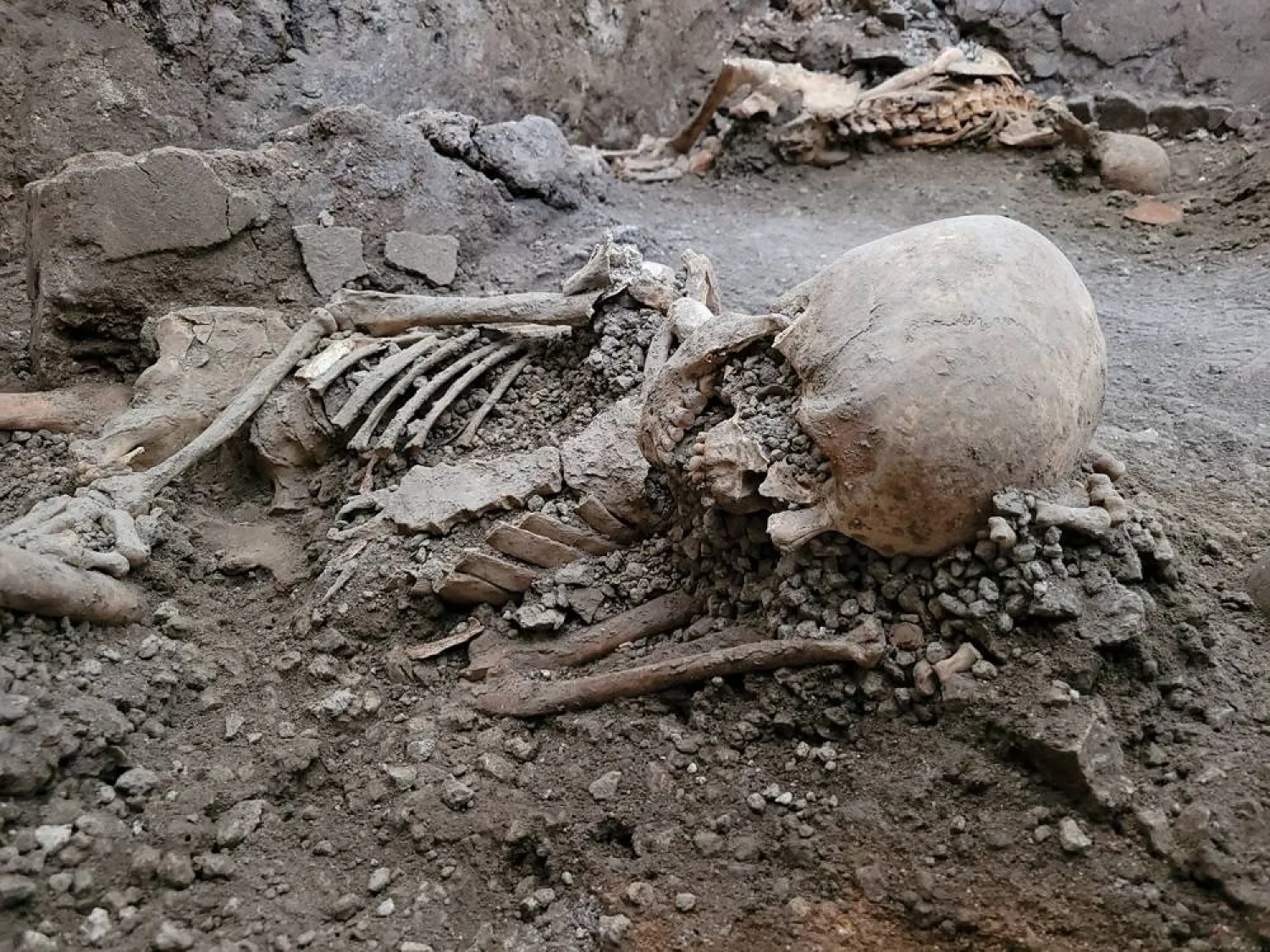
This undated photo issued as a handout on May 16, 2023 by the Archaeological Park of Pompeii shows two skeletons uncovered at the Archaeological Park of Pompeii, likely middle-aged males who died in an earthquake during the devastating volcanic eruption that buried the Italian city in 79 AD. (Photo by Handout / Parco Archeologico di Pompei press office / AFP)
TT

Two More Victims of Volcano Eruption Found in Roman Ruins of Pompeii 

This undated photo issued as a handout on May 16, 2023 by the Archaeological Park of Pompeii shows two skeletons uncovered at the Archaeological Park of Pompeii, likely middle-aged males who died in an earthquake during the devastating volcanic eruption that buried the Italian city in 79 AD. (Photo by Handout / Parco Archeologico di Pompei press office / AFP)

Two skeletons have been found in the ruins of Pompeii, the ancient Roman city wiped out by an eruption of volcano Mount Vesuvius nearly 2,000 years ago, the Italian Culture Ministry said on Tuesday.

The skeletons were recovered from a building known as the "House of the Painters at Work", and are probably of two men in their 50s who died in an earthquake that accompanied the eruption, a ministry statement said.

Pompeii Archaeological Park Director Gabriel Zuchtriegel said they were killed not by volcanic ash but by collapsing buildings, noting that wall fragments were found between their fractured bones.

"Modern excavation techniques help us to better understand the inferno that completely destroyed the city of Pompeii over two days, killing many inhabitants", the German archaeologist said.

Pompeii, 23 km (14 miles) southeast of Naples, was home to about 13,000 people when it was buried under ash, pumice pebbles and dust as it endured the force of an eruption in the year 79 AD equivalent to many atomic bombs.

The Culture Ministry said "at least 15-20% of the population" was killed. Over the past two and a half centuries, archaeologists have recovered the remains of more than 1,300 victims.

The Pompeii site, not discovered until the 16th century, has seen a burst of recent archaeological activity aimed at halting years of decay and neglect, largely thanks to a recently concluded 105-million-euro ($115.58 million) EU-funded project.

Italian Culture Minister Gennaro Sangiuliano said conservation and archaeological research efforts would continue.

"The discovery of these two skeletons shows us that we still need to study a lot, do more excavations to bring out everything that is still (hiding) in this immense treasure," he said.


Prince Mohammed bin Salman Project Renovates Historic Al-Qibli Mosque in Riyadh

Al-Qibli Mosque is named for its location west of Manfuha and near the Principality Palace - SPA
TT

Prince Mohammed bin Salman Project Renovates Historic Al-Qibli Mosque in Riyadh

Al-Qibli Mosque is named for its location west of Manfuha and near the Principality Palace - SPA

The Prince Mohammed bin Salman Project for the Development of Historical Mosques continues efforts to preserve the Kingdom’s authentic architectural identity.

One of its recent projects is the comprehensive renovation of Al-Qibli Mosque in the old neighborhood of Manfuha in Riyadh. The restoration reflects traditional Najdi architecture and highlights the mosque’s connection to the town’s administrative and social history, SPA reported.

Al-Qibli Mosque is named for its location west of Manfuha and near the Principality Palace. It was historically the closest mosque to the town’s seat of government and was frequented by princes and prominent figures. The mosque spans approximately 500 square meters. It includes an outer courtyard, an inner prayer hall, and a lower prayer room of equal size that dates back to the original construction. Square, plaster-lined windows on the north and south sides provide natural ventilation.

These were added during the mosque’s second reconstruction around 1364 AH (1945 AD).

The covered inner prayer hall measures 15 by 8 meters and rests on 33 columns arranged in three rows. It was built by architect Abdullah bin Masoud upon the order of King Abdulaziz bin Abdulrahman. The roof is constructed using tamarisk and palm trunks, and a minaret stands at the center of the northern façade. Following earlier renovations in 1414 AH (1993 AD), the mosque remains the last mud-brick mosque in old Manfuha.

According to SPA, its design creates a visual connection between the courtyard and the inner hall, alongside a secluded lower prayer room. The site also includes the historic water fountain of Faris bin Abdullah bin Shaalan, who died in 1175 AH (1762 AD), and an old ablution area.

The current renovation uses the same local materials as the original construction, including mud, plaster, tamarisk wood, and palm fronds. Specialized Saudi heritage companies and engineers are overseeing the work to ensure preservation of historical authenticity while meeting modern sustainability standards.

The restoration aligns with the project’s four objectives: preparing historical mosques for worship, restoring architectural authenticity, highlighting the Kingdom’s cultural dimension, and enhancing religious significance. The project supports the cultural and civilizational goals of Saudi Vision 2030 and contributes to preserving the Kingdom’s architectural heritage for future generations.


Qassim Region Principality Illuminated in Green in Celebration of Founding Day

The Qassim Region Principality illuminated in green marking Founding Day - SPA
TT

Qassim Region Principality Illuminated in Green in Celebration of Founding Day

The Qassim Region Principality illuminated in green marking Founding Day - SPA

The Qassim Region Principality building was illuminated in green in celebration of Founding Day.

The scene reflected pride in the historical roots of the Saudi state and embodied feelings of belonging on this cherished national occasion, SPA reported.

The illumination affirms the deep historical significance of Founding Day, marking 299 years since the establishment of the First Saudi State by Imam Mohammed bin Saud.

It also reflects the enduring principles upon which it was founded, including unity, stability, and state-building. These foundations culminate in the security, stability, and prosperity that the Kingdom of Saudi Arabia enjoys today under its wise leadership.


Prince Mohammed bin Salman Project Restores Century-Old Uqlat Al-Suqur Mosque in Qassim

The renovation utilized traditional mud, stone, and wood to preserve the mosque's authentic Najdi architectural style. (SPA)
TT

Prince Mohammed bin Salman Project Restores Century-Old Uqlat Al-Suqur Mosque in Qassim

The renovation utilized traditional mud, stone, and wood to preserve the mosque's authentic Najdi architectural style. (SPA)

The Prince Mohammed bin Salman Project for the Development of Historical Mosques has completed the restoration of the Uqlat Al-Suqur Mosque in Qassim Region, revitalizing a heritage landmark dating back to 1922, reported the Saudi Press Agency on Saturday.

Originally the only mosque in the area, it served as a vital religious and social hub for education and community governance.

The renovation, executed by specialized Saudi firms, utilized traditional mud, stone, and wood to preserve its authentic Najdi architectural style.

The project increased the mosque's area to 544 square meters, expanding its capacity to 250 worshippers while maintaining its historical identity.

The initiative aligns with Vision 2030 to preserve the Kingdom's urban heritage and boost the cultural and religious significance of its historical mosques for future generations.