‘Happy Dancing’ Routine Boosts Fitness in Fast-Ageing China

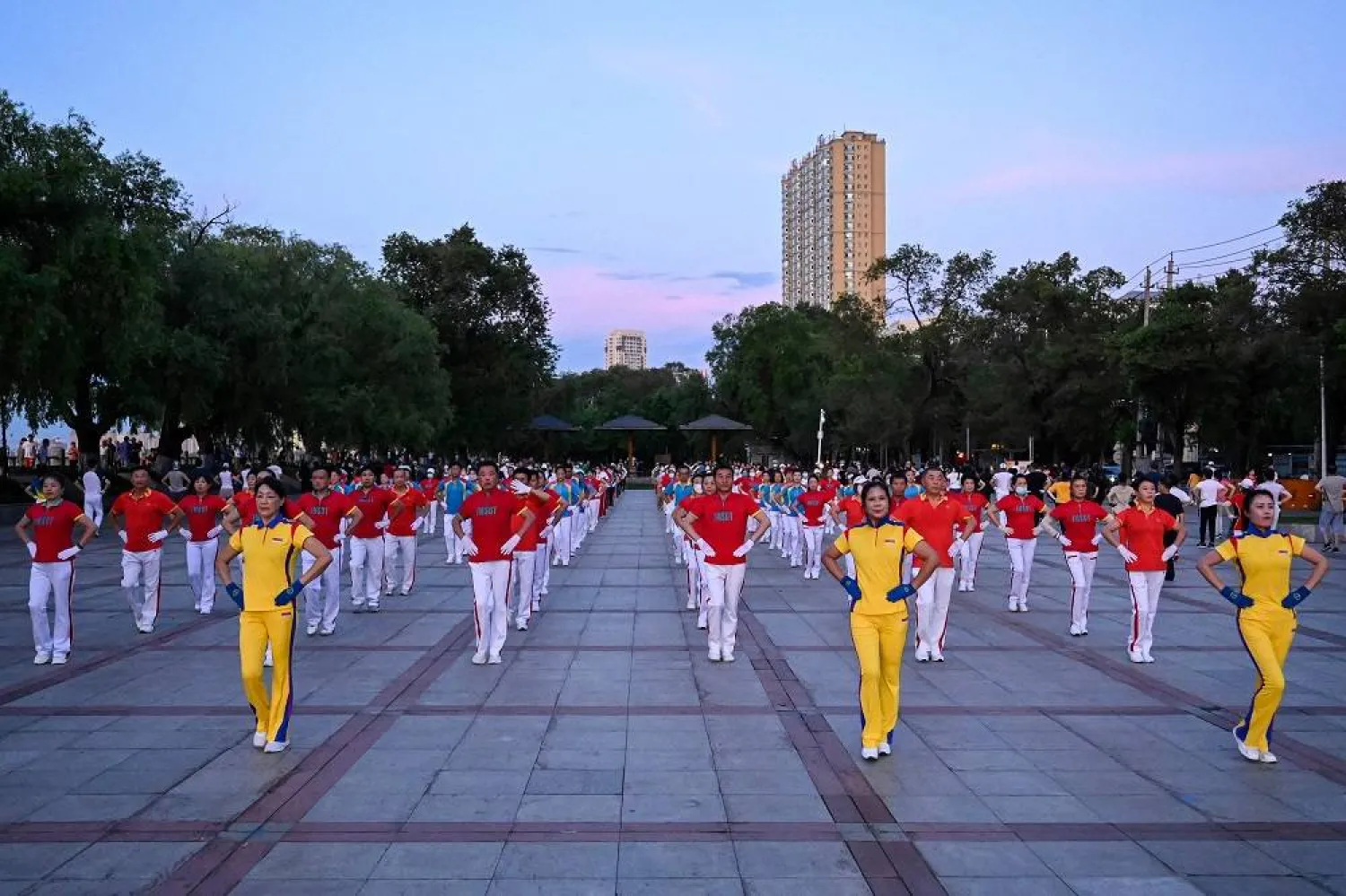
The photo taken on July 3, 2023 shows local residents taking part in an aerobics exercise called "Jiamusi Happy Dancing" at a square in Jiamusi, in northeastern China’s Heilongjiang province. (AFP)
TT

‘Happy Dancing’ Routine Boosts Fitness in Fast-Ageing China

The photo taken on July 3, 2023 shows local residents taking part in an aerobics exercise called "Jiamusi Happy Dancing" at a square in Jiamusi, in northeastern China’s Heilongjiang province. (AFP)

Hundreds of dancers twirl in unison by a riverside in northeastern China, thrusting hips and shimmying shoulders in an unusual but beloved routine that has taken the country by storm.

China has a vibrant public square dancing culture, with ranks of retirees thronging city plazas at dawn and dusk to groove in time to thumping electronic music.

Despite the occasional noise complaints, authorities generally view the aerobics gatherings as good for maintaining public health in a rapidly ageing society.

And one of the country's most popular dance programs in recent years has emerged from the fading rust-belt province of Heilongjiang.

Participants in Jiamusi Happy Dancing perform a series of unconventional moves, from strutting with puffed-out chests to pinwheeling their arms.

Founder Yu Jicheng, 73, said the exercises stand out for their "focus on the waist, abdomen... shoulders and hips".

"They're all done on the move, unlike the sedentary routines broadcast on the radio," the retired civil servant told AFP.

Yu designed the routine in 2008 and still teaches daily public classes in Jiamusi, a city of around two million people near the Russian border.

Lean and spry with a ramrod-straight posture, he keeps a close watch over classes of up to 500 participants, contorting himself to demonstrate each move and barking orders at those who execute them incorrectly.

"The aim of all of this is health. Our concept is: you exercise to be healthy and happy, and you do it by relying on yourself," he said after wrapping up an early morning session.

"It relieves fatigue, helps you lose weight and keeps you fit."

China faces a looming demographic crisis as hundreds of millions of people move into their twilight years in the next few decades, putting new pressures on society and the country's fragile healthcare system.

Yu contends that his routine can ease the transition, claiming it helped him lose 30 kilos (66 pounds) since he turned 50 and brought him back within a healthy weight range.

In recent years, other cities in China have also set up Happy Dancing branches.

Regular participant Zhang said eight years of the exercises had left him in far better health.

"I've definitely felt the effects -- it cleared up my hunched back and my paunch," the 65-year-old told AFP.

"It's great for physical fitness, as it's systematic and scientific in making use of each joint."


Students Discover 1,800-Year-Old Roman Villa Beneath School Gym

Students' curiosity uncovered what had lain hidden beneath the earth for centuries. (Special Superintendency of Rome)
TT

Students Discover 1,800-Year-Old Roman Villa Beneath School Gym

Students' curiosity uncovered what had lain hidden beneath the earth for centuries. (Special Superintendency of Rome)

Archaeologists in Rome have uncovered the remains of a luxury Roman residence dating to the second century CE beneath a high school near the Colosseum, after students' curiosity about mysterious underground rooms led to a formal excavation of the site.

According to Live Science, students at Liceo Scientifico Cavour, located just steps from the Colosseum, had long shared stories about hidden chambers beneath the school's gymnasium. What began as rumors ultimately led to a remarkable archaeological discovery.

During unofficial explorations of the underground spaces, students came across evidence of an ancient structure beneath the school.

After informing a teacher, who alerted the relevant authorities, archaeologists were called in to investigate the site. Excavations carried out earlier this year revealed that the dark passageways and partially lit rooms formed part of an elaborate Roman residence dating back nearly 1,800 years.

Liceo Scientifico Cavour occupies a building near the Colosseum that originally served as the headquarters of a Catholic missionary organization. When the complex was constructed in the late nineteenth century, preliminary excavation work uncovered part of an ancient domus, the term used for a large Roman urban residence.

The area is among the most historically significant parts of ancient Rome. Prominent figures including Cicero, Pompey and Octavian, later known as Augustus, are known to have lived there. Yet the district remains only partially understood by archaeologists because layers of modern construction cover much of the ancient landscape.

Researchers say the discovery offers a rare opportunity to study a section of ancient Rome that has remained largely inaccessible, while shedding new light on the city's residential life during the height of the Roman Empire.


Saudi, Malaysian Translation Associations Sign MoU to Promote Cultural Exchange

The MoU aims to enhance cooperation in the fields of translation and publishing, promote cultural and knowledge exchange, and support scientific and academic efforts of mutual interest. SPA
TT

Saudi, Malaysian Translation Associations Sign MoU to Promote Cultural Exchange

The MoU aims to enhance cooperation in the fields of translation and publishing, promote cultural and knowledge exchange, and support scientific and academic efforts of mutual interest. SPA

The Saudi Arabian Translation Association and the Malaysian Translators Association have signed a memorandum of understanding (MoU) at Saudi Arabia's pavilion, the guest of honor at the 2026 Kuala Lumpur International Book Fair.

The MoU aims to enhance cooperation in the fields of translation and publishing, promote cultural and knowledge exchange, and support scientific and academic efforts of mutual interest.

It also seeks to facilitate the exchange of expertise and specialized consultations, contributing to advancing the translation sector and strengthening its presence on the international cultural scene.

The memorandum represents an important step toward building sustainable professional and cultural partnerships that contribute to strengthening civilizational dialogue between Saudi Arabia and Malaysia, while opening the door to joint projects and initiatives that support translation activities and expand the exchange of literature and knowledge between the two languages.

The MoU comes as part of the cultural momentum witnessed by the Kingdom’s pavilion at the 2026 Kuala Lumpur International Book Fair, led by the Literature, Publishing and Translation Commission through a diverse cultural and knowledge-based program that highlights the growing stature of Saudi culture and its presence in international forums.

This underscores the importance of international book fairs as effective platforms for enhancing cultural cooperation and signing agreements and partnerships that contribute to expanding prospects for joint work among cultural and knowledge institutions around the world.


Saudi Heritage Commission Uncovers Over 1,700 Artifacts at Ancient Al-Juhfah Miqat Site

Discoveries included diverse fragments used in daily life, six pottery kilns, a water channel - SPA
TT

Saudi Heritage Commission Uncovers Over 1,700 Artifacts at Ancient Al-Juhfah Miqat Site

Discoveries included diverse fragments used in daily life, six pottery kilns, a water channel - SPA

Saudi Arabia's Heritage Commission completed the first season of its joint scientific mission with the University of Exeter at the ancient Al-Juhfah Miqat site, uncovering more than 1,700 artifacts, including pottery, glass, stone pieces, shells, and worked objects, confirming the site's significance along the Egyptian pilgrimage route.

Discoveries included diverse fragments used in daily life, six pottery kilns, a water channel believed to have served pilgrims and travelers, and 13 tombstones dating to the Umayyad and Abbasid periods. Some finds originated from the Levant, Egypt, and Ethiopia, reflecting the diverse origins of pilgrims who passed through this miqat, SPA reported.

Al-Juhfah Miqat is located 187 kilometers northwest of Makkah and has been an established miqat since the early Islamic period, associated with the Prophet's migration, and is known to have flourished in the second Hijri century, with water facilities and shops serving pilgrims.

These works are part of the Heritage Commission's efforts to survey and document archaeological sites along the Hijrah route between Makkah and Madinah, using advanced technologies to reveal the historical and civilizational depth of the Kingdom.