Senegal Tapestry Production Finds New Lease of Life

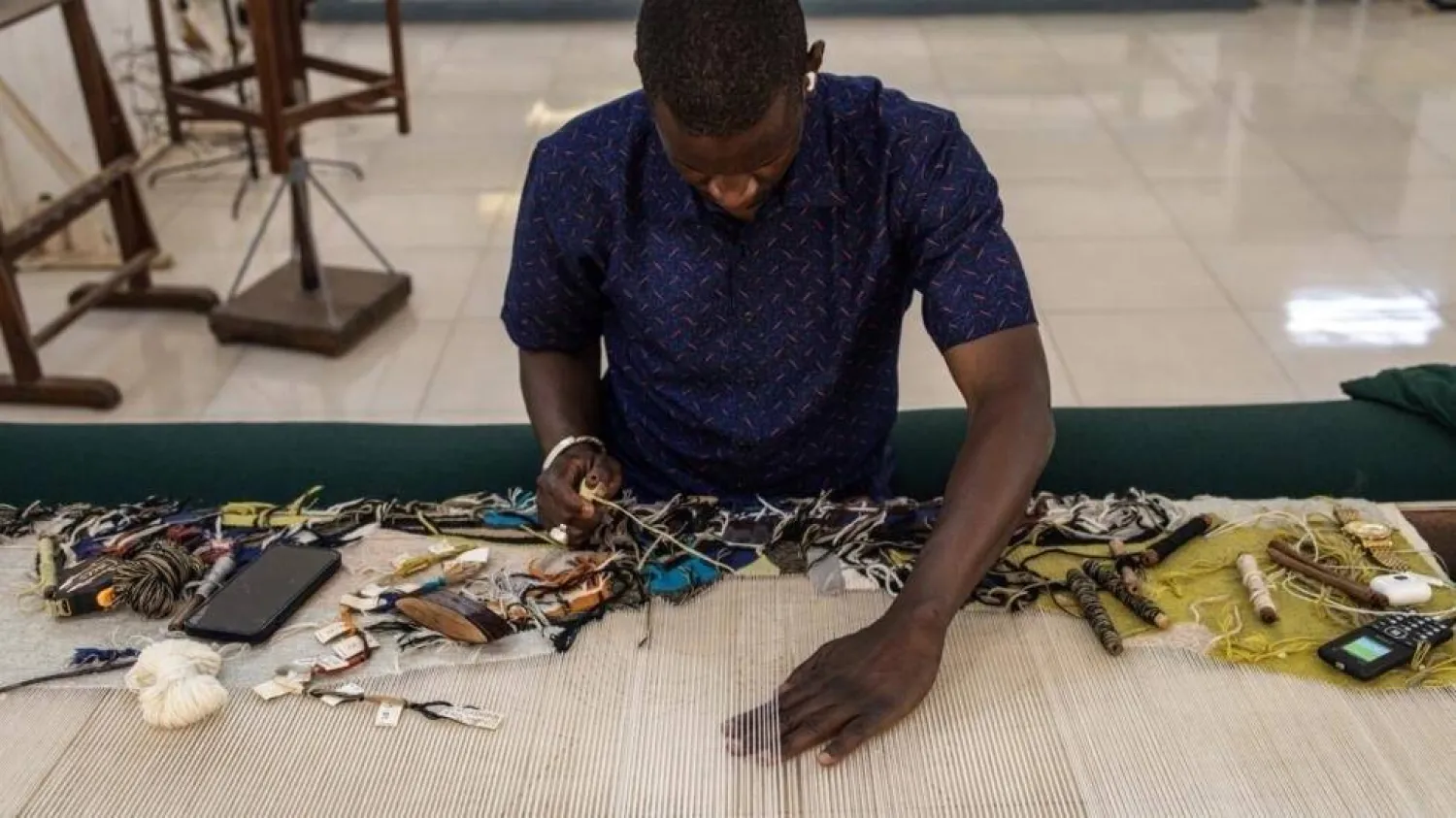
Senegalese tapestries adorn the walls of organizations the world over. JOHN WESSELS / AFP
TT

Senegal Tapestry Production Finds New Lease of Life

Senegalese tapestries adorn the walls of organizations the world over. JOHN WESSELS / AFP

After cutting away the loose woolen threads from his loom, 28-year-old Senegalese weaver Seydina Oumar Cisse turns the roll to watch the tapestry gradually take shape before his eyes.
Everything from the colors to the design is identical to the original work created by Senegalese artist Cheikh Diouf.
"It's very satisfying," Cisse said, seeing the result of six months' work for the first time.
Cisse is a weaver at the Senegalese manufacturers of decorative arts in the central city of Thies, a leading producer of high quality artistic goods on the African continent.
The establishment's creations adorn the walls of organizations the world over, from the UN headquarters in New York to the African Union in Addis Ababa, as well as the palaces of numerous heads of state.
Tapestry production in Thies was a flagship cultural policy of Senegal's first president, poet Leopold Sedar Senghor, with production now revitalized thanks to a broadening of operations and new partnerships, including with fashion giant Chanel.
The creations are "attracting renewed interest, driven locally by galleries with international stature and a resurgence of interest in textiles and tapestries" on the art market, said Coline Desportes, a researcher at the national institute of art history (INHA).
'Symbiosis of techniques'
Senghor established national tapestry production in Thies in 1966, six years after Senegal gained independence from France, with the goal of "creating a new art for a new nation".
While weaving techniques had previously proved popular in African clothing designs, the art of wall tapestries was little known in Senegal.
Two years before production got underway, four craftsmen headed to France for specialized training, with the new art form representing "the symbiosis of techniques imported from France and traditional culture," according to Senghor.
Over the years the former president's legacy has been kept alive, but not without difficulty.
The state reduced support after Senghor's departure and tapestries went out of fashion, leading production in Thies to almost disappear before orders picked up again in the 2000s.
In the weaving workshops, situated within the white and green walls of former army barracks, the weavers have no room for error.
Each meticulously follows the cardboard lines on their looms, using wool from Europe and cotton from Thies to trace their designs.
'Cultural powerhouse'
Not far away, a group of about 30 American school students listen to a talk given by the head of the cardboard workshop, where the models which guide the weaving process are produced.
The establishment now welcomes tourists and film crews onto the premises, evidencing its commitment to diversifying operations.
Fourteen rooms will soon be available for visitors, as well as an artists' residence, managing director Aloyse Diouf said.
"We want to turn the manufacturers into a cultural powerhouse, a link between art and tourism," he added, although government commissions remain essential to keeping production afloat.
"Tapestry is not necessarily linked to our history and has remained mainly elitist -- it is mainly the authorities who buy tapestries to contribute to Senegal's artistic influence," Diouf said.
"The ownership of this art form by the Senegalese is a long-term project that we are developing by inviting schools to visit the factories".
The establishment now also produces prayer rugs, batik and ceramics, which are slightly more affordable for the Senegalese than the wall tapestries, which cost 1.5 million CFA francs ($2,400) per square meter.



Latin American, Caribbean Women Top Nobel Literature Buzz

A statue of Alfred Nobel in Stockholm, Sweden, on October 5, 2026. Jonathan Nackstrand / AFP
TT

Latin American, Caribbean Women Top Nobel Literature Buzz

A statue of Alfred Nobel in Stockholm, Sweden, on October 5, 2026. Jonathan Nackstrand / AFP

This year's Nobel literature prize could go to a Latin American or Caribbean woman when it is awarded on Thursday amid efforts to diversify an award that has most often gone to male, European authors, literary critics say.

There is no public shortlist for the Nobel, and since the nominees and the jury deliberations remain sealed for 50 years, Stockholm's literary circles engage in frantic guessing ahead of the announcement.

Antiguan-American author Jamaica Kincaid, 77, whose work explores Caribbean culture, family and identity as well as colonialism and race, has often been mentioned in Nobel speculation, as has China's Can Xue, whose avant-garde experimental writing has been compared to that of Franz Kafka.

The suspense will end at 1:00 pm (1100 GMT) Thursday when the 18-member Swedish Academy reveals its pick.

A 2018 sex assault scandal left the Academy in tatters and more than half of its 18 members were replaced.

Since then, every other literature laureate has been a woman -- making it likely that this year's nod could go to a woman, after last year's prize for Hungary's Laszlo Krasznahorkai.

Punters are this year putting their money on Can Xue and Mexico's Cristina Rivera Garza, as well as Spanish author Enrique Vila-Matas, Australia's Gerald Murnane, his Aboriginal compatriot Alexis Wright and American author Thomas Pynchon.

"It's about time for Jamaica Kincaid to get it," Victor Malm, culture critic at Swedish daily Expressen, told AFP.

"She has been mentioned for a long time," agreed Bjorn Wiman, culture editor at Sweden's largest daily Dagens Nyheter.

- Women under-represented -

Kincaid's 1990 novel "Lucy" is an autobiographical tale of an embittered young girl who travels from the West Indies to the United States to work as an au pair.

"It's exactly the kind of book where it's enough to read three lines to say: 'OK, we're talking about a Nobel laureate here'," Wiman said.

Giving her the nod could also be interpreted as a political choice, given her fierce criticism of US President Donald Trump, analysts say.

The Swedish Academy has long been criticized for the over-representation of Western male authors since the prize was first awarded in 1901.

There are only 18 women among the 122 laureates. Very few have worked in Asian or Middle Eastern languages. No African languages are represented.

The Academy insists however that its only consideration is the quality of a writer's work.

But unlike the Nobel prizes in medicine, physics and chemistry, there is no groundbreaking research on which to base speculation for the literature prize, Wiman said.

"In physics or chemistry, you can say that one discovery was more important than others", in terms of the impact it has had on mankind, he said.

"But when it comes to literature, it's different. There are easily 50 to 100 authors who could win the Nobel literature prize."

"That's why it's so interesting to follow the geographic distribution, the gender distribution, the kind of mark they want to make with the choice of laureate and so on," he said.

- 'Dark and violent' writing -

So what about the literature?

Lina Kalmteg, literary critic for Swedish public broadcaster SR, said it was time for a Spanish-language author from Latin America.

"In recent years, there has been a lot of talk about the 'Latin American literary miracle', this new generation that came after the male authors devoted to magical realism, like Gabriel Garcia Marquez," she told AFP.

"In this new wave, it's women who are taking the lead, with writing often tinged with feminism, but also often quite dark and violent, punctuated by surreal touches," she noted.

Argentine author Samanta Schweblin, 48, would be an interesting and surprising choice in this category, she said.

"But she is surely still too young," she added.

Literature laureates are honored for their body of work, not a single publication.

The last writer from South America to be honored was Peru's Mario Vargas Llosa in 2010.

Several new names getting Nobel buzz the past few years are Germany's Jenny Erpenbeck, who won the 2024 International Booker Prize for the novel "Kairos", and Duong Thu Huong, one of Vietnam's most popular writers whose first books in the late 1980s were bestsellers before they were banned. Her books are mainly published outside Vietnam.


KSGAAL Signs MoU with Jordan Academy of Arabic

KSGAAL Signs MoU with Jordan Academy of Arabic
TT

KSGAAL Signs MoU with Jordan Academy of Arabic

KSGAAL Signs MoU with Jordan Academy of Arabic

As part of its fifth annual international conference, themed "Arabic Language and Culture: Intersections and Dimensions," King Salman Global Academy for Arabic Language (KSGAAL) signed a memorandum of understanding (MoU) with the Jordan Academy of Arabic.

The agreement aims to foster cooperation in serving the Arabic language and its associated disciplines. It also establishes a framework for joint action to facilitate the exchange of expertise and integration of capabilities between the two academies.

KSGAAL was represented at the signing by its Secretary-General Dr. Abdullah bin Saleh Al-Washmi, while the Jordan Academy of Arabic was represented by its President Dr. Mohammad Adnan Al-Bakhit. The MoU was signed remotely.

The agreement outlines areas of cooperation, including research, studies, and scholarly projects related to the Arabic language and its sciences. It also covers the publication, translation, and printing of studies and the implementation of specialized training programs in linguistic sciences, SPA reported.

The MoU also covers the administration of the "Hamza" academic Arabic proficiency test for non-native speakers and the development of digital dictionaries and linguistic corpora. These resources will be made accessible through the "SIWAR" Linguistic Lexicon platform and the "FALAK" Linguistic Corpus platform. The two academies will also exchange linguistic and cultural data.

The memorandum provides for World Arabic Language Day celebrations and the organization of exhibitions, linguistic competitions, events, academic programs, seminars, training courses, and panel discussions. These activities aim to serve the Arabic language and enhance its presence, along with other areas agreed upon by both parties.


Prince Mohammed bin Salman Center Promotes Arabic Calligraphy Through Specialized Training

These initiatives support the center's efforts to develop the skills of practitioners and enthusiasts  - SPA
These initiatives support the center's efforts to develop the skills of practitioners and enthusiasts - SPA
TT

Prince Mohammed bin Salman Center Promotes Arabic Calligraphy Through Specialized Training

These initiatives support the center's efforts to develop the skills of practitioners and enthusiasts  - SPA
These initiatives support the center's efforts to develop the skills of practitioners and enthusiasts - SPA

The Prince Mohammed bin Salman Global Center for Arabic Calligraphy is conducting a series of specialized training programs and courses in Arabic calligraphy during the last quarter of 2026 across Madinah, Riyadh, and Dammam.

These initiatives support the center's efforts to develop the skills of practitioners and enthusiasts while promoting the art form as a key component of the Kingdom's cultural identity, SPA reported.

The programs support practitioners of all nationalities and contribute to the preservation of Arabic calligraphy by passing on its knowledge and skills to future generations.