


Study Firms up Date of Famous Ancient Shipwreck off Cyprus 

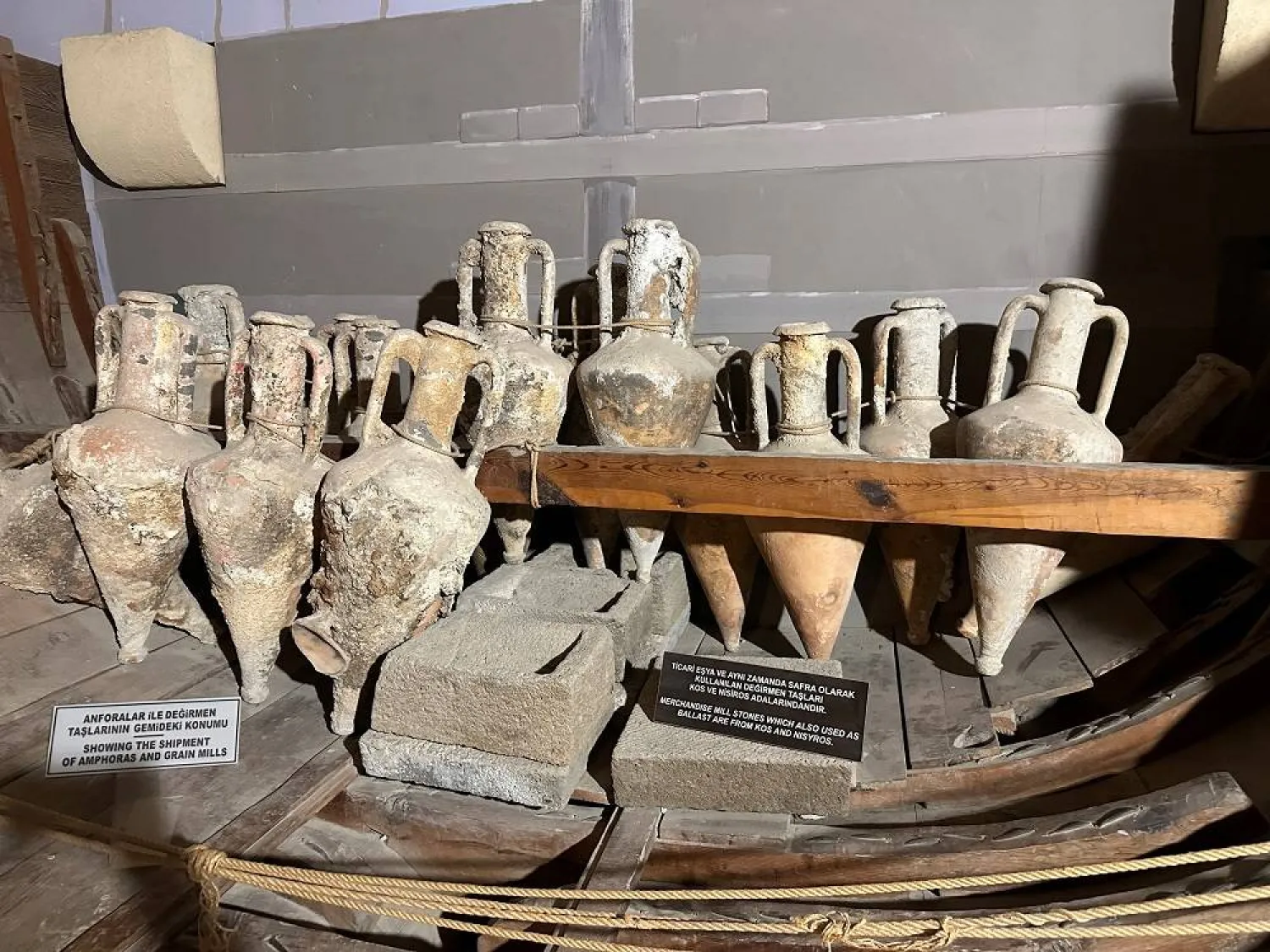
Amphoras and grain mills are seen in a museum dedicated to the ancient Kyrenia merchant ship that sank off the coast of Cyprus, at Kyrenia Castle in Cyprus, February 9, 2024. Adam Dunham/Handout via Reuters
TT

Study Firms up Date of Famous Ancient Shipwreck off Cyprus 

Amphoras and grain mills are seen in a museum dedicated to the ancient Kyrenia merchant ship that sank off the coast of Cyprus, at Kyrenia Castle in Cyprus, February 9, 2024. Adam Dunham/Handout via Reuters

When scientists in the 1960s excavated the wreck of an ancient Greek merchant ship off the northern coast of Cyprus, what they found was an amazing time capsule from a pivotal period in the Mediterranean world following the death of Alexander the Great.

But determining the date of the Kyrenia shipwreck with any sort of precision has proven difficult, and some previous scientific dating yielded conclusions that conflicted with the archeological evidence. Researchers have now calculated this timeline with new precision using improved techniques that they said can be applied to date other ancient shipwrecks as well.

By analyzing organic material from the wreck, including the vessel's wooden timbers, almonds from its cargo, and a gaming piece called an astragalus made from animal bone and used like dice, they concluded that the ship went down around 280 BC. That is a bit later than prior scientific dating estimates but a better match for the archeological evidence.

Sturt Manning, a Cornell University professor of classical archaeology, called the Kyrenia vessel an "iconic ship from the early Hellenistic period, central to the history of ancient maritime technology."

The ship, about 46 feet (14 meters) long, was built of wood with lead sheathing, with one mast bearing a square sail, and likely carrying a crew of four. It sank about a mile (1.6 km) off the coast. Aboard were nearly 400 amphoras - large two-handled pottery storage jars - some filled with almonds and others apparently with wine, along with heavy millstones as ballast.

"Likely it was going to or from Cyprus, and the cargo - amphora types - suggest it was trading in the Aegean and east Mediterranean area. The main cargo comprised amphora of a type associated with the island of Rhodes in the southeast Aegean," said Manning, lead author of the study published in the journal PLOS ONE.

Using various lines of evidence, the researchers determined that the ship had been constructed between about 345-313 BC and sank between about 286-272 BC.

The death in 323 BC of Alexander, who had conquered wide swathes of the Mediterranean region and beyond, led to regional scrambles for power. Cyprus became a contested area pitting successors of Alexander ruling in the Aegean region versus those in Egypt, with the latter winning control of the island.

The Kyrenia ship's remains are displayed at a museum in Cyprus.

"Ancient shipwrecks hold several unique sources of information for archaeologists to reconstruct the human past. In underwater sites like where the Kyrenia was buried, archaeological materials decay much more slowly. As a result, organic materials like wood, seeds or rope can be much better preserved than on land," said University of Georgia anthropology professor and study co-author Brita Lorentzen.

The discovery of a deepwater shipwreck off the coast of Israel, dating to roughly 1300 BC, was announced just last week.

"Ships were a critical source of transportation in the ancient world, which allowed people to move from one place to another, create social networks, and exchange trade goods and ideas. A shipwreck's contents can tell us specifically which items were being traded or exchanged, where and how people were moving around by sea, which groups of people were in contact with one another, and how they were impacted by these early social and economic networks," Lorentzen said.

This ship's timbers were embalmed decades ago using the chemical compound polyethylene glycol (PEG) to preserve the wood on land. This complicated the use of radiocarbon dating, a technique for determining an object's age based on the decay over time of a radioactive form of carbon.

"Adding PEG prevents ship timbers from drying out, shrinking and turning to dust out of the water. But it also contains petroleum, with lots of carbon from long-dead organic remains," Lorentzen said.

The researchers devised improved methods to remove PEG so radiocarbon dating could be used for the timbers. They also used radiocarbon dating on the almonds and astragalus.

Analysis of annual growth rings in trees also helps govern the dating of ancient wooden artifacts. The researchers found a discrepancy in a scientific standard used in analyzing wood from this time period to convert radiocarbon measurements into calendar dates for the northern hemisphere, and updated it.

"The work here is relevant to ancient shipwrecks generally," Manning said.


UNESCO Honors Al-Bisht Al-Hasawi as Thousands Flock to Al-Ahsa Festival

Visitors can explore interactive displays, participate in live workshops, and witness the meticulous process of tailoring this iconic symbol of prestige - SPA
TT

UNESCO Honors Al-Bisht Al-Hasawi as Thousands Flock to Al-Ahsa Festival

Visitors can explore interactive displays, participate in live workshops, and witness the meticulous process of tailoring this iconic symbol of prestige - SPA

The third edition of Al-Bisht Al-Hasawi Festival is drawing thousands of regional and international visitors to Ibrahim Palace in historic Al-Hofuf.

Organized by the Heritage Commission, this year’s festival celebrates the inscription of the Bisht on UNESCO’s Representative List of the Intangible Cultural Heritage of Humanity.

The event showcases Al-Ahsa’s centuries-old tradition of hand-weaving and gold embroidery, a craft passed down through generations of local families, SPA reported.

Visitors can explore interactive displays, participate in live workshops, and witness the meticulous process of tailoring this iconic symbol of prestige.

With UNESCO's participation and representatives from six countries, the festival has evolved into a global platform for cultural dialogue, cementing the Bisht’s status as a world-class cultural treasure.


Saudi, Syrian Culture Ministers Tour National Museum of Damascus

The ministers observed the museum’s extensive collections spanning prehistoric eras to modern art. SPA
TT

Saudi, Syrian Culture Ministers Tour National Museum of Damascus

The ministers observed the museum’s extensive collections spanning prehistoric eras to modern art. SPA

Saudi Minister of Culture Prince Badr bin Abdullah bin Farhan and his Syrian counterpart, Mohammed Yassin Saleh, have toured the National Museum of Damascus during the Kingdom’s participation as guest of honor at the 2026 Damascus International Book Fair.

The ministers observed on Thursday the museum’s extensive collections spanning prehistoric eras to modern art.

A particular focus was placed on the Arab-Islamic wing, featuring significant artifacts from the Umayyad period.

The Kingdom's participation as guest of honor at the 2026 Damascus International Book Fair, which runs until February 16, stems from the role culture plays within Saudi Vision 2030.


Saudi Culture Minister Inaugurates Kingdom's Pavilion as Guest of Honor at Damascus Book Fair

Saudi Culture Minister Inaugurates Kingdom's Pavilion as Guest of Honor at Damascus Book Fair
TT

Saudi Culture Minister Inaugurates Kingdom's Pavilion as Guest of Honor at Damascus Book Fair

Saudi Culture Minister Inaugurates Kingdom's Pavilion as Guest of Honor at Damascus Book Fair

Saudi Minister of Culture Prince Badr bin Abdullah bin Farhan, who is the Literature, Publishing and Translation Commission Board Chairman, has inaugurated the Kingdom’s pavilion as guest of honor at the 2026 Damascus International Book Fair.

The inauguration took place on Thursday in the Syrian capital in the presence of Syrian Minister of Culture Mohammed Yassin Saleh and his Qatari counterpart, Sheikh Abdulrahman bin Hamad bin Jassim bin Hamad Al Thani.

The Kingdom's participation as guest of honor at the fair, which runs until February 16, stems from the role culture plays within Saudi Vision 2030.

Literature, Publishing, and Translation Commission Chief Executive Dr. Abdul Latif Al-Wasil affirmed that the Kingdom's presence as guest of honor at the fair reflects its leading role in the Arab cultural landscape and embodies its belief in the role of culture as a bridge for communication, a space for dialogue, and a tool for supporting joint cultural initiatives.

He explained that the Kingdom's presence in Damascus affirms the depth of Saudi-Syrian relations, based on partnership and mutual respect, and stems from the Kingdom's commitment to strengthening cultural exchange.

The Kingdom's pavilion showcases the cultural and creative diversity of the Saudi cultural and literary scene through a comprehensive cultural program that includes intellectual seminars, poetry evenings, a manuscripts exhibition, a Saudi fashion corner, a hospitality corner, and a corner displaying archaeological replicas, in addition to Saudi performing arts performances that express the depth of the Kingdom's cultural heritage.

The pavilion offers visitors to the exhibition the opportunity to explore aspects of Saudi culture in its literary, heritage, and human dimensions within a cultural experience presented in a unifying Arab spirit, affirming that culture remains one of the most effective means of fostering understanding and building shared meaning.

Syrian President Ahmed al-Sharaa met on Thursday with Prince Badr at the Conference Palace in Damascus.

The meeting was attended on the Saudi side by Advisor at the Royal Court Mohammed Al-Tuwaijri, along with other officials.
