Culinary Arts Commission Showcases Saudi Culture at Sirha Lyon 2025

The Culinary Arts Commission logo
TT

Culinary Arts Commission Showcases Saudi Culture at Sirha Lyon 2025

The Culinary Arts Commission logo

The Culinary Arts Commission is participating in the Sirha Lyon 2025 Exhibition, which will be held in Lyon, France, on January 23-27, where the Commission will showcase through its pavilion "Taste of Saudi Culture" a distinguished cultural experience that highlights Saudi culinary arts and its diversity.
Sirha is one of the world's leading events specializing in food and hospitality services. More than 40 countries are participating this year as they contribute to showcasing the latest food products, organizing international cooking competitions, and shedding light on the sector's future and its most prominent trends SPA reportd.
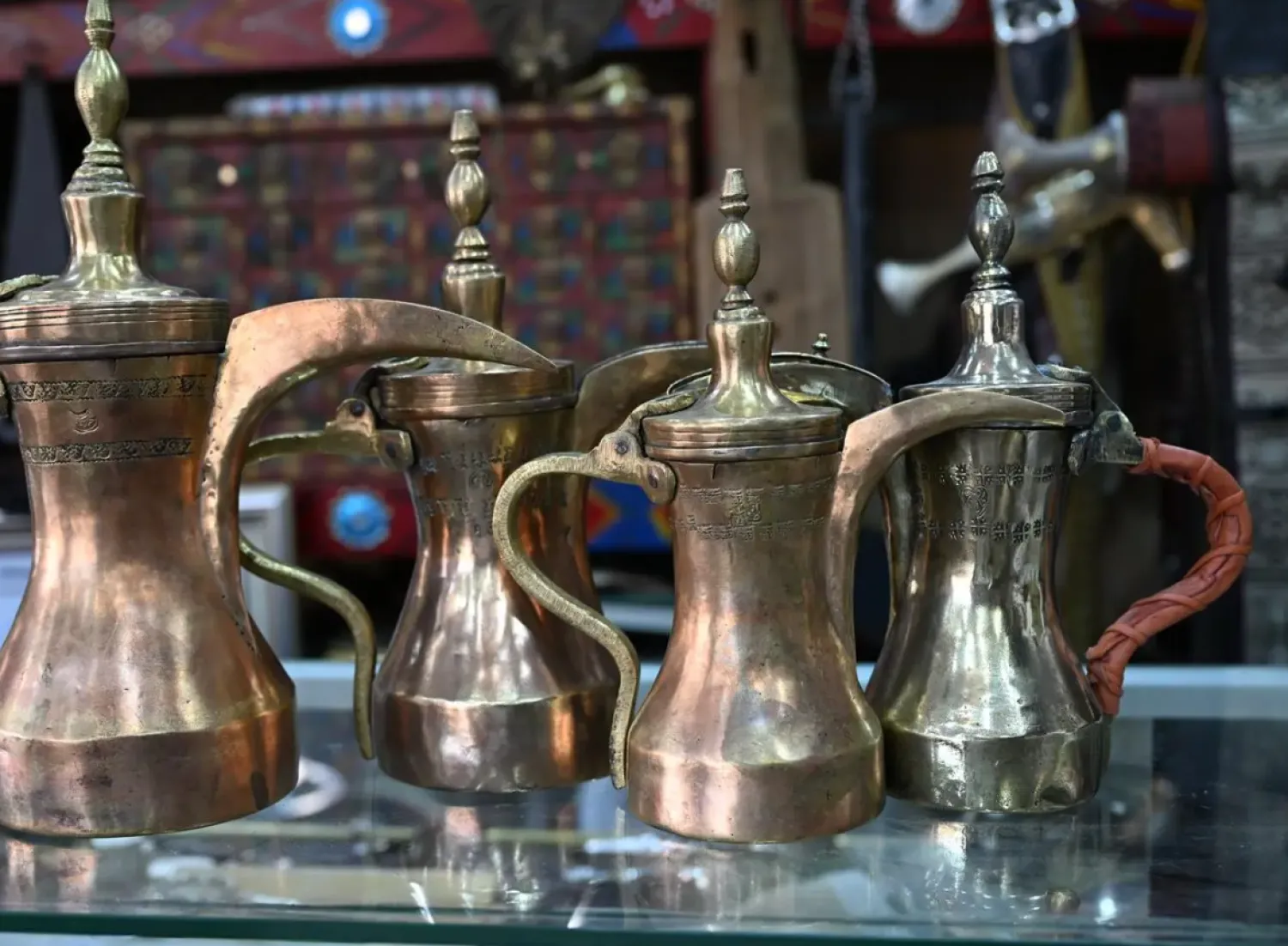
The "Taste of Saudi Culture" pavilion includes five interactive zones that introduce visitors to local Saudi products. The tour starts from the reception area, which reflects Saudi hospitality by serving Saudi Coffee. Other local food products include Ma'amoul, dates and their derivatives, and spices.
The Culinary Arts Commission's participation in the Sirha Exhibition enhances cooperation and partnerships that contribute to the global definition of Saudi food identity.



'Architecture of the Two Holy Mosques' Exhibition Traces Expansion through History at Hajj Conference

'Architecture of the Two Holy Mosques' exhibition at Darah Pavilion showcases expansions through history at Hajj Conference. (SPA)
TT

'Architecture of the Two Holy Mosques' Exhibition Traces Expansion through History at Hajj Conference

'Architecture of the Two Holy Mosques' exhibition at Darah Pavilion showcases expansions through history at Hajj Conference. (SPA)

The King Abdulaziz Foundation for Research and Archives (Darah) is showcasing an exhibition titled “Architecture of the Two Holy Mosques and the Holy Sites” as part of the Hajj Conference and Exhibition 2025.

The pavilion offers a visual journey through key stages in the expansions of the Two Holy Mosques and the development of the holy sites over the decades, from the earliest construction works to the completion of major projects that define the sacred places today, the Saudi Press Agency reported on Monday.

The pavilion takes visitors back to the first expansion phase of the Grand Mosque, featuring rare photographs showing the construction of the second floor of Al-Safa and Al-Marwah corridor (Al-Masaa), highlighting the advanced architectural and engineering work of that time.

The exhibition also includes documentary footage capturing the final moments of the first and second expansions, with scenes showing heavy equipment, excavation, and concrete works at construction sites.

Extending to Madinah, the display presents historical photographs of the Prophet’s Mosque, including the western façade and the installation of large sunshades built under the directive of the late King Faisal bin Abdulaziz Al Saud, which marked a major milestone in enhancing comfort within the mosque courtyards.

A prominent section of the pavilion is dedicated to the Kiswa (the covering of the Kaaba) and the evolution of its craftsmanship over the decades.

It features samples and photographs documenting the stages of production - from spinning and weaving to embroidery and modern design technologies - as well as images of artisans at the King Abdulaziz Complex for the Holy Kaaba Kiswa, meticulously working with gold and silver threads, blending manual artistry with advanced technology in service of Islam's holiest site.

Beyond the Two Holy Mosques, the exhibition highlights the development of the holy sites, showcasing archival images of pilgrims’ tents in Mina in earlier years and their gradual transformation into organized and fully equipped accommodations for lodging, prayer, and meal preparation.

It also presents historic images of Jamarat Bridge following the construction of the surrounding barriers to better manage pilgrim movement during the ritual of stoning - representing one of the key milestones in crowd management at the holy sites.

Blending engineering with history, and documentation with imagery, the pavilion presents a coherent chronological narrative showing how the Two Holy Mosques and the holy sites evolved from modest structures into one of the world’s most sophisticated infrastructure systems.

Visitors leave the pavilion with a vivid understanding of the architectural and service transformations that have shaped the Hajj experience through decades of continuous development.


Darah Launches ‘History of Hajj and the Two Holy Mosques’ Forum

Muslim pilgrims walk out after the Friday prayer at the Grand mosque ahead of annual Hajj pilgrimage in the holy city of Makkah, Saudi Arabia August 17, 2018.REUTERS/Zohra Bensemra
TT

Darah Launches ‘History of Hajj and the Two Holy Mosques’ Forum

Muslim pilgrims walk out after the Friday prayer at the Grand mosque ahead of annual Hajj pilgrimage in the holy city of Makkah, Saudi Arabia August 17, 2018.REUTERS/Zohra Bensemra

King Abdulaziz Foundation for Research and Archives (Darah) launched Monday the “History of Hajj and the Two Holy Mosques” forum at the Hajj Conference and Exhibition, organized by the Ministry of Hajj and Umrah in collaboration with the “Pilgrim Experience Program”.

The forum aims to highlight the Kingdom’s historical and organizational efforts in serving the Two Holy Mosques, document the architectural and artistic transformations of the holy sites, and adopt the latest digital methods for studying the history of Hajj, SPA reported.

Secretary-General of the Muslim World League, Chairman of the Council of Muslim Scholars, and member of the Supreme Supervisory Committee for the Hajj and Two Holy Mosques History Project Sheikh Dr. Mohammed bin Abdulkarim Al-Issa delivered a speech underscoring the importance of preserving the history of Hajj and its landmarks. He emphasized the scholarly responsibility to document the Kingdom’s prominent role in serving pilgrims and caring for the Two Holy Mosques throughout history.

For his part, Minister of Hajj and Umrah Tawfig Al-Rabiah highlighted major advancements in the Hajj ecosystem, including administration, organization, and services. He stressed the importance of harnessing historical research and modern technologies to support decision-making, shape the future of Hajj and Umrah, and enhance the quality of services provided to pilgrims.

The forum aims to promote specialized scientific research in this field and translate its outcomes into educational and media content. It also seeks to shed light on the historical evolution of the Hajj in the Islamic world, reflecting the Kingdom’s deep commitment to documenting and preserving the legacy of Hajj and the Two Holy Mosques, two of Islam’s greatest rituals and enduring symbols of civilization.

The forum’s significance lies in its focus on Hajj as a pillar of Islamic identity and a manifestation of unity among Muslims. Through this platform, Darah seeks to transform research outputs into accessible cultural and educational content. Organized as part of the broader project on the history of Hajj and the Two Holy Mosques, the forum aligns with the Foundation’s mission to preserve and document the Kingdom’s history and that of its holiest sites.

It aspires to serve as a national and global reference for chronicling the Hajj ritual and promoting the Kingdom’s cultural and civilizational image, in line with Vision 2030 objectives in culture and tourism, through interactive scientific and digital content that showcases the historical depth of Hajj and the Two Holy Mosques.


Mexican Art Historians Weigh in on Upcoming Kahlo’s Auction That Could Fetch up to $60 Million 

"El sueno" by Frida Kahlo is pictured at Sotheby's Marquee Sales Series in New York on November 8, 2025. (AFP)
TT

Mexican Art Historians Weigh in on Upcoming Kahlo’s Auction That Could Fetch up to $60 Million 

"El sueno" by Frida Kahlo is pictured at Sotheby's Marquee Sales Series in New York on November 8, 2025. (AFP)

Frida Kahlo’s “El sueno (La cama)” — in English, “The Dream (The Bed)” — is causing a stir among art historians as its estimated $40 million to $60 million price tag would make it the most expensive work by any female or Latin American artist when it goes to auction later this month.

Sotheby’s auction house will put the painting up for sale on Nov. 20 in New York after exhibiting it in London, Abu Dhabi, Hong Kong and Paris.

“This is a moment of a lot of speculation,” said Mexican art historian Helena Chavez Mac Gregor, a researcher at UNAM’s Institute of Aesthetic Research and author of “El liston y la bomba. El arte de Frida Kahlo.” (The ribbon and the bomb. The art of Frida Kahlo).

In Mexico, Kahlo’s work is protected by a declaration of artistic monument, meaning pieces within the country cannot be sold or destroyed. However, works from private collections abroad, like the painting in question, whose owner remains unrevealed, are legally eligible for international sale.

“The system of declaring Mexican modern artistic heritage is very anomalous,” said Mexican curator Cuauhtemoc Medina, an art historian and specialist in contemporary art.

Judas in bed “El sueno (La cama)” was created in 1940 following Kahlo's trip to Paris, where she came into contact with the surrealists.

Contrary to contemporary belief, the skull on the bed’s canopy is not a Day of the Dead skeleton, but a Judas — a handmade cardboard figure. Traditionally lit with gunpowder during Easter, this effigy symbolizes purification and the triumph of good over evil, representing Judas Iscariot who betrayed Jesus.

In the painting, the skeleton is detailed with firecrackers, flowers on its ribs and a smiling grimace — a detail inspired by a cardboard skeleton Kahlo actually kept in the canopy of her own bed.

Kahlo “spent a lot of time in bed waiting for death,” said Chavez Mac Gregor. “She had a very complex life because of all the illnesses and physical challenges with which she lived.”

Although Kahlo’s painting is being auctioned alongside works by surrealists like Salvador Dali, Rene Magritte, Max Ernst and Dorothea Tanning, she did not consider herself a member of the movement, despite having met its founder, Andre Breton, in Mexico and had an exhibition organized by him in Paris in 1939.

“Breton was fascinated by Frida’s work, because he saw that surrealist spirit there,” said Chavez Mac Gregor.

Kahlo, a committed communist, considered surrealism — a movement proposing a revolution of consciousness — to be bourgeois. As Chavez Mac Gregor noted, “Frida always had a critical distance from that.”

Despite this, specialists have found elements of surrealism in Kahlo’s work related to the dreamlike, to an inner world and to a revolutionary freedom — a concept visible in a bed suspended in the sky with Kahlo sleeping among a vine.

‘Crazy-priced purchases’

“El sueno (La cama)” was last exhibited in the 1990s, and after the auction, it could disappear from public view once again, a fate shared by many paintings acquired for large sums at auction.

There are exceptions, including “Diego y yo” (“Diego and I”), which set Kahlo’s record sale price when it sold for $34.9 million in 2021.

The painting, depicting the artist and her husband muralist Diego Rivera, was acquired by Argentine business owner Eduardo Costantini and then lent to the Museum of Latin American Art of Buenos Aires (Malba) where it remains on exhibit.

Medina, the art historian, regretted that the “crazy-priced” purchases have reduced art to a mere economic value.

He lamented that when funds purchase art as mere investments, like buying shares in a public company, the works are often relegated to tax-free zones to avoid costs. Their fate, he said, “may be worse; they may end up in a refrigerator at Frankfurt airport for decades to come.”

The current sale record for a work by a female artist is held by Georgia O’Keeffe’s “Jimson Weed/White Flower No. 1,” which fetched $44.4 million at Sotheby’s in 2014.

However, the auction market still reflects a profound disparity as no female artist has yet exceeded the maximum sale price of a male artist. The current benchmark is “Salvator Mundi,” attributed to Leonardo da Vinci, which was auctioned by Christie’s for $450.3 million in 2017.