


Ancient Bread Rises Again as Türkiye Recreates 5,000-year-old Loaf 

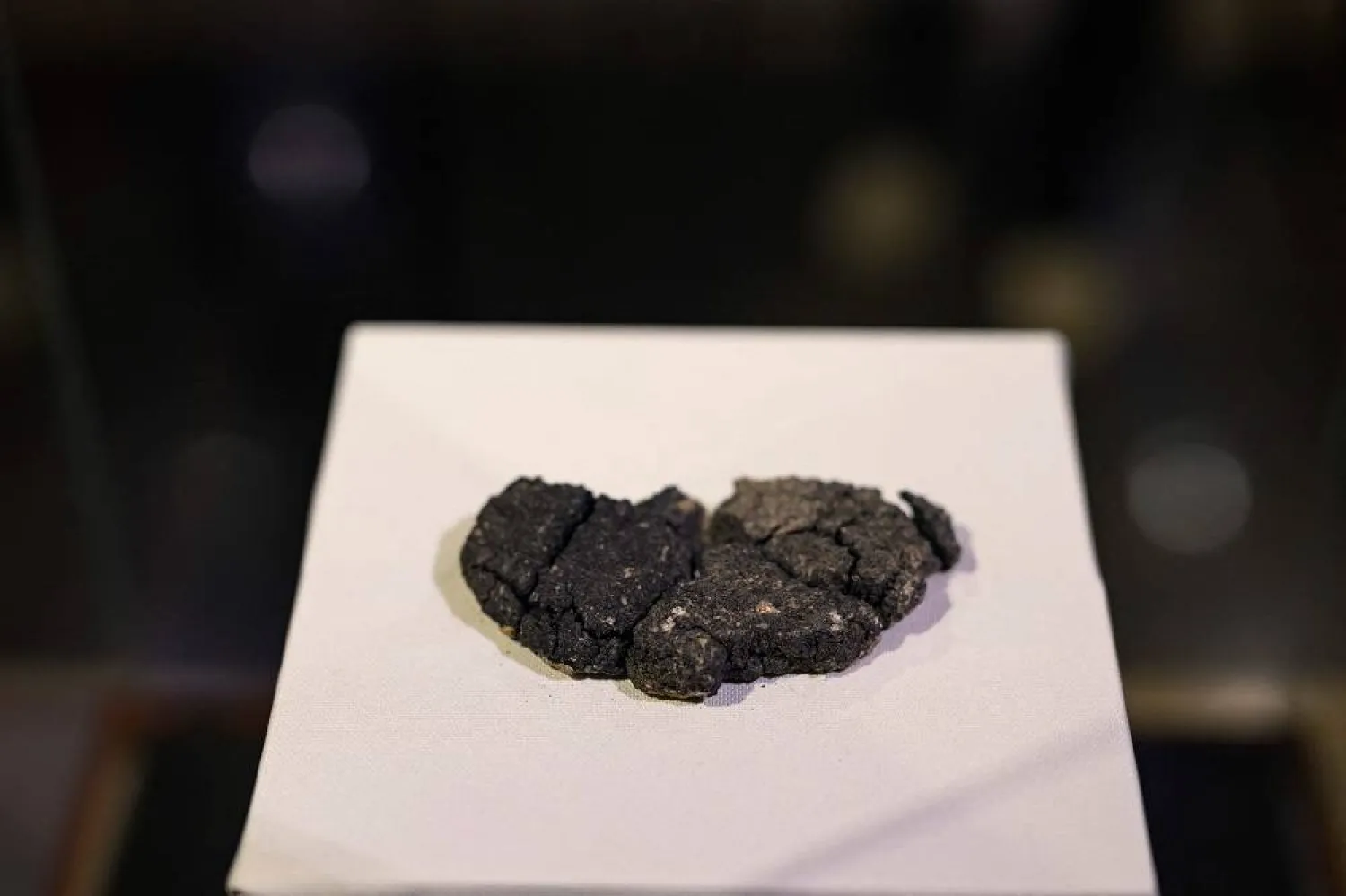
This photograph shows Kulluoba bread, a 5,000-year-old bread unearthed in an archeological excavation in Eskisehir province, in central Türkiye, exhibited at Eskisehir ETI archeology museum, on May 23, 2025. (AFP)
TT

Ancient Bread Rises Again as Türkiye Recreates 5,000-year-old Loaf 

This photograph shows Kulluoba bread, a 5,000-year-old bread unearthed in an archeological excavation in Eskisehir province, in central Türkiye, exhibited at Eskisehir ETI archeology museum, on May 23, 2025. (AFP)

In the early Bronze Age, a piece of bread was buried beneath the threshold of a newly built house in what is today central Türkiye.

Now, more than 5,000 years later, archaeologists have unearthed it, and helped a local bakery to recreate the recipe with customers lining up to buy it.

Round and flat like a pancake, 12 centimeters (five inches) in diameter, the bread was discovered during excavations at Kulluoba, a site near the central Anatolian city of Eskisehir.

"This is the oldest baked bread to have come to light during an excavation, and it has largely been able to preserve its shape," said Murat Turkteki, archaeologist and director of the excavation.

"Bread is a rare find during an excavation. Usually, you only find crumbs," he told AFP.

"But here, it was preserved because it had been burnt and buried," he said.

The bread was charred and buried under the entrance of a dwelling built around 3,300 BC.

A piece had been torn off before the bread was burnt, then buried when the house was built.

"It makes us think of a ritual of abundance," Turkteki said.

Unearthed in September 2024, the charred bread has been on display at the Eskisehir Archaeological Museum since Wednesday.

"We were very moved by this discovery. Talking to our excavation director, I wondered if we could reproduce this bread," said the city's mayor, Ayse Unluce.

Analyses showed that the bread was made with coarsely ground emmer flour, an ancient variety of wheat, and lentil seeds, with the leaf of an as yet undetermined plant used as yeast.

Ancient emmer seeds no longer exist in Türkiye.

To get as close as possible to the original recipe, the municipality, after analyzing the ancient bread, decided to use Kavilca wheat, a variety that is close to ancient emmer, as well as bulgur and lentils.

At the Halk Ekmek bakery (meaning "People's Bread" in Turkish), promoted by the municipality to offer low-cost bread, employees have been shaping 300 loaves of Kulluoba by hand every day.

"The combination of ancestral wheat flour, lentils and bulgur results in a rich, satiating, low-gluten, preservative-free bread," said Serap Guler, the bakery's manager.

The first Kulluoba loaves, marketed as 300-gram (11-ounce) cakes that cost 50 Turkish lira (around $1.28), sold out within hours.

"I rushed because I was afraid there wouldn't be any left. I'm curious about the taste of this ancient bread," said customer Suzan Kuru.

In the absence of written traces, the civilization of Kulluoba remains largely mysterious.

In the Bronze Age, the Hattians, an Anatolian people who preceded the Hittites, lived in the Eskisehir region.

"Kulluoba was a medium-sized urban agglomeration engaged in commercial activities, crafts, agriculture and mining. There was clearly a certain family and social order," said archaeologist Deniz Sari.

The rediscovery of the bread has sparked interest in the cultivation of ancient wheats better adapted to drought.

Once rich in water sources, the province of Eskisehir is today suffering from drought.

"We're facing a climate crisis, but we're still growing corn and sunflowers, which require a lot of water," said Unluce, the local mayor.

"Our ancestors are teaching us a lesson. Like them, we should be moving towards less thirsty crops," she added.

The mayor wants to revive the cultivation of Kavilca wheat in the region, which is resistant to drought and disease.

"We need strong policies on this subject. Cultivating ancient wheat will be a symbolic step in this direction," she said.

"These lands have preserved this bread for 5,000 years and given us this gift. We have a duty to protect this heritage and pass it on."



Jazan Festival 2026 Kicks Off Thursday with Grand Parade

his year’s festival offers an unprecedented experience that brings together the charm of the region’s unique geographic diversity - SPA
TT

Jazan Festival 2026 Kicks Off Thursday with Grand Parade

his year’s festival offers an unprecedented experience that brings together the charm of the region’s unique geographic diversity - SPA

The Jazan Festival 2026 will launch on Thursday in a carnival anticipated by thousands of visitors from within the region and beyond.

The festival will open with a grand celebratory parade starting at 3:45 p.m. along the Jazan city waterfront, signaling the start of an entertainment and cultural season that will extend for several months, according to SPA.

This year’s festival offers an unprecedented experience that brings together the charm of the region’s unique geographic diversity, from its towering green mountains and golden beaches to its picturesque islands, alongside the authenticity of its rich heritage, complemented by modern touches in entertainment programs designed to meet the aspirations of all age groups.

Performing arts inspired by local folklore will add an authentic dimension, while moving installations will flow in harmonious rhythm.

Completing the visual spectacle, integrated light and sound shows will create an enchanting atmosphere before the festivities conclude with a dazzling fireworks display lighting up the Jazan sky in vibrant colors.


UNESCO Chair in Translating Cultures Hosts Lectures on Safeguarding Intangible Cultural Heritage

The program was presented as an advanced knowledge initiative that combined theoretical perspectives with practical application - SPA
TT

UNESCO Chair in Translating Cultures Hosts Lectures on Safeguarding Intangible Cultural Heritage

The program was presented as an advanced knowledge initiative that combined theoretical perspectives with practical application - SPA

The United Nations Educational, Scientific and Cultural Organization (UNESCO) Chair in Translating Cultures at the King Faisal Center for Research and Islamic Studies (KFCRIS), with support from the Literature, Publishing, and Translation Commission, organized a training course and a series of specialized lectures on the translation and safeguarding of intangible cultural heritage, SPA reported.

The program was presented as an advanced knowledge initiative that combined theoretical perspectives with practical application, opening space for in-depth discussion of the challenges of translating intangible heritage as a living, evolving form of culture closely tied to its cultural, social, and performative contexts.

The course and lectures adopted a comprehensive approach that views translation as a cultural tool for preserving oral memory and building bridges between local specificity and the global sphere.

This approach was reflected through applied models, field experiences, and contemporary conceptual frameworks.


Ancient Egyptian Pharaoh’s Boat Is Being Reassembled in Public at Grand Egyptian Museum

People walk next to King Khufu's boat gem, also known as the Solar Boat, as work to restore the second solar boat has started with wooden planks part of the 1,650-piece structure being installed on a metal frame through Egyptian-Japanese cooperation with two Japanese universities, marking the start of preparations for the second boat's public display at the Grand Egyptian Museum (GEM), near the Giza Pyramid Complex, in Giza, Egypt, December 23, 2025.
TT

Ancient Egyptian Pharaoh’s Boat Is Being Reassembled in Public at Grand Egyptian Museum

People walk next to King Khufu's boat gem, also known as the Solar Boat, as work to restore the second solar boat has started with wooden planks part of the 1,650-piece structure being installed on a metal frame through Egyptian-Japanese cooperation with two Japanese universities, marking the start of preparations for the second boat's public display at the Grand Egyptian Museum (GEM), near the Giza Pyramid Complex, in Giza, Egypt, December 23, 2025.

A boat belonging to an Egyptian pharaoh is being assembled in full view at the Grand Egyptian Museum’s exhibition hall.

Staff began piecing together the cedarwood boat, one of two that were found that belong to King Khufu, Tuesday morning as dozens of visitors watched.

The assembly of the 42-meter (137-foot) -long vessel, which sits next to its already-assembled twin that has been on display, is expected to take around four years, according to Issa Zeidan, head of restoration at the Grand Egyptian Museum. It contains 1,650 wooden pieces.

King Khufu ruled ancient Egypt more than 4,500 years ago and built the Great Pyramid of Giza.

“You’re witnessing today one of the most important restoration projects in the 21st century,” said Tourism and Antiquities Minister Sherif Fathy, who attended the event.

The $1 billion museum, also known as GEM, was touted as the world’s largest when it was lavishly inaugurated last month. It's home to nearly 50,000 artifacts, including the collection of treasures from the tomb of the famed King Tutankhamun, which was discovered in 1922. The museum, located near the pyramids at the edge of Cairo, is expected to boost Egypt’s tourism revenues and help bolster its economy.

The boat was one of two discovered in 1954, opposite the southern side of the Great Pyramid. The excavation of its wooden parts began in 2014, according to the museum’s website.

The exact purpose of the boats remains unclear, but experts believe they were either used to transport King Khufu’s body during his funeral or were meant to be used for his afterlife journey with the sun god Ra, according to the museum.